
VAT deadlines guide
VAT Return Deadlines 2026 to 2027: Due Dates for Every VAT Quarter
From VAT period end to paid
- Period endsLast day of your VAT quarter
- Records readyFinish bookkeeping for the quarter
- File onlineThrough MTD software
- Pay HMRCCleared by the deadline
- Due date1 month and 7 days after
Your VAT quarter has just ended and you are not sure whether the return is due this week, next month or already late. The dates move with your stagger group, weekends do not give you extra time any more, and one missed deadline earns a penalty point that stays on your record for two years.
This guide gives you a date checker for any VAT period, a table of VAT return deadlines for every quarter of 2026 to 2027, and the rules for monthly, annual and payments on account businesses. It also explains exactly what happens if you file or pay late.
VAT return deadline checker
Enter the last day of your VAT period and how you plan to pay. The checker shows the filing deadline, the latest safe day to pay and, if you pay by Direct Debit, when HMRC will collect the money.
VAT return deadline checker
Works out the filing deadline and the latest safe day to pay
Working it out
Uses England and Wales bank holidays to the end of 2028. For non standard periods, always check the date in your VAT online account.
Key facts
- Standard deadline
- 1 calendar month and 7 days after the period ends
- Weekends
- Deadlines do not move to the next working day
- Direct Debit
- Collected 3 working days after the deadline
- Annual Accounting
- Return due 2 months after the year end
- Late return
- A penalty point; 4 points brings £200 for quarterly filers
- Late payment
- 3% at day 15, 3% more at day 30, then 10% a year
When is your VAT return due?
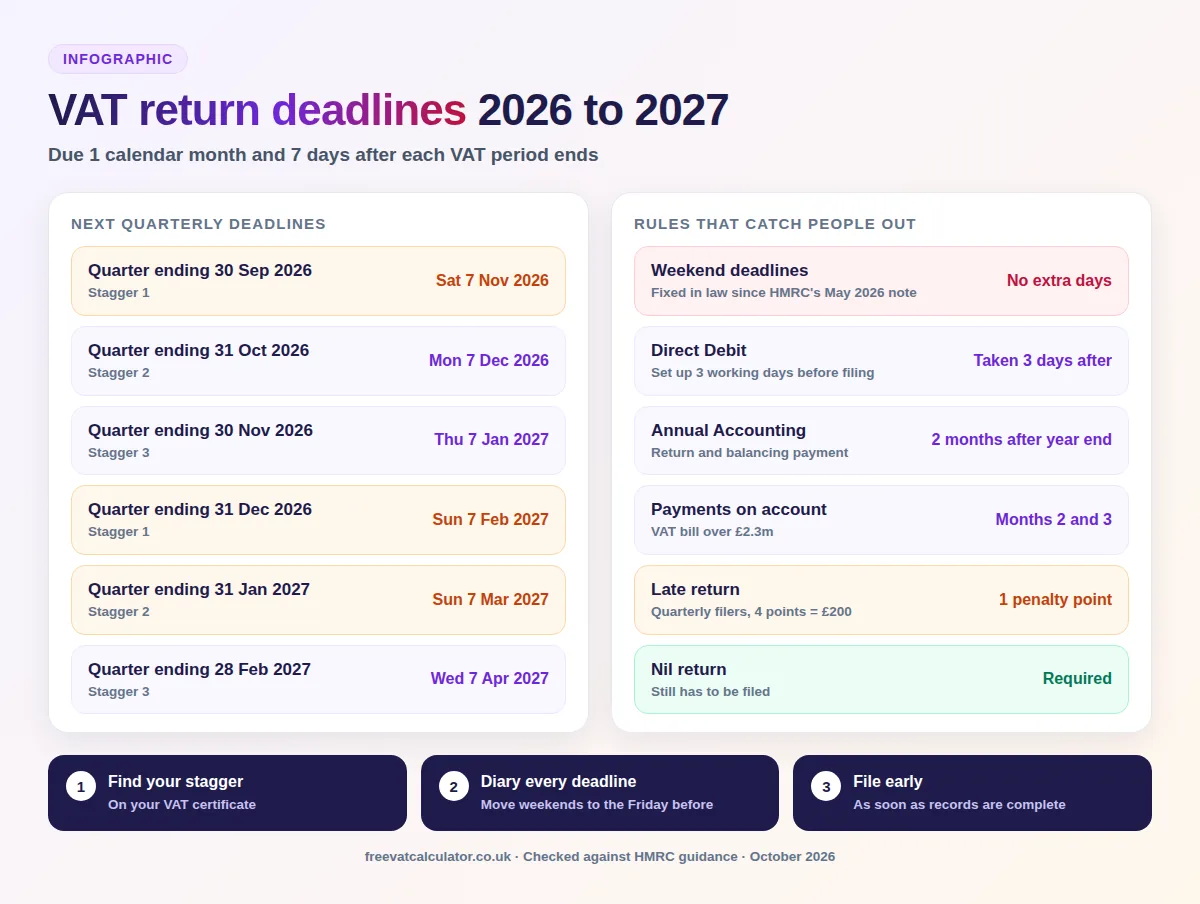
For most businesses the VAT return and the payment are both due one calendar month and seven days after the end of the VAT period. A quarter ending on 30 September 2026 is due by 7 November 2026, and a quarter ending on 31 December 2026 is due by 7 February 2027. The money must have cleared into HMRC’s account by that date, not just left yours.
In law, the base deadline is the last day of the month after the period ends, and an HMRC direction adds the extra seven days for returns filed online and payments made electronically. Those seven days do not apply to the Annual Accounting Scheme or to payments on account, which have their own dates below.
Do VAT deadlines move at weekends or bank holidays?
No. In May 2026 HMRC confirmed that VAT deadlines are fixed in law and do not move to the next working day, after a rise in late returns that it linked to wrong advice on third party websites and AI summaries. You can file online at the weekend, but if you cannot, file by the last working day before the deadline.
Payments follow the same rule. Faster Payments and card payments work at weekends, while Bacs and CHAPS only move on working days, so use those by the Friday before a weekend deadline.
When is VAT due for payment?
The deadline to pay is the same as the VAT submission deadline for most businesses, so your VAT payment dates match your return dates. If you pay by Direct Debit, HMRC collects the money three working days after the deadline, as long as you set it up at least three working days before you file. Our guide on how to pay VAT shows how long every payment method takes to reach HMRC.
VAT quarters and stagger groups
HMRC spreads VAT returns across the year by putting quarterly filers into one of three stagger groups. Your group is set when you register, shown on your VAT registration certificate, and decides your VAT quarter dates.
| Stagger group | Quarters end in |
|---|---|
| Stagger 1 | March, June, September, December |
| Stagger 2 | April, July, October, January |
| Stagger 3 | May, August, November, February |
| Monthly returns | Every month |
VAT return deadlines 2026 to 2027 for every quarter
These are the quarterly VAT return dates for periods ending between September 2026 and December 2027. Where the deadline falls on a weekend, the last column shows the last working day to file and pay by Bacs or CHAPS.
Stagger 1 deadlines
| Quarter ends | Deadline | If paying on working days only |
|---|---|---|
| 30 September 2026 | Saturday 7 November 2026 | Friday 6 November |
| 31 December 2026 | Sunday 7 February 2027 | Friday 5 February |
| 31 March 2027 | Friday 7 May 2027 | No change |
| 30 June 2027 | Saturday 7 August 2027 | Friday 6 August |
| 30 September 2027 | Sunday 7 November 2027 | Friday 5 November |
| 31 December 2027 | Monday 7 February 2028 | No change |
Stagger 2 deadlines
| Quarter ends | Deadline | If paying on working days only |
|---|---|---|
| 31 October 2026 | Monday 7 December 2026 | No change |
| 31 January 2027 | Sunday 7 March 2027 | Friday 5 March |
| 30 April 2027 | Monday 7 June 2027 | No change |
| 31 July 2027 | Tuesday 7 September 2027 | No change |
| 31 October 2027 | Tuesday 7 December 2027 | No change |
Stagger 3 deadlines
| Quarter ends | Deadline | If paying on working days only |
|---|---|---|
| 30 November 2026 | Thursday 7 January 2027 | No change |
| 28 February 2027 | Wednesday 7 April 2027 | No change |
| 31 May 2027 | Wednesday 7 July 2027 | No change |
| 31 August 2027 | Thursday 7 October 2027 | No change |
| 30 November 2027 | Friday 7 January 2028 | No change |
Monthly VAT return deadlines
Monthly returns follow the same one month and seven days rule, so a month ending 31 October 2026 is due on 7 December 2026. HMRC usually allows monthly returns for businesses that regularly reclaim VAT, such as exporters, because they get their repayments sooner. The trade off is twelve deadlines a year instead of four.
Annual Accounting Scheme deadlines
On the Annual Accounting Scheme you file one return a year, due two months after the end of your accounting year, together with any balancing payment. During the year you make advance payments, either nine monthly payments of 10% at the end of months four to twelve, or three quarterly payments of 25% at the end of months four, seven and ten. The scheme is open to businesses with estimated taxable turnover of £1.35 million or less.
Payments on account deadlines
If you file quarterly and your VAT bill is over £2.3 million in any 12 months, you make two payments on account in each quarter. Each one is a twenty fourth of your annual VAT liability, due on the last working day of the second and third months of the quarter, with no seven day extension. The return and balancing payment are due by the last day of the month after the quarter ends, and if that is a weekend the money must clear on the working day before unless you pay by Faster Payments.
First and final VAT returns
Your first VAT period starts on your effective date of registration, so it can be shorter or longer than a normal quarter. The deadline still follows the one month and seven days rule from the end of that first period, and your VAT online account shows the exact date.
When you deregister, the final return is due one month after the cancellation date. If HMRC’s letter confirming the cancellation arrives after that date, a rule in force since June 2025 gives you one month from the date of the letter instead. Our VAT deregistration guide covers the final return in detail.
How to find your own VAT return deadline
Your VAT online account and your MTD software both show each period and its due date. This is the safest place to check if you have non standard periods, such as four, four and five week quarters agreed with HMRC, because simple month counting can give the wrong date. HMRC also runs a VAT payment deadline calculator on GOV.UK for standard periods.
How to change your VAT quarter
If your VAT quarters do not match your financial year, you can ask to change VAT quarter dates so they line up. Since 5 August 2024, changes to your VAT registration details, including your return dates, must be made through your VAT online account rather than on paper. HMRC can refuse a change, or move your stagger itself, if a change would give an unfair tax advantage.
What happens if you miss a VAT return deadline?
For VAT periods starting on or after 1 January 2023, late returns earn penalty points rather than an instant fine. Each late return adds one point, and once you reach the threshold for how often you file, HMRC charges a £200 penalty, plus another £200 for every further late return.
| How often you file | Points threshold | Time on time to clear points |
|---|---|---|
| Annually | 2 points | 24 months |
| Quarterly | 4 points | 12 months |
| Monthly | 5 points | 6 months |
How penalties for late VAT returns expire
Below the threshold, a point expires about 24 months after the deadline that caused it. Once you reach the threshold, points only reset after you file on time for the period shown in the table and have sent every return due in the previous 24 months. Nil returns and repayment returns count too, so a late nil return still earns a point.
Late payment penalties and interest
Paying late is penalised separately from filing late. Nothing is charged for the first 15 days, then 3% of the VAT still unpaid at day 15, a further 3% of what is unpaid at day 30, and a daily penalty at 10% a year from day 31. Late payment interest at 7.75% a year runs on top from the first day, and our VAT late payment calculator shows the cost for any bill.
How to never miss a VAT deadline
A simple routine stops most late returns. These habits work for almost every business:
- set up a Direct Debit, so payment happens three working days after the deadline
- put every deadline for the year into your calendar now, using the tables above
- file the return as soon as the period ends and your records are complete
- move weekend deadlines to the Friday before in your calendar
- file a nil return when you have nothing to report
- keep your MTD software and bridging connection authorised, because HMRC links expire
Ready to pay this quarter’s bill?
See every payment method, the HMRC bank details and how long each takes in our guide on how to pay VAT.
VAT return deadlines FAQs
These are the questions business owners ask most about VAT return deadlines. The tables and checker above cover each case in more detail.
When is the next VAT return due?
It depends on your stagger group. For quarters ending 30 September 2026, 31 October 2026 and 30 November 2026, the deadlines are 7 November 2026, 7 December 2026 and 7 January 2027.
When is VAT return due for a newly registered business?
The first period starts on your effective date of registration, and the return is due one month and seven days after that first period ends. Your VAT online account shows the exact date.
Can I submit my VAT return early?
Yes, any time after the VAT period has ended. Filing early does not change when a Direct Debit is collected, which is still three working days after the deadline.
Do I need to file a VAT return if I have nothing to declare?
Yes. A nil return is still required, and filing it late earns a penalty point like any other return.
What if HMRC’s systems are down on the deadline?
Contact the VAT online services helpdesk and keep a record of the problem. You still need to pay on time, and a reasonable excuse can cancel a penalty point if the outage stopped you filing.
Is the MTD deadline different from the VAT return deadline?
No. Returns filed through Making Tax Digital software have the same one month and seven days deadline.
If your dates look unusual, check your VAT online account, which always shows the deadline HMRC has set for each period. The VAT helpline on 0300 200 3700 can also confirm a date.
You now have every VAT return deadline for 2026 to 2027, the rules for monthly, annual and payments on account filers, and a checker for any period end. All the information you need to file and pay on time is above.
Sources: HMRC, VAT Returns deadlines; HMRC manual VATAC1300; LITRG, clarifying VAT return deadlines; HMRC, Annual Accounting Scheme deadlines; HMRC, VAT payments on account; HMRC, penalty points for late VAT returns; GOV.UK bank holidays. This page is general information, not tax advice.