VAT basics guide
What is VAT: How Value Added Tax Works in the UK and Who Really Pays It
How VAT moves from a sale to HMRC
- Business sellsAdds VAT at 20%, 5% or 0%
- Customer paysVAT is inside the price
- Business reclaimsVAT on its own costs
- Return filedUsually every quarter
- HMRC is paidOutput tax minus input tax
You open a supplier’s invoice and find a VAT line you did not expect, or a customer asks if your price includes VAT and you are not sure what to say. Receipts and invoices all mention it, yet nobody explains who actually pays it, why businesses collect it, or why some things carry 20% while others carry nothing.
This guide clears that up in plain English. It starts with a one line definition and a live example that follows a single sale from the maker to the shop till, then covers the rates, registration, returns and the changes confirmed at the 28 October 2026 Budget. By the end, the question of what is VAT will have a clear answer, along with who carries its cost and what it means for your business.
What is VAT? The short answer
VAT stands for Value Added Tax. It is a tax on consumer spending that VAT registered businesses add to most of the goods and services they sell, and then pass on to HM Revenue and Customs (HMRC).
In one sentence: VAT is charged at every step of a sale, each business claims back the VAT it paid on its own purchases, and only the final consumer, who cannot claim anything back, ends up paying it. HMRC’s VAT guide, Notice 700, calls it a tax on consumer expenditure.
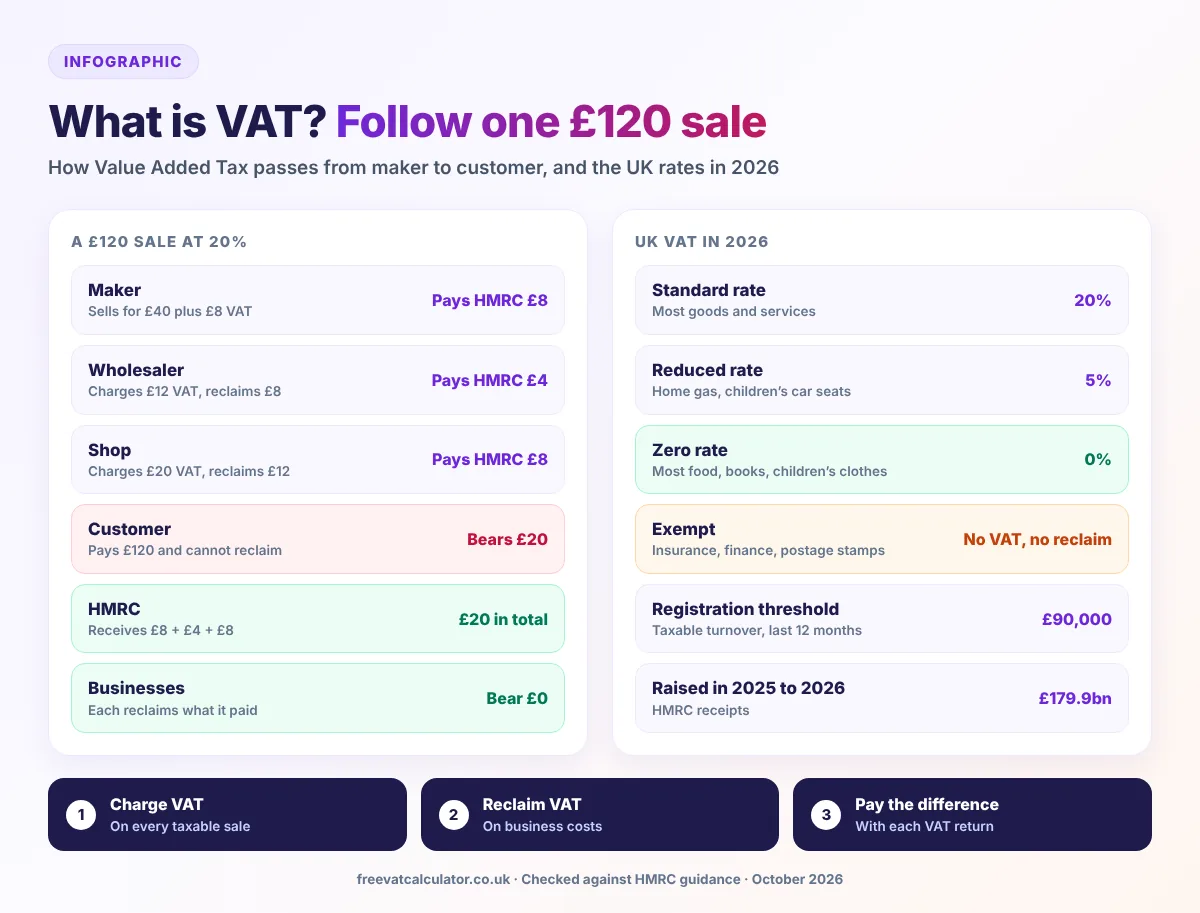
Try it with your own figure below. Enter the price a shop charges, and the example shows the VAT each business charges, reclaims and pays, and proves that none of them is left with a VAT cost.
VAT through the supply chain
Enter a shop price to see who charges, reclaims and pays the VAT
| Stage | Sells for, before VAT | VAT charged | VAT reclaimed | Net VAT to HMRC |
|---|---|---|---|---|
| Maker | £40.00 | £8.00 | £0.00 | £8.00 |
| Wholesaler | £60.00 | £12.00 | £8.00 | £4.00 |
| Shop | £100.00 | £20.00 | £12.00 | £8.00 |
| Final customer | Does not resell | None | None, cannot reclaim | Bears £20.00 |
Only the customer bears the VAT
HMRC receives £20.00 in three parts. Each business reclaims the VAT it paid, so the customer bears all of it.
The example assumes the maker sells for 40% of the shop’s price before VAT, the wholesaler for 60%, and that the maker’s own costs carry no VAT. Real margins differ, but the VAT HMRC receives always matches the VAT in the final price. If the final buyer is a VAT registered business buying for its business, it reclaims the VAT too.
Key facts
- What VAT stands for
- Value Added Tax
- UK rates
- 20% standard, 5% reduced, 0% zero
- Who pays it
- The final consumer
- Registration threshold
- £90,000 taxable turnover in 12 months
- Introduced
- 1 April 1973 at 10%
- Raised in 2025 to 2026
- £179.9 billion
VAT meaning: what does VAT stand for?
The letters stand for Value Added Tax, and the name explains the idea. Each business in a chain adds value by making, moving or selling a product, and VAT in effect taxes that added value one slice at a time. People use the word in slightly different ways, which is why it confuses so many.
- On a shop receipt, VAT is part of the price, so a £12 item at 20% includes £2 of VAT.
- On a business invoice, VAT is a separate line the buyer may claim back.
- For a VAT registered business, the answer to what is VAT is simple: money held for HMRC.
- For the Treasury, VAT raised £179.9 billion in 2025 to 2026.
Is VAT the same as sales tax?
Not quite, although the shopper pays both in the end. A sales tax, such as those used across the United States, is normally charged once at the final sale, while VAT is charged at every stage and the right to reclaim input tax stops it piling up.
| Feature | VAT | Sales tax |
|---|---|---|
| When it is charged | At every stage of the supply chain | Usually only at the final sale |
| Who collects it | Every VAT registered business in the chain | Usually only the retailer |
| Who bears the cost | The final consumer | The final consumer |
How does VAT work?
VAT works through two figures that every registered business tracks. Output tax is the VAT you charge on your sales, and input tax is the VAT you pay on business purchases. At the end of each VAT period, you pay HMRC the difference.
- A business sells and adds VAT at the correct rate.
- The customer pays that VAT as part of the price.
- The business records VAT charged as output tax and VAT on costs as input tax.
- It sends a VAT return, usually every three months.
- It pays HMRC the difference, or HMRC repays it if input tax is higher.
Output tax and input tax
Output tax belongs to HMRC from the moment you charge it, even though it sits in your bank account until the return is due. Input tax can only be reclaimed when the purchase is for your business and you hold a valid VAT invoice. HMRC’s VAT guide also blocks VAT on cars and on business entertainment, even when they are genuine costs.
When HMRC pays you back
A business gets a VAT repayment when its input tax is higher than its output tax. This is common for exporters and sellers of zero rated goods, such as a children’s clothes shop, because they charge 0% but still pay 20% on many costs.
Who pays VAT?
The final consumer pays VAT. Businesses collect it and hand it over, but because each one reclaims the VAT on its purchases, none carries the cost. When the rate rose to 17.5% in 1991, the Chancellor told Parliament that VAT falls on consumers rather than producers, as Hansard records.
How VAT affects the price you pay in shops
Prices shown to shoppers normally include VAT, and at 20% one sixth of the price is VAT, a share HMRC calls the VAT fraction. The Office for Budget Responsibility estimates that the 20% rate covers around half of household spending, and only about 2.5% is taxed at 5%.
When a business ends up paying VAT itself
VAT only becomes a cost for a business when it cannot reclaim it. That happens to businesses that are not registered, to those making exempt sales such as insurers, and on blocked items such as cars. Charities are often caught too, because much of their income is exempt or outside the scope.
UK VAT rates and categories in 2026
There are three rates of VAT, plus two kinds of sale that carry no VAT at all. The Budget 2026 rates annex keeps 20% and 5% for 2026 to 2027 and 2027 to 2028, and our current VAT rate page lists them in full.
| Category | Rate | Examples | Reclaim VAT on costs? | Counts towards the £90,000 threshold? |
|---|---|---|---|---|
| Standard rated | 20% | Most goods and services, adult clothing, restaurant meals, private school fees | Yes | Yes |
| Reduced rated | 5% | Home gas, children’s car seats, mobility aids installed for people over 60 | Yes | Yes |
| Zero rated | 0% | Most food, books, children’s clothes, sanitary products, exports, home electricity in Great Britain until 30 June 2027 | Yes | Yes |
| Exempt | No VAT | Insurance, finance, education, healthcare, postage stamps, renting out homes | Usually not | No |
| Outside the scope | No VAT | Wages, dividends, statutory fees such as the London congestion charge | Not applicable | No |
Standard rate: 20%
The standard rate applies to everything not given another rate or an exemption, so it covers most sales. It has been 20% since 4 January 2011, and from 1 November 2026 it is confirmed for public electric vehicle charging too.
Reduced rate: 5%
HMRC’s examples are child car seats, domestic fuel and power, and mobility aids for someone over 60 when installed at home. Gas and heating oil stay at 5%, but home electricity in Great Britain is temporarily at 0%.
Zero rate: 0%
Zero rated goods are still taxable, just at 0%, so the seller records the sale and can reclaim the VAT on its costs. Food, books and children’s clothing were zero rated when VAT began in 1973, and most still are.
Exempt supplies
Exempt supplies carry no VAT, and the seller generally cannot reclaim VAT on related costs. HMRC’s examples include finance and insurance, property, education, healthcare, funeral services, betting and lotteries. Private schools are the recent exception, because their fees have carried 20% VAT since 1 January 2025.
Outside the scope of VAT
Some transactions are not part of the VAT system at all. HMRC’s examples are goods or services bought and used abroad, statutory fees, hobby sales and donations given for nothing in return, and wages and dividends are outside the scope too.
Zero rated, exempt and outside the scope compared
All three leave the customer paying no VAT, which is why they are so often mixed up. The difference shows up in the seller’s own figures.
- Zero rated: taxable at 0%, counts towards the threshold, VAT on costs reclaimed
- Exempt: not taxable, ignored for the threshold, VAT on costs usually lost
- Outside the scope: not part of the VAT system, left off the return
A business whose sales are all exempt has no taxable turnover, so it cannot register just to reclaim VAT on costs. A business selling only zero rated goods can register, and it usually receives a repayment on each return.
Who has to register for VAT?
You must register if your VAT taxable turnover for the last 12 months goes over £90,000, or if you expect it to pass £90,000 in the next 30 days alone. Taxable turnover includes zero rated sales but not exempt or out of scope ones. The rule covers sole traders, partnerships and companies alike.
On the rolling test, you must register within 30 days of the end of the month you went over. Our guide to the VAT threshold explains both tests and the £88,000 deregistration limit. Businesses based outside the UK get no threshold, because since December 2012 a non established taxable person must register on its first UK taxable supply.
Voluntary registration
You can register voluntarily below £90,000 to reclaim VAT on start up costs. It usually pays off when your customers are VAT registered businesses, but rarely when you sell to the public, who would see prices rise by up to 20%.
What happens after you register
HMRC sends you a 9 digit VAT registration number, your effective date of registration and the date your first return is due. From the effective date you must account for VAT on your sales, even before the number arrives.
While you wait for your number, you cannot show VAT on your invoices. HMRC suggests raising your prices to cover the VAT you will owe, then reissuing the invoices with VAT shown once the number arrives.
What is a VAT number?
A VAT number is the unique reference HMRC gives a registered business. A UK VAT number is 9 digits long, often written with GB in front, such as GB123456789, and it must appear on every VAT invoice. Northern Ireland businesses supplying goods to EU customers use the prefix XI instead on those invoices.
You cannot reclaim VAT from an invalid invoice, so check a supplier’s number with our UK VAT number checker or HMRC’s service. It shows the name and address the number is registered to, but it cannot search by business name.
Charging VAT and issuing VAT invoices
Once registered, you add VAT to everything you sell unless it is exempt, show it separately on your invoices and report the totals on your return. When a rate changes, HMRC says you must apply the new rate immediately, from the date it changes.
What a VAT invoice must show
A full VAT invoice must carry the details below. Our guide to what a valid VAT invoice must include covers each one in more detail.
- A unique invoice number that follows a sequence
- Your name, address and VAT registration number
- The date of issue and the time of supply, or tax point
- The customer’s name and address
- A description, quantity and unit price for each item
- The VAT rate and the amount excluding VAT for each item
- The total excluding VAT and the total VAT in sterling
Retailers have a shortcut. For a sale of £250 or less including VAT, a simpler invoice showing the seller’s name, address and VAT number, the tax point, a description, the VAT rate and the total including VAT is enough.
How to work out the VAT on a price
To add VAT at 20%, multiply the net price by 1.2, and to take it out, divide the gross price by 1.2. Our how to calculate VAT guide shows every formula with examples, and the remove VAT calculator strips VAT from any gross price in one step.
Keeping VAT records
Keep records of everything you buy and sell, and copies of the invoices you issue and receive. VAT records must be kept for at least 6 years, or 10 years if you use the One Stop Shop scheme.
VAT returns, payments and Making Tax Digital
Most businesses file a VAT return every three months, and the return and payment are usually due one calendar month and 7 days after the period ends. You must file even when you owe nothing, and the deadline does not move for weekends.
All VAT registered businesses must follow Making Tax Digital for VAT, keeping records in software and filing through software that works with HMRC. Figures must move between programs by digital links, so copy and paste is not allowed, but spreadsheets are fine with bridging software.
Late returns earn penalty points, and a quarterly filer who reaches 4 points gets a £200 penalty. Late payment adds 3% of the VAT unpaid at day 15, another 3% at day 30 and then 10% a year, plus interest, currently 7.75% a year. Our guide to how to do a VAT return walks through each box.
VAT schemes that make life simpler
HMRC offers optional schemes that change how or when you account for VAT, though not what your customers pay. These are the main ones for smaller businesses.
| Scheme | Who can join | What changes |
|---|---|---|
| Flat Rate Scheme | VAT turnover of £150,000 or less, excluding VAT | You pay a fixed percentage of turnover and cannot reclaim VAT on most purchases |
| Cash Accounting Scheme | Estimated taxable turnover of £1.35 million or less | VAT is due when customers pay you; leave above £1.6 million |
| Annual Accounting Scheme | Estimated taxable turnover of £1.35 million or less | One return a year with advance payments; leave above £1.6 million |
| Margin schemes | Sellers of second hand goods, art, antiques and collectors’ items | VAT is charged only on the margin |
VAT on imports, exports and overseas services
VAT is also due on most goods brought into the UK, and a registered importer can use postponed VAT accounting to declare and reclaim it on the same return. Goods exported from Great Britain to outside the UK are zero rated, as long as you keep the evidence of export.
The reverse charge
Services bought from overseas suppliers usually fall under the reverse charge, where the UK customer accounts for the VAT instead of the supplier. From April 2027 this only applies when the customer is VAT registered, so overseas suppliers will charge UK VAT to unregistered UK businesses. A domestic reverse charge also covers most construction services under the Construction Industry Scheme.
A short history of VAT in the UK
VAT arrived on 1 April 1973 at 10%, replacing purchase tax, which dated from 1940. It was planned in anticipation of Britain’s entry into the European Economic Community, and it reached services as well as goods, according to the UK Parliament archive.
| Date | Standard rate | What happened |
|---|---|---|
| 1 April 1973 | 10% | VAT replaces purchase tax |
| 29 July 1974 | 8% | Standard rate cut from 10% |
| 18 June 1979 | 15% | One rate replaces the 8% standard rate and 12.5% higher rate |
| 1 April 1991 | 17.5% | Rise to fund lower community charge bills |
| 1 December 2008 | 15% | Temporary cut |
| 1 January 2010 | 17.5% | Rate returns to 17.5% |
| 4 January 2011 | 20% | Today’s standard rate begins |
Both big rises shifted tax from somewhere else. In 1979 the move to 15% was expected to raise £4,175 million in a full year to pay for income tax cuts, and in 1991 the rise paid for lower community charge bills.
How much money VAT raises
HMRC collected £179.9 billion of VAT in 2025 to 2026, up from £171.0 billion the year before, according to its tax receipts statistics. That is about 19% of the £937.8 billion HMRC raised, and only the combined income tax, capital gains tax and National Insurance receipts were larger.
Receipts are still growing. Provisional figures show £90.5 billion of VAT from April to September 2026, £3.8 billion more than a year earlier.
- £179.9bnVAT collected in 2025 to 2026
- 19%Share of all HMRC receipts
- £90.5bnCollected April to September 2026
Advantages and drawbacks of VAT
Supporters say VAT is hard to avoid because it is collected in stages, and zero rating softens its effect on essentials such as food. Critics say it takes a bigger share of income from poorer households and adds paperwork for small firms.
VAT changes in 2026 and what comes next
The 28 October 2026 Budget left the rates and the £90,000 and £88,000 thresholds unchanged, but it extended one relief and confirmed changes to how VAT is collected. The Budget overview of tax legislation sets out these dates.
| Date | Change |
|---|---|
| 23 June 2026 | New zero rate for qualifying medicines supplied free of charge |
| 25 June to 1 September 2026 | Temporary 5% rate on children’s meals and family days out, now ended |
| 1 October 2026 | Home electricity in Great Britain falls from 5% to 0% |
| 1 November 2026 | Public electric vehicle charging confirmed at 20% |
| 1 April 2027 | Energy saving materials return to 5%; overseas services reverse charge limited to VAT registered customers |
| 30 June 2027 | 0% on home electricity in Great Britain ends after the Budget extension |
| October 2027 | Online marketplaces start collecting VAT on sales by UK sellers |
| 1 April 2028 | A new legal duty to correct errors in tax returns |
| April 2029 | Electronic invoicing between businesses, and a Direct Debit instruction required for VAT returns, though other ways to pay remain |
For most small businesses, the dates to watch are the marketplace rules in 2027 and electronic invoicing in 2029. Neither changes the basic idea on this page: businesses collect the tax, and the final consumer pays it.
Need the VAT on a price?
Our main VAT calculator adds or removes VAT at 20%, 5% or any rate you choose.
What is VAT? Questions people often ask
These are the questions that come up most once the basics are clear. Each answer reflects HMRC guidance at 31 October 2026.
What is VAT in simple terms?
It is a tax added to most things businesses sell, collected bit by bit along the supply chain and paid in full by the final customer. Businesses act as collectors for HMRC.
Do sole traders pay VAT?
Yes, once their taxable turnover passes £90,000 the same rules apply as for a limited company. Below that, a sole trader can still register voluntarily.
Is there VAT on food?
Most food bought in shops is zero rated. Restaurant meals, hot takeaway food, alcohol, sweets and crisps are generally charged at 20%.
Can tourists get VAT back in the UK?
Not in Great Britain, where tax free shopping only works if the shop delivers the goods to an address outside the UK. In Northern Ireland, eligible visitors can still claim from some shops with form VAT 407(NI).
Does VAT apply in Northern Ireland?
Yes, the same rates and thresholds apply across the UK, except that the temporary 0% rate on home electricity covers only Great Britain. HMRC’s VAT guide covers the Isle of Man too. Northern Ireland follows some EU rules for goods, which is why its businesses use the XI prefix with EU customers.
What is VAT fraud?
It ranges from charging VAT without being registered to missing trader schemes, where a business collects VAT and disappears before paying it over. Checking a supplier’s VAT number before you pay is the simplest protection.
So the answer to what is VAT is simpler than it first looks: a tax on spending that businesses collect in stages and the final consumer pays. With the rates, registration rules and 2026 changes above, you now know when VAT applies to you, what to charge and what you can reclaim, and our VAT calculator will do the sums whenever you need them.
Sources: HMRC VAT guide (VAT Notice 700); GOV.UK VAT rates; GOV.UK Register for VAT; GOV.UK Charge, reclaim and record VAT; HMRC Record keeping (VAT Notice 700/21); Budget 2026 OOTLAR and Annex A; HMRC tax receipts statistics; OBR, VAT; UK Parliament, post war taxation. This page is general information, not tax advice.