
VAT threshold guide
VAT Threshold 2026: The £90,000 Registration Limit and When You Must Register
How the VAT threshold works
- Add up 12 monthsTaxable sales at each month end
- Look 30 days aheadOne big order can trigger it
- Compare with £90,000It must be over, not equal
- Tell HMRC in timeWithin 30 days of the month end
- Charge VATFrom your effective date
Sales are finally picking up, and then a new client asks for your VAT number. You start adding up invoices late at night, unsure whether HMRC means your tax year, your calendar year or something else, and you begin to worry that you may already have missed a deadline.
This guide settles that in one place. It opens with a table of every limit and a checker that tells you whether you must register and by when, then covers HMRC’s two tests, what counts as turnover, exceptions, voluntary registration, penalties and the Budget on 28 October 2026. Every figure has been checked against HMRC guidance, so by the end you will know exactly where you stand against the VAT threshold.
VAT threshold 2026 at a glance
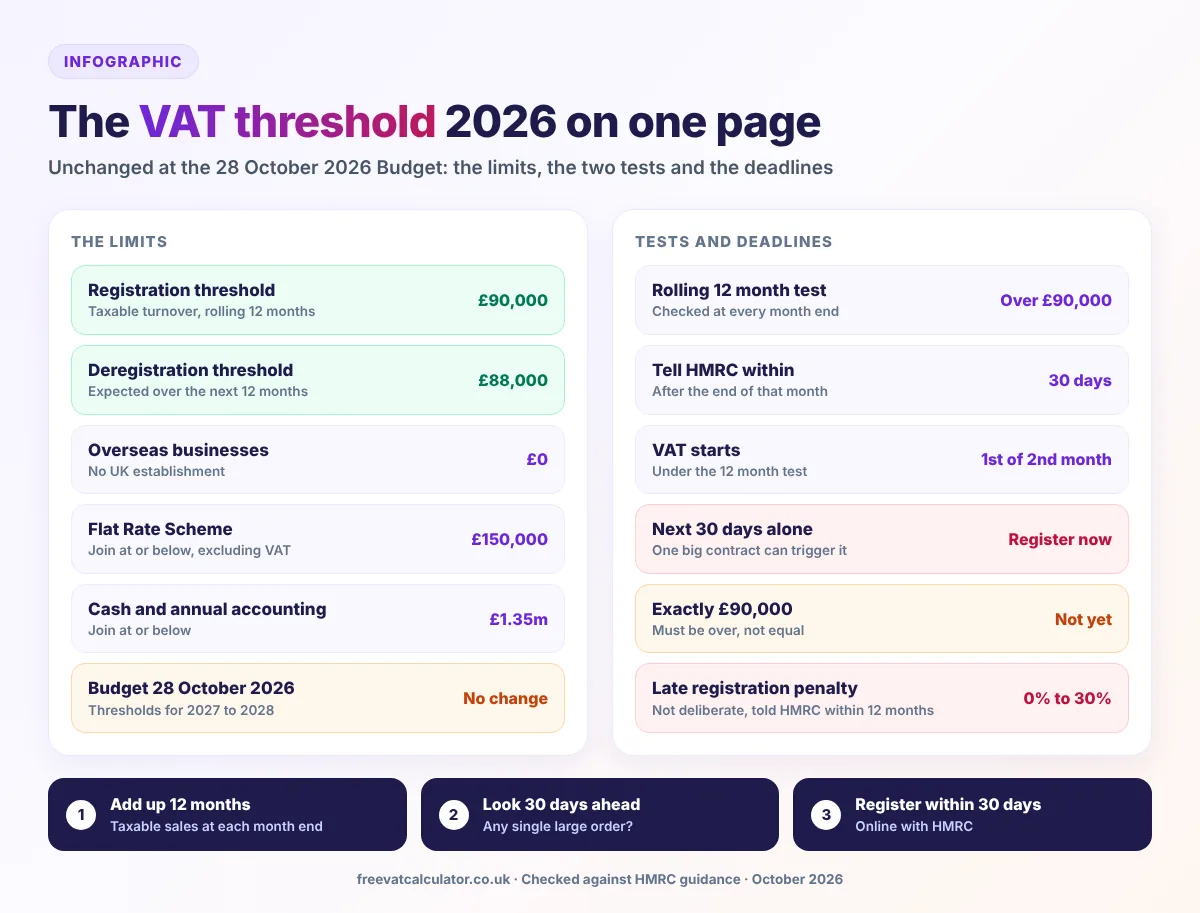
The VAT threshold for 2026 to 2027 is £90,000 of taxable turnover, and the deregistration threshold is £88,000. These are the VAT limits UK businesses work with, gathered into one table.
| Limit or rule | Figure | What it means |
|---|---|---|
| Registration threshold | £90,000 | Register if taxable turnover in the last 12 months goes over this |
| Deregistration threshold | £88,000 | You may cancel if you expect the next 12 months to be this or less |
| Rolling 12 months | Checked at every month end | Not your tax year, calendar year or accounting year |
| 30 day rule | Over £90,000 in the next 30 days alone | Register by the end of those 30 days |
| Deadline to register | 30 days after the month end | VAT starts on the first day of the second month after |
| Overseas businesses | £0 | Register within 30 days of the first UK taxable sale, or sooner if one is expected |
| In force since | 1 April 2024 | Unchanged at the Budget on 28 October 2026 |
Want a quick answer for your own business? Enter your taxable turnover for the last 12 months, anything you expect to sell in the next 30 days on its own, and the month your 12 months end.
Do I need to register for VAT?
Enter your taxable turnover to test it against the £90,000 limit
You must register for VAT
Your taxable turnover for the 12 months to the end of October 2026 is £2,400 over the limit. Tell HMRC by 30 November 2026 and charge VAT from 1 December 2026. If this was a one off and you expect £88,000 or less in the next 12 months, you can ask HMRC for an exception instead.
Count taxable sales at 20%, 5% and 0% before costs, plus any services from abroad you must reverse charge. This checker is a guide to HMRC’s rules, not a ruling, and nothing you enter is stored or sent.
Key facts
- Registration threshold
- £90,000 of taxable turnover in any rolling 12 months
- Deregistration threshold
- £88,000 expected over the next 12 months
- Deadline to register
- 30 days after the end of the month you went over
- 30 day test
- Over £90,000 expected in the next 30 days alone
- Overseas businesses
- No threshold: register within 30 days of making or expecting a first UK sale
- Budget 28 October 2026
- No change, and £90,000 is also set for 2027 to 2028
What is the VAT threshold?
The VAT threshold is the level of taxable turnover at which a UK business must register for VAT with HMRC. Its full name is the VAT registration threshold, and the supplement to HMRC’s VAT Notice 700/1 confirms it has been £90,000 since 1 April 2024. It measures sales, not profit, so a business with thin margins can cross it long before it feels successful.
Does the VAT threshold apply to sole traders?
Yes. The £90,000 limit is the same for sole traders, partnerships and limited companies. VAT registration belongs to the person rather than to each trade, so a sole trader who runs a photography business and an online shop must add the taxable sales of both together.
A limited company you own is a separate legal person, so its sales are not added to your sole trader sales. HMRC can still look through arrangements that split one business up artificially, which is covered further down.
Is the first £90,000 VAT free?
No. The threshold decides whether you must register, not how much of your income is taxed. Once you are registered, VAT applies to every taxable sale from your registration date, starting with the first pound.
When do I need to register for VAT? HMRC’s two tests
HMRC uses two separate tests, and you must register if either one is met. Most growing businesses meet the first, while the second catches people who land a single large contract.
The rolling 12 month test
At the end of every month, add up your taxable turnover for that month and the 11 before it. If the total is over £90,000, you must tell HMRC within 30 days of the end of that month, and your registration starts on the first day of the second month after it.
This window has nothing to do with your tax year or the year end in your accounts. It rolls forward one month at a time, so the oldest month drops out as each new one is added.
Example. A bakery finds its total for April 2025 to March 2026 is £92,400. It must register by 30 April 2026 and is VAT registered from 1 May 2026, so its April sales carry no VAT but every sale from 1 May does.
The next 30 days test
If at any time you expect your taxable turnover in the next 30 days on its own to go over £90,000, you must register by the end of that 30 day period. This time registration starts on the date you first expected it, not at the start of a later month.
Example. On 10 November 2026 a joinery firm that usually turns over about £40,000 a year signs a contract to fit out an office, and it will invoice £95,000 for the work within the next 30 days. It must register by 9 December 2026, and its registration starts on 10 November 2026, so VAT is due on that job.
| Test | Triggered when | Register by | Registration starts |
|---|---|---|---|
| Rolling 12 months | The total for the last 12 months goes over £90,000 at a month end | 30 days after that month ends | First day of the second month after |
| Next 30 days | You expect over £90,000 in the next 30 days alone | The end of that 30 day period | The day you first expected it |
The word that matters is over. A total of exactly £90,000 does not trigger either test, but £90,000.01 does.
Worked example: checking the rolling total month by month
Here is how the rolling total moves for a consultancy that invoices a little more each month. Each figure is the total for the 12 months ending in that month.
| 12 months ending | Rolling total | Over £90,000? | What happens |
|---|---|---|---|
| June 2026 | £84,200 | No | Keep checking each month end |
| July 2026 | £86,900 | No | £3,100 under the limit |
| August 2026 | £89,600 | No | £400 under the limit |
| September 2026 | £91,300 | Yes | Register by 30 October 2026 and charge VAT from 1 November 2026 |
Common mistakes when measuring turnover
- Using your tax year instead of a rolling 12 months
- Counting profit instead of total sales
- Leaving out zero rated sales
- Counting marketplace payouts after fees
- Forgetting a second trade run by the same person
- Checking once a year instead of every month end
What counts towards the VAT threshold
Only taxable turnover counts. That is everything you sell that would carry VAT at 20%, 5% or 0% if you were registered, which is not the same as your total income.
| Type of income | Counts? | Notes |
|---|---|---|
| Standard rated sales | Yes | Sales that would carry 20% VAT |
| Reduced rated sales | Yes | Sales that would carry 5% VAT |
| Zero rated sales | Yes | Such as most food, books and children’s clothes |
| Goods hired out or lent | Yes | Hire charges count like sales |
| Goods used personally, bartered or given away | Yes | Business goods only, including part exchanges |
| Services you reverse charge | Yes | Services from overseas suppliers, plus domestic reverse charge supplies |
| Building work for your own business | Yes | Only when it is worth over £100,000 |
| Exempt sales | No | Such as most residential rent, insurance and financial services |
| Sales outside the scope of UK VAT | No | Not part of taxable turnover at all |
| Sales of capital assets | No | Such as a van or machinery used in the business |
| Loans, grants and capital you put in | No | Not payment for a supply |
Example. Over the last 12 months a marketing consultant has invoiced £84,000 in fees, received £6,000 of rent from a flat she lets and sold her old business car for £8,000. Her income is £98,000, but her taxable turnover is only £84,000, because residential rent is exempt and the car is a capital asset.
Zero rated sales and exemption from registration
Zero rated sales catch many people out, because no VAT would be charged on them. A greengrocer selling mostly fruit and vegetables still counts every one of those sales towards the threshold.
If all or most of your taxable sales are zero rated, you can ask HMRC for an exemption from registration, since you would usually be reclaiming more VAT than you pay. If HMRC agrees, you cannot reclaim VAT on your costs, and you must tell HMRC if your sales mix changes.
Do marketplace sales count gross or after fees?
Count the full price your customers paid, not the payout you receive after the marketplace takes its fees. The fees are a separate charge to you, so a seller with £75,000 of payouts can easily have gross sales above £90,000.
From October 2027, a Budget measure will make online marketplaces account for the VAT on sales by VAT registered UK sellers, and by unregistered UK sellers with £90,000 or more of annual sales on one platform. The final threshold and date will be set in regulations, and our guide to online marketplace VAT follows the changes.
Services from abroad and the reverse charge
An unregistered UK business that buys services such as software or advertising from an overseas supplier must include those reverse charge services in its taxable turnover. That can push a small business over £90,000 even when its own sales are lower.
From 1 April 2027 the reverse charge will apply only where the UK customer is VAT registered, and overseas suppliers will charge UK VAT to unregistered businesses instead. HMRC’s policy paper ties the rule on counting these services to the reverse charge, so once the reverse charge stops applying to unregistered businesses, the services should no longer count towards their threshold test. HMRC has not yet updated its registration guidance, so check it before April 2027.
What to do when you go over the VAT threshold
Once you know you have crossed the line, act within the deadline rather than waiting for your accounts. These are the steps in order.
- Work out which test you met, your deadline and your effective date of registration.
- Register online with HMRC using our guide on how to register for VAT, or ask an accountant to do it. Use form VAT1 by post if you want an exception.
- Build VAT into your prices from your effective date, even before your VAT number arrives.
- When the number arrives, reissue invoices for sales since your effective date showing the VAT, within 30 days.
- Set up Making Tax Digital software and note the due date of your first VAT return.
How long does VAT registration take?
HMRC sends your 9 digit VAT number and effective date of registration by post, but its guidance promises no fixed processing time. Apply as soon as you know you must register, because the deadline is for telling HMRC, not for receiving your number.
Charging VAT before your VAT number arrives
You must account for VAT from your effective date even while you wait, but you cannot show VAT on an invoice until you have your number. HMRC’s answer is to raise your prices to cover the VAT and tell customers why.
On a £100,000 contract, for example, you would invoice £120,000 and then reissue the invoice showing £20,000 of VAT once the number arrives. A VAT registered customer can then reclaim that £20,000 on its own return, and our guide to what a valid VAT invoice must include lists the details to show.
Your duties once you are registered
- Charge VAT at the right rate on your taxable sales and give VAT invoices to business customers
- Keep digital records and file returns through Making Tax Digital software
- File and pay most returns quarterly, one month and seven days after each period ends
- Keep your VAT records for at least six years
Special situations and exceptions
Some businesses cross the line in unusual ways. HMRC has specific rules for each of these cases.
Going over the limit temporarily
If a one off sale pushed you over £90,000 but you can show HMRC that your taxable turnover in the next 12 months will be £88,000 or less, you can ask for an exception from registration. You still have to contact HMRC within the normal deadline, using form VAT1 by post, with evidence such as forecasts and the details of the unusual sale.
A self employed gardener with steady sales of about £70,000 a year who takes on a single £30,000 estate job is a typical case. HMRC decides, and if it refuses you are registered from the normal date.
Taking over a business
If you take over a business as a going concern from someone who was, or should have been, VAT registered, add its taxable turnover for the 12 months before the transfer to your own. If the combined total is over £90,000 on the day of the transfer, you must register from that date unless an exception or exemption applies, so buying a VAT registered café that took £60,000 when your catering business took £35,000 means registering straight away. You may be able to keep the seller’s VAT number, but that can also mean taking on any VAT the previous owner still owes.
Businesses based outside the UK
The £90,000 threshold only protects businesses established in the UK. An overseas business with no UK establishment must register within 30 days of its first UK taxable sale, however small, or by the end of any 30 day period in which it expects to make one. That matters for many online sellers who store stock in UK warehouses, because expecting a sale can start the clock before the first order arrives.
Splitting a business to stay under the threshold
Running what is really one business through two or more people or companies, just so each stays under £90,000, does not work. HMRC can direct that they are treated as a single taxable person and registered together. Genuinely separate businesses with their own customers, premises, staff and records are not affected.
Northern Ireland: goods from the EU and sales to EU consumers
Northern Ireland businesses have two extra limits under the Windsor Framework. One that buys more than £90,000 of goods from VAT registered EU suppliers must register even if everything it sells is exempt, and sales of goods to EU consumers have a separate limit of £8,818 a calendar year.
Voluntary VAT registration below the threshold
You can register at any turnover. Voluntary registration suits you best when your customers are VAT registered or your costs carry a lot of VAT, and least when you sell to the public.
Benefits of voluntary registration
- You can reclaim VAT on business purchases such as equipment, stock and software
- A VAT number can make a small firm look more established to larger clients
- VAT registered business customers can usually reclaim the VAT you charge, so it costs them nothing extra
- You are already set up when growth takes you past £90,000
- Businesses that mostly sell zero rated goods often receive regular VAT repayments
Example. A web designer with £45,000 of sales to VAT registered clients spends £12,000 a year, before VAT, on software and equipment. Registering lets her reclaim £2,400 of VAT on those costs, while her clients simply reclaim the 20% she adds to her invoices.
When voluntary registration does not make sense
- Your customers are mainly the public, who cannot reclaim VAT and would see higher prices
- Your costs carry little VAT, so there is not much to reclaim
- You would rather avoid quarterly returns, digital records and Making Tax Digital software
- Your cash flow is tight, since VAT is often due to HMRC before customers pay you
- All your sales are exempt, in which case you cannot register at all
Backdating and reclaiming VAT from before you registered
When you register voluntarily you can ask for a start date up to four years in the past, but once you are registered HMRC will not let you change it. You can also register before your first sale if you are setting up a business that intends to trade.
After registering, you can usually reclaim VAT on goods bought in the four years before your registration date if you still hold them and use them in the business, and on services bought in the six months before. A backdated start date moves both windows back with it, which is why some businesses choose their date with care.
Is it better to stay under £90,000?
For a business selling to the public, crossing £90,000 can mean adding 20% to prices or absorbing it, so some owners deliberately stay below the line. HMRC research found that about one in five unregistered businesses trading close to the threshold had done something to stay under it.
Turning work away is legal, but splitting one business into several is not safe. The better question is whether the extra profit above £90,000 outweighs the VAT, once you count the VAT on costs you could reclaim.
Penalties for registering late
If you should have registered but did not, you owe VAT on your taxable sales from the date you should have been registered. If you cannot recover it from customers, it comes out of what you were paid: on standard rated sales that is one sixth of the amount charged, so £48,000 of sales in the late period means £8,000 of VAT.
HMRC can add a failure to notify penalty, worked out as a percentage of the VAT you owe. The range depends on why you were late, whether you told HMRC before it found you, and how long ago the tax became due.
| Why you were late | You told HMRC first | HMRC found you first |
|---|---|---|
| Not deliberate, within 12 months of the tax becoming due | 0% to 30% | 10% to 30% |
| Not deliberate, 12 months or more after | 10% to 30% | 20% to 30% |
| Deliberate | 20% to 70% | 35% to 70% |
| Deliberate and concealed | 30% to 100% | 50% to 100% |
Where you land in each range depends on how much you help: telling HMRC, helping it work out the figures and giving access to your records. If you had a reasonable excuse, such as a serious illness, and told HMRC without unreasonable delay once it ended, there may be no penalty at all.
Older guidance that quotes late registration penalties of 5%, 10% and 15% only covers cases where the duty to register arose before 1 April 2010. Some websites still repeat those figures, but the failure to notify rules above apply now.
Our VAT penalties guide covers the separate points based penalties for late returns and the charges for paying late. Interest on late VAT is the Bank of England base rate plus 4%, which is 7.75% a year until 23 November 2026 and 8% from 24 November 2026, after the base rate rose to 4% on 5 November.
The VAT deregistration threshold
You can ask HMRC to cancel your registration if you expect your taxable turnover in the next 12 months to be £88,000 or less. The £2,000 gap below the registration threshold stops a business hovering around the line from registering and cancelling over and over.
You must cancel within 30 days if you stop making taxable supplies, for example because you close or sell the business. When you leave, you may have to pay VAT on stock and assets you still hold if the VAT on them would be more than £1,000, and our deregistration guide explains the process.
VAT scheme thresholds once you are registered
Registering also opens the door to schemes that make VAT simpler. Each has its own turnover limits for 2026 to 2027.
| Scheme | Join if turnover is | Must leave above |
|---|---|---|
| Flat Rate Scheme | £150,000 or less, excluding VAT | £230,000, including VAT |
| Cash Accounting Scheme | £1.35 million or less | £1.6 million |
| Annual Accounting Scheme | £1.35 million or less | £1.6 million |
The Flat Rate Scheme lets a small business pay a fixed percentage of its turnover, while cash accounting means you pay VAT only when customers pay you. Both can ease the first year after registration.
VAT threshold history
The threshold rose with inflation most Aprils, then stayed at £85,000 for seven years before reaching £90,000 in April 2024. HMRC’s records give these figures.
| From | Registration | Deregistration |
|---|---|---|
| 1 April 2024 | £90,000 | £88,000 |
| 1 April 2017 | £85,000 | £83,000 |
| 1 April 2016 | £83,000 | £81,000 |
| 1 April 2015 | £82,000 | £80,000 |
| 1 April 2014 | £81,000 | £79,000 |
| 1 April 2013 | £79,000 | £77,000 |
Going further back, the threshold was £5,000 when VAT began in 1973, according to the House of Commons Library. The 2024 rise was expected to take about 28,000 businesses out of VAT, at a cost of £150 million in 2024 to 2025 rising to £185 million in 2025 to 2026.
How the UK VAT threshold compares internationally
The UK threshold is high by international standards. A Treasury minister told Parliament that at £90,000 it is higher than the threshold in any EU country and the joint highest in the OECD.
Since 1 January 2025, EU rules have capped each country’s small business limit at €85,000, and the relief works across borders only for firms with EU turnover of €100,000 or less. Online sales of goods to consumers in other EU countries have a separate €10,000 limit across the whole EU.
Despite the high threshold, the UK register is large. HMRC’s annual statistics for 2024 to 2025 give these figures.
- 2,330,400VAT registered traders in 2024 to 2025
- 234,000new VAT registrations in the year
- 218,000VAT deregistrations in the year
Did the VAT threshold change at the Autumn Budget 2026?
No. At the Budget on 28 October 2026 the registration threshold stayed at £90,000 and the deregistration threshold at £88,000, and the rates annex published with the Budget shows the same figures for 2027 to 2028.
The thresholds have now been unchanged since 1 April 2024. With no rise for inflation, higher prices alone pull more small businesses over £90,000 each year, an effect often called fiscal drag.
- The VAT threshold stays at £90,000 for 2026 to 2027 and 2027 to 2028
- Online marketplaces will collect VAT on many sales by UK sellers from October 2027
- The reverse charge on services from abroad will apply only to VAT registered customers from 1 April 2027
- Electronic invoicing becomes mandatory between VAT registered businesses from 1 April 2029
- VAT registered businesses will need a Direct Debit mandate for VAT payments from April 2029
Our Autumn Budget VAT guide covers every VAT measure announced on 28 October 2026. This page will be updated if the threshold changes.
Track your rolling total every month
Our VAT threshold calculator adds up your sales month by month and shows your deadline and start date.
VAT threshold FAQs
These are the questions people ask most often about the threshold. Each answer reflects the rules in force on 31 October 2026.
What is the VAT threshold for 2026 to 2027?
£90,000 to register and £88,000 to deregister. Both have applied since 1 April 2024, and the Budget on 28 October 2026 kept them for 2027 to 2028 as well.
Is the VAT threshold based on turnover or profit?
Turnover. It is the total of your taxable sales before any costs are taken off, so profit plays no part.
How long do I have to register once I go over?
Thirty days from the end of the month in which your 12 month total went over £90,000. Under the 30 day test, you have until the end of that 30 day period.
What if I have already gone over without realising?
Register straight away and give HMRC the date you should have been registered from. Telling HMRC before it contacts you keeps any failure to notify penalty in the lowest range, which starts at 0% if the tax became due less than 12 months ago.
Do overseas sellers get the £90,000 threshold?
No. A business with no UK establishment must register within 30 days of its first taxable sale in the UK, whatever the amount. If it expects to make a UK sale within the next 30 days, it must register by the end of that 30 day period instead.
Will the VAT threshold go up in 2027?
Not on current plans. The Budget rates annex shows £90,000 to register and £88,000 to deregister from April 2027, the same as now.
You now have the answer to the question that brought you here: whether you must register, by when, and what happens next. Use the checker at the top whenever your rolling total moves, and register within 30 days of the end of the month you go over.
Sources: HMRC VAT Notice 700/1; Notice 700/1 supplement; GOV.UK, Register for VAT; GOV.UK, How to register for VAT; GOV.UK, Cancel your VAT registration; HMRC CC/FS11; HMRC VAT Notice 700/41; HMRC VIT32000; HMRC VATDSAG05150; HMRC VATPOSG3530; Budget 2026, Annex A rates and allowances; HMRC, reverse charge reform; HMRC, online marketplace liability; HMRC, 2024 threshold increase; HMRC, annual UK VAT statistics 2024 to 2025; GOV.UK, VAT Flat Rate Scheme; GOV.UK, Cash Accounting Scheme; GOV.UK, Annual Accounting Scheme; House of Commons Library, VAT registration threshold; European Commission, SME VAT rules. This page is general information, not tax advice.