
Company tax calculator
Corporation Tax Calculator: 2026 to 2027 Rates, Marginal Relief and Payment Dates
How a corporation tax bill is worked out
- Accounts profitProfit before tax
- Adjust itAdd backs and allowances
- Set the limitsAssociates and period
- Apply the rate19%, 25% or relief
- Pay HMRC9 months and 1 day
Your company’s year end has passed, the accounts show a profit, and nobody has told you what the tax bill will be. HMRC does not send one, the rate is no longer a flat 19%, and profits between £50,000 and £250,000 fall into a band that catches out even experienced directors.
The tool below applies the current rates, marginal relief, associated companies and short periods, and shows the working. After it come the rates, worked examples, taxable profit rules and every deadline, so start with the corporation tax calculator and read on where you need to.
Corporation tax calculator for 2026 to 2027
Enter the taxable profit and the dates of the accounting period. Add any associated companies and any dividends received from companies outside your group, because both change the limits.
Corporation tax calculator
With marginal relief, associated companies and short periods
Marginal relief band
Augmented profits of £100,000.00 are between the limits of £50,000.00 and £250,000.00, so tax is worked out at 25% and reduced by marginal relief.
The working
An estimate based on HMRC’s marginal relief rules. Enter profit after allowable expenses, capital allowances and losses, and excluding VAT if the company is VAT registered.
What the calculator includes and leaves out
- The corporation tax calculator covers periods starting on or after 1 April 2022
- Enter profit after allowable expenses, capital allowances and losses
- Exempt distributions count towards the limits but are not taxed
- Ring fence oil and gas profits are not covered
- The Budget confirmed the same rates and limits from 1 April 2028, so the tool uses them too
Key facts
- Small profits rate
- 19% up to £50,000
- Main rate
- 25% from £250,000
- Marginal relief
- 3/200 × (£250,000 minus profit)
- Marginal tax rate
- 26.5% inside the band
- Associated companies
- Limits split between the companies
- Payment due
- 9 months and 1 day after the period
Corporation tax rate UK: current rates and bands
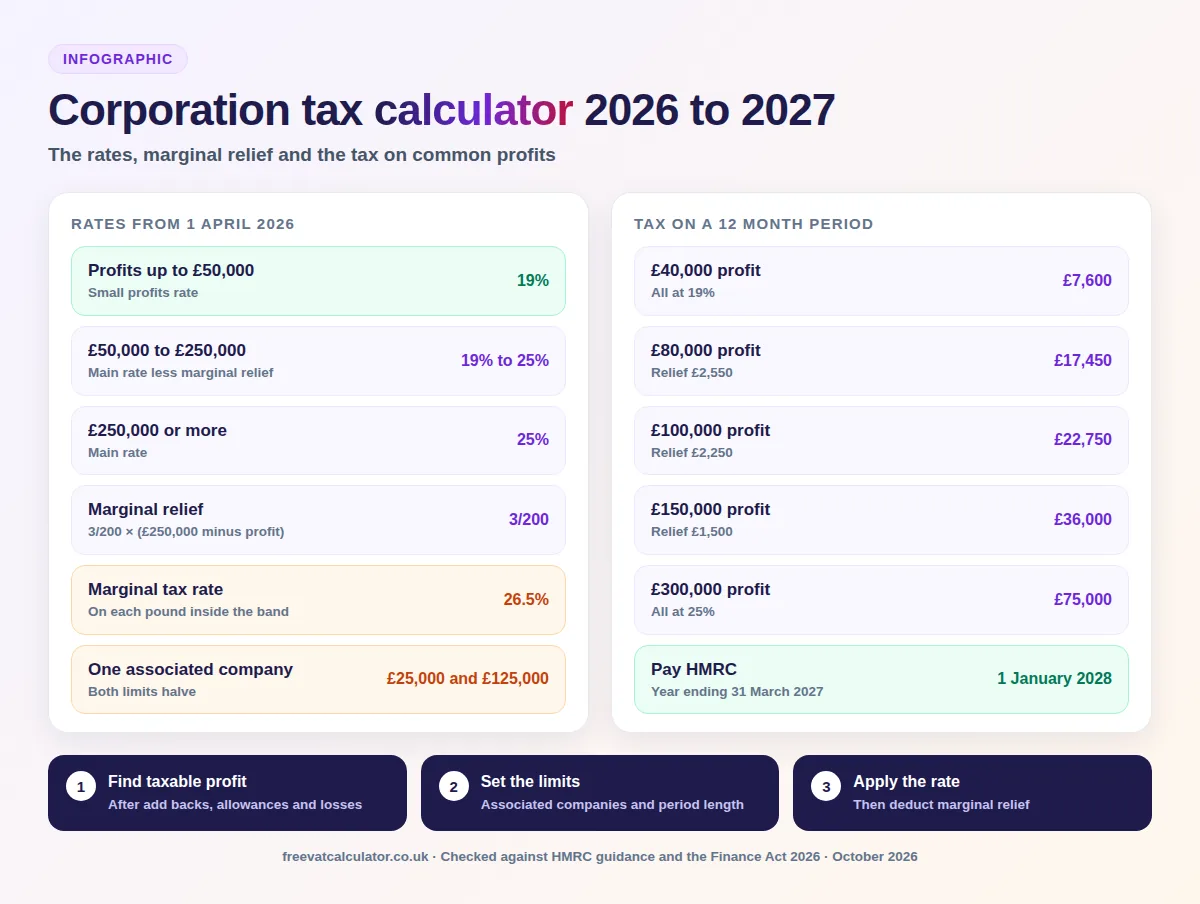
The current corporate tax rate in the UK depends on profit. Since 1 April 2023 a small profits rate of 19% applies up to £50,000 and a main rate of 25% over £250,000, with marginal relief in between, so the corporation tax percentage for a mid sized profit lands between the two.
- 19%Small profits rate up to £50,000
- 26.5%Marginal rate between £50,000 and £250,000
- 25%Main rate from £250,000
| Financial year from 1 April | Small profits rate | Main rate | Limits | Marginal relief fraction |
|---|---|---|---|---|
| 2022 | No separate rate | 19% on all profits | Not used | Not used |
| 2023, 2024 and 2025 | 19% | 25% | £50,000 and £250,000 | 3/200 |
| 2026 (to 31 March 2027) | 19% | 25% | £50,000 and £250,000 | 3/200 |
| 2027 (to 31 March 2028) | 19% | 25% | £50,000 and £250,000 | 3/200 |
| 2028 (to 31 March 2029) | 19% | 25% | £50,000 and £250,000 | 3/200 |
Each financial year takes the name of the year it starts in, so the 2026 year began on 1 April 2026. The 2027 rates are already law under sections 11 and 12 of the Finance Act 2026, while oil and gas ring fence profits have a 30% main rate and an 11/400 fraction instead.
Did the 25% main rate change in the Budget?
The Corporate Tax Roadmap of 30 October 2024 commits to capping the main rate at 25% for this Parliament and keeping the small profits rate and marginal relief thresholds. The Autumn Budget of 28 October 2026 kept those commitments, leaving the 19% and 25% rates and the £50,000 and £250,000 limits unchanged. It also confirmed the same rates and limits for the year from 1 April 2028, to be set in the next Finance Bill, and our Autumn Budget guide covers the other changes for businesses.
How corporation tax marginal relief works
Marginal relief stops a company on £50,001 suddenly paying 25% on everything. Tax is worked out at the main rate, then a relief is deducted that shrinks to nothing at the upper limit, and you enter it in box 435 of the CT600.
The marginal relief formula
HMRC’s formula is F × (U minus A) × N ÷ A, where F is 3/200, U the upper limit, A augmented profits and N taxable total profits. With no exempt distributions, N and A are equal, so the relief is simply 3/200 × (£250,000 minus profit).
- Multiply taxable profit by 25%
- Take augmented profits away from the upper limit
- Multiply by 3/200, then by taxable profit divided by augmented profits
- Deduct the relief from the tax at 25%
Why the marginal tax rate is 26.5% in the band
Each extra pound between the limits attracts 25p of tax and loses 1.5p of relief, so the marginal tax rate is 26.5%. For a corporate taxpayer, a quick check is £9,500 plus 26.5% of profit above £50,000, so £100,000 costs £22,750. It also means a deduction inside the band saves 26.5p per pound.
Exempt distributions and augmented profits
Augmented profits are taxable profits plus exempt distributions, mainly dividends from companies that are not 51% group members. HMRC’s manual example has £90,000 of profit and £8,000 of such dividends, giving relief of £2,094 and tax of £20,406. Enter it for a year ending 30 September 2026 and the calculator agrees to the pound.
Who cannot claim marginal relief
Close investment holding companies pay 25% on all profits, with no small profits rate or marginal relief, and HMRC’s guidance says a company that is not resident in the UK cannot claim marginal relief either. A close company counts as a close investment holding company unless it mainly trades, lets land commercially to tenants who are not connected with it or with its owners’ families, or acts as a holding or service company for a trading or property letting group. HMRC notes that even a company holding only a bank deposit is caught.
Corporation tax worked examples for 2026 to 2027
These figures assume a 12 month period from 1 April 2026, no associated companies and no exempt distributions. They come from the same formula as the tool.
| Taxable profit | Tax at 19% or 25% | Marginal relief | Tax due | Effective rate |
|---|---|---|---|---|
| £40,000 | £7,600 | £0 | £7,600 | 19.00% |
| £50,000 | £9,500 | £0 | £9,500 | 19.00% |
| £80,000 | £20,000 | £2,550 | £17,450 | 21.81% |
| £100,000 | £25,000 | £2,250 | £22,750 | 22.75% |
| £150,000 | £37,500 | £1,500 | £36,000 | 24.00% |
| £200,000 | £50,000 | £750 | £49,250 | 24.63% |
| £300,000 | £75,000 | £0 | £75,000 | 25.00% |
Example: £100,000 profit with one associated company
Two companies share the limits, so they become £25,000 and £125,000. Relief falls to 3/200 × (£125,000 minus £100,000), which is £375, so the bill is £24,625 instead of £22,750.
Example: a six month accounting period
A period from 1 April 2026 to 30 September 2026 has 183 days, so the limits fall to 183/365 of the full amounts, £25,068.49 and £125,342.47. On £40,000 the tax is £10,000 less relief of £1,280.14, which is £8,719.86, against £7,600 for a full year.
Associated companies and short accounting periods
The limits are divided by the number of associated companies plus one. For a period shorter than 12 months they are also reduced in proportion.
| Associated companies | Lower limit | Upper limit |
|---|---|---|
| None | £50,000 | £250,000 |
| 1 | £25,000 | £125,000 |
| 2 | £16,666.67 | £83,333.33 |
| 3 | £12,500 | £62,500 |
What counts as an associated company
Companies are associated if one controls the other or the same people control both, wherever they are resident. One associated for only part of the period counts for all of it, while a company with no trade or business, or a passive holding company, is ignored. The count goes in box 326 of the CT600.
Short accounting periods
An accounting period can never exceed 12 months, so 15 months of accounts need two returns. HMRC’s manual shows a nine month example using 9/12 of each limit but says the strict method uses days, which is what the calculator does.
Accounting periods that straddle 1 April
When rates or limits change on 1 April, profit is split by days and each part is taxed at its own rates. HMRC’s manual says no split is needed while they stay the same, as they have since 1 April 2023. For older periods the tool matches HMRC’s 2023 example of £41,160.94, which uses the 366 days of that financial year.
What counts as taxable profit
Corporation tax is charged on trading profits, investment income and chargeable gains, not on turnover. The profit in your accounts is only the starting point.
Corporation tax computation step by step
- Start with profit before tax from the accounts
- Add back costs that are not allowable, such as depreciation and client entertaining
- Deduct capital allowances on plant and machinery
- Add other income and gains, then deduct any losses you can use
- Apply the rates and marginal relief to what remains
Allowable expenses and costs you add back
- Allowed: salaries, employer National Insurance and employer pension contributions
- Allowed: rent, insurance, repairs, software and accountancy fees
- Added back: depreciation, business entertainment and fines
- Not deductible: dividends paid to shareholders
Capital allowances: AIA, full expensing and the 40% allowance rising to 50%
The annual investment allowance covers up to £1 million a year of most plant and machinery, but not cars. Full expensing gives companies 100% on new main rate plant and machinery other than cars, and the Corporate Tax Roadmap confirms it is permanent. Since 1 January 2026 a 40% first year allowance also covers new main rate assets other than cars, including many bought to lease out, and the Autumn Budget of 28 October 2026 raises it to 50% for spending on or after 1 January 2027. The main pool writing down allowance fell from 18% to 14% on 1 April 2026 and will fall to 12% from 1 April 2027, with a blended rate for an accounting period that spans that date.
VAT and your taxable profit
For a VAT registered company, HMRC’s Business Income Manual says sales and costs are shown without VAT, so enter figures excluding VAT. On the Flat Rate Scheme, turnover is shown net of the flat rate VAT paid, so any VAT you keep becomes taxable profit. Our flat rate VAT calculator shows how big that gap is.
Trading losses
A trading loss can be set against other profits of the same period, carried back against total profits of the previous 12 months if the company carried on the same trade then, or carried forward. Carry back claims are due within two years, and since 1 April 2017 carried forward losses above £5 million a year can only cover half the remaining profits.
How a limited company can reduce its corporation tax
A limited company cannot change its rate, but it can lower the profit taxed. These are the usual legitimate levers.
- Claim every capital allowance and time big purchases before the year end
- Make employer pension contributions, normally deductible in the period they are paid
- Pay directors a salary, which is deductible, before dividends, which are not
- Claim research and development relief for advances in science, technology or, since April 2023, mathematics
- Use losses from earlier years
Corporation and dividend tax together
Dividends come out of profit after corporation tax, so £100,000 of profit leaves £77,250 to distribute. Shareholders then pay dividend tax above the £500 allowance, which our dividend tax calculator works out, and our sole trader vs limited company guide compares both ways of trading.
| Income tax band | Dividend tax rate |
|---|---|
| Basic rate | 10.75% |
| Higher rate | 35.75% |
| Additional rate | 39.35% |
When to pay corporation tax and file the CT600
The tax is due before the return, and HMRC sends no bill. The company works out, pays and reports the tax itself.
| What | Rule | Date |
|---|---|---|
| Pay corporation tax | 9 months and 1 day after the period ends | 1 January 2028 |
| File accounts at Companies House | 9 months after the year end | 31 December 2027 |
| File the CT600 | 12 months after the period ends | 31 March 2028 |
| Large company instalments | 14th of months 7, 10, 13 and 16 | 14 October 2026 to 14 July 2027 |
| Very large company instalments | 14th of months 3, 6, 9 and 12 | 14 June 2026 to 14 March 2027 |
How the 9 months and 1 day rule works
For a period ending on the last day of a month, HMRC’s manual makes the tax due on the first day of the tenth month after, so 30 June becomes 1 April. Pay with the 17 character reference, and for a weekend deadline make sure the money arrives on the last working day before unless you use Faster Payments.
Quarterly instalments for large companies
Profits over £1.5 million make a company large and over £20 million very large, with both thresholds divided by associated companies plus one. Tax of £10,000 or less for the period needs no instalments, and profits up to £10 million are exempt if the company was not large in the previous 12 months.
Late filing penalties and interest
For returns due on or after 1 April 2026, the Finance Act 2026 doubled the penalties to £200, then £400 after 3 months, or £1,000 and £2,000 for a third late return in a row. HMRC adds 10% of unpaid tax at 6 months and again at 12, and since 9 January 2026 late payment interest is 7.75% and repayment interest 2.75%. From 1 April 2028 a company must also correct any error it finds in a return, under a duty confirmed in the Autumn Budget, and amended Company Tax Returns will have to be filed online.
Scotland corporation tax, Wales and Northern Ireland
Corporation tax rates in Scotland, Wales and Northern Ireland are the same as in England, and the tax is not on the Scottish Government’s list of devolved taxes. Scottish income tax bands affect a director’s salary but not dividends. The Corporation Tax (Northern Ireland) Act 2015 lets the Northern Ireland Assembly set its own rate, but the Treasury has not yet appointed a start year.
Is there an HMRC corporation tax calculator?
HMRC’s marginal relief calculator asks for the period dates, profit, outside distributions and associated companies, and gives an indicative bill. HMRC does not use the figures you enter, and neither tool files your CT600 for you.
Common corporation tax mistakes
Most wrong estimates come from a few errors. Check these first.
- Charging 25% between the limits and forgetting marginal relief
- Charging 19% on the first £50,000 and 25% on the rest
- Ignoring associated companies or a short period
- Leaving VAT in a VAT registered company’s turnover
- Treating dividends paid to shareholders as an expense
- Waiting for the 12 month filing date when the tax was due earlier
Taking the profit out as dividends?
Our dividend tax calculator shows the personal tax on what is left after corporation tax.
Corporation tax calculator FAQs
These are the questions company owners ask most. The sections above cover each in more detail.
How much corporation tax do I pay on £50,000 profit?
A stand alone company with a 12 month period pays £9,500, which is 19%. With one associated company the same profit costs £11,375.
Is corporation tax 19% or 25%?
Both, depending on profit. Up to £50,000 pays 19%, £250,000 or more pays 25%, and the band in between pays 25% less marginal relief.
Do I pay corporation tax on turnover or profit?
On profit. Turnover is reduced by allowable expenses, capital allowances and losses before any rate applies.
When is corporation tax due for a year ending 31 December 2026?
Pay by 1 October 2027 and file the CT600 by 31 December 2027. Large companies pay by instalments from the seventh month instead.
Do I need to file a return if the company made a loss?
Yes. A return is still required with a loss or no tax to pay, and it records the loss for later use.
You now have the rates, the marginal relief formula, the effect of associated companies and short periods, and every deadline. Use the corporation tax calculator whenever profit changes, and all the information you need to check the result is above.
Sources: GOV.UK, Corporation Tax rates; HMRC, Marginal Relief; HMRC manual CTM03900; CTM01800; Finance Act 2026; Corporate Tax Roadmap; HMRC, instalments; HMRC, late filing penalties; HMRC interest rates; BIM31585; GOV.UK, capital allowances; GOV.UK, tax on dividends. This page is general information, not tax advice.