
VAT reclaim guide
Input VAT: How to Reclaim the VAT Your Business Pays and What You Can Claim Back
How to reclaim VAT on costs
- Be registeredOnly VAT registered businesses claim
- Business useFor taxable sales
- Not blockedClient entertaining and most cars are out
- Hold evidenceA valid VAT invoice
- Claim in box 4Within 4 years
Quarter end arrives with a pile of receipts. The stock invoice and the new laptop look safe, but the client lunch, the leased car and the phone you also use at home leave you guessing. Claim too little and the money stays with HMRC, claim too much and you risk a penalty.
This guide starts with a checker that shows whether a cost qualifies and how much goes in box 4. It then sets out the rules behind each answer, from blocked costs and mixed use to evidence and the 4 year limit, so you know exactly how much input VAT to claim and how to get it back.
Can I reclaim this VAT? Input VAT checker
If you are unsure how to reclaim VAT on a purchase, pick the type of cost and enter the price and the VAT on the invoice. Answer four short questions and the checker gives the box 4 figure with its reasons.
Input VAT checker
Check one purchase at a time and get the figure for box 4 of your VAT return
Yes, put £200.00 in box 4
All of the VAT on this purchase can be claimed. Keep the evidence for at least 6 years.
The reasons
- Box 4: £200.00 × 100% = £200.00, on a full VAT invoice with no private use or exempt sales.
Based on sections 24 to 26 of the Value Added Tax Act 1994, the Value Added Tax (Input Tax) Order 1992 and VAT Notices 700, 700/64, 706 and 733. It checks one purchase at a time and does not apply the de minimis test, the annual adjustment or the Capital Goods Scheme. A guide, not a ruling, and nothing you enter is stored or sent.
Key facts
- Where it goes
- Box 4 of your VAT return
- Time limit
- 4 years from the return’s due date
- Evidence
- A valid VAT invoice; simplified up to £250
- Usually blocked
- Client entertaining and most cars
- Repayments
- Usually within 30 days
- Before registration
- Goods 4 years, services 6 months
What is input VAT? Meaning and how it works
Input VAT, also called input tax, is the VAT your business is charged on what it buys, including import VAT and VAT on services from abroad. Output VAT is the VAT you add to your own sales. A registered business deducts the first from the second, so the tax ends up with the final consumer.
Input VAT and output VAT compared
The two figures sit side by side on every VAT return. This is how they differ.
| Point | Input VAT | Output VAT |
|---|---|---|
| What it is | VAT you pay on purchases and imports | VAT you charge on sales |
| Box on the return | Box 4 | Box 1 |
| Evidence | Supplier’s VAT invoice or import statement | Your sales invoices and till records |
| If it is the larger figure | HMRC repays the difference | You pay the difference |
A worked example of net VAT
A decorator invoices £12,000 plus £2,400 VAT in a quarter and buys paint, tools and a van service carrying £900 of VAT. Box 1 shows £2,400, box 4 shows £900 and box 5 shows £1,500 to pay. If box 4 had been bigger, HMRC would have repaid the difference.
Who can claim VAT back?
Only a business registered for VAT can claim back VAT on a VAT return, whether it is a sole trader, a partnership or a limited company. The business that received the supply must be the one that claims. Certain public bodies and charities that are not registered use a separate refund claim on form VAT126.
Businesses not registered yet
Your first return can include VAT on goods bought up to 4 years before registration that you still hold, and on services bought up to 6 months before. Our guide to pre registration VAT explains the limits and records.
Flat Rate Scheme users
The flat rate percentage already allows for the VAT on your costs, so you normally claim nothing back. The main exception is a single purchase of capital goods costing £2,000 or more including VAT, such as a van, while services never qualify.
Overseas businesses and VAT paid abroad
A business outside the UK that is not registered here claims on form VAT65A, for the year from 1 July to 30 June, by the following 31 December. UK businesses that paid VAT in an EU country use that country’s own refund process and may need a certificate of status from HMRC.
The conditions HMRC sets for input tax
HMRC’s VAT Input Tax Manual lists the tests every claim must pass. If any one fails, the VAT stays a cost to the business.
- You are VAT registered, or the cost falls within the pre registration limits.
- A VAT registered supplier properly charged the VAT, or it is import VAT.
- The supply was made to your business, not to someone personally.
- It is used for taxable sales, which include zero rated sales.
- You hold a valid VAT invoice or other evidence HMRC accepts.
- The cost is not blocked, as client entertaining and most cars usually are.
VAT charged by a supplier who is not registered, or charged by mistake, is not input tax. When a small trader adds VAT to a bill, check their VAT number before you claim.
What VAT can I claim back?
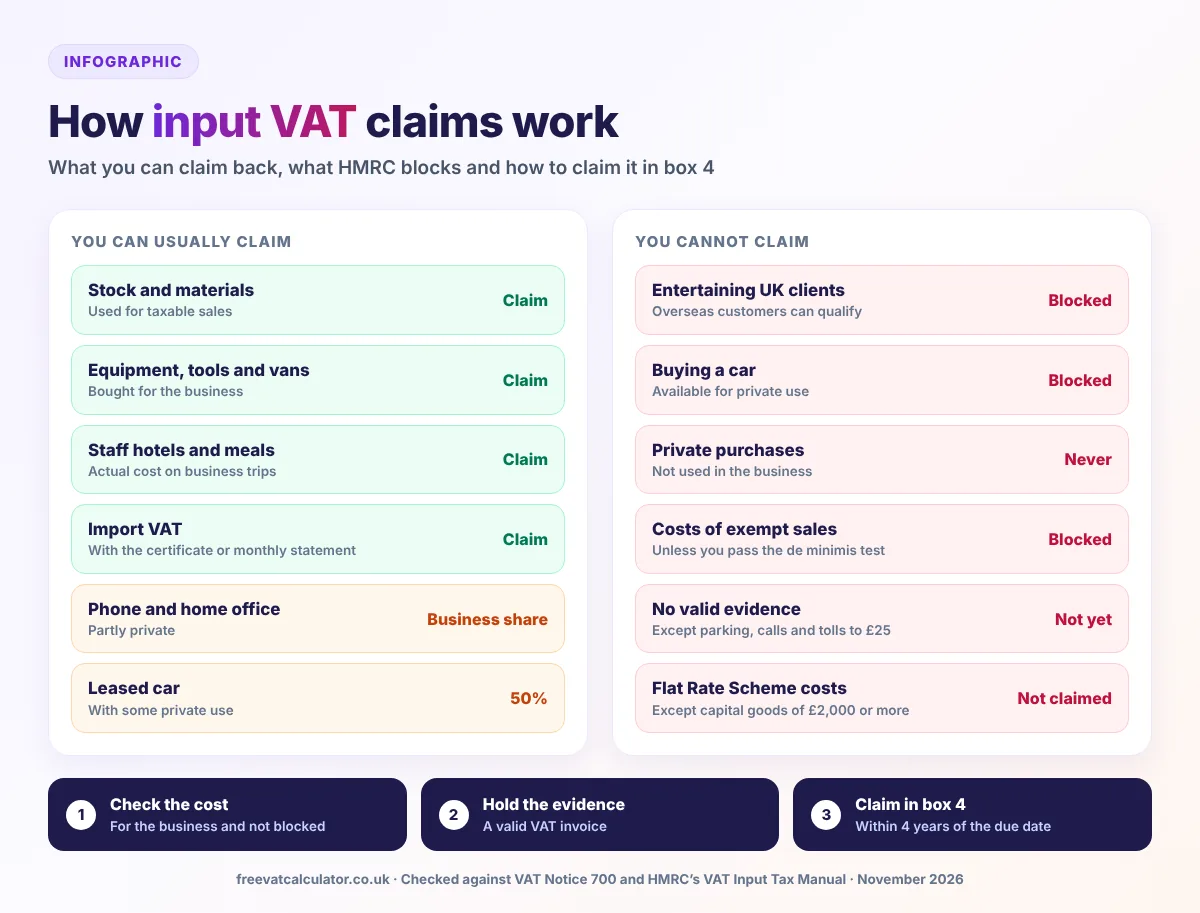
Most everyday business costs qualify if they are used for taxable sales and you hold the invoice. Zero rated sales count as taxable, so a bookshop can reclaim VAT on its costs even though it charges 0% on books.
| Cost | Usual answer | Watch for |
|---|---|---|
| Stock and materials | Claim in full | Goods for exempt sales |
| Equipment, tools and computers | Claim in full | Private use |
| Phone, internet and software | Business share | Home use |
| Accountancy and legal fees | Claim in full | Private matters |
| Premises rent and energy | Claim where VAT is charged | Rent where the landlord has not opted to tax |
| Vans and lorries | Claim, less any private share | Private trips |
| Buying a car | Blocked | Claimable with no private use |
| Leasing a car | Usually 50% | All of it with no private use |
| Staff hotels and meals on trips | Claim in full | Not on flat allowances |
| Entertaining UK clients | Blocked | Overseas customers can qualify |
Staff travel and subsistence
When you pay the actual cost of an employee’s hotel or meal on a business trip, you can reclaim the VAT. A flat rate allowance gives you nothing to claim. Directors and sole traders can claim for their own hotels and meals too, but only when they are away on a business trip.
Imports and services from abroad
Under postponed VAT accounting you show import VAT in box 1 and claim it back in box 4 on the same return, using the monthly statement, so download each one within 6 months, before it is archived. Services bought under the reverse charge work the same way, so a fully taxable business pays nothing extra. From 1 April 2027 the reverse charge applies only to VAT registered customers.
VAT you cannot reclaim
Some VAT can never be claimed back, however good the invoice. HMRC’s list covers these costs.
- Anything bought only for private use
- Costs of exempt sales, unless you are de minimis
- Entertaining clients and other contacts
- Most cars available for private use
- Goods bought under a margin scheme
- A business bought as a going concern
Business entertainment
Article 5 of the Value Added Tax (Input Tax) Order 1992 blocks VAT on hospitality for clients and other contacts. The exception is an overseas customer, where the VAT can be claimed if the hospitality is reasonable in kind and scale. Staff events follow other rules, set out in our guide to VAT on staff entertainment.
Cars, leases and hire
VAT on a car is blocked unless it is not available for private use at all, or is used mainly as a taxi, for driving lessons or for self drive hire. On a lease with some private use you normally claim 50% of the VAT, but hire of no more than 10 days purely for business escapes that block. Repairs and parking stay claimable, as our guide to VAT on cars explains.
Mixed use: claiming only the business share
When a cost is partly private, you claim only the business share. GOV.UK gives two examples: half the VAT on a phone bill if half the calls are personal, and a fifth of the VAT on energy if your home office is a fifth of the floor space. Keep a note of how you worked out each share.
Fuel and claiming VAT on mileage
For fuel with private use you can claim it all and pay the fuel scale charge, claim only business miles from detailed records, or claim nothing. If you choose not to claim on one vehicle, you cannot claim fuel VAT on any vehicle in the business.
You can also claim VAT on mileage allowances paid to employees, but only on the fuel element. Multiply it by one sixth at 20% and keep fuel receipts dated no later than the journeys you claim for.
Exempt sales and partial exemption
VAT on costs of exempt sales, such as insurance, most financial services and residential lettings, cannot normally be claimed. Our guide to VAT exempt and zero rated supplies explains the difference. A business making both kinds of sale is partly exempt and must split its input tax.
Shared overheads are usually split by the share of taxable turnover. You can still claim everything if exempt input tax is no more than £625 a month on average and no more than half of all input tax. Our partial exemption guide covers the year end adjustment.
Evidence: invoices, receipts and records
You need evidence before you claim, usually a valid VAT invoice made out to your business. Without it, HMRC can refuse the claim even when the purchase was genuine.
- £250The most a simplified invoice can cover, including VAT
- £25Parking, calls, tolls and coin machines you can claim without an invoice
- 6 yearsHow long to keep VAT records
Full and simplified VAT invoices
A full invoice shows the supplier’s VAT number, the rate and the VAT charged, as our guide to what a valid VAT invoice must include explains. For supplies of £250 or less including VAT, a simplified invoice is enough.
Small purchases with no invoice
VAT Notice 700 allows a claim without an invoice only for car park charges, phone calls, coin operated machines and tolls paid at the tollbooth, where each costs £25 or less including VAT. Keep the receipt or a note to show it was a business cost.
Missing or wrong invoices
Ask the supplier for a proper invoice first. If you cannot get one, HMRC may accept other evidence where you took reasonable steps and there is no risk of fraud.
Records under Making Tax Digital
Keep invoices, receipts, import statements and your workings for at least 6 years. Making Tax Digital also requires digital records, joined by digital links to the software that files the return.
How to claim VAT back on your VAT return
Claiming input VAT is part of the normal return, not a separate application. Most businesses follow these steps.
- Match each purchase invoice to a payment and save it digitally.
- Remove private use, blocked costs and anything without evidence.
- Split shared costs if you make exempt sales.
- Add reverse charge VAT, postponed import VAT and any bad debt relief, then enter the total in box 4.
- Enter the total value of purchases, leaving out the VAT, in box 7.
- Submit through compatible software within one month and 7 days of the period end.
Claim each cost in the period of the supplier’s tax point if you hold the invoice by then. On the Cash Accounting Scheme you must also have paid. Our guide on how to do a VAT return covers every box.
How far back can you claim VAT?
You have 4 years from the due date of the return for the period in which you first became entitled to the input tax. A purchase in the quarter to 31 March 2023 fell on a return due by 7 May 2023, so the deadline is 7 May 2027.
An invoice that only reached you later is claimed on the return for the period it arrived. Old invoices you held but forgot are errors, which you can fix on your next return if the net total is £10,000 or less, or up to £50,000 and within 1% of box 6. Larger or deliberate errors go to HMRC separately, as our guide to correcting VAT errors explains.
VAT repayments: how long they take and how HMRC checks them
When box 4 is bigger than box 3, HMRC repays the box 5 figure, usually within 30 days. It checks some repayment returns first and will contact you for invoices or explanations, which can take longer. Section 25 of the Value Added Tax Act 1994 also lets HMRC hold a repayment while earlier returns are outstanding.
Repayment interest runs from the day after the later of the due date and the date you filed. The rate is 2.75% until 23 November 2026 and 3% from 24 November 2026.
When you must pay input VAT back
If you have not paid a supplier within 6 months of the supply, or of a later due date, you must repay the input tax, then claim it again in proportion to what you pay. The supplier’s side of this is bad debt relief.
Supplier credit notes reduce your input tax, as our guide to VAT on refunds sets out. Land and buildings of £600,000 or more before VAT, and aircraft and boats of £50,000 or more, fall under the Capital Goods Scheme, which adjusts the claim if taxable use changes.
Common input VAT mistakes
Most HMRC adjustments come from the same few slips. Check for these before you submit.
- Claiming input VAT from a receipt with no VAT number
- Reclaiming VAT on client lunches
- Claiming all the VAT on a car with private use
- Forgetting the private share of phone bills
- Claiming from a quote or a pro forma
- Leaving postponed import VAT out of box 4
Changes ahead for reclaiming VAT, 2027 to 2029
The Autumn Budget on 28 October 2026 left the claim rules unchanged but confirmed changes to how returns work. These are the dates to plan around.
- 1 April 2027: reverse charge only for VAT registered customers
- 1 April 2028: a legal duty to correct errors
- 1 April 2029: electronic invoices between VAT registered businesses
- 1 April 2029: a Direct Debit mandate needed for VAT
Need the VAT out of a gross price?
Our VAT calculator takes the VAT out of any price, so you can check the figure on a receipt before it goes in box 4.
Input VAT FAQs
These are the questions business owners ask most about claiming VAT back. Each answer reflects HMRC guidance in November 2026.
Can I claim VAT back without a VAT invoice?
Usually not, because the invoice is your evidence. The exceptions are parking, phone calls, coin operated machines and tolls of £25 or less, and cases where HMRC accepts other evidence.
Can you claim VAT back on purchases made before registration?
Yes, within limits. Goods you still hold count if bought up to 4 years before registration, and services up to 6 months before.
Can a business claim back VAT on everything it buys?
No. Private use, entertaining, most cars and costs of exempt sales are restricted.
Is VAT recovery different for a sole trader?
The rules are the same. A sole trader simply has more mixed use to split, such as a phone or a room at home.
How long does a VAT reclaim take to be paid?
HMRC usually repays within 30 days. A check can take longer, and repayment interest is added from the day after the later of the due date and the date you filed.
Is recovering VAT possible if all my sales are zero rated?
Yes. Zero rated sales are taxable at 0%, so the business can claim its input tax and often gets a repayment each period.
You now know what input VAT is, which costs qualify, what HMRC blocks and how to claim through box 4 within 4 years. Run any doubtful receipt through the checker before you file and keep its reasons with your records.
Sources: Value Added Tax Act 1994, section 24; Value Added Tax Act 1994, section 25; Value Added Tax Act 1994, Schedule 9 (exemptions); Value Added Tax (Input Tax) Order 1992, article 5; HMRC VAT Input Tax Manual, VIT10100; HMRC VAT Notice 700, sections 10, 11, 12, 16 and 19; GOV.UK, reclaim VAT on business expenses; GOV.UK, keeping VAT records; VAT Notice 700/12; VAT Notice 700/64; VAT Notice 706; VAT Notice 733; VAT Notice 700/45; VAT Notice 700/18; GOV.UK, postponed import VAT statement; VAT Notice 723A; GOV.UK, VAT repayments; HMRC, repayment interest on VAT credits; HMRC interest rates; Revenue and Customs Brief 7 (2026); HMRC, reverse charge reform from 1 April 2027; Budget 2026, overview of tax legislation and rates. This page is general information, not tax advice.