
Receipts and reclaiming VAT
VAT Receipt: What It Must Show, the £250 Rule and What to Do If You Lose One
How to check a receipt before you claim
- Check the sellerIs a VAT number printed?
- Check the detailsDate, items, rate, total
- Check the value£250 or less, or more
- Find the VATOne sixth at 20%
- Keep a copyScan it, keep 6 years
You paid for fuel, parking near a client or a box of printer ink, and all you kept was a card machine slip or a faded till roll. When the return is due, you are left guessing whether that scrap of paper lets you claim the VAT back, or whether HMRC would strike the claim out at a compliance check.
This guide starts with a checker that tells you in seconds whether your receipt is good enough, what is missing and how much VAT sits inside the total. It then sets out what a valid VAT receipt must show under HMRC’s rules, how the £250 limit works, which small costs need no receipt at all, and what to do when the paper is lost or the seller will not hand one over.
VAT receipt checker: can you reclaim the VAT on it?
Enter the total you paid, pick the VAT rate printed on the slip and tick each detail it shows. The checker applies HMRC’s rules for simplified and full VAT invoices, lists anything missing and works out the tax hidden inside a VAT inclusive total.
Receipt checker
Tick what the slip shows to see if the VAT on it can be reclaimed
Good enough to reclaim the VAT
The slip shows everything a simplified VAT invoice needs.
£54.00 includes VAT at 20%, so the VAT is one sixth: £54.00 ÷ 6 = £9.00, leaving £45.00 before VAT.
Based on VAT Notice 700 paragraphs 16.6 and 19.5.9, checked 11 November 2026. HMRC can still ask about any claim, and nothing you enter is stored or sent.
Key facts
- Simplified invoice limit
- £250 or less, including VAT
- Must show
- Seller, VAT number, date, items, rate, total
- No invoice needed
- Car parks, tolls and phone calls up to £25
- VAT inside a 20% total
- One sixth of the price
- Lost receipt
- HMRC may accept other evidence
- Keep receipts
- At least 6 years
What is a VAT receipt?
It is a receipt from a VAT registered seller that carries enough detail to count as a VAT invoice. HMRC’s guidance hardly uses the word receipt at all: VAT Notice 700 calls the same document a simplified or less detailed VAT invoice. In practice, the meaning is a till slip, card voucher or emailed receipt that meets the invoice rules for its value.
Only a business registered for VAT can issue one, because only a registered business can charge VAT. A slip from a trader below the £90,000 threshold who has not registered contains no VAT to reclaim, however detailed it looks.
VAT receipt vs invoice vs an ordinary receipt
An ordinary receipt proves that you paid. A VAT invoice proves that a registered business charged you VAT, and HMRC’s record keeping notice calls it the primary evidence for reclaiming input tax. A receipt that meets the simplified invoice rules does both jobs, so its details matter more than its name.
| Document | What it proves | Can you reclaim VAT with it? |
|---|---|---|
| Full VAT invoice | The supply, the VAT and both parties | Yes, at any value |
| Simplified invoice (a compliant receipt) | The supply and the VAT charged | Yes, for £250 or less including VAT |
| Till receipt with no VAT number | Payment only | No, unless HMRC accepts other evidence |
| Card machine slip | Payment only | Only if the seller has adapted it as an invoice |
| Pro forma invoice | A request for payment | No |
| Bank or card statement | Payment only | No |
| Delivery note | Goods were delivered | No |
Why the receipt matters when you reclaim VAT
Regulation 29 of the VAT Regulations 1995 says you must hold the required invoice at the time you claim the input tax. If you claim without one, HMRC can refuse the amount when it checks your records. The same regulation adds that when an invoice reaches you late, you claim the VAT on the return for the period in which you first hold it.
What a VAT receipt must show
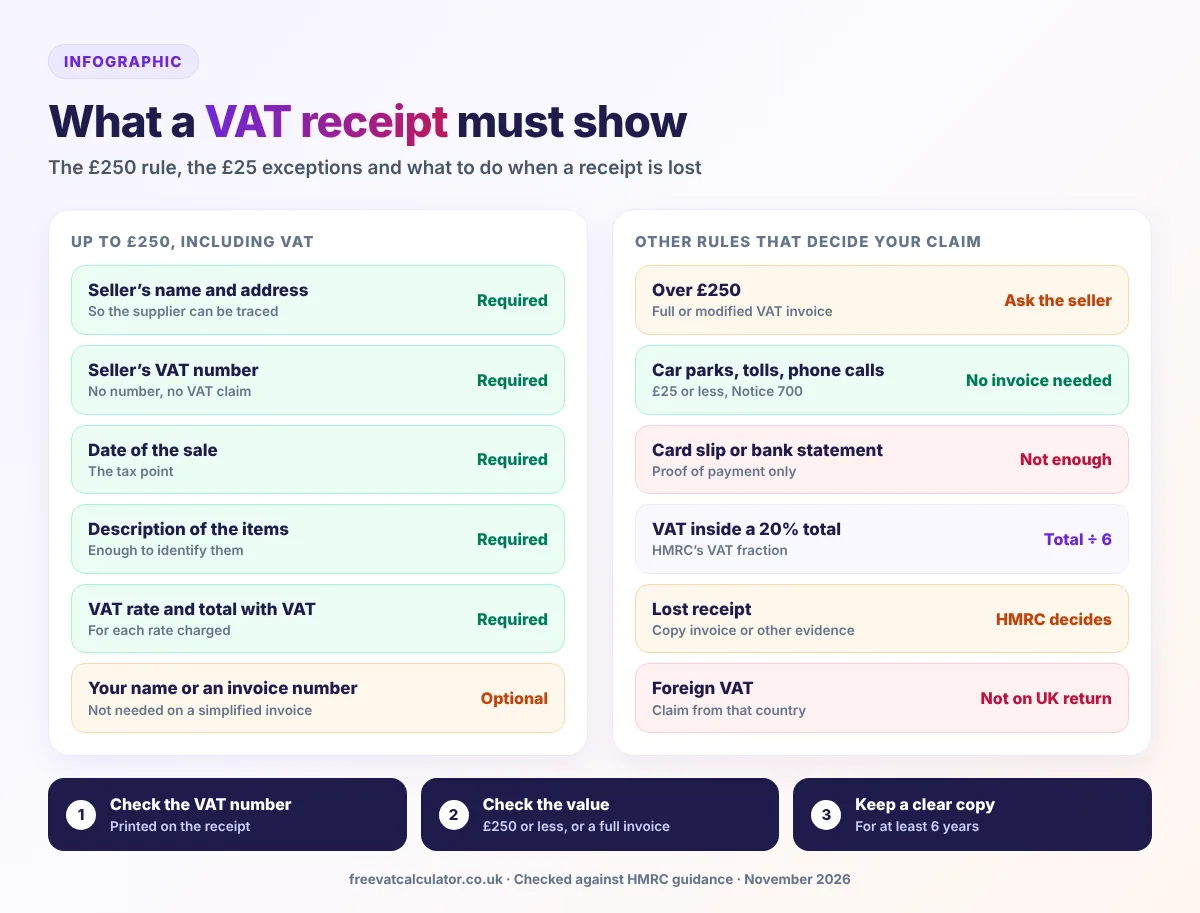
The requirements depend on how much you spent. For £250 or less, a simplified invoice is enough, while above that the seller must give you a full or modified VAT invoice.
| Detail | Simplified invoice, £250 or less | Full VAT invoice, over £250 |
|---|---|---|
| Seller’s name and address | Yes | Yes |
| Seller’s VAT registration number | Yes | Yes |
| Date of the supply (tax point) | Yes | Yes, plus the issue date if different |
| Description of the goods or services | Yes | Yes |
| VAT rate | Yes, for each rate | Yes, for each line |
| Total including VAT | Yes, for each rate | No, the total before VAT instead |
| Unique invoice number | No | Yes |
| Customer’s name and address | No | Yes |
| Quantity, unit price and value before VAT | No | Yes, for each line |
| Total VAT in pounds sterling | No | Yes |
Simplified VAT invoices for £250 or less
Retailers and other sellers can give a simplified VAT invoice when the supply comes to £250 or less. It does not need the buyer’s name, an invoice number or the VAT in pounds, which is why an ordinary till slip can qualify. Exempt items must not appear on it, and where it covers goods at two rates, it shows the rate and the VAT inclusive total for each one.
The £250 limit includes VAT. A £220 order before VAT becomes £264 with VAT at 20%, so it needs a full invoice, even though some online guides wrongly quote the limit before VAT.
Full and modified invoices above £250
Above £250, a retailer that is asked for an invoice must give a full VAT invoice or a modified one showing values including VAT. Every field, with a free template, is in our guide to what a valid VAT invoice must include. A seller may invoice in euros or dollars, but paragraph 16.4 of Notice 700 says the VAT total must be shown in sterling.
Receipts with more than one VAT rate
A supermarket receipt, from Tesco or anywhere else, often mixes standard rated cleaning products with zero rated food. A valid one shows each rate with the VAT inclusive total for that rate, often as a VAT summary at the foot. Zero rated lines carry no VAT, so only the tax inside the other totals can be reclaimed.
How to work out the VAT on a receipt
Most receipts show a total including VAT, so you need the VAT fraction to find the tax inside it. HMRC’s formula is the rate divided by 100 plus the rate, which gives one sixth at 20% and one twenty first at 5%.
A £54.00 receipt at 20% holds £9.00 of VAT, because £54.00 ÷ 6 = £9.00, leaving £45.00 before VAT. Taking 20% of the total gives the wrong answer.
VAT receipt example and template
Here is a sample of a simple VAT receipt for a small purchase, set out as the fields a till would print. Every row except the optional VAT line is a detail HMRC requires, so a slip like this is good enough at £250 or less.
| Field | What the receipt shows |
|---|---|
| Seller | Example Stationers Ltd, 1 High Street, Anytown |
| VAT registration number | 123 4567 89 (an illustration only) |
| Date and time | 19 November 2026, 10:42 |
| Items | 2 printer ink cartridges, 1 ream of A4 paper |
| VAT rate | 20%, marked against each line |
| Total including VAT | £54.00 |
| VAT included (optional) | £9.00 |
Whether you use a till, a spreadsheet or an online receipt generator, the template needs the same fields. For business customers spending over £250, use a full invoice layout instead.
- Print your business name, address and VAT registration number at the top of every VAT receipt.
- Add the date of the sale, and the time if your till records it.
- Describe each item clearly enough to identify it.
- Show the VAT rate for each line, or a code that points to the rate.
- Print the total including VAT for each rate used.
- Keep a copy or the till data for 6 years.
Till receipts, card slips and other documents
The name on a piece of paper matters less than the details printed on it. Here is how HMRC treats the documents businesses keep most often.
Till receipts
A till receipt counts when it carries the seller’s name, address and VAT number, the date, a description, and the rate with the total. Many large retailers print all of this, while small shops and market stalls often print only a total. Cash and carry warehouses can even use till rolls as VAT invoices if they meet the conditions in paragraph 17.2 of Notice 700, which include keeping the rolls for 6 years.
Card machine and contactless slips
The slip from a card terminal only proves payment unless the seller has adapted it. Notice 700 lets a retailer turn the card voucher into a VAT invoice by adding its VAT number, the VAT rate and a description to the name, address, VAT inclusive charge and date already printed. If the seller also hands over a separate receipt, only one of the two can be the VAT invoice.
Documents that never count on their own
Some papers look official but cannot support a claim by themselves. GOV.UK lists pro forma invoices, statements and delivery notes as documents you cannot use to reclaim VAT.
- Pro forma invoices
- Bank and credit card statements
- Delivery notes
- Papers marked “this is not a VAT invoice”
- Slips with no VAT registration number
- Order emails with no VAT details
Receipts for fuel, parking, meals and online orders
Expense claims are where receipts most often go missing or fall short. Each common cost has its own rule, and a few need no receipt at all.
Fuel receipts and mileage claims
A fuel receipt works like any other, and up to £250 it can be a simplified invoice. Above £250, paragraph 17.1 of Notice 700 lets the station print the vehicle registration instead of your name and address, without the litres supplied.
If you pay staff a mileage allowance, the VAT on the fuel element has to be backed by fuel receipts for mileage claims. Notice 700/64 says a receipt dated after the period of the claim cannot support it, so drivers should keep every one. Where a car is also used privately, the fuel scale charge or a mileage split decides what you can claim.
Parking, tolls and phone calls: the £25 rule
Paragraph 19.5.9 of Notice 700 lets you reclaim VAT without any invoice on a few small costs of £25 or less including VAT. They are car park charges, a single or return toll, phone calls from public or private phones, and coin operated machines. HMRC’s employee expenses guidance adds that you should be able to show the supplier is VAT registered.
| Cost | Can you reclaim VAT? | Receipt needed? |
|---|---|---|
| Off street car park, £25 or less | Yes, normally at 20% | No |
| Off street car park, over £25 | Yes, normally at 20% | Yes |
| On street parking meter | No, outside the scope of VAT | Not applicable |
| Single or return toll, £25 or less | Yes, where VAT is charged | No |
| Toll tags, ticket books and accounts | Yes, where VAT is charged | Yes, at any value |
| Parking fine or penalty charge | No, outside the scope of VAT | Not applicable |
Restaurant and hotel receipts
A restaurant receipt works like any other simplified invoice, but what you can reclaim depends on who ate. VAT on entertaining UK clients is blocked under Notice 700/65, while meals for your own staff on a business trip are subsistence, outside the entertainment rules. Our guide to VAT on staff entertainment covers team events.
Online orders from Amazon, eBay, Trainline and Uber
For online orders, the order email is rarely the receipt you need. Amazon Business says business sellers offer downloadable VAT invoices while other sellers must be asked, and eBay lets sellers who opt in post invoices on the order details page.
Trainline issues an expense receipt from Manage My Booking, but it says UK rail and coach fares carry no VAT, so the only VAT on it is on the booking fee, as our guide to VAT on train tickets explains. For a ride booked through an app such as Uber, the same test applies: claim only from a document that shows the seller’s VAT number and the VAT charged. Under a Budget 2026 measure, from January 2028 agents selling taxi and private hire trips above a turnover threshold will be treated as the supplier and charge VAT on the full fare.
No VAT number on a receipt: what to check
A receipt without the seller’s VAT number is not a valid VAT invoice, so you cannot rely on it for a claim. Either the seller is not registered and charged no VAT, or it left the number off and should give you a proper invoice.
Check any number with our UK VAT number checker or HMRC’s service, which shows the name and address it belongs to. A number registered to someone else is a warning sign, and HMRC will not consider other evidence where VAT was not actually due.
Lost VAT receipt: can I claim VAT without a receipt?
Losing a receipt does not always mean losing the VAT, but it moves the decision to HMRC. Start by asking the seller for a copy, which many retailers can reprint from their till records.
Alternative evidence and HMRC’s discretion
Regulation 29(2) lets HMRC accept other evidence, and its manual at VIT31200 says it should normally use that discretion where good alternative evidence exists and there is no sign of abuse. HMRC asks whether you can show the supply, the payment, how the goods were used in the business and how you know the supplier exists. It can refuse where a business offers other evidence as a matter of routine.
- Ask the seller for a copy invoice and keep the request.
- Gather the card statement, order email and delivery note.
- Note what the purchase was for and where it is now.
- Claim once you hold the copy, or ask HMRC to accept the other evidence.
- If the evidence is thin, leave the VAT out and claim it within 4 years if a copy turns up.
A tribunal case on receipts in the wrong name
In Athena Luxe Ltd v HMRC [2025] UKFTT 1507 (TC), a luxury goods exporter claimed VAT on purchases from Harrods and Louis Vuitton. The tribunal found the Harrods invoices valid when read with the till receipts, and while the Louis Vuitton invoices naming staff instead of the company were invalid, HMRC had acted unreasonably in refusing to weigh other evidence. The lesson is to ask for paperwork in the business name at the till.
How to get a VAT receipt when the seller will not give one
Retailers do not have to hand out a VAT invoice with every sale, but Notice 700 says they should give one when a customer asks. If a VAT registered customer asks and the retailer refuses, the retailer can face a penalty.
Ask at the till or by email, give your business name and address for anything over £250, and keep a copy of the request. If the seller still refuses, HMRC may consider alternative evidence once you can show repeated attempts.
Foreign receipts and VAT paid abroad
A receipt from a hotel in Paris or a supplier in Dublin shows foreign VAT, and that does not go on your UK VAT return. HMRC’s guidance says you normally reclaim it from the tax authority in the country that charged it, using that country’s refund process.
Each country sets its own deadlines, and a UK business may be asked for a certificate of status. Businesses established in Northern Ireland can use the EU VAT refund system for goods only, while others use the separate 13th Directive process.
Keeping receipts: digital copies, MTD and the 6 year rule
Paper or digital copies
Notice 700 accepts electronic invoices if their authenticity, integrity and legibility are protected, so an emailed PDF is as good as paper. If a scan of a paper slip keeps every detail HMRC needs, Notice 700/21 says you need not keep the original unless another rule requires it.
Thermal till paper fades, so photograph or scan receipts when you get them. A clear image taken on the day beats a blank slip found at the quarter end.
What Making Tax Digital needs
Under Making Tax Digital, you must record each purchase digitally with its date, value and the VAT you claim, but the receipt itself does not have to be digital. Notice 700/22 lets you record petty cash items under £50 including VAT as one entry, as long as each entry stays at or below £500. Staff claims can go in as the total an employee gives you, but you still need the receipts for expenses behind it.
How long to keep receipts
Keep VAT records, including the receipts you claim from, for at least 6 years. If you use the One Stop Shop scheme, GOV.UK sets the period at 10 years, and records you also need for income tax or corporation tax may have their own limits.
Giving receipts to your own customers
If you are the seller, you do not have to issue a VAT invoice for retail sales to customers who are not VAT registered, unless they ask. When a business customer asks and the sale is £250 or less, a till receipt laid out as a simplified invoice is enough, but exempt items must stay off it. Sales to consumers also sit outside the e invoicing mandate due from 1 April 2029, so till receipts for the public are not affected.
Common VAT receipt mistakes
The same few errors turn up in HMRC guidance and tribunal cases. Check for them before each return.
- Claiming from a card slip with no VAT number
- Using a simplified receipt for a purchase over £250
- Taking 20% of a VAT inclusive total, not one sixth
- Reclaiming VAT on client entertaining
- Putting foreign VAT on the UK return
- Accepting invoices in a staff member’s name
Once a receipt passes these checks, the VAT goes in box 4 of your return. Our guide to reclaiming input VAT explains which costs qualify.
Need to add or remove VAT?
Our main VAT calculator works out the VAT in any price at 20%, 5% or any other rate.
VAT receipt FAQs
These are the questions people ask most about VAT receipts. Each answer follows HMRC’s guidance as it stands in November 2026.
Do I need a VAT receipt to claim VAT back?
Yes, in almost every case you must hold a valid VAT invoice or a simplified invoice before you claim. The exceptions are car parks, tolls, phone calls and coin operated machines costing £25 or less, and cases where HMRC accepts alternative evidence.
What does a VAT receipt need to show?
For £250 or less it needs the seller’s name, address and VAT number, the date, a description, and the VAT rate with the total including VAT for each rate. Above £250 you need a full or modified VAT invoice with more detail.
Is the £250 limit before or after VAT?
It includes VAT. A purchase of £240 before VAT costs £288 with VAT at 20%, so it needs a full or modified invoice.
Can I reclaim VAT from a contactless card slip?
Only if the seller has added its VAT number, the VAT rate and a description to the slip. A plain slip proves payment, not VAT, so ask for the till receipt as well.
How much VAT is in a £100 receipt?
At 20% it is £16.67, because £100 ÷ 6 is £16.666 rounded to the nearest penny. At 5% it is £4.76, since £100 ÷ 21 is £4.7619.
You now know what a receipt must show to support a claim, how the £250 limit works, which small costs need no receipt and what to do when one goes missing. Run your next receipt through the checker at the top before it goes into your return, and the VAT you claim will stand up if HMRC asks.
Sources: HMRC VAT Notice 700; VAT Notice 700/21; VAT Notice 700/22; VAT Notice 700/64; VAT Notice 700/65; HMRC manual VIT31200; VAT Regulations 1995, regulation 29; GOV.UK, Keeping VAT records; GOV.UK, Reclaim VAT on business expenses; HMRC GfC8, employee expenses; GOV.UK, VAT paid in an EU member state; Athena Luxe Ltd v HMRC [2025] UKFTT 1507 (TC); HMRC, VAT on passenger transport through agents; Trainline, expense receipts; Amazon Business, managing VAT invoices; eBay, downloadable VAT invoices. This page is general information, not tax advice.