Payslip and PAYE guide
Tax Code Explained: What 1257L, BR, K and Emergency Codes Mean
How to sort out your code
- Find itApp, payslip or letter
- Read the numberTimes 10 is tax free pay
- Read the lettersL, M, N, T, K, BR, 0T
- CompareWith HMRC’s records
- UpdateOnline or by phone
A payslip arrives with less in it than you expected, and the only clue is a short string such as 1257L, BR or K475 M1 printed next to your name. HMRC chooses that string and your employer simply follows it, so a wrong one can take hundreds of pounds from your pay before anyone notices.
The decoder below reads any code, including Scottish and Welsh versions and emergency endings, and tells you if yours looks right for your situation. The guide then walks through every part of a tax code, why HMRC changes it and how to get a wrong one fixed.
Tax code decoder: check what your code means
Type your code exactly as it appears, with any letters before or after the number. The decoder compares it with where you live, which job it is for and your income, then flags anything worth raising with HMRC.
Tax code decoder
Type the code from your payslip, P60 or HMRC letter to see what it means
Or try an example
| Part | What it means |
|---|---|
| Read as | 1257L |
| 1257 | Tax free pay of £12,570 for the year from this job or pension (the number times 10) |
| L | You get the standard tax free Personal Allowance |
| No ending | Cumulative basis: tax is worked out on your pay for the year so far |
Looks right
This is the standard code for 2026 to 2027, with the full £12,570 allowance. It fits one job or pension, no taxable benefits and income under £100,000.
What to do
Nothing to do now. Check again whenever your job, pay, benefits or home change.
Based on GOV.UK guidance for 2026 to 2027, while your coding notice shows how your own code was built. Nothing you type is stored or sent.
Key facts
- Standard code for 2026 to 2027
- 1257L, giving £12,570 tax free
- Scotland and Wales
- S1257L and C1257L
- Emergency endings
- W1, M1, X or NONCUM
- K code limit
- No more than half your pay in tax
- HMRC update time
- Within 15 working days
- Personal Allowance
- £12,570, fixed until 5 April 2031
What a PAYE code is and who gets one
Your code tells an employer or pension provider how much income tax to take from each payment under Pay As You Earn (PAYE). HMRC builds it from what it knows about you, so it is only as accurate as that information.
You get a separate code for every job and every workplace or private pension. Under the standard code for 2026 to 2027, tax starts once pay passes £242 a week or £1,048 a month, the threshold in HMRC’s P9X notice to employers.
Who does not have one
Self employment profit has no code because it is taxed through Self Assessment, which our self employed tax calculator works out. The State Pension is paid with no tax taken off, so HMRC collects tax on it through the code on another pension or job, or by a Simple Assessment bill if it is your only income.
Where to find your code
The fastest answer to “what is my code?” is HMRC’s Check your Income Tax service or the free HMRC app. Both show the code each employer or pension provider uses now, codes for earlier years and an option to get an email when yours changes.
- Your payslip, usually beside your National Insurance number
- The HMRC app or your HMRC online account
- A Tax Code Notice letter (form P2) from HMRC
- Your P60 after the year ends, or your P45 when you leave
How to read a code: the number and the letters
Most codes are a number followed by a letter. The number is the tax free pay that job gives you for the year with the last digit dropped, and the letter describes your situation.
What the numbers mean
HMRC starts with the £12,570 Personal Allowance, takes off anything it must tax through your pay and drops the final digit. GOV.UK’s own example is a £1,570 medical insurance benefit, which leaves £11,000 tax free and the code 1100L, while additions such as job expenses relief push the number up.
What the letters mean
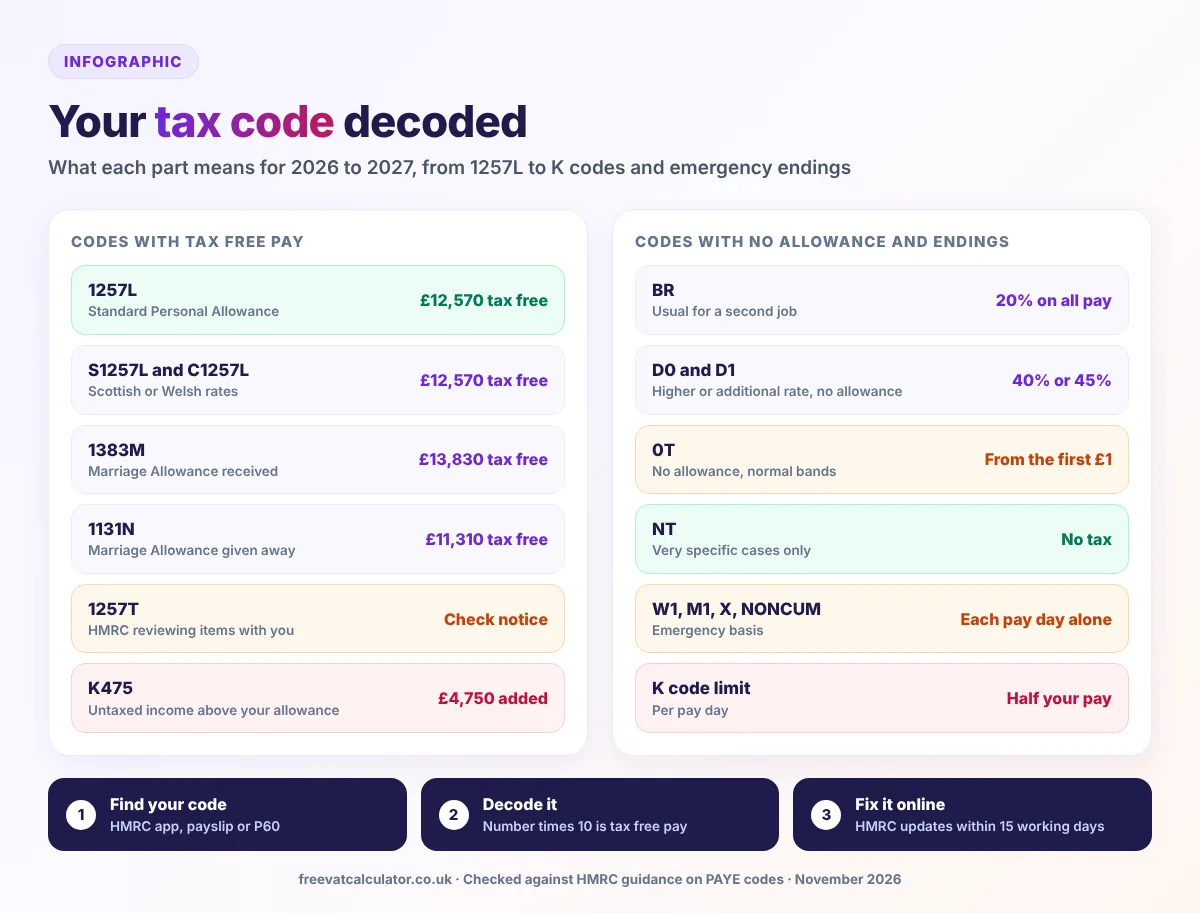
A letter after the number changes how the allowance works, and letters alone replace the number. The table follows HMRC’s official guide and its employer version.
| Letters | Meaning | Example |
|---|---|---|
| L | The standard tax free Personal Allowance | 1257L |
| M | You receive 10% of your partner’s allowance | 1383M |
| N | You passed 10% of your allowance to your partner | 1131N |
| T | Other calculations included, or HMRC needs to review items | 1257T |
| K | Untaxed income or deductions bigger than your allowance | K475 |
| 0T | No allowance, normal bands still apply | 0T |
| BR, D0, D1 | Every pound taxed at 20%, 40% or 45% | BR |
| NT | No tax taken from this income | NT |
| S or C in front | Scottish or Welsh rates apply | S1257L, C1257L |
| W1, M1, X, NONCUM after | Emergency basis | 1257L M1 |
1257L meaning: the standard code for 2026 to 2027
1257L gives the full £12,570 allowance with nothing added or taken off, and it suits most people with one job or pension. The government has fixed the allowance until 5 April 2031, so 1257L stays the normal starting point for years.
- £12,570Tax free pay for the year
- £1,048Roughly tax free each month
- £242Roughly tax free each week
Is 1257L right for you?
- This is your only or main job or pension
- Your total income is under £100,000
- You get no taxable perks such as a company car
- You owe no old tax and claim no job expenses
- You live in England or Northern Ireland (S1257L in Scotland, C1257L in Wales)
Codes just above or below 1257L
A small difference usually has a simple cause, and your coding notice lists every item behind it. The £60 flat rate uniform allowance for jobs not on HMRC’s list lifts the code to 1263L, while a few points lower often means a small benefit or untaxed interest.
BR, D0, D1, 0T and NT: codes with no tax free pay
These codes have no number because they give no allowance. They mostly appear on second jobs and pensions, where your allowance has gone to your main income.
BR meaning
BR takes 20% from every pound of that pay and is the usual code for a second job. HMRC’s starter checklist also tells employers to use it when a new starter ticks Statement C.
BR on your only job almost always means overpaying, because it ignores your allowance. Within the basic rate band that costs up to £2,514 a year, which is £12,570 at 20%.
D0 and D1
D0 takes 40% from every pound and D1 takes 45%, for a second income sitting wholly in the higher or additional rate band. GOV.UK’s guide to more than one job names these, with BR, as the usual codes for other jobs.
0T meaning, often written OT
0T gives no allowance but still uses the normal bands, so tax starts at 20% on the first pound. It appears when your allowance is used up, when income passes £125,140, or when a new employer lacks your details, and HMRC’s PAYE manual sets 0T on a week 1 or month 1 basis if a starter checklist is left unsigned.
NT meaning
NT means no tax is taken from that income. HMRC’s employer guidance keeps it for very specific cases, such as musicians treated as self employed and outside PAYE.
K codes: when you owe more than your allowance
A K before the number means HMRC must collect tax on more than your allowance covers, such as a company car, the State Pension or tax owed from an earlier year. The number times ten is added to your taxable pay, so K475 adds £4,750 a year.
However large the K number, no employer or pension provider can take more than half of your pay before tax on any pay day, says GOV.UK. The limit applies per pay day, so a bonus month can still carry a large deduction.
Emergency codes: what W1, M1 and X mean
An emergency ending taxes each pay period on its own, as though you earn that amount every week or month, ignoring your pay for the year so far. W1 is for weekly pay, M1 for monthly and X where pay dates vary, and some payslips print NONCUM or W1 M1.
It usually appears after you start a job without a P45, or when company benefits or a State Pension begin. For 2026 to 2027 the emergency code is 1257L, so a new starter often sees 1257L W1 or 1257L M1.
Which code a new employer starts you on
Without a P45, your employer picks the starting code from the statement you tick on the starter checklist. The current form is dated December 2025.
| Statement | Your situation since 6 April | Starting code |
|---|---|---|
| A | First job, no taxable benefits | 1257L, cumulative |
| B | Only job now, but another job or benefits earlier | 1257L, week 1 or month 1 |
| C | Another job, or a State, workplace or private pension | BR |
| None ticked | Checklist left unsigned | 0T, week 1 or month 1 |
How long an emergency code lasts
HMRC usually sends a proper code within 35 days of a new job, and handing over your P45 helps, after which overpaid emergency tax comes back through your wages. Codes linked to new benefits or a State Pension can last until 5 April, but employers must not carry a week 1 or month 1 marking into the new year.
Scottish and Welsh codes: the S and C prefixes
An S at the start means Scottish rates because your main home is in Scotland, and a C means Welsh rates. The prefix follows your home, not your employer, so someone living in Dumfries and working in Carlisle still has an S.
| Rate on every pound | England and NI | Wales | Scotland |
|---|---|---|---|
| Basic 20% | BR | CBR | SBR |
| Intermediate 21% | None | None | SD0 |
| Higher 40%, 42% in Scotland | D0 | CD0 | SD1 |
| Additional or advanced 45% | D1 | CD1 | SD2 |
| Top 48% | None | None | SD3 |
| No allowance, normal bands | 0T | C0T | S0T |
S codes such as S1257L use six Scottish bands: 19% from £12,571, 20% from £16,538, 21% from £29,527, 42% from £43,663, 45% from £75,001 and 48% over £125,140. Savings and dividends still use UK rates, which our dividend tax calculator applies.
Welsh rates for 2026 to 2027 are 20%, 40% and 45%, the same as England, so a C changes nothing this year. You pay them if you live in Wales longer than anywhere else in the UK during the year, and a move is backdated to 6 April.
Marriage Allowance codes: M and N
Marriage Allowance lets a spouse or civil partner with income below £12,570 pass £1,260 of allowance to a basic rate partner, cutting that partner’s tax by up to £252. The receiver’s code becomes 1383M and the giver’s 1131N, if nothing else changes.
In Scotland the receiver can pay the starter, basic or intermediate rate, so income up to £43,662. Claims can be backdated to 6 April 2022.
Why your code changed
HMRC reworks your code whenever the tax you owe for the year seems to have moved, and GOV.UK lists the usual triggers. Changing jobs is the familiar one, but many happen without you doing anything.
- A new job, or an extra job or pension
- Taxable state benefits or a new State Pension amount
- Company benefits starting or stopping
- Savings interest above your Personal Savings Allowance
- Claiming Marriage Allowance or job expenses relief
- The High Income Child Benefit Charge paid through wages
- Repaying a Winter Fuel Payment on income over £35,000
- Tax owed from an earlier year
Why a code can drop sharply mid year
Since July 2017 HMRC has set a revised code for the whole year and added an in year adjustment to collect any shortfall over the remaining pay days, its PAYE manual explains. So a benefit reported in October can push the number far lower than its yearly value suggests.
Self Assessment bills and income over £100,000
Owe less than £3,000 on a Self Assessment return filed online by 30 December, and HMRC collects it through your code over 12 months of the next tax year unless you opt out, as our Self Assessment deadline guide explains. Above £100,000 your allowance falls by £1 for every £2 and is gone at £125,140, so HMRC lowers the number or uses a T code.
How to check my code is right
Checking takes about five minutes. Sign in to HMRC’s online service or app, then run through these points.
- The tax code on your payslip matches your HMRC account
- Every job and pension listed is one you really have
- Any benefit shown matches what you get
- Estimated income for the year looks close
- Your address puts you in the right part of the UK
- No emergency ending remains weeks after a new job
Use the decoder above as a quick tax code checker, then confirm the detail with HMRC’s figures. Its online service also shows the tax it expects for the year, to compare with your payslips.
Wrong or incorrect code? How to change it
Most wrong codes come from out of date information at HMRC, not payroll errors. Your employer chooses only a starting code and must then use the one HMRC sends, so the fix has to come from HMRC.
- Sign in to Check your Income Tax or the HMRC app and review your jobs, pensions, benefits and estimated income.
- Update anything wrong or missing, and claim job expenses there.
- After starting a job, give the employer your P45 and wait 35 days before contacting HMRC.
- If you cannot go online, phone the Income Tax helpline on 0300 200 3300, listed in our contact HMRC guide.
- Expect the new code within 15 working days, on the next or following monthly payslip or the third weekly one.
If you have paid too much or too little
An overpayment usually comes back through your pay once the new code arrives, and HMRC’s end of year letters go out from June to the following March, as our HMRC tax refund guide explains. A shortfall is normally collected through a lower code, or by a Simple Assessment bill if you owe more than £3,000.
Two jobs, or a job and a pension
Your allowance normally goes to the job that pays most, and other jobs or pensions get BR, D0 or D1. If the main job pays under £12,570, you can ask HMRC whether the allowance can be split.
GOV.UK’s example is £8,000 from one job and £7,000 from another: moving £4,570 of allowance to the second leaves £2,430 taxed, which is £486. Without a split, BR on the £7,000 job would take £1,400, and you would wait until after 5 April for the £914 difference.
Codes for students and pensioners
There is no special student code. A student whose holiday job is their first since 6 April ticks Statement A and gets 1257L on the normal basis, so pay below the allowance usually has no tax taken.
The full new State Pension is £241.30 a week for 2026 to 2027, or £12,547.60 a year, which uses almost the whole allowance. Tax on it is taken through the code on one workplace or private pension, which is often why that code is tiny or starts with K.
Does your code affect National Insurance?
No, your code only controls income tax. For 2026 to 2027 employees pay National Insurance of 8% on pay from £242 to £967 a week, and 2% above, worked out on each pay day separately, so an emergency code never changes it.
Your code for 2027 to 2028: what to expect
HMRC runs its annual coding review in January, and new codes apply from 6 April 2027. The allowance stays at £12,570, so 1257L remains standard, and the PAYE manual says no notice is sent when the only change is a Budget change to allowances.
Three changes follow from the Budget of 28 October 2026. Subject to the next Finance Bill, company cars, vans, fuel and medical cover are due to be taxed through payroll from 6 April 2027 instead of through your code, with most other benefits following from 6 April 2028. The same bill would create a Pension Tax Allowance for the three tax years from 6 April 2027, so pensioners whose total income is no more than the full new State Pension would pay no income tax. From April 2028 larger job expense claims should be able to go through PAYE too.
Need HMRC on the phone?
Our contact HMRC guide lists the Income Tax helpline, the overseas number and the opening hours.
Tax code FAQs
These are the questions people ask most after looking at a payslip. Each answer uses the 2026 to 2027 rules.
What does 1257L M1 mean?
It is the standard allowance on a month 1 emergency basis, so each month is taxed alone with about £1,048 tax free. It normally changes within 35 days of starting a job.
What does my code mean if it ends in X?
X is an emergency ending used where pay dates vary, so each payment is taxed on its own. Like W1 and M1, it should go once HMRC sends a full code.
Where can I find my code without a payslip?
The HMRC app and the Check your Income Tax service show the current code for every job and pension. A P60, P45 or Tax Code Notice letter shows it too.
What phone number do I call about a wrong code?
The Income Tax helpline is 0300 200 3300, Monday to Friday, 8am to 6pm. Have your National Insurance number and a recent payslip ready.
You now know what each part of your code means, how to check it against HMRC’s records and how to get a wrong one changed. Run it through the decoder whenever your job, benefits or home change, and you will catch a mistake before it costs you.
Sources: PAYE codes; numbers and letters; emergency codes; K codes; why codes change; employer letters guide; P9X 2026; starter checklist; PAYE61030; PAYE11120; PAYE13005; income tax rates; Scottish income tax; Welsh income tax; 2031 freeze; Marriage Allowance; more than one job; Self Assessment through PAYE; underpayments; Check your Income Tax; new State Pension; National Insurance; uniform relief; Winter Fuel Payment; Budget 2026 overview. This page is general information, not tax advice.