
Capital gains tax tool
Capital Gains Tax Calculator 2026 to 2027: Property, Shares and Business Assets
How capital gains tax is worked out
- Find the gainSale minus cost and fees
- Take off reliefsSuch as relief on a former home
- Deduct lossesThis year first, then older ones
- Use the allowance£3,000 tax free
- Apply the rate18% or 24% by income
You have sold a buy to let flat, a block of shares or your stake in a business, and the price looked good until you remembered that part of the profit belongs to HMRC. The rates were reset in 2024, the relief rate for business sales has risen twice since, the tax free allowance has shrunk to £3,000, and a sale of UK property gives you only 60 days to report and pay.
This page works out the real figure from your own numbers, including Private Residence Relief, losses and Business Asset Disposal Relief, and then explains every rule behind it. Enter your sale in the capital gains tax calculator below and you will see the gain, the tax at 18% and 24%, your deadline and the full working.
Capital gains tax calculator for 2026 to 2027
The results update as you type. Choose the tax year of the sale, which runs from 6 April to 5 April, and the type of asset, because that decides which reliefs and deadlines apply.
Capital gains tax calculator
Your gain, reliefs, the 18% and 24% split and the deadline to pay
| Step | Amount | Tax |
|---|---|---|
| Sale price | £300,000.00 | |
| Less what you paid | £200,000.00 | |
| Less costs | £8,000.00 | |
| Gain | £92,000.00 | |
| Less annual exempt amount | £3,000.00 | |
| Taxable gain | £89,000.00 | |
| Taxed at 18% | £10,270.00 | £1,848.60 |
| Taxed at 24% | £78,730.00 | £18,895.20 |
| Capital gains tax | £20,743.80 |
Report and pay within 60 days
As a UK resident, report this sale and pay £20,743.80 within 60 days of completion through a Capital Gains Tax on UK property account. If you are in Self Assessment, also include it on your 2026 to 2027 return, due by 31 January 2028.
Reliefs and losses
The working
Gain: £300,000.00 sale minus £200,000.00 paid and £8,000.00 of costs is £92,000.00. After the £3,000.00 annual exempt amount, £89,000.00 is taxable. Your income of £40,000.00 leaves £10,270.00 of the basic rate band after the personal allowance, so £10,270.00 at 18% is £1,848.60 and £78,730.00 at 24% is £18,895.20. Capital gains tax is £20,743.80, or 22.5% of the gain.
An estimate for a UK resident individual selling one asset, counting Private Residence Relief in whole months. Nothing you enter is stored or sent.
How to use the capital gains tax calculator
Enter the sale price, what you paid and the costs of buying, selling and improving the asset. For a former home, give the months you lived there before the final 9 months, and the calculator adds those 9 for you. Your income matters because gains share the £37,700 basic rate band with it.
What it assumes and leaves out
It assumes a UK resident individual selling one asset, and like any capital gains calculator it is only as good as the figures you enter. It counts Private Residence Relief in whole months, while HMRC works in days, and leaves out Lettings Relief, Founders’ Relief and trusts.
Key facts
- Rates on gains
- 18% inside the basic rate band, 24% above
- Annual exempt amount
- £3,000 for 2026 to 2027 and 2027 to 2028
- Business Asset Disposal Relief
- 18%, £1 million lifetime limit
- From 6 April 2027
- Relief limit falls to £500,000
- UK residential property
- Report and pay within 60 days of completion
- Other gains made in 2026 to 2027
- Tax due by 31 January 2028
What capital gains tax is and who pays it
Capital gains tax is charged on the profit when you dispose of an asset that has grown in value, not on the whole price. GOV.UK’s example is a painting bought for £5,000 and sold for £25,000, where only the £20,000 gain is taxed.
Giving an asset away, swapping it or paying for something with crypto also counts as a disposal. UK residents pay on gains above the annual allowance, while people living abroad pay on UK land and property.
Assets you pay it on, and assets that are tax free
- Property that is not your main home
- Shares and funds held outside an ISA or PEP
- Business assets and cryptoassets
- Possessions sold for £6,000 or more, other than your car
Gains inside an ISA or PEP, UK government gilts, Premium Bonds and betting, lottery or pools winnings are tax free. Since 6 April 2026 carried interest has also left the regime and is taxed as income instead.
How capital gains tax is worked out
Every calculation follows the same order, shown step by step in the calculator’s working box. Losses and the allowance come off before any rate is applied.
- Take the sale price, or market value for a gift, minus what you paid and your allowable costs.
- Take off any relief, such as Private Residence Relief on a former home.
- Deduct losses from the same tax year, then older losses if the gain is still above £3,000.
- Deduct the £3,000 annual exempt amount.
- Stack the rest on your taxable income: 18% inside the £37,700 basic rate band, 24% above it.
Costs you can deduct
You can deduct solicitors’ and estate agents’ fees and the cost of improvements such as an extension. Section 38 of the Taxation of Chargeable Gains Act 1992 also allows stamp duty land tax, surveyor and valuer fees and advertising to find a buyer, but normal maintenance such as decorating does not count.
When market value replaces the price
If you give an asset away, or sell it cheaply to help the buyer, you use its market value instead of the price. Assets owned since before April 1982 use their value on 31 March 1982 as the cost.
Capital gains tax rates for 2026 to 2027
Since 30 October 2024 the same two rates apply to residential property and almost everything else. What sets your rate is not the asset but how much of your basic rate band your income has already used.
| Type of gain | Inside your basic rate band | Above it |
|---|---|---|
| Residential property that is not your main home | 18% | 24% |
| Shares, funds, crypto, land and possessions | 18% | 24% |
| Business Asset Disposal Relief or Investors’ Relief | 18% | 18% |
| Trustees and personal representatives | 24% | 24% |
How the rates have changed since 2023
Rates rose in stages after the October 2024 Budget, and the relief rate moved from 10% to 14% to 18%. The history matters if you still have an earlier return to amend.
| Tax year | Main rates | Relief rate | Allowance |
|---|---|---|---|
| 2023 to 2024 | 10% and 20%; property 18% and 28% | 10% | £6,000 |
| 2024 to 2025 | 18% and 24% from 30 October 2024 | 10% | £3,000 |
| 2025 to 2026 | 18% and 24% | 14% | £3,000 |
| 2026 to 2027 | 18% and 24% | 18% | £3,000 |
| 2027 to 2028 | 18% and 24% | 18%; £500,000 limit for Business Asset Disposal Relief | £3,000 |
How your income decides between 18% and 24%
Your gains sit on top of your taxable income, which is your income minus the £12,570 personal allowance. Whatever is left of the £37,700 basic rate band is charged at 18%, and the rest of the gain at 24%.
- £37,700Basic rate band shared by income and gains
- 18%Rate on gains inside the band
- 24%Rate on gains above it
GOV.UK’s own example uses taxable income of £20,000 and a gain of £52,600. After the £3,000 allowance, £17,700 fits in the band at 18% and £31,900 is charged at 24%, a total of £10,842.
| Income before tax | Band left | At 18% | At 24% | Tax |
|---|---|---|---|---|
| £12,570 | £37,700 | £17,000 | £0 | £3,060.00 |
| £30,000 | £20,270 | £17,000 | £0 | £3,060.00 |
| £45,000 | £5,270 | £5,270 | £11,730 | £3,763.80 |
| £60,000 | £0 | £0 | £17,000 | £4,080.00 |
Unused personal allowance cannot be set against gains, so someone with no income still pays 18% on gains above £3,000. The allowance itself comes off the gains taxed at 24% first, which gives the lowest bill.
Capital gains tax in Scotland and Wales
Scottish taxpayers pay income tax at Scottish rates, but their gains use the UK band. HMRC’s Capital Gains Manual works out the unused band as if the person were not a Scottish or Welsh taxpayer, so the calculator works the same way in Scotland.
Pension contributions and Gift Aid widen the band
Personal pension contributions under relief at source, and Gift Aid donations, extend your basic rate band by their gross amount. A £400 Gift Aid gift extends it by £500, which can move £500 of gain from 24% to 18% and save £30.
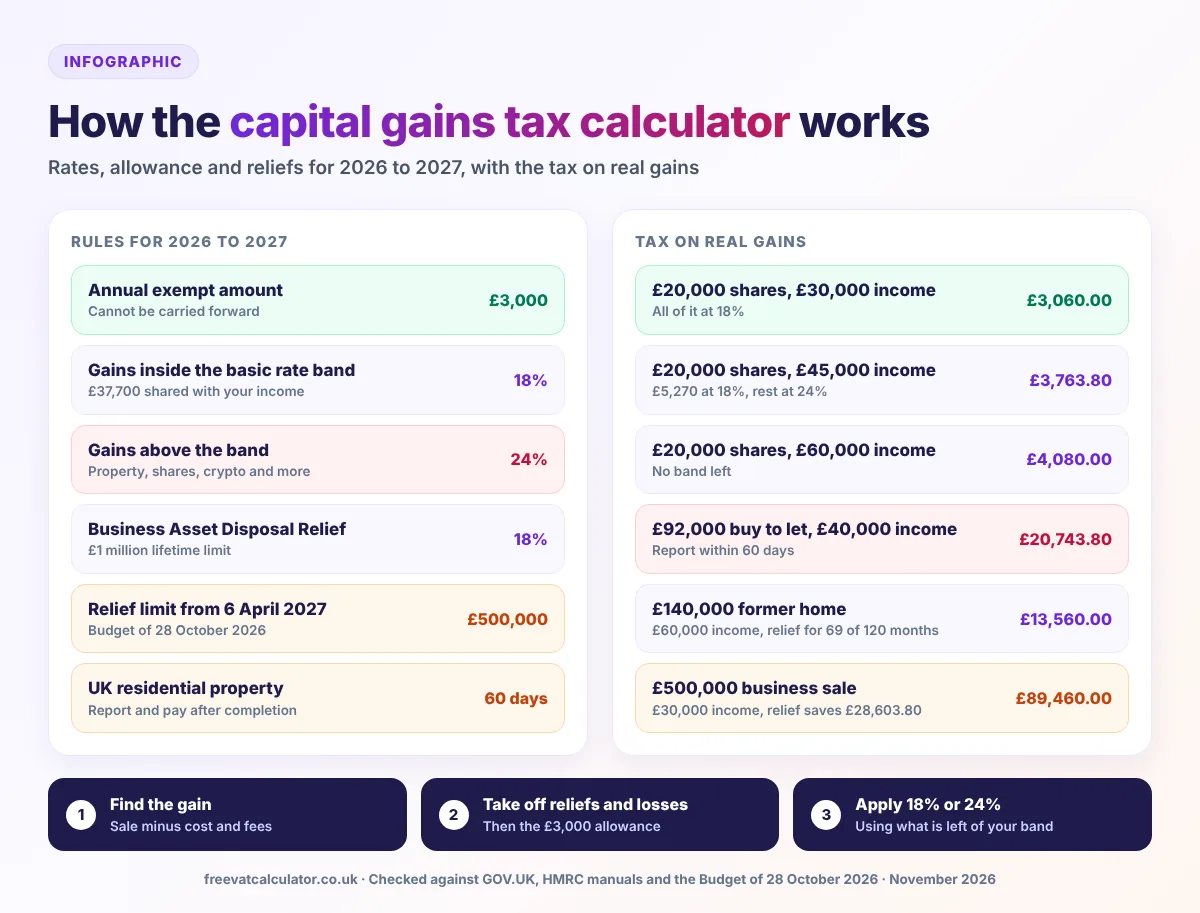
Capital gains tax allowance for 2026 to 2027
The capital gains tax allowance, officially the annual exempt amount, is £3,000 per person, and the Budget keeps it there for 2027 to 2028. It was £12,300 as recently as 2022 to 2023, which is why many people now pay this tax for the first time.
| Tax year | Individuals | Most trustees |
|---|---|---|
| 2022 to 2023 | £12,300 | £6,150 |
| 2023 to 2024 | £6,000 | £3,000 |
| 2024 to 2025 onwards | £3,000 | £1,500 |
Any part you do not use is lost on 5 April, because the allowance cannot be carried forward. If you are registered for Self Assessment and your sale proceeds for the year are over £50,000, you must report the disposals even when no tax is due.
Capital gains tax on property
Your main home is normally tax free, but a second home, a buy to let or a former home you have let out is not. Choosing UK residential property turns this page into a property capital gains tax calculator that adds Private Residence Relief and the 60 day deadline.
Second homes and buy to let property
On a sale of property like this, the gain is usually large enough to push most of it into the 24% band. A £92,000 gain on £40,000 of income is £10,270 at 18% and £78,730 at 24%, a bill of £20,743.80.
Joint owners each work out the gain on their own share and use their own allowance and band. Two owners therefore usually pay less in total than one.
Private Residence Relief on a home you lived in
Private Residence Relief removes the gain for the time a property was your only or main home, and the last 9 months always count if it was ever your main home. It is automatic only if you did not let it out or use part only for business, and the grounds are under 5,000 square metres.
Say you owned a flat for 120 months, lived in it for the first 60 and then let it. Relief covers 69 of the 120 months, so on a £140,000 gain £80,500 is exempt and £59,500 is chargeable.
Some absences still count, such as up to 3 years for any reason or any period working abroad, if you lived there before and after. Disabled people and those in long term care who own one home get the last 36 months instead of 9.
Lettings Relief
Lettings Relief now applies only if you lived in the home with your tenant, and it is the lowest of your Private Residence Relief, £40,000 and the gain on the let part. In GOV.UK’s example a let bedroom is 10% of a home with a £75,000 gain, so the reliefs cover £67,500 and £7,500.
Capital gains tax on inherited property
You do not usually owe tax at the moment you inherit, but you may when you sell. Your starting value is the property’s value when the person died, normally the figure used for Inheritance Tax, so only growth since then is taxed.
Property owned through a limited company
A company pays corporation tax on its gains instead, with no £3,000 allowance: 19% if its profits are £50,000 or less, 25% above £250,000, and a rate tapered by marginal relief in between. Our corporation tax calculator shows that bill, and our sole trader or limited company comparison weighs up the two routes.
Capital gains tax on shares and crypto
Shares and funds outside an ISA or PEP are taxed when you sell, give away or swap them, but employer Share Incentive Plan shares are not. For your own company, our dividend tax calculator covers the income you take out and this page covers the sale.
How HMRC matches shares you buy and sell
HMRC matches a sale first with shares bought the same day, then with shares bought in the next 30 days, and only then with your section 104 pool. The pool cost is an average, so selling a quarter of the pooled shares uses a quarter of the cost, as helpsheet HS284 shows.
Cryptoassets
Selling tokens, swapping one for another, paying with them or giving them away can all create a gain. Each type of token has its own pool with the same matching rules as shares, and HMRC says exchange reports will not track your pooled cost, so keep your own records in pounds.
Personal possessions and other assets
Possessions such as jewellery, paintings or antiques are taxed only if sold for £6,000 or more, and items with a limited lifespan, such as a clock, are tax free. Land and commercial property fall under the other assets option and are reported like shares, not within 60 days.
Business Asset Disposal Relief and the lifetime limit
Business Asset Disposal Relief charges 18% on qualifying gains from 6 April 2026, up from 14% in 2025 to 2026. You can claim it on up to £1 million of gains over your lifetime, and the Budget cuts that to £500,000 for disposals from 6 April 2027.
With the rate now equal to the lower main rate, the relief only saves tax on gains that would otherwise fall in the 24% band. On a £500,000 gain with £30,000 of income, the capital gains tax calculator shows £89,460 with the relief against £118,063.80 without it.
Who qualifies
Sole traders and partners need to have owned the business for at least 2 years. For shares, you need 2 years as an employee or office holder of a trading company with at least 5% of the shares and votes, and for a 2025 to 2026 sale the claim deadline is 31 January 2028.
How the relief uses your basic rate band
Gains that qualify for the relief use your basic rate band before any other gains. In 2025 to 2026, with the relief at 14%, this can push a second gain from 18% into 24%, and the calculator follows the same order.
The £500,000 limit from 6 April 2027
From 6 April 2027 the lifetime limit halves, and relief already claimed counts towards it, with special provisions for contracts entered into before that date. Choose 2027 to 2028 in the capital gains tax calculator: an £800,000 business gain with £60,000 of income then costs £161,280, because only £500,000 gets the relief.
Founders’ Relief and Investors’ Relief
The Budget announced Founders’ Relief, a 10% rate on up to £10 million of lifetime gains from 6 April 2027, for founders who held 25% of the shares when trading began. HMRC expects about 600 people a year to use it, and its consultation closes on 30 November 2026. Investors’ Relief, for external investors, keeps its 18% rate and £1 million limit.
Using capital losses to cut the bill
A loss is deducted from your gains in the same tax year, even if that takes them below £3,000 and wastes part of the allowance. You must claim it within 4 years of the end of the tax year, so a loss on a 2026 to 2027 sale must be claimed by 5 April 2031.
Losses from earlier years are used only to bring this year’s gains down to £3,000. With a £20,000 gain, a £5,000 loss this year and £15,000 of older losses, you use £12,000 of the older losses, pay no tax and keep £3,000 for later.
A loss on a sale to a family member only counts against gains from that same person. Shares that become worthless can be claimed as a loss through a negligible value claim.
Spouses, civil partners and gifts
You pay no capital gains tax on assets you give or sell to your husband, wife or civil partner while you live together. If you separate, the same applies for up to 3 tax years after the year you split up, and to transfers made under a divorce agreement or court order. Their later gain runs from your original cost, so moving shares to a partner with no income could put up to £37,700 more at 18%, saving up to £2,262.
Gifts to charity are tax free, but a gift to anyone else counts as a disposal at market value. Gift hold over relief can postpone the gain on business assets, and the Budget updates its rules from 6 April 2027.
How much capital gains tax will I pay? Worked examples
These results use 2026 to 2027 rates unless stated. Each assumes the full allowance and no losses.
| Sale | Gain | Income | Tax |
|---|---|---|---|
| Shares | £20,000 | £30,000 | £3,060.00 |
| Shares | £20,000 | £45,000 | £3,763.80 |
| Buy to let flat | £92,000 | £40,000 | £20,743.80 |
| Former home, lived in 60 of 120 months | £140,000 | £60,000 | £13,560.00 |
| Business sale with relief | £500,000 | £30,000 | £89,460.00 |
| Business sale in 2027 to 2028 | £800,000 | £60,000 | £161,280.00 |
The two share sales show the band at work, since £15,000 more income adds £703.80 to the same gain. Without Private Residence Relief, the former home would cost £32,880 instead of £13,560.
Reporting and paying capital gains tax
UK residential property: the 60 day rule
If you are UK resident and owe tax on UK residential property, you must report and pay within 60 days of completion through a Capital Gains Tax on UK property account. HMRC then gives you a 14 character payment reference starting with X.
The 60 day clock starts at completion, even though the date you exchanged contracts sets the tax year. If you are registered for Self Assessment, you must also put the sale on your annual return.
Late filing penalties and the Budget change
A late property return brings a £100 penalty, and if it is still missing after 6 months and again after 12 months, a further 5% of the tax or £300, whichever is more. Late tax also carries interest: 7.75% until 23 November 2026 and 8% from 24 November 2026.
From 28 October 2026, these penalties stop growing once you have reported the sale and paid the tax through Self Assessment. That helps anyone who missed the property return but declared the gain on their tax return.
Shares and other assets
Other gains go on your Self Assessment return, or through HMRC’s real time Capital Gains Tax service if you do not file one. For a 2026 to 2027 sale, that report is due by 31 December 2027 and the tax by 31 January 2028, and our Self Assessment deadline guide lists every date.
Non residents selling UK property
Non residents must report every disposal of UK land or property within 60 days, even with a loss or no tax to pay. The calculator assumes UK residence.
Legal ways to reduce your capital gains tax
Most savings come from timing and ownership rather than schemes. Each one rests on the rules above.
- Use your £3,000 allowance every tax year, because it cannot be carried forward.
- Spread a sale across two tax years where the asset can be split.
- Transfer part of an asset to a spouse or civil partner before the sale.
- Claim every loss within 4 years, including shares that became worthless.
- Hold shares and funds in an ISA, where gains are tax free.
- Sell in a year when your income is lower, such as after you retire.
- Run the capital gains tax calculator for each tax year you could sell in.
Each step needs to be genuine, because HMRC can challenge arrangements made only to avoid tax. For large sums, ask an accountant before you exchange.
What the Budget of 28 October 2026 changed
The Budget kept the 18% and 24% rates and the £3,000 allowance for 2027 to 2028. Its changes target business owners, property sellers and crypto users.
- Business Asset Disposal Relief limit cut to £500,000 from 6 April 2027
- Founders’ Relief at 10% from 6 April 2027
- Property return penalties stop growing from 28 October 2026
- Some crypto loans become no gain, no loss from 6 April 2027
Income tax bands stay frozen, so the £37,700 band that sets your rate on gains is unchanged. With the personal allowance frozen too, rising pay uses up more of the band each year.
Common mistakes with capital gains tax
- Missing the 60 day deadline on a property sale
- Charging 24% on the whole gain
- Forgetting buying and selling costs
- Treating redecorating as an improvement
- Using older losses below £3,000
- Assuming a let former home is fully exempt
Reporting a gain on your tax return?
Our Self Assessment deadline guide has every date, and our self employed tax calculator works out the income that sets your band.
Capital gains tax calculator FAQs
These are the questions people ask most about working out the tax on a sale. Each answer uses the 2026 to 2027 rules.
How much is capital gains tax in the UK?
Gains above the £3,000 allowance are taxed at 18% within your remaining basic rate band and 24% above it. Gains that qualify for Business Asset Disposal Relief or Investors’ Relief are taxed at 18%.
What is the CGT allowance for 2026 to 2027?
It is £3,000 for individuals and £1,500 for most trustees. The Budget keeps it at £3,000 for 2027 to 2028.
Do I pay capital gains tax when I sell my home?
Not usually, because Private Residence Relief covers a home that was your only or main home throughout. If you let it out or used part of it only for business, part of the gain may be taxable.
Is there an HMRC capital gains tax calculator?
Yes, GOV.UK has a basic calculator for one property or one holding of shares, but you cannot use it if you sold other assets that year or claim reliefs such as Business Asset Disposal Relief. This CGT calculator follows the same rates and order of steps, so you can see the bill before you sell.
How long do I have to pay capital gains tax on a second home?
If you are UK resident, you report and pay within 60 days of completion. Missing it brings a £100 penalty and interest on the late tax.
Do I pay capital gains tax on shares in an ISA?
No, gains inside an ISA or PEP are tax free and you do not report them. Shares held outside one are taxed on gains above your allowance.
You now have the gain, the rate, the reliefs and the deadline for your sale, worked out in the order HMRC uses. Run the capital gains tax calculator at the top again with your final completion figures, and put the 60 day or 31 January date in your diary.
Sources: GOV.UK CGT rates; allowance; rates by year; chargeable assets; need to pay; losses; gifts; property gains; PRR; absence; Lettings Relief; inheritance; shares; HS284; cryptoassets; possessions; BADR; BADR tax; BADR claims; 60 day reporting; other gains; FA 2009 Sch 55; TCGA s38; CG21204; CG10245; interest rates; Budget 2026; Annex A; Founders’ Relief; property return penalties. This page is general information, not tax advice.