
VAT exemption guide
VAT Exempt: What It Means, the Full UK List and How It Differs from Zero Rated
How to sort any sale for VAT
- Name the supplyAs the customer sees it
- Zero rated?Schedule 8 comes first
- Exempt?Schedule 9 and its conditions
- Outside the scope?Donations, fees, abroad
- Apply the resultRegister, charge, reclaim
A supplier’s invoice shows some lines as exempt and others as zero rated, and both carry £0.00 of VAT. Or you run a clinic, a tutoring business or a small letting and keep hearing that you are exempt from VAT, yet nobody explains what that means for registration or the VAT on your own costs.
The two labels look identical to a customer but lead to very different results for the seller. This guide opens with a checker, then gives the full UK lists from the VAT Act 1994 and what each treatment means for registration, invoices and reclaiming VAT. By the end you will know which of your sales are VAT exempt and what to do about it.
VAT exempt checker: exempt, zero rated or outside the scope?
Pick the kind of sale, then enter your yearly sales of it without VAT and the VAT you pay on related costs. The checker shows the treatment, the law behind it, and the effect on charging VAT, the £90,000 registration test and reclaiming VAT.
VAT exempt checker
Exempt, zero rated, standard rated or outside the scope, and what it means for registration, charging VAT and reclaiming it
Exempt: private tuition
Lessons in a subject ordinarily taught in a school or university, given by an individual teacher working independently, are exempt under Group 6 of Schedule 9 to the VAT Act 1994.
The working
Exempt, so no VAT is charged on £95,000.00 and none of it counts towards the £90,000 threshold. The £1,200.00 of VAT on related costs cannot be reclaimed, unless you also make taxable sales and your exempt input tax stays within the de minimis limits of £625 a month on average and half of all your input tax.
Based on the VAT Act 1994 and HMRC guidance in November 2026. Each treatment has conditions, and nothing you enter is stored or sent.
Key facts
- Exempt sales
- No VAT, and no reclaim on costs
- Zero rated sales
- 0% VAT, and costs reclaimable
- Exempt sales in the £90,000 test
- Not counted
- Zero rated sales in the test
- Counted in full
- Partial exemption de minimis
- £625 a month on average
- The legal lists
- VAT Act 1994, Schedules 8 and 9
What does VAT exempt mean?
The legal meaning is narrow: an exempt sale is taken out of the VAT charge altogether, so no VAT is added at any rate. Section 31 of the VAT Act 1994 makes a supply exempt when it matches a description in Schedule 9, which has 16 groups such as insurance, finance, education and health.
The catch falls on the seller. HMRC’s Notice 700 says a business making exempt supplies cannot normally recover the VAT on its own expenses, so that VAT becomes a running cost, as our guide to what VAT is explains in more depth.
Exempt from VAT is not the same as not VAT registered
Many sole traders and small companies call themselves exempt when they simply sell less than £90,000 a year and have not registered. Their sales are still taxable, so once turnover passes £90,000 in any rolling 12 months they must register. Exemption depends on what you sell, not how much.
VAT exempt vs zero rated: the key differences
Both leave the customer paying no VAT, so the difference between exempt and zero rated shows only in the seller’s figures. Section 30 of the Act treats a zero rated supply as taxable in every respect except the rate, which is nil.
| Question | Standard rated | Zero rated | Exempt | Outside the scope |
|---|---|---|---|---|
| VAT on the price | 20%, or 5% reduced | 0% | None | None |
| Counts towards £90,000 | Yes | Yes | No | No |
| Register on these sales alone | Yes | Yes, or ask for exemption | No | Only voluntarily, for some sales abroad |
| Reclaim VAT on costs | Yes | Yes | No, unless de minimis | Only for sales abroad that would be taxable here |
| VAT return | Boxes 1 and 6 | Box 6 | Box 6 | Box 6 for services abroad, otherwise left off |
| Examples | Adult clothes, phones | Food, books | Insurance, loans | Donations, wages |
Why it matters: a worked example
A greengrocer and a self employed maths tutor each take £95,000 a year and spend £6,000 plus £1,200 of VAT on equipment. The greengrocer’s produce is zero rated, so it must register and reclaims the £1,200. The tutor’s lessons are exempt under Group 6 of Schedule 9, so the tutor cannot register and the equipment really costs £7,200.
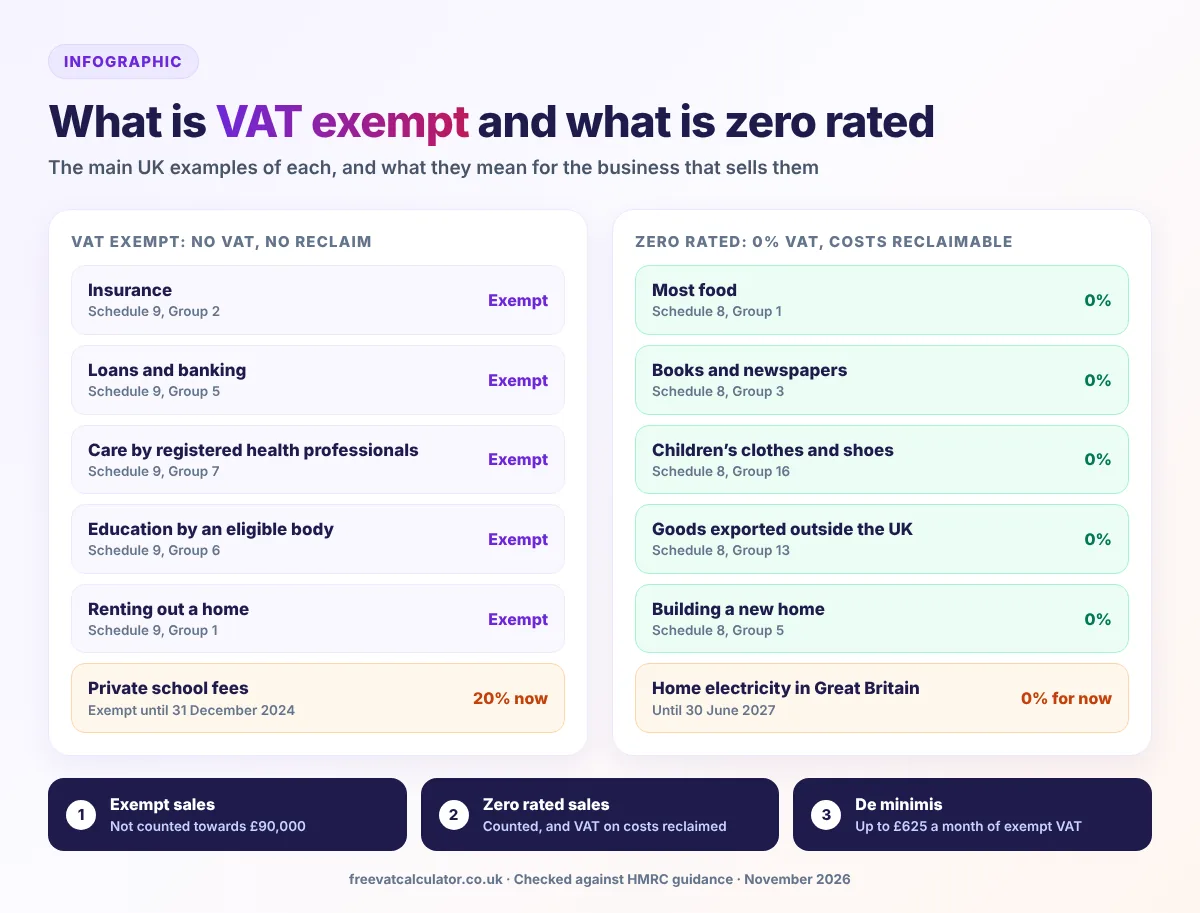
VAT exempt list UK: what is exempt from VAT
Schedule 9 is the full legal list of exempt supplies. Most groups carry conditions about who supplies, who receives or how, so treat this as a starting point.
| Group | What is exempt | Watch out for |
|---|---|---|
| 1 Land | Selling or letting land and buildings, including homes | Hotels, holiday lets, parking, new commercial freeholds |
| 2 Insurance | Insurance, brokers and agents | Insurance premium tax instead |
| 3 Post | Royal Mail’s universal service | Couriers carry 20% |
| 4 Gambling | Betting, bingo, machine games, lotteries | Venue food and drink |
| 5 Finance | Loans, credit, accounts, payments, shares | Finance must be the main element |
| 6 Education | Eligible bodies and independent private tutors | Private schools 20% since 2025 |
| 7 Health and welfare | Registered health professionals, charity welfare | Doctors’ deputies 20% from May 2027 |
| 8 Burial | Burial and cremation | Covers disposal of remains and its arrangements only |
| 9 Subscriptions | Trade unions, professional bodies | No extras beyond membership |
| 10 Sport | Sport from non profit eligible bodies | Commercial gyms 20% |
| 11 Works of art | Some heritage sales to public collections | Ordinary art sales taxable |
| 12 Fundraising | Charity fundraising events | Over 15 alike at one place a year |
| 13 Culture | Museums and zoos run by public or volunteer bodies | Commercial attractions 20% |
| 14 Blocked goods | Goods on which no VAT could be reclaimed | Lost if any VAT was reclaimed |
| 15 Investment gold | Bars of 995 thousandths purity, qualifying coins | Jewellery 20% |
| 16 Cost sharing | Services at cost to exempt members | No mark up |
Exempt goods and specified supplies
Most exemptions cover services, so searches for exempt VAT items, goods or products find little beyond gold, land and Group 14 goods. Insurance and some financial services sold to customers outside the UK are specified supplies, and Notice 741A lets the seller recover input tax on them.
Zero rated VAT: the full list of 0 rated supplies
Zero rated supplies, also written as 0 rated, are taxable sales at a nil rate listed in Schedule 8. The seller counts them in taxable turnover and reclaims VAT on costs, so zero rated businesses often get repayments.
| Group | What is zero rated | Watch out for |
|---|---|---|
| 1 Food | Most food, farm feed, food crop seeds | Catering, hot food, sweets, alcohol |
| 2 Water | Mains water and sewerage for homes | Bottled water 20% |
| 3 Books | Books, newspapers, magazines, digital editions | Diaries and stationery 20% |
| 5 and 6 Buildings | New homes, charitable buildings, rebuilt listed homes | Repairs and extensions 20% |
| 8 Transport | Vehicles with 10 or more seats, international freight | Taxis and hire cars 20% |
| 12 Health | Prescription medicines, aids for disabled people | Over the counter medicines 20% |
| 13 Exports | Goods sent outside the UK | Proof of export needed |
| 15 Charities | Donated goods sold, charity advertising | Bought in stock 20% |
| 16 Clothing | Children’s clothes and shoes, cycle helmets | Adult sizes, real fur |
| 19 Sanitary | Women’s sanitary products, period pants | None common |
| 23 Energy saving | Solar panels, heat pumps, insulation fitted | 5% from 1 April 2027 |
| Others | Talking books, export work, caravans, central bank gold, bank notes, free zones, some online marketplace sales | Narrow conditions |
Outside the scope of VAT: out of scope supplies
Some income never enters the VAT system, so it is neither taxable nor exempt. Notice 700 says a supply is outside the scope if the seller is not a taxable person, it is made outside the UK and the Isle of Man, or it is not made in business.
- donations and grants with nothing given in return
- statutory fees, such as the London congestion charge
- hobby sales, such as part of a stamp collection
- services supplied abroad under the place of supply rules
Which businesses are exempt from VAT?
Insurers, lenders, private tutors and landlords letting only homes usually make nothing but exempt sales. Notice 700/1 says that if all your supplies are exempt you will not be able to register, so you charge no VAT and absorb the VAT on every bill.
A business mixing both kinds, such as a shop letting the flat upstairs, is partly exempt and must register once taxable sales pass £90,000. A greengrocer or children’s bookshop is fully taxable at 0%, and our guides to VAT on food, VAT on books and VAT on children’s clothes explain each zero rate.
Pros and cons of being an exempt business
- no VAT on prices, which helps when customers are the public
- no VAT returns or Making Tax Digital for VAT
- VAT on rent, equipment and services becomes a real cost
- no repayments, even in a heavy start up year
Do exempt and zero rated sales count towards the £90,000 threshold?
Zero rated sales count in full, while exempt and out of scope income does not count at all. Notice 700/1 also leaves out sales of capital assets such as vehicles. You must register once taxable turnover passes £90,000 in any rolling 12 months, and you can ask to cancel when it is expected to fall below £88,000.
One trap catches exempt businesses: until 31 March 2027, overseas services bought under the reverse charge are added to an unregistered business’s taxable supplies under Notice 741A. From 1 April 2027, under a Budget measure still to be legislated, the reverse charge will apply only to VAT registered customers, so overseas suppliers will charge UK VAT instead.
Exemption from VAT registration for zero rated traders
If all or most of your taxable sales are zero rated, paragraph 3.11 of Notice 700/1 lets you ask HMRC for exemption from registration. You give up repayments, and you must tell HMRC if your sales change.
Why zero rated businesses can reclaim VAT and exempt ones cannot
Input tax is recoverable only when linked to taxable supplies, and a zero rated sale is taxable while an exempt one is not. Notice 700 bars reclaiming VAT relating to exempt supplies or non business activity, judged cost by cost.
Partial exemption and the £625 de minimis limit
Under Notice 706, a partly exempt business still reclaims everything if exempt input tax is no more than £625 a month on average and no more than half of all input tax. Our partial exemption VAT calculator runs the full test.
Large assets and the Capital Goods Scheme
Land or buildings costing £600,000 or more before VAT, bought from 29 July 2026, fall in the Capital Goods Scheme, so reclaimed VAT is adjusted over up to 10 years as exempt use changes. The threshold was £250,000 before Revenue and Customs Brief 7 (2026).
How to show exempt and zero rated sales on invoices and VAT returns
Registered businesses still record and report these sales. Notices 700 and 700/12 set the rules.
- Zero rated sales do not need a VAT invoice.
- On a mixed invoice, show no VAT is due on zero rated or exempt lines and total them separately.
- A retailer’s invoice must not include exempt supplies.
- Zero rated and exempt sales go in Box 6, with nothing in Box 1.
How to tell if a sale is exempt or zero rated
The same product can change treatment with who sells it, who buys it and how it is presented. Work through these steps for each type of sale.
- Describe the supply as the customer sees it.
- Look in Schedule 8 first, then Schedule 9, then Schedule 7A for the 5% rate.
- Check conditions, such as an eligible body or a child’s size.
- If nothing matches, it is standard rated at the current VAT rate of 20%, unless outside the scope.
- Keep evidence, such as export proof or a signed declaration.
Can a sale be both zero rated and exempt?
Occasionally a supply fits both schedules. HMRC’s manual page VATHLT5060 takes a bus ambulance, which fits the exemption for transporting sick people and the zero rate for passenger transport, and says the zero rate prevails.
Exemption certificates and eligibility declarations
Several reliefs need the customer to confirm in writing that they qualify, and people often call these papers VAT exemption certificates. In law most lead to zero rating or the 5% rate, not exemption.
| Who signs | What it covers | Result |
|---|---|---|
| A disabled person | Equipment designed for their own use | Zero rated, Group 12 |
| A charity | Advertising, medical equipment, fuel | 0% or 5%, kept 4 years |
| The buyer of a qualifying building | A new building for a relevant residential or charitable purpose | Zero rated, given before the supply |
Notice 708 warns that a customer giving an incorrect building certificate can face a penalty equal to the VAT that should have been charged. Our guides to VAT relief for disabled people and VAT for charities cover each declaration.
Can you choose to be exempt, or give up an exemption?
You cannot choose exemption or refuse it, because the treatment follows the law’s description of the supply. There is no form to apply for VAT exemption either, since a fully exempt business simply does not register.
Land and buildings are the exception. An owner can opt to tax, making supplies of a building standard rated so its VAT becomes recoverable, and Notice 742A says HMRC must normally be told within 30 days, and the option normally cannot be revoked for 20 years. It never applies to homes, as our guide to the option to tax explains.
Exemption and zero rating changes for 2026 and 2027
The 20%, 5% and 0% rates were unchanged at the Budget on 28 October 2026, but the lists keep moving. The electricity extension and the 2027 changes for social housing land, the reverse charge and deputies for doctors are Budget announcements still awaiting legislation.
| Date | What changes | Effect |
|---|---|---|
| 1 January 2025 | Private school fees | Exempt to 20% |
| 23 June 2026 | Donated medicines | New zero rate |
| 1 October 2026 | Home electricity, Great Britain | 0% to 30 June 2027 |
| 1 April 2027 | Energy saving materials | 0% back to 5% |
| 1 April 2027 | Land sold to social housing providers | Zero rate announced, legislation to follow |
| 1 April 2027 | Overseas services reverse charge | Registered customers only |
| 1 May 2027 | Deputies for doctors | Exempt to 20%, unless mainly medical care |
Common mistakes with exempt sales
The same errors come up again and again. Each can mean VAT underpaid, VAT wrongly reclaimed or a late registration.
- treating zero rated sales as VAT exempt and leaving them out of the £90,000 test
- reclaiming VAT on costs of exempt income, such as a let flat
- calling a business exempt when it is simply unregistered
- charging VAT on an exempt sale, which must then be paid to HMRC
Need the VAT on a price?
Our main VAT calculator adds or removes VAT at 20%, 5% or 0% and shows the working.
VAT exempt FAQs
These are the questions people ask most about exempt and zero rated sales. Each answer reflects HMRC guidance in November 2026.
Is insurance exempt from VAT?
Yes, insurance and the services of brokers who arrange it are exempt under Group 2 of Schedule 9. Many policies carry insurance premium tax instead, as our guide to VAT on insurance explains.
Is renting out a house exempt from VAT?
Yes, letting a home to live in is exempt under Group 1 of Schedule 9. Holiday lets and hotel rooms are excluded and carry 20%.
Is zero rated the same as VAT free?
For the customer it is, and shops may label either kind of item VAT free or non vatable. For the seller it is not, because only zero rated sales count towards registration and let the business reclaim VAT on costs.
What if I charge VAT on an exempt sale by mistake?
VAT shown on an invoice is payable to HMRC even if the sale was exempt. To put it right, issue a credit note, refund the customer and adjust your return.
You now have the checker, the full exempt and zero rated lists, and the rules for registration, invoices and reclaiming VAT. Whether your sales turn out to be VAT exempt, zero rated or outside the scope, everything you need to decide what to charge and what to claim back is above.
Sources: VAT Act 1994, s30; s31; Sch 8; Sch 9; VAT Notice 700; VAT Notice 700/1; VAT Notice 700/12; VAT Notice 706; VAT Notice 708; VAT Notice 741A; VAT Notice 742A; VAT rates on different goods and services; When not to charge VAT; Exemption and partial exemption; VAT registration thresholds; VAT relief for disabled people; VATHLT5060; Revenue and Customs Brief 7 (2026); Revenue and Customs Brief 12 (2026); Domestic electricity zero rate; Budget 2026 OOTLAR. This page is general information, not tax advice.