
Online selling guide
Online Marketplace VAT: What Changes for UK Sellers From October 2027
How online marketplace VAT will work from October 2027
- Check your statusVAT registered, or over £90,000 on one platform
- Sell to a consumerNew goods held in the UK
- Platform charges VATAnd pays it to HMRC
- Your sale is zero ratedA proposed deemed supply to the platform
- Reclaim input taxOn stock and costs
You sell on Amazon, eBay or Etsy, and the Budget on 28 October 2026 said the platform will soon collect VAT on your sales. Now you need to know whether that includes you, what happens to your VAT return and your cash, and whether your prices must change.
This guide starts with a quick checker that tells you whether the marketplace will collect VAT for you, and from when. It then explains who is in and out, how the system will work, your input tax and invoices, the timetable and what to do now, so you understand online marketplace VAT well before October 2027.
Will the marketplace collect VAT for me? Online marketplace VAT checker
Answer four questions about how you sell. The checker tells you whether the platform is expected to account for VAT on your sales from October 2027, and what that means for your VAT return.
Online marketplace VAT checker
Will the marketplace collect VAT for me from October 2027?
Yes. The marketplace will collect VAT from October 2027
As you are VAT registered, the platform will account for VAT on all your qualifying sales to consumers, whatever their value.
Based on the policy confirmed at the Budget on 28 October 2026. Regulations in 2027 will set the threshold rules and the start date. Overseas sellers are already covered by the 2021 rules. Nothing you enter is stored or sent.
The checker follows the policy confirmed at the Budget. The threshold rules and start date will be fixed in secondary legislation during 2027, so treat the result as a guide rather than a ruling.
Key facts
- Start date
- October 2027, with the day set by regulations in 2027
- Who is in
- VAT registered UK sellers, and unregistered sellers over £90,000 on one platform
- Excluded
- Personal sales, second hand goods and sales to businesses
- Businesses affected
- About 100,000, according to HMRC
- Input tax
- Still reclaimable, and some sellers may move into repayment
- Already covered
- Overseas sellers and imports of £135 or less, since 2021
Online marketplace VAT at a glance: now and from October 2027
The table shows who accounts for the VAT on a marketplace sale today and once the extended rules start. The right hand column reflects what the government confirmed on 28 October 2026.
| Seller and sale | Now | From October 2027 |
|---|---|---|
| UK seller, VAT registered, selling to consumers | The seller | The marketplace |
| UK seller, not registered, over £90,000 on one platform | The seller, who must already be registered | The marketplace, on that platform |
| UK seller, not registered, £90,000 or less on each platform | No VAT charged | No change |
| Private individual selling personal belongings | No VAT | No change, as personal sales are excluded |
| Business selling second hand goods | The seller, often under the margin scheme | No change, as second hand goods are excluded |
| Sale to a business customer | The seller | No change, as business to business sales are excluded |
| Overseas seller, or an imported parcel of £135 or less | The marketplace, since 1 January 2021 | No change |
Nothing changes before October 2027. Until then, keep charging and accounting for VAT on your marketplace sales exactly as you do today.
What is online marketplace VAT?
Online marketplace VAT is the set of rules that makes a platform, rather than the seller, responsible for charging and paying VAT on certain sales. The law treats the marketplace as if it had bought the goods and sold them on, which is why advisers call it the deemed supplier.
The rules sit in section 5A of the Value Added Tax Act 1994 and have applied since 1 January 2021. Until now they have only caught overseas sellers and imported parcels, because HMRC found it hard to collect VAT from businesses with no UK presence.
What counts as an online marketplace
A website or app is an online marketplace when it lets third parties sell goods, sets the terms of sale in some way, handles or facilitates the payment, and takes part in ordering or delivery. Amazon, eBay and Etsy all work this way, but a business that only processes payments, only advertises goods or only redirects shoppers is not a marketplace.
How the deemed supplier model works
The seller is treated as making a zero rated supply to the marketplace, and the marketplace charges the customer VAT and declares it on its own return. The seller does not invoice that deemed supply, while the marketplace issues the customer’s invoice and keeps full records for 6 years.
How the 2021 rules work for overseas sellers
Since the Brexit transition period ended on 31 December 2020, marketplaces have accounted for VAT in two situations. Both involve goods or sellers from outside the UK, and both continue unchanged.
Imported consignments of £135 or less
When goods outside the UK are sold to a customer in Great Britain in a consignment worth £135 or less, the marketplace charges UK VAT at the point of sale. Low value consignment relief, which let goods worth £15 or less in free of VAT, ended at the same time.
Above £135, the customer usually pays import VAT and any duty on arrival. Our import VAT and customs duty calculator shows what that adds to an order.
Goods already in the UK sold by overseas sellers
When an overseas business keeps stock in the UK, the marketplace accounts for the VAT on sales to consumers of any value, as HMRC’s marketplace guidance explains. The seller still pays import VAT when the stock arrives and can register to reclaim it.
Sales to VAT registered business customers
If a business customer gives a valid UK VAT number, the marketplace does not charge VAT. The seller or the customer then accounts for it, depending on where the goods are.
Northern Ireland
Northern Ireland stays aligned with EU rules for goods, so it works slightly differently. For goods there sold to customers there, the marketplace is liable only when the seller is established outside both the UK and the EU.
How much the 2021 rules have raised
HMRC estimates the 2021 reforms have raised more than £8 billion and, with the end of low value consignment relief, still bring in about £1.8 billion a year. The government calls them a significant success, which is why it chose to extend the same model.
Online marketplace VAT changes for UK sellers from October 2027
At the Autumn Budget on 28 October 2026, the government confirmed it will extend the marketplace rules to UK businesses from October 2027. Marketplaces will collect VAT on sales of goods to consumers by every VAT registered UK seller, and by unregistered UK sellers whose annual sales on that platform are over £90,000.
The goods must be in the UK at the point of sale, and VAT rates do not change, so zero rated items such as books stay zero rated. HMRC expects about 100,000 businesses to be significantly affected.
- October 2027Start date for UK sellers
- 100,000Businesses significantly affected
- £320mExpected yield in 2028 to 2029
Why the government is making the change
HMRC found overseas businesses posing as UK businesses, UK sellers splitting sales across platforms to stay under the threshold, and registered businesses closing down before paying their VAT. It estimates tens of thousands of UK marketplace sellers are not meeting their obligations, while online sales grew from 5% of retail sales in 2008 to 28% in 2025.
Takeaways and food delivery apps
The consultation singled out delivered hot food as a particular and ongoing problem, with hundreds of millions of pounds of VAT lost each year. It said takeaway delivery platforms may face a bigger adjustment than other marketplaces when the rules start.
The consultation and the government response
HMRC and HM Treasury consulted from 23 June to 18 August 2026 and received 67 responses, 17 of them from marketplaces. The response kept the £90,000 platform threshold, rejected a lower one and dropped the idea of a special VAT rate relief for small sellers.
Many respondents wanted at least 12 months after detailed guidance. The government chose October 2027 anyway, saying it felt obliged to act quickly given the level of non compliance and the revenue at stake.
How much the change will raise
The Office for Budget Responsibility certified the yield below. HMRC also expects one time costs of about £40 million and net running costs of about £8 million a year, with each platform bearing more of the cost than each seller.
| Tax year | Exchequer impact |
|---|---|
| 2027 to 2028 | £165 million |
| 2028 to 2029 | £320 million |
| 2029 to 2030 | £270 million |
| 2030 to 2031 | £250 million |
| 2031 to 2032 | £265 million |
Who will be in scope from October 2027
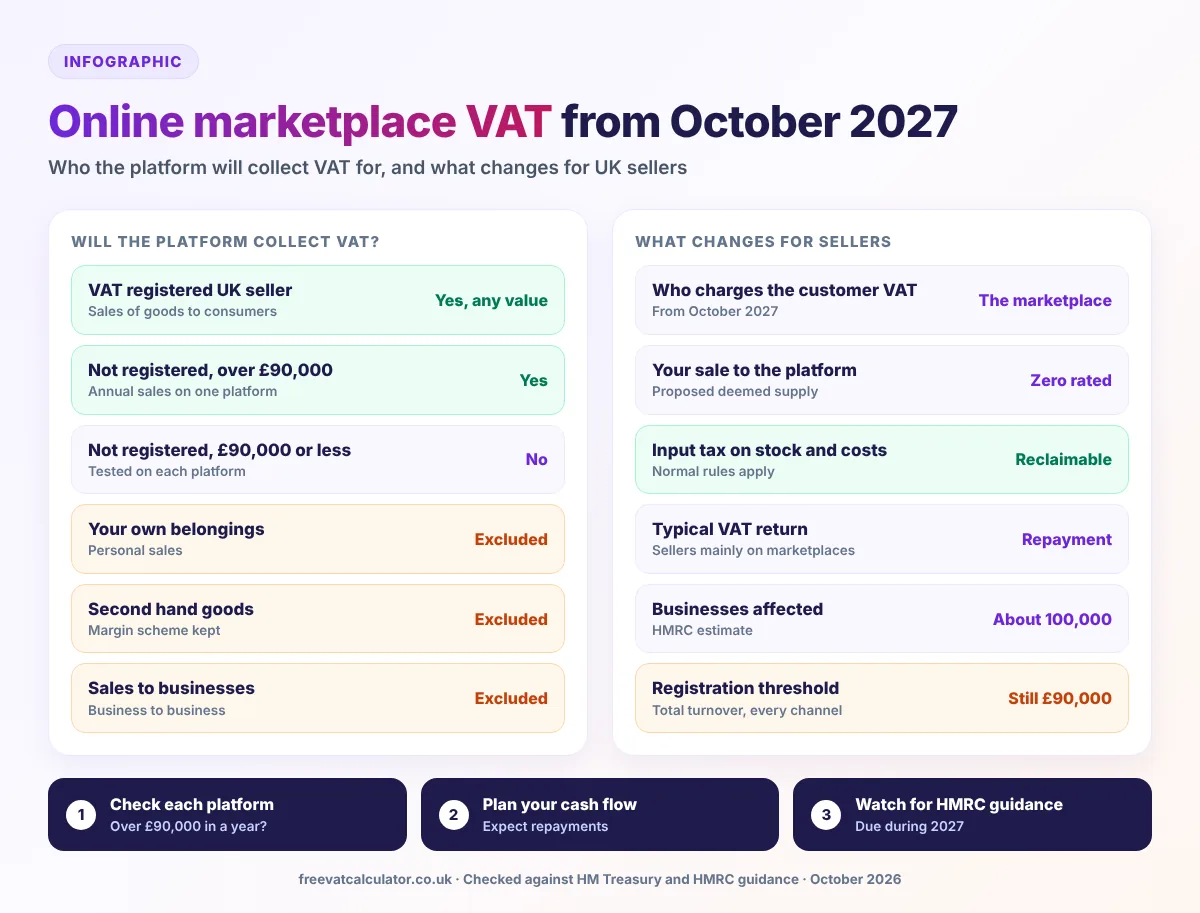
Whether a platform collects VAT on your sales depends on two things: whether you are VAT registered, and how much you sell on that platform. The extension covers UK businesses selling goods held in the UK.
VAT registered UK sellers
If you are VAT registered, the marketplace will account for VAT on all your qualifying sales to consumers, whatever their value. A seller with £5,000 of sales on Etsy is caught just like one with £5 million on Amazon.
Unregistered sellers and the £90,000 platform threshold
If you are not registered, the marketplace collects VAT only once your annual sales on that platform go over £90,000. The test applies to each platform separately, so £75,000 on Amazon and £40,000 on eBay brings neither platform into the rules on its own.
The platform threshold does not replace the normal registration test, which looks at your total turnover. That seller has £115,000 of sales and must register, and once registered, both platforms collect VAT on all its qualifying sales.
Registering for VAT if you are over £90,000
You must register within 30 days of the end of any month in which your taxable turnover for the last 12 months went over £90,000. If you expect to pass £90,000 in the next 30 days alone, you must register by the end of that 30 day period. Our VAT threshold guide explains both tests, and how to register for VAT covers the application.
Sales that stay outside the new rules
Three types of sale are excluded, and a fourth never goes through a marketplace at all. If all your sales fall into these groups, the change will not affect you.
- Personal sales of your own belongings
- Second hand goods sold by a business
- Sales to business customers
- Sales through your own website, shop or stall
Personal sales and platform reporting
People who occasionally sell their own clothes or household items are not in business, so no VAT applies to their sales. Platforms do report many sellers’ details to HMRC under separate digital platform rules, but sellers with fewer than 30 sales of goods and €2,000 (about £1,700) or less a year are left out.
Second hand goods and the margin scheme
Excluding second hand goods protects dealers who use the margin scheme to pay VAT only on the difference between buying and selling price. A marketplace cannot use that scheme, so VAT would otherwise fall on the full price, and our VAT margin scheme guide explains how it works.
Business to business sales
Sales to other businesses are outside the extension, so you keep accounting for VAT on them yourself. Under the current rules, a platform recognises a business buyer when it gives a valid UK VAT number.
How online marketplace VAT will work in practice
The consultation proposed that the new rules mirror the 2021 model. Under that proposal, your sale to the marketplace would become a zero rated deemed supply, and the marketplace would charge the customer VAT and pay it to HMRC.
Worked example: one sale before and after
A VAT registered seller sells a lamp to a consumer for £60.00 including VAT, having bought it for £24.00 plus £4.80 of VAT. The figures ignore marketplace fees and follow the proposed mechanism.
| Item | Now | From October 2027 |
|---|---|---|
| Who accounts for the £10.00 of output VAT | You | The marketplace |
| Output VAT on your return | £10.00 | £0.00 |
| Input VAT you reclaim | £4.80 | £4.80 |
| Result of your VAT return | You pay £5.20 | HMRC repays you £4.80 |
| Total VAT received by HMRC | £5.20 | £5.20 |
Will prices go up?
HM Treasury says most businesses already comply and will not need to raise prices, because the measure only raises money from sellers who are not paying. The policy paper accepts some shoppers may pay more where those sellers pass the charge on.
Input tax, VAT returns and invoices
For VAT registered sellers, the change is mostly about bookkeeping. You keep filing returns, but marketplace sales to consumers are expected to appear as zero rated supplies to the platform.
You can still reclaim input tax
The consultation said businesses will still be able to recover input tax, including on costs linked to online sales. Under the normal rules, that covers VAT on stock, packaging, couriers, software and the platform’s own fees.
Repayment returns and monthly VAT returns
With the platform collecting your output VAT, a seller who trades mainly on marketplaces may get a repayment on most returns. The government response says businesses in scope can apply to move onto monthly returns, which shortens the wait.
VAT invoices and records
Under the 2021 rules, the marketplace invoices the customer and eBay, for example, tells sellers not to issue their own VAT invoice where it collected the VAT. HMRC’s 2027 guidance will confirm the position for UK sellers, and you should keep platform VAT reports with your records for at least 6 years.
Flat Rate Scheme users
The Flat Rate Scheme is open to businesses with VAT taxable turnover of £150,000 or less, excluding VAT. The government has not yet decided how it will work alongside the extension, so ask your adviser and read how the Flat Rate Scheme works.
Cash flow: the biggest practical change
Today, a VAT registered seller collects VAT from customers and keeps it until the return is due, often weeks later. From October 2027, the platform takes the VAT at the point of sale, so that money never reaches your account.
A quick way to size the change is to add up the output VAT on your marketplace sales to consumers for the last 12 months, leaving out second hand goods. That figure is roughly the cash that will stop passing through your account each year.
Amazon VAT, eBay VAT and Etsy: what the platforms do now
Every marketplace that meets HMRC’s definition follows the same law. Today, each collects VAT only for overseas sellers and on imported parcels of £135 or less.
Amazon
VAT on Amazon sales by UK sellers is currently the seller’s job. Amazon itself called for the rules to cover all sellers in October 2025, saying it had collected more than £6 billion of VAT from overseas sellers since 2021.
eBay
eBay collects VAT on imported parcels of £135 or less and on UK stock sold by sellers based abroad. Where it collects the VAT it cannot apply a margin scheme, so VAT falls on the full value of the item.
Etsy and other platforms
Etsy and smaller platforms fall under the same rules whenever they meet the marketplace test. Sales through your own checkout stay with you, as our guide to VAT for ecommerce explains.
Timetable: consultation, legislation and start date
The measure moved quickly from proposal to confirmed policy. These are the key dates so far.
- 23 June 2026: an eight week consultation opens.
- 18 August 2026: the consultation closes with 67 responses.
- 28 October 2026: the Budget confirms the policy and publishes the response.
- Finance Bill 2026 to 2027: the main legislation goes through Parliament.
- During 2027: secondary legislation sets the threshold and start date, and HMRC publishes guidance.
- October 2027: marketplaces start collecting VAT for UK sellers, with the official costings assuming 1 October.
What sellers should do now
You do not need to change anything yet, but the year ahead is the time to prepare. Work through these steps.
- Total your sales on each platform for the last 12 months, and keep a monthly running total.
- Check your total taxable turnover across every channel against the £90,000 registration threshold.
- Separate marketplace sales from website and shop sales in your bookkeeping.
- Check the VAT rate on every listing, because the platform will rely on your product data.
- Model your cash flow with the platform keeping the output VAT, and consider monthly returns.
- Never split one business into several to stay under a threshold, as HMRC can treat an artificial split as one business.
- Read HMRC’s online marketplace VAT guidance when it appears in 2027.
Do not stop charging VAT early. Until October 2027, a VAT registered seller who leaves VAT off marketplace sales still owes it to HMRC.
What happens if you get it wrong
Sellers who fail to register or under declare VAT face assessments, penalties and late payment interest, currently 7.75%. A new legal duty to correct errors in tax returns is also due from 1 April 2028.
Platforms carry risk too. Since 2018, a marketplace that keeps hosting a UK or overseas seller after HMRC has flagged them can become jointly and severally liable for that seller’s VAT, which is why platforms suspend sellers who ignore VAT checks.
Other Budget changes that affect online sellers
The marketplace measure was one of several VAT changes in the Autumn Budget 2026. Our Autumn Budget VAT guide covers them all, and these matter most to online sellers.
- Customs duty relief on imported parcels of £135 or less ends by October 2028, as announced in June 2026 and confirmed in the Budget documents.
- From April 2027, the reverse charge on overseas services applies only to VAT registered customers.
- Electronic invoicing between VAT registered businesses becomes mandatory from 1 April 2029.
- The VAT rates and the £90,000 registration threshold are unchanged.
Pricing a marketplace listing?
Work out the VAT inside any price, or add it to a net price, with our free VAT calculator.
Online marketplace VAT FAQs
These are the questions UK sellers ask most about the change. Each answer reflects the policy confirmed on 28 October 2026.
When do marketplaces start collecting VAT for UK sellers?
The rules start in October 2027, and regulations will set the exact date. Until then, you account for VAT on marketplace sales as you do now.
Will Amazon or eBay charge VAT if I am not VAT registered?
Only if your annual sales on that platform go over £90,000. You must still register if your total taxable turnover across all channels passes £90,000.
Can I still reclaim VAT on my stock and costs?
Yes. VAT registered sellers keep their right to recover input tax, so those who sell mainly through marketplaces may receive regular repayments.
Does this affect sales on my own website?
No. The rules only cover sales through an online marketplace, so your own website, shop or stall sales stay with you.
Will I pay VAT when I sell my old clothes online?
No. Personal sales of your own belongings are excluded, and HM Treasury says no VAT will apply to them.
Is the change law yet?
Not yet. The government will put the main legislation in the Finance Bill 2026 to 2027, and regulations in 2027 will set the threshold and the start date.
You now know whether the platform will collect VAT for you, what happens to your input tax, invoices and cash flow, and what to do before October 2027. All the information you need to plan for the change is above.
Sources: HMRC, Extending VAT online marketplace liability; HM Treasury factsheet; HMRC consultation; summary of responses; Budget 2026 OOTLAR; HMRC, overseas goods sold using online marketplaces; HMRC, guidance for marketplace operators; VAT Act 1994, section 77B; GOV.UK, Register for VAT; HMRC, digital platform reporting; HMRC VAT Notice 700/21; GOV.UK, Flat Rate Scheme eligibility; HMRC interest rates; eBay, VAT obligations; Amazon, reforming tax collection. This page is general information, not tax advice.