
Commercial property VAT guide
Option to Tax: VAT on Commercial Property, Rent and the VAT1614A Form
From decision to VAT on rent
- Check the propertyCommercial, mixed or new
- Check occupiersCan they reclaim VAT?
- Check permissionExempt lets in 10 years?
- Notify HMRCVAT1614A within 30 days
- Charge VAT20% from the effective date
You have bought or refurbished a commercial unit, the VAT on the purchase and the building work runs into tens of thousands of pounds, and your accountant says you cannot reclaim a penny of it unless you start charging VAT on the rent. Or your landlord has just written to say the rent is going up by a fifth because the building has been opted. Either way, a decision that lasts at least 20 years is suddenly on the table.
This guide explains in plain terms what opting does, who gains and who pays, and how to notify HMRC without the slips that make an option invalid. It starts with a short answer and a decision checker, then covers form VAT1614A, permission, VAT on rent, sales, the 2026 Capital Goods Scheme change and how to revoke an option to tax.
Should you opt to tax? The short answer and a decision checker
The short answer: opting usually pays when your tenants or buyers are VAT registered businesses that can reclaim VAT, and you face large VAT bills on buying, building or refurbishing. It usually hurts when your occupiers are banks, insurers, doctors, charities or other businesses that cannot reclaim VAT, because the rent effectively rises by 20% for them. It has no effect at all on homes.
Answer the questions below for a reasoned lean and the next step to take. The checker also shows the VAT on your monthly rent, so you can see what a tenant would pay, but it is a starting point and not tax advice.
Opting decision checker
A reasoned lean on whether opting helps, hurts or is not possible
Opting is likely to help
Your tenants or buyers can reclaim the 20% you charge, and you can reclaim the VAT on your costs.
Next step
Record the decision with its date, then email form VAT1614A to HMRC within 30 days and keep the automated reply.
This checker gives a general lean based on HMRC’s Notice 742A, not tax advice. Figures assume the 20% standard rate and no other change to the rent.
Key facts
- Default position
- Commercial lets and sales are exempt from VAT
- Effect of opting
- Rent and sale prices become standard rated at 20%
- Notify HMRC
- On form VAT1614A within 30 days of deciding
- How long it lasts
- At least 20 years, with a 6 month cooling off window
- Never covered
- Homes, relevant residential and charitable non business use
- CGS threshold
- £600,000 for land and buildings from 29 July 2026
What is the option to tax?
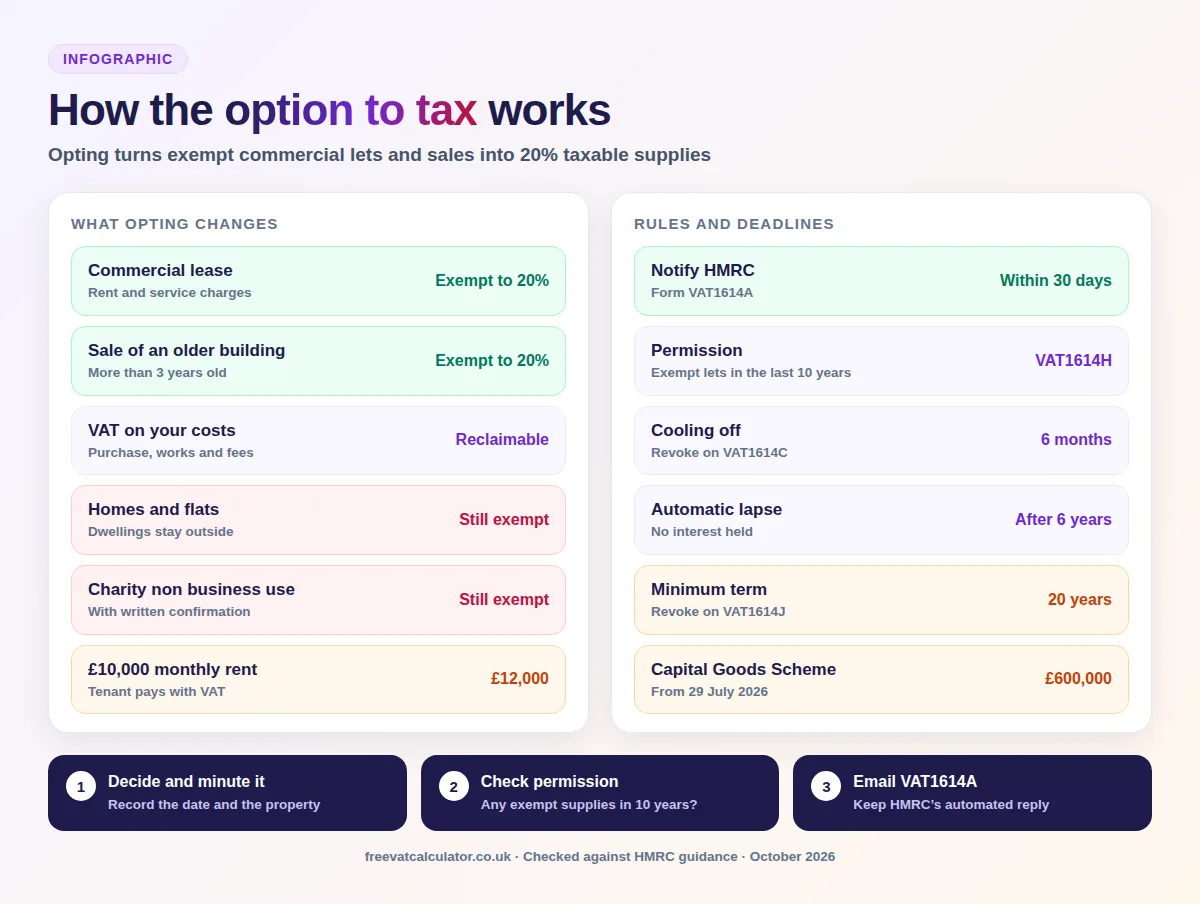
The option to tax is an election that lets an owner or landlord charge VAT on land and commercial buildings that would otherwise be exempt. Once it takes effect, your rents and sale prices for that property are standard rated at 20%, and in return you can normally reclaim the VAT you pay on costs linked to it. The rules sit in Schedule 10 of the Value Added Tax Act 1994, and HMRC explains them in VAT Notice 742A, last updated on 26 May 2026.
The word option matters, because nothing happens automatically. You choose to opt, property by property, and the choice binds you for at least 20 years unless one of a few narrow revocation routes applies.
- 20%VAT on rent and sale prices once you opt
- 30 daysto notify HMRC on form VAT1614A
- 20 yearsbefore you can normally revoke
Commercial property and VAT: the default position
Most supplies of land and buildings are exempt from VAT, and that covers selling the freehold, granting a lease or simply licensing space. Exempt means no VAT is charged, but it also means the VAT you pay on purchase costs, building work, repairs and professional fees cannot be reclaimed. That lost VAT is the problem opting is designed to fix.
Some supplies are standard rated whatever you decide. HMRC’s Notice 742 lists the freehold sale of a new or uncompleted commercial building, most car parking, hotel and holiday accommodation, many sports facilities and the right to fell timber. A building counts as new for 3 years from completion, which is the earlier of the practical completion certificate or the date it is fully occupied.
| Supply | Without an option | With an option |
|---|---|---|
| Lease or licence of a commercial building | Exempt | Standard rated at 20% |
| Freehold sale of a commercial building over 3 years old | Exempt | Standard rated at 20% |
| Freehold sale of a new commercial building under 3 years old | Standard rated at 20% | Standard rated at 20% |
| Sale or letting of bare land | Exempt | Standard rated at 20% |
| Houses, flats and other dwellings | Exempt | Still exempt |
| Building used solely for a charity’s non business activities | Exempt | Still exempt, with written confirmation |
| Hotel rooms, holiday lets and most car parking | Standard rated at 20% | Standard rated at 20% |
Who can opt to tax
Anyone who holds, or is about to hold, an interest in land or a commercial building can opt, including freeholders, landlords and tenants who sub let. HMRC confirms that you do not need to own the land, and buyers often opt before they complete so they can reclaim VAT on the purchase. If you are not yet VAT registered, you send the notification with your registration application.
The option is personal to whoever makes it. It does not bind your tenants or sub tenants, so a tenant who sub lets and wants to reclaim VAT on fitting out has to opt separately for its own interest. HMRC suggests telling tenants about your decision early, so they can protect their own VAT recovery.
In a VAT group, other members can be bound as relevant associates of the company that opted. They generally keep charging VAT on that property even after leaving the group, until they stop being a relevant associate automatically or by notifying HMRC on form VAT1614B.
Benefits and drawbacks of opting to tax
The decision is a trade off between the VAT you can reclaim and the VAT your tenants or buyers must pay. Which side wins depends far more on who occupies the building than on the building itself.
Benefits of opting
- an option to tax lets you reclaim VAT on the purchase price, construction, refurbishment, repairs and professional fees
- VAT registered tenants that make taxable supplies reclaim the VAT on rent, so in the end it costs them nothing
- a let, opted building can be sold as a transfer of a going concern, with no VAT on the price
- reclaiming VAT during a large refurbishment improves cash flow while the works are under way
- a buyer who opts before completion can reclaim the VAT charged by a seller who has opted
Drawbacks of opting
- tenants and buyers who cannot reclaim VAT, such as banks, insurers, doctors, dentists and charities, pay 20% more
- buyers pay stamp duty land tax on the VAT inclusive price
- the option normally lasts at least 20 years, through every change of tenant and market
- you must be VAT registered, issue VAT invoices and file returns through Making Tax Digital software
- a later move to exempt use can mean repaying VAT under the Capital Goods Scheme
- anti avoidance rules can switch the option off where a connected, partly exempt business will occupy
If your occupiers would all be fully taxable businesses, the drawbacks are mostly paperwork. If even one large tenant is exempt, run the numbers in the checker above before you commit.
When opting to tax helps and when it hurts
Most decisions fall into a handful of familiar situations. The table shows the usual lean for each one, but your own figures always decide.
| Situation | Usual lean | Why |
|---|---|---|
| Letting to VAT registered businesses after a refurbishment | Opt | Large VAT reclaim, and tenants recover the VAT on rent |
| Developer building commercial units to sell or let | Opt | VAT on construction becomes reclaimable |
| Buying a let building as a going concern | Opt before completion | Needed for the purchase to fall outside VAT |
| Letting to a bank, insurer, surgery or charity | Usually do not opt | The tenant bears the extra 20% as a real cost |
| Fully taxable business buying premises to use itself | Often unnecessary | It can usually reclaim VAT on its costs anyway |
| Selling to a buyer who will convert to homes | No effect | The buyer’s VAT1614D certificate disapplies the option |
| Few costs and every tenant VAT registered | Neutral | Small gain against extra admin |
How to opt to tax: the decision, VAT1614A and the 30 day rule
Opting is a two stage process. First you make the decision, then you notify HMRC in writing, and the notification is the stage people most often get wrong.
- Make the decision and record it, for example in board minutes, with the date and an exact description of the property.
- Check for any exempt supplies of the property in the last 10 years, because you may need permission first.
- Fill in form VAT1614A on screen at GOV.UK, print it and sign it, or add an authorised electronic signature.
- Email it to optiontotaxnationalunit@hmrc.gov.uk with the property address, postcode and effective date in the subject line.
- If you cannot email, post it to BT VAT, HM Revenue and Customs, BX9 1WR.
- Keep HMRC’s automated email reply with the decision record and a copy of the form.
- Charge VAT from the effective date and tell your tenants in writing.
What to put on form VAT1614A
HMRC’s form VAT1614A, sometimes written VAT 1614A, asks for your details, your VAT number, a clear description of the land or buildings and the date the option takes effect, followed by a declaration. Give the full postal address with postcode for a building, and attach a map or plan for land without one, because a vague description is a common reason an option fails to cover what the owner expected. Adding your VAT registration number, or the reference for a pending registration, speeds up processing.
The form must be signed by an authorised person. For a company that is a director or company secretary, for a partnership a partner, for an LLP a member and for a sole trader the owner. Electronic signatures have been allowed permanently since 1 August 2021, but an agent must be able to show that the signature came from an authorised person who gave them authority to send it.
The 30 day time limit and late notification
You should normally notify HMRC within 30 days of the decision. HMRC will normally accept a late notification if you send documents from the time showing the decision was made then, such as minutes or letters mentioning the option. If you have none, VAT records that fit the option, such as invoices showing VAT charged on rent, can be enough when a director or similar responsible person signs a written declaration. Send a short explanation of why the notification is late with it.
When the option takes effect
The option takes effect from the date of the decision or a later date you choose, but never earlier than the decision itself. That date only stands if you notify HMRC in writing within the time limit, so a late notification needs the evidence described above.
HMRC no longer sends acknowledgement letters
HMRC stopped sending receipt letters for option to tax notifications from 1 February 2023, and updated Notice 742A on 8 March 2024 to say so. Emailed notifications get an automated reply showing the date HMRC received them, while posted ones get no response at all. The option is valid without an acknowledgement, so keep that email safe, because a buyer’s solicitor will ask for it.
HMRC has also stopped confirming whether a property has been opted, except where the option is likely to be more than six years old or the request comes from a receiver or insolvency practitioner. It will contact you only if it needs more information.
New digital channels promised by the end of 2026
In its Tax Update 2026, published on 23 June 2026, the government said it will introduce digital channels for submitting notifications and revocations, including bulk uploads for large portfolios. It says these will be live before the end of 2026. Until they appear on GOV.UK, email and post remain the only routes, so check the form page before you send anything.
Records and evidence to keep
Keep the board minute or other decision record, a copy of the form, the automated email reply and any permission letter for at least 6 years, and preferably for as long as you own the property. These papers are your only proof that the option exists, and buyers, lenders and HMRC will all expect to see them. Questions go to HMRC’s Option to Tax Unit on the email address above or the VAT helpline on 0300 200 3700.
When you need HMRC’s permission to opt
If you have made, or intend to make, exempt supplies of the land or building in the 10 years before the option is due to take effect, you need HMRC’s written permission first. The rule stops owners letting a building exempt for years and then opting just to reclaim VAT on a refurbishment. You do not need permission if you meet one of four automatic permission conditions, which have the force of law.
The four automatic permission conditions
- Condition 1: the development is mixed use and your only exempt supplies were of the dwellings.
- Condition 2: your only exempt income was regular rent or service charges, you are not claiming back VAT incurred before the option, and afterwards you expect to reclaim VAT only on overheads such as repairs and maintenance.
- Condition 3: the opted supplies will not go to a connected person who cannot reclaim at least 80% of the VAT, no exempt right to occupy carries on after the option, and capital spending you reclaim VAT on will not be used for exempt or private purposes, subject to a £5,000 allowance.
- Condition 4: the exempt supplies were only incidental to the main use, such as space for an advertising hoarding, a radio mast or an electricity substation.
Letting space to an occupying tenant is never incidental, however small the space. If you rely on a condition, say which one on your VAT1614A.
How to apply for permission on VAT1614H
If no condition fits, apply on form VAT1614H and give HMRC everything the form asks for. Once permission is granted, the option takes effect from the date you applied or a later date you asked for, and no separate VAT1614A is needed. HMRC can refuse if it thinks the result would not give a fair and reasonable recovery of VAT.
Opting without permission when you needed it makes the option invalid. HMRC has discretion to accept it anyway, but generally only where tax would otherwise be at risk, or where you checked carefully and missed something minor, such as a single exempt letting.
What an option to tax covers
An option on a building covers the whole building, the land underneath it and its curtilage, meaning the forecourts, yards and other land immediately around it. You cannot opt one floor or one unit on its own. Buildings joined by an internal walkway or covered access count as one building, and so does a group of units around an enclosed concourse, such as a shopping centre.
An option on land covers every building on that land now and in the future, but not the land next door. Car parks, public paths and fire escapes do not count as links between buildings.
Extensions, demolition and new buildings
If you extend an opted building upwards, downwards or sideways, the option covers the whole extended building. A link built after both buildings are finished does not carry the option across, and enclosing separate units into a complex later does not spread it to units you never opted.
Demolishing an opted building leaves the option on the land, so it will cover whatever you build next. You can exclude a new building on opted land by notifying HMRC on form VAT1614F, normally within 30 days of the earliest of its first grant, first use or completion, once construction has risen above the foundations. The exclusion is permanent, although you can opt that building again later.
Does the option pass to a new owner?
No. A buyer is never bound by the seller’s option and must make its own, and paying VAT on the purchase does not create an option for the buyer either. There is no public register of opted buildings, so buyers rely on the seller’s copy of the form and HMRC’s automated reply during due diligence.
Real estate elections for large portfolios
Investors who buy commercial property regularly can make a real estate election on form VAT1614E instead of opting building by building. It works as a blanket option over the property interests they acquire after the election, which saves a separate notification for every purchase.
What an option to tax cannot change
Some supplies stay exempt even when the building has been opted. Notice 742A lists nine of them, and the option simply has no effect on each one.
- buildings designed or adapted as dwellings, such as houses and flats
- buildings for a relevant residential purpose, such as care homes and student halls, with the buyer’s or tenant’s written confirmation
- buildings a buyer will convert into homes, when they give you certificate VAT1614D
- buildings used solely for a charity’s non business activities or as a village hall, but not a general administration office
- land sold to a registered housing association that gives you certificate VAT1614G, although the Budget on 28 October 2026 announced that land sold to registered social housing providers will be zero rated from 1 April 2027
- land sold to an individual who will build their own home, with no certificate needed
- pitches for residential caravans
- moorings for residential houseboats
- grants caught by the anti avoidance test described below
Hotels, hospitals and prisons are not relevant residential buildings, so an option still applies to them. For charitable or residential use, get the tenant’s or buyer’s confirmation in writing before the supply and keep it with your VAT records.
Mixed use buildings
Where a building is partly commercial and partly residential, such as a shop with a flat above, the option applies to the shop but not to the flat. You split the rent or price between the two on any basis that gives a fair and reasonable result. If the upper floor is not yet a dwelling but will be converted, the buyer needs to give a VAT1614D certificate for that part.
Buyers converting to homes: certificate VAT1614D
A buyer or tenant who intends to convert a commercial building into homes can give you form VAT1614D, and you must then treat the supply as exempt. The certificate must reach you before the price is legally fixed, usually at exchange of contracts. You do not have to accept a late certificate, although you may choose to apply it to supplies made after you receive it. The buyer must intend to convert the building for use as a dwelling, and cannot give the certificate if the building will first be put to some other use, although minor incidental use is ignored.
The anti avoidance test
The option is switched off for a particular grant if three things are all true at the time: the property is, or will become, a capital item under the Capital Goods Scheme, the owner or someone financing it expects it to be occupied by them or a connected person, and that occupier will not use it wholly or substantially wholly for eligible purposes, which broadly means making taxable supplies. Typical cases are a partly exempt business leasing a building it plans to occupy, a sale and leaseback, or a bank financing a building it will use itself.
Because the test only bites on Capital Goods Scheme items, the higher £600,000 threshold for land and buildings acquired on or after 29 July 2026 should take many smaller properties outside it. If the test does apply, the supplies become exempt and VAT already reclaimed may have to be repaid.
VAT on rent once you opt
Once the option takes effect, rent that was exempt becomes standard rated, so you add 20% VAT to every rent demand. The tax point is the earlier of a VAT invoice or payment, which is why many landlords send a request for payment and issue the VAT invoice only when the rent arrives. On £10,000 a month, the tenant now pays £12,000.
| Item | Not opted | Opted |
|---|---|---|
| Monthly rent | £10,000 | £10,000 |
| VAT at 20% | £0 | £2,000 |
| Tenant pays each month | £10,000 | £12,000 |
| VAT over a year | £0 | £24,000 |
| Tenant pays over a year | £120,000 | £144,000 |
| Real cost to a fully taxable tenant | £120,000 | £120,000 |
| Real cost to an exempt tenant | £120,000 | £144,000 |
Commercial rent VAT: what tenants pay and reclaim
A VAT registered tenant that makes taxable supplies reclaims the VAT on rent on its own return, so its only real cost is the cash flow gap before that return is repaid. For exempt businesses, such as banks, insurers, doctors, dentists and charities using the space for non business work, the VAT is simply an extra cost. Partly exempt tenants reclaim only part of it, depending on their method, which our guide to partial exemption VAT explains.
Service charges, rent arrears and invoices
Service charges under a commercial lease follow the rent, so they become standard rated when the landlord opts. HMRC says rent that fell due before the option but is paid after it carries VAT when it is received. Each VAT invoice must show the details in our guide to what a valid VAT invoice must include.
Check the lease before you opt
Read the VAT clause in each lease before you notify HMRC. Most modern commercial leases let the landlord add VAT to the rent, but if a lease says the rent includes any VAT, the VAT may have to come out of the rent you already receive. Agree terms with key tenants early, especially any that cannot reclaim VAT.
Residential and holiday lets
Rent from homes stays exempt and cannot be opted, so residential landlords never charge VAT on rent and cannot reclaim VAT on their costs. Holiday lets and hotel rooms are different, because they are standard rated anyway, so opting makes no difference to them.
VAT for rental income: registration and returns
Exempt rent does not count towards the VAT registration threshold, but opted rent does. Once you opt, your rent is taxable turnover, so if it goes over £90,000 in any rolling 12 months you must register, and below that you can register voluntarily to reclaim VAT on your costs. Our VAT threshold calculator shows where you stand, and our guide on how to register for VAT covers the application.
If you are not registered when you opt, send the option notification with your registration application, because HMRC needs to see that you will make taxable supplies. Where permission to opt is needed, you cannot register until HMRC grants it. After that you file VAT returns through Making Tax Digital software like any other VAT registered business.
The option survives deregistration
Cancelling your VAT registration does not cancel the option. HMRC updated Notice 742A on 26 May 2026 to make clear that opted land or buildings still held when your registration ends can mean output tax on your final return, and you must register again if the property later takes you over the threshold. Our guide on how to deregister from VAT covers the final return and the 2026 Capital Goods Scheme change.
Selling or buying: VAT on commercial property sales
When an opted building is sold, the price is standard rated, so a £1,000,000 sale carries £200,000 of VAT unless the deal is a transfer of a going concern. A buyer that is VAT registered and will make taxable supplies from the building can reclaim that VAT, but it still has to fund it until its VAT return is repaid.
VAT for commercial property buyers
Ask early whether the seller has opted, and get a copy of the VAT1614A and HMRC’s automated reply. If you will let the building, opt yourself before completion so you can reclaim the VAT on the price, or so the purchase can qualify as a going concern. Watch deposits too, because a deposit paid straight to the seller, rather than held by a stakeholder, can create an early tax point.
Transfer of a going concern
A let building can be sold as a transfer of a going concern, which is outside the scope of VAT, but only if the buyer has opted and notified HMRC by the relevant date. The buyer must also tell the seller in writing, by the same date, that its option will not be disapplied by the anti avoidance rules. HMRC’s manual VTOGC6200 explains that the relevant date is normally completion, or earlier if a deposit is paid to the seller rather than a stakeholder.
Miss either step and VAT is due on the full price, whatever option the buyer makes later. Capital Goods Scheme adjustments pass to the buyer, so the seller must hand over the history of any adjustments.
New commercial buildings under 3 years old
The freehold sale of a new or uncompleted commercial building is standard rated whether or not anyone has opted. A building stays new for 3 years from completion, and after that its freehold sale is exempt unless the seller opts. Leases of new buildings follow the normal rule, so they are exempt unless the landlord has opted.
Stamp duty land tax on the VAT
Stamp duty land tax is charged on the price including any VAT payable, even if the buyer later reclaims that VAT. On a £1,000,000 opted building, SDLT is worked out on £1,200,000. HMRC’s SDLT manual confirms that VAT arising only because a landlord opts after a lease has been granted does not count, and Scotland and Wales charge their own land taxes instead.
How to check whether a building is opted
There is no public register, and HMRC now confirms an option only in limited cases. Ask the seller or landlord for the decision record, the VAT1614A and the automated reply, and check whether VAT has been charged on past rent or sale invoices. If the paperwork is missing, the owner can write to HMRC about an option that is likely to be more than six years old.
The Capital Goods Scheme and the new £600,000 threshold
If you reclaim VAT on a land or building purchase, construction or refurbishment at or above the scheme threshold, the Capital Goods Scheme adjusts that recovery over 10 intervals, which usually means 10 years. If the building later moves into exempt use, for example because you let it to an exempt tenant after revoking, part of the VAT goes back to HMRC each year.
The threshold for land, buildings and civil engineering works rose from £250,000 to £600,000, excluding VAT, from 29 July 2026, and computers were removed from the scheme. Many property guides still quote the old £250,000 figure. Capital items already in the scheme on that date stay in it until their normal adjustment periods end, so an older purchase of £250,000 or more can still need adjustments.
As an example, if you reclaimed £200,000 of VAT on a £1,000,000 building and its taxable use then falls to 50%, each remaining interval needs an adjustment of £200,000 ÷ 10 × 50%, which is £10,000 repayable. HMRC’s Revenue and Customs Brief 7 (2026) sets out the new rules.
How to revoke an option to tax
An option is designed to be hard to undo. There are only three ways out, and none of them is a simple change of mind after the first six months.
| Route | When | Main conditions | Form |
|---|---|---|---|
| Cooling off | Within 6 months of the option taking effect | No VAT charged under the option, no going concern sale and limited VAT reclaimed | VAT1614C |
| Automatic lapse | After a continuous 6 years holding no interest in the property | No overage arrangements or group interests | None needed |
| After 20 years | More than 20 years after the option took effect | Set conditions, or HMRC permission | VAT1614J |
Revoking within the 6 month cooling off period
You can revoke within 6 months of the effective date if no VAT has become chargeable because of the option, the property has not been sold as a going concern, and you send form VAT1614C before the 6 months end. You must also meet one of three extra conditions: you have reclaimed no extra VAT because of the option, you will repay all of it, or what you reclaimed was on a single capital item and is less than 20% of the VAT on that item.
In practice, the window helps when a deal falls through or the tenant you opted for turns out to be exempt. Once VAT becomes chargeable on a single rent invoice, it closes.
Automatic revocation after 6 years
An option ends automatically, with no form needed, if you have held no interest in the property for a continuous 6 years after it took effect. It does not lapse if you sold on terms that could bring later overage payments, or in some VAT group cases where a related company still holds an interest.
Revoking after 20 years
An option does not end on its own after 20 years, which surprises many owners. You can revoke it on form VAT1614J once more than 20 years have passed, if you meet the conditions, which include the property not being in a Capital Goods Scheme adjustment period, no sales below market value in the previous 10 years, and no rent or other payment received in advance for use more than 12 months after the revocation. The revocation takes effect from the date you choose, but never earlier than the day you notify HMRC.
Option to tax forms at a glance
HMRC uses a family of forms numbered VAT1614. Each one is on GOV.UK, and most can be filled in on screen and printed.
| Form | What it is for |
|---|---|
| VAT1614A | Notify HMRC of an option |
| VAT1614B | Stop being a relevant associate in a VAT group |
| VAT1614C | Revoke within the 6 month cooling off period |
| VAT1614D | Buyer’s certificate to disapply the option for conversion into homes |
| VAT1614E | Notify a real estate election |
| VAT1614F | Exclude a new building from an option on land |
| VAT1614G | Housing association certificate to disapply the option |
| VAT1614H | Apply for permission to opt |
| VAT1614J | Revoke after 20 years |
| VAT5L | Tell HMRC about land and property supplies when you register |
Worked example: should this landlord opt?
A VAT registered investor buys an empty warehouse for £800,000 plus £160,000 VAT, because the seller has opted and an empty building cannot be sold as a going concern. It spends £150,000 plus £30,000 VAT on refurbishment, then lets the unit at £10,000 a month.
| Item | Investor opts | Investor does not opt |
|---|---|---|
| VAT paid on purchase and works | £190,000 | £190,000 |
| VAT reclaimed | £190,000 | £0 |
| VAT charged on rent each year | £24,000 | £0 |
| Yearly cost to a fully taxable tenant | £120,000 | £120,000 |
| Yearly cost to an exempt tenant | £144,000 | £120,000 |
With a logistics tenant that reclaims VAT, opting saves the investor £190,000 and costs the tenant nothing. With an insurance broker as tenant, the same decision adds £24,000 a year to the broker’s costs, so the investor would either accept a lower rent or look for a different tenant.
Because the purchase was over £600,000 and made after 29 July 2026, the building is a Capital Goods Scheme item, so a switch to exempt use within the 10 intervals would claw back part of the £160,000. The £150,000 refurbishment is below the threshold and falls outside the scheme. Stamp duty land tax on the purchase is worked out on £960,000, the price including VAT.
Common option to tax mistakes and myths
Most problems come from paperwork rather than the law. These are the errors and myths that turn up most often.
- charging VAT on rent without ever notifying HMRC, which does not create a valid option
- missing the 30 day limit with no evidence of when the decision was made
- describing the property so loosely that the option misses land you meant to include
- opting without permission after exempt lettings in the last 10 years
- assuming that paying VAT on a purchase means you have opted
- believing the option ends by itself after 20 years or when you deregister
- forgetting the buyer’s notification to the seller on a going concern sale
- relying on the old £250,000 Capital Goods Scheme limit
- letting someone sign who is not an authorised signatory
- assuming an option to tax covers the flats above a shop
Need to add VAT to a rent or price?
Our VAT calculator adds 20% to any rent or sale price and shows the VAT on its own, ready for your invoice.
Option to tax FAQs
These are the questions landlords, tenants and buyers ask most often. Each answer is covered in more detail above.
What does opted to tax mean?
It means the owner or landlord has elected to charge VAT on that property and has notified HMRC. Rent and sale prices then carry VAT at 20%, unless the supply is one the option cannot touch, such as a home.
Is there VAT on commercial rent?
Only if the landlord has opted, or the space is something like car parking that is standard rated anyway. Otherwise commercial rent is exempt from VAT.
Does an option to tax apply to residential property?
No. Dwellings and buildings for a relevant residential purpose, such as care homes and student halls, stay exempt even if the rest of the building is opted.
How long does an option to tax last?
It lasts until it is revoked, which is normally possible only after 20 years. The exceptions are the 6 month cooling off period and the automatic lapse after 6 years with no interest held.
Can I opt to tax before I buy a building?
Yes. You do not need to own the property, and buyers often opt before completion so they can reclaim the VAT on the price or qualify for a going concern purchase.
Do I have to be VAT registered to opt?
You can opt before you register, but you then send the notification with your VAT registration application. Opted rent counts as taxable turnover, so you must register if it takes you over £90,000.
Can HMRC confirm that my building is opted?
Only in limited cases, where the option is likely to be more than six years old or a receiver or insolvency practitioner asks. Keep your own copy of the form and the automated email reply instead.
Does opting to tax increase stamp duty?
It can, because stamp duty land tax is charged on the VAT inclusive price of a purchase. VAT added by a landlord who opts after the lease was granted does not count.
For unusual cases, such as VAT groups or overage deals, our contact HMRC page lists the right helpline, and a VAT adviser can check your figures. You now know what opting does, when it helps or hurts, how to notify HMRC on VAT1614A and how to get out of it, so you can make a 20 year decision with all the facts in front of you.
Sources: HMRC VAT Notice 742A, Opting to tax land and buildings; HMRC VAT Notice 742, Land and property; HMRC form VAT1614A; HMRC form VAT1614H; HMRC, VAT option to tax enquiries; Tax Update 2026 summary; Revenue and Customs Brief 7 (2026); HMRC manual VTOGC6200; HMRC manual SDLTM03800; HMRC, when to register for VAT; VAT Regulations 1995, regulation 114. This page is general information, not tax advice.