
Salary and tax tool
Take Home Pay Calculator 2026 to 2027: Your Salary After Tax, National Insurance, Pension and Student Loan
How the take home pay calculator gets your figure
- Start with gross paySalary, wage or hourly rate
- Take off pensionSacrifice or net pay first
- Work out income taxUK or Scottish bands
- Add National Insurance8% then 2% each pay day
- See your take homeA year, a month, a week
A job offer says £35,000, a pay rise lifts you to £52,000, or your first payslip arrives and the figure at the bottom is far smaller than you expected. Income tax, National Insurance, a workplace pension and a student loan all come off before the money reaches your bank, and each follows its own rules.
This page works out what you actually keep from any UK salary, monthly wage or hourly rate for the 2026 to 2027 tax year, with the working shown line by line. Our take home pay calculator handles Scottish rates, your tax code, three kinds of pension and every student loan plan, so you can plan a budget or compare offers with real numbers.
Take home pay calculator for 2026 to 2027
Enter your pay and choose whether it is a yearly salary, a monthly or weekly wage, or an hourly rate. Add your tax code, pension and student loan from your payslip, and the results update as you type.
Take home pay calculator 2026 to 2027
Income tax, National Insurance, pension and student loan on your pay
| Your pay | Year | Month | Week |
|---|---|---|---|
| Waiting for your figures |
Extra pension relief to claim
Worth knowing
The working
Enter your pay to see the working.
An estimate for 2026 to 2027 for one job with the same pay every pay day. Income tax is worked out on the year, and National Insurance and student loans on each pay day, as payroll does. Nothing you enter is stored or sent.
The defaults show a £30,000 salary with the auto enrolment minimum of 5% of qualifying earnings going into a relief at source pension. Change any box and the breakdown and the working follow.
Key facts
- Personal allowance
- £12,570, code 1257L, frozen until April 2031
- Income tax
- 20%, 40% and 45%, or 19% to 48% in Scotland
- Employee National Insurance
- 8% from £1,048 to £4,189 a month, then 2%
- Student loans
- 9% over the plan threshold, 6% for postgraduate
- Allowance taper
- £1 lost for every £2 over £100,000
- National Living Wage
- £12.71 an hour from April 2026
How the calculator works out your take home pay
Every UK payslip follows the same order, and the calculator copies it. It starts from gross pay and takes off each deduction in turn.
- It turns hourly, weekly or monthly pay into a yearly figure, using 52 weeks or 12 months.
- It takes a salary sacrifice or net pay pension off before tax.
- It works out income tax on the whole year from your tax code and the UK or Scottish bands, as HMRC does after 5 April.
- It works out National Insurance and any student loan on each pay day.
- It takes off a relief at source pension and shows the take home pay calculator result for a year, a month and a week.
Take home pay on common UK salaries in 2026 to 2027
The table shows salary after tax and National Insurance for someone paid monthly on the 1257L code, with no pension or student loan. The Scotland column uses the Scottish bands, and National Insurance is the same in both.
| Salary | Income tax (rest of UK) | National Insurance | A month, rest of UK | A month, Scotland |
|---|---|---|---|---|
| £12,570 | £0.00 | £0.00 | £1,047.50 | £1,047.50 |
| £25,000 | £2,486.00 | £993.96 | £1,793.34 | £1,796.64 |
| £30,000 | £3,486.00 | £1,393.92 | £2,093.34 | £2,096.25 |
| £40,911 (average) | £5,668.20 | £2,266.80 | £2,748.00 | £2,741.82 |
| £50,270 | £7,540.00 | £3,015.36 | £3,309.55 | £3,179.93 |
| £60,000 | £11,432.00 | £3,210.00 | £3,779.83 | £3,634.00 |
| £100,000 | £27,432.00 | £4,010.04 | £5,713.16 | £5,438.16 |
| £110,000 | £33,432.00 | £4,209.96 | £6,029.84 | £5,692.33 |
| £125,140 | £42,516.00 | £4,512.84 | £6,509.26 | £6,077.13 |
| £150,000 | £53,703.00 | £5,010.00 | £7,607.25 | £7,112.97 |
The £40,911 row is the median gross pay for full time employees in April 2026, from the Office for National Statistics. At £100,000 you keep £5,713.16 a month in England, but the next £10,000 adds only £316.68 a month because of the allowance taper. A Scottish taxpayer pays slightly less income tax than the rest of the UK up to about £33,500 and more above it.
Minimum wage take home pay
The National Living Wage for workers aged 21 and over is £12.71 an hour from April 2026. A 37.5 hour week paid weekly comes to £24,784.50 a year and leaves £410.88 a week after tax and National Insurance, before any pension. The rate rises to £13.21 an hour in April 2027.
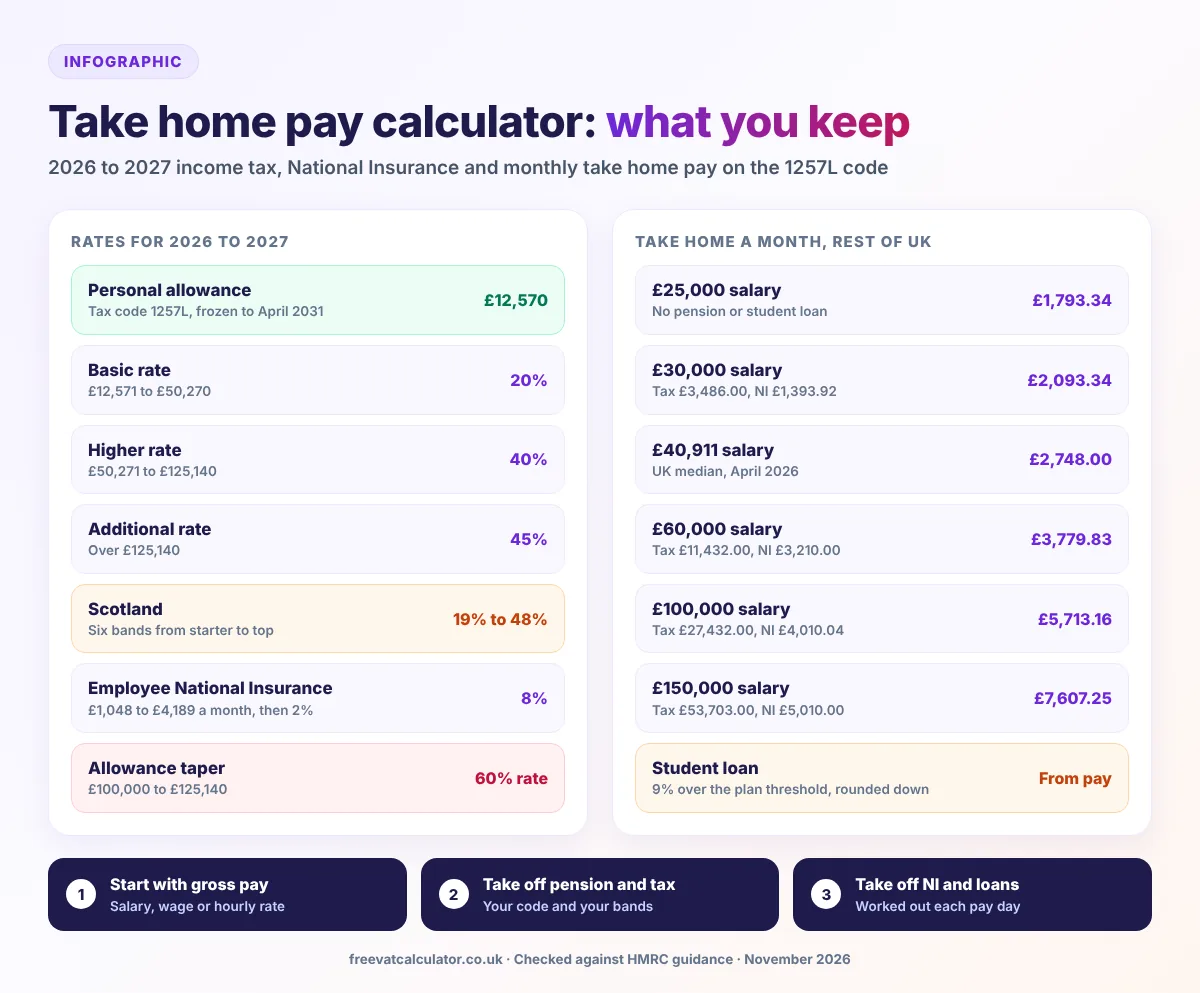
Income tax rates and bands for 2026 to 2027
Income tax bands apply to taxable income, which is your pay after the personal allowance. England, Wales and Northern Ireland pay the rates below, and Welsh taxpayers simply have a C at the start of their code.
| Band | Pay with the £12,570 allowance | Rate |
|---|---|---|
| Personal allowance | Up to £12,570 | 0% |
| Basic rate | £12,571 to £50,270 | 20% |
| Higher rate | £50,271 to £125,140 | 40% |
| Additional rate | Over £125,140 | 45% |
Personal allowance, 1257L and the £100,000 taper
Most employees get a personal allowance of £12,570, which is why the usual tax code is 1257L. Once adjusted net income passes £100,000, the allowance falls by £1 for every £2 above that level and is gone at £125,140. The thresholds stay frozen until April 2031, so pay rises pull more income into the higher bands.
Scottish income tax: take home pay in Scotland
If you live in Scotland, the Scottish Parliament sets your income tax rates and HMRC puts an S at the start of your tax code. There are six bands, and the 42% rate starts at £43,663 rather than £50,271, while National Insurance stays the same.
| Band | Pay with the £12,570 allowance | Rate |
|---|---|---|
| Starter rate | £12,571 to £16,537 | 19% |
| Basic rate | £16,538 to £29,526 | 20% |
| Intermediate rate | £29,527 to £43,662 | 21% |
| Higher rate | £43,663 to £75,000 | 42% |
| Advanced rate | £75,001 to £125,140 | 45% |
| Top rate | Over £125,140 | 48% |
Employee National Insurance in 2026 to 2027
Employees pay Class 1 National Insurance at 8% on earnings between the primary threshold and the upper earnings limit, and 2% above it. Your employer also pays 15% above £5,000 a year, but that never comes out of your pay.
| Threshold | Week | Month | Year |
|---|---|---|---|
| Lower earnings limit (counts for State Pension) | £129 | £559 | £6,708 |
| Primary threshold (8% starts) | £242 | £1,048 | £12,570 |
| Upper earnings limit (2% above) | £967 | £4,189 | £50,270 |
Why National Insurance is worked out on each pay day
HMRC’s employer guide sets the National Insurance earnings period by how often you are paid, and each period stands alone. Monthly pay uses the £1,048 threshold twelve times, which is £12,576 a year, so £30,000 paid monthly costs £1,393.92 rather than the £1,394.40 a yearly sum suggests. Pay between £559 and £1,048 a month costs nothing yet still counts towards your State Pension.
National Insurance after State Pension age
Most people stop paying National Insurance once they reach State Pension age, even if they keep working. Income tax still applies, so choose State Pension age or over and only the National Insurance line drops to £0.00.
How your tax code changes your take home pay
Your tax code tells payroll how much tax free pay to give you, so a wrong code is a common reason a payslip looks off. The calculator reads the code the way payroll does, and our guide to your tax code explains every letter.
- 1257L: the standard £12,570 allowance, which the calculator tapers above £100,000 as HMRC will through your code or after the year ends
- Another number with L or T, such as 1100L: the number times 10 is your allowance
- M or N, such as 1383M: marriage allowance of £1,260 received or given away
- BR, D0 and D1: all pay taxed at 20%, 40% or 45%, usually for a second job
- SBR, SD0, SD1, SD2 and SD3: all pay taxed at 20%, 21%, 42%, 45% or 48% in Scotland
- 0T: no allowance, with the normal bands
- NT: no tax taken from this pay
- K codes such as K475: £4,750 added to your taxable pay
Emergency codes and K codes
A code ending W1, M1 or X, such as 1257L M1, is an emergency code used while your employer waits for your details, and the calculator shows the year as if it ran all year. A K code means untaxed income or benefits, such as a company car, are larger than your allowance. HMRC’s manual caps the tax taken on any pay day at 50% of the gross pay for that period, and the calculator applies the same cap to the year.
Take home pay with pension: salary sacrifice, net pay or relief at source
How your pension is taken changes your take home pay even when the percentage is the same. Your payslip or scheme booklet says which method you have.
| Method | From your pay | Income tax | National Insurance | Take home a year |
|---|---|---|---|---|
| Salary sacrifice | £3,000.00 | £10,232.00 | £3,150.00 | £43,618.00 |
| Net pay arrangement | £3,000.00 | £10,232.00 | £3,210.00 | £43,558.00 |
| Relief at source | £2,400.00 | £11,432.00 | £3,210.00 | £42,958.00, plus £600.00 to claim |
Salary sacrifice
You give up part of your pay and your employer pays it into your pension, so you pay no income tax, National Insurance or student loan on that slice. GOV.UK says it must not take your cash pay below the National Minimum Wage, and it can lower earnings related benefits such as Maternity Allowance.
Net pay arrangement
Your contribution comes off before income tax but not before National Insurance, so you get full tax relief straight away. The Department for Education says the Teachers’ Pension Scheme works this way, so a teacher should pick net pay, choose all of your pay and enter the rate on their payslip.
Relief at source
You pay 80% of the contribution from your take home pay and the provider claims the other 20% from HMRC. Higher and additional rate taxpayers claim the extra relief through Self Assessment or HMRC’s online service, and the calculator shows that amount separately. A Scottish taxpayer on the 19% starter rate still gets the full 20%.
Auto enrolment, qualifying earnings and the annual allowance
Under auto enrolment the minimum is 8% of qualifying earnings, with at least 3% from your employer, and for 2026 to 2027 qualifying earnings are pay between £6,240 and £50,270. Choose qualifying earnings in the calculator if your scheme uses that band, or all of your pay if it uses full salary. Tax relief is limited to 100% of your earnings, and saving more than the £60,000 annual allowance across all your pensions brings a tax charge, with a lower allowance for very high earners.
Salary sacrifice changes from April 2029
From April 2029 only the first £2,000 a year of salary sacrificed pension contributions will be free of National Insurance, while the income tax relief stays. The calculator uses the 2026 to 2027 rules, so it shows the full saving that applies now.
Take home pay with student loan repayments
Student loans come out through payroll at 9% of pay above your plan’s threshold, or 6% above the Postgraduate Loan threshold. If you have a Postgraduate Loan and an undergraduate plan, both are taken, so set the Postgraduate Loan box to yes as well as choosing your plan.
| Plan | Usually for | Year | Month | Week | Rate |
|---|---|---|---|---|---|
| Plan 1 | England or Wales courses before September 2012, and Northern Ireland | £26,900 | £2,241.66 | £517.30 | 9% |
| Plan 2 | England courses from September 2012 to July 2023, and Wales from September 2012 | £29,385 | £2,448.75 | £565.09 | 9% |
| Plan 4 | Student Awards Agency Scotland | £33,795 | £2,816.25 | £649.90 | 9% |
| Plan 5 | England courses from August 2023 | £25,000 | £2,083.33 | £480.76 | 9% |
| Postgraduate Loan | Master’s or doctoral courses from September 2012 | £21,000 | £1,750.00 | £403.84 | 6% |
Why student loan deductions are rounded down
Payroll works out each repayment on the pay day and rounds it down to the whole pound, as the GOV.UK examples show. On £40,000 paid monthly, Plan 2 takes 9% of £884.58, which is £79.61, so you repay £79 a month and £948 a year.
The 60% tax trap between £100,000 and £125,140
In this band every £2 of extra income removes £1 of personal allowance, so a £100 rise costs £40 in tax plus £20 on the £50 of allowance you lose. That is an effective rate of 60%, or 62% with National Insurance, and 69.5% with National Insurance for a Scottish taxpayer.
- 60%Income tax on each extra £1 from £100,000 to £125,140
- 62%The same slice with 2% National Insurance
- 69.5%The same slice in Scotland, with National Insurance
How a pension contribution restores your allowance
Someone on a 100k salary who gets a £10,000 rise keeps only £3,800.08 of it. Pension contributions lower adjusted net income, so on £110,000 a 10% salary sacrifice of £11,000 restores the full allowance and leaves £67,978.00 a year. That puts £11,000 into the pension for a drop of only £4,380.04 in take home pay.
Working out take home pay from hourly, weekly or monthly pay
Choose per hour, per week or per month and the calculator turns your pay into a yearly figure first. Hourly pay is multiplied by your weekly hours and 52 weeks, weekly pay by 52 and monthly pay by 12, so it works as an hourly, weekly or monthly take home pay calculator in one.
Bonus and overtime
A bonus or overtime is taxed in the pay period it is paid, and income tax then evens out over the year through your tax code. National Insurance does not even out, so adding a bonus to your yearly pay gives the right income tax and a close National Insurance figure.
Why your payslip can differ from the calculator
The calculator gives the figure you should end the year with, while payroll gets there one pay day at a time. Gaps of a few pence are normal, and bigger gaps usually have one of these causes.
- Your tax code changed part way through the year
- You started after 6 April or were on an emergency code
- Overtime, a bonus, benefits in kind or other deductions went through payroll
If you think too much tax was taken, check your code in your HMRC online account first. Our guide to an HMRC tax refund explains how overpaid tax comes back.
What this calculator does not cover
The calculator is built for one employee with steady pay in the 2026 to 2027 tax year. Treat it as a careful estimate and check these gaps against your own situation.
- Pay every two or four weeks: choose weekly for the closest result
- A second job, and income from savings, dividends, rent or self employment
- Benefits in kind and expenses not already in your tax code
- Plan 1 and Plan 2 held together
- The High Income Child Benefit Charge, which starts at £60,000 of adjusted net income
- Employer National Insurance and employer pension contributions
- Week 53, starting part way through the year, and pay that changes
- National Insurance categories other than the standard category A
- Any tax year other than 2026 to 2027
Employed, self employed or paid through a company
This calculator is for people paid through payroll. If you work for yourself, our self employed tax calculator works out income tax and Class 4 National Insurance on your profit. Directors who take dividends can use our dividend tax calculator, and sole trader vs limited company compares the two structures.
Not sure your tax code is right?
Our guide to the tax code explains 1257L, BR, K codes and emergency codes. It also shows how to fix a code that looks wrong.
Take home pay calculator FAQs
These are the questions people ask most when they check their pay after tax. Each answer uses the 2026 to 2027 rules for an employee paid monthly.
How do I work out my take home pay?
Start with gross pay and take off any salary sacrifice or net pay pension, then income tax on pay above your allowance, National Insurance at 8% above £1,048 a month and any student loan. The calculator above does each step and shows the working, so you can check it against your payslip.
How much is 45k, 50k or 60k after tax in the UK?
In England, Wales or Northern Ireland, £45,000 leaves £35,920.08 a year, £50,000 leaves £39,520.12 and £60,000 leaves £45,358.00. That is £2,993.34, £3,293.34 and £3,779.83 a month, with no pension or student loan.
Is this a gross to net salary calculator?
Yes, it turns gross pay into net pay, which is the money paid into your bank. It also works as a take home salary check on a job offer, because you can enter the advertised salary with your own tax code and loan plan.
Is take home pay different in Northern Ireland?
No, Northern Ireland uses the same income tax bands and National Insurance as England and Wales. Only Scotland has different income tax rates, and Northern Ireland borrowers are usually on Plan 1.
You now have your take home pay for the year, the month and the week, with every deduction explained against the 2026 to 2027 rules. Run the calculator again whenever your salary, tax code, pension or student loan changes.
Sources: GOV.UK income tax rates; Scottish income tax; Welsh income tax; rates and thresholds for employers 2026 to 2027; National Insurance rates; CWG2 2026 to 2027; NIM11002; what your tax code means; PAYE11095 K codes; student loan repayments; student loan guidance for employers; student loan plans; pension tax relief; annual allowance; workplace pension contributions; auto enrolment thresholds 2026 to 2027; salary sacrifice; salary sacrifice from April 2029; Department for Education on teachers’ pensions; minimum wage rates; tax after State Pension age; marriage allowance; High Income Child Benefit Charge; ONS earnings 2026; Budget 2026 overview. This page is general information, not tax advice.