Couples tax guide
Marriage Allowance 2026 to 2027: Calculator, Eligibility and How to Claim the £252 Tax Break
How the transfer works
- Married or civil partnersLiving together is not enough
- Lower earnerIncome £12,570 or less
- Higher earnerBasic rate, or up to intermediate in Scotland
- Apply freeOnline, or form MATCF for past years
- Renews each AprilUntil you cancel
One of you earns little or nothing, perhaps because of childcare, study, a small pension or a few hours of work, so part of that person’s £12,570 tax free allowance goes unused every year. Meanwhile the other partner pays basic rate tax on every pound above the same line. Many couples only learn years later that some of that spare allowance could have moved across.
This page shows in a minute if you qualify, what you save this year and what you can reclaim back to April 2022. It also covers Scotland, the new tax codes and what happens if your income changes, you separate or one of you dies. Claimed directly on GOV.UK, marriage allowance costs nothing and can be worth up to £1,260 across five tax years.
Marriage allowance calculator: do you qualify and how much will you save?
Enter both incomes for this tax year before tax, say where each of you pays income tax and choose how many earlier years to add. The calculator applies the GOV.UK tests, works out the tax change on both sides and shows the codes HMRC will issue.
Marriage allowance calculator
Who qualifies, the saving, backdated years and the new tax codes
| Tax year | Saving | How you get it |
|---|---|---|
| 2026 to 2027 | £252.00 | Tax code from now |
| 2025 to 2026 | £252.00 | Lump sum, claim by 5 April 2030 |
| 2024 to 2025 | £252.00 | Lump sum, claim by 5 April 2029 |
| 2023 to 2024 | £252.00 | Lump sum, claim by 5 April 2028 |
| 2022 to 2023 | £252.00 | Lump sum, claim by 5 April 2027 |
| Total | £1,260.00 |
You qualify: you transfer £1,260 to your partner
You make the claim as the lower earner. Your partner’s tax falls by £252.00 a year, about £21.00 a month, and your reduced allowance of £11,310 still covers all of your income.
Tax codes after the claim
From the standard 1257L code, your partner’s code becomes 1383M, a tax free amount of £13,830, and yours becomes 1131N, a tax free amount of £11,310. The change can take up to 2 months and is backdated to 6 April.
The working
Your partner pays £3,486.00 of income tax on £30,000.00. The transfer cuts that by 20% of £1,260, which is £252.00. Your allowance falls to £11,310, which still covers your income of £8,000.00, so you pay no extra tax. The couple saves £252.00 a year, and the same amount for each of the 4 earlier years adds £1,008.00, £1,260.00 in all.
Uses 2026 to 2027 rates. The allowance and the limits were the same in every year back to 2022 to 2023, and the tool assumes your incomes were similar in those years. Income means wages, pensions and profit; if you have large savings interest or dividends, check with the Income Tax helpline. Nothing you enter is stored or sent.
Key facts
- Allowance transferred
- £1,260, 10% of the £12,570 personal allowance
- Most a couple saves
- £252 a year, about £21 a month
- Backdating
- To 6 April 2022, up to £1,008 more
- Higher earner limit
- £50,270, or £43,662 in Scotland
- New tax codes
- 1383M for the receiver, 1131N for the giver
- Who applies
- The lower earner, free on GOV.UK
What is marriage allowance?
It is a transfer of £1,260 of tax free personal allowance from the lower earner in a marriage or civil partnership to the higher earner. The law fixes it at 10% of the personal allowance, rounded up to the next £10, so it stays at £1,260 while the allowance is frozen at £12,570. HMRC then cuts the higher earner’s tax by 20% of the transfer, which is £252 a year or £21 a month.
The relief began on 6 April 2015, when the amount was £1,060. You will also see it called the marriage tax allowance, the transferable tax allowance, the married tax allowance or even the marital allowance, and all of these mean the same relief.
How the £1,260 transfer works in practice
GOV.UK’s own example has a lower earner on £11,500 and a partner on £20,000. After the claim the lower earner’s allowance falls to £11,310, so they pay 20% on £190, which is £38. The partner’s bill falls by £252, so the couple keeps £214 a year even though the giver now pays a little tax.
Marriage allowance eligibility: who can claim
Three tests decide if you qualify, and HMRC applies them to each tax year separately. Scotland differs only on the higher earner’s limit.
| Condition | England, Wales and Northern Ireland | Scotland |
|---|---|---|
| Relationship | Married or in a civil partnership | Married or in a civil partnership |
| Lower earner’s income | £12,570 or less, no income tax paid | £12,570 or less, no income tax paid |
| Higher earner’s tax band | Basic rate only | Starter, basic or intermediate rate only |
| Higher earner’s income, usually | £12,571 to £50,270 | £12,571 to £43,662 |
The lower earner’s income
The partner who gives up the allowance should normally have income below the £12,570 personal allowance, counting earnings, pensions, rent and profit actually received in the year. Being out of work or on maternity leave does not stop a claim. A wife, husband or civil partner with no income gives the biggest benefit, and the rules treat a married man and a married woman the same way.
The higher earner must be a basic rate taxpayer
The partner receiving the transfer must pay no more than basic rate tax, which usually means income between £12,571 and £50,270. A single pound taxed at 40% rules out the whole year.
Gift Aid and pension contributions paid under relief at source lengthen the basic rate band under section 10 of the Income Tax Act 2007. A partner just over £50,270 may then pay no higher rate tax.
Scotland: starter, basic and intermediate rates
In Scotland the receiving partner must pay only the starter, basic or intermediate rate, which for 2026 to 2027 usually means income between £12,571 and £43,662. Each partner is tested on where they live, so a couple can include one Scottish taxpayer and one who is not.
The cut stays at 20% because the law sets it at the Scottish basic rate, so a receiver on the 19% or 21% rate still saves up to £252. A Scottish giver earning between £11,310 and £12,570 pays the extra tax at only 19%.
Pensioners, the self employed and couples abroad
A pension does not affect eligibility, and many retired couples qualify. Someone whose only income is the full new State Pension of £241.30 a week, £12,547.60 over 52 weeks, sits just £22.40 under the allowance, so a transfer saves that couple only £4.48.
Self employed partners face the same tests on taxable profit, which our self employed tax calculator works out. Living abroad does not block a claim as long as you still receive a UK personal allowance.
Who cannot claim
- Couples who live together but are not married or in a civil partnership
- Couples where either partner pays higher rate tax
- Couples where both partners have income above £12,570
- Couples where neither partner pays income tax
- Anyone claiming married couple’s allowance for the same year
How much is marriage allowance worth?
For most couples the answer is £252 a year, but the figure shrinks when either income sits close to £12,570. The table shows the net saving when the higher earner is on £30,000 in England.
- £252Most a couple saves in one tax year
- £21The same saving each month through PAYE
- £1,260Five years claimed together, back to 2022 to 2023
| Lower earner’s income | Extra tax for the lower earner | Couple’s saving |
|---|---|---|
| £0 to £11,310 | £0.00 | £252.00 |
| £11,500 (the GOV.UK example) | £38.00 | £214.00 |
| £12,000 | £138.00 | £114.00 |
| £12,547.60 (full new State Pension) | £247.52 | £4.48 |
| £12,570 | £252.00 | £0.00 |
When the lower earner earns between £11,310 and £12,570
Once the allowance moves, every pound the giver earns above £11,310 is taxed at 20%, or 19% in Scotland. The gain shrinks by 20p for each extra pound until it reaches nothing at £12,570 in England, Wales and Northern Ireland.
When the higher earner earns less than £13,830
The cut can only come off tax the receiver actually owes. A partner on £13,000 in England pays just £86, so the cut stops there, and if the giver earns over £11,310 the couple can lose. The full £252 applies from £13,830, or about £13,897 in Scotland.
Marriage allowance backdated: claim for up to four earlier years
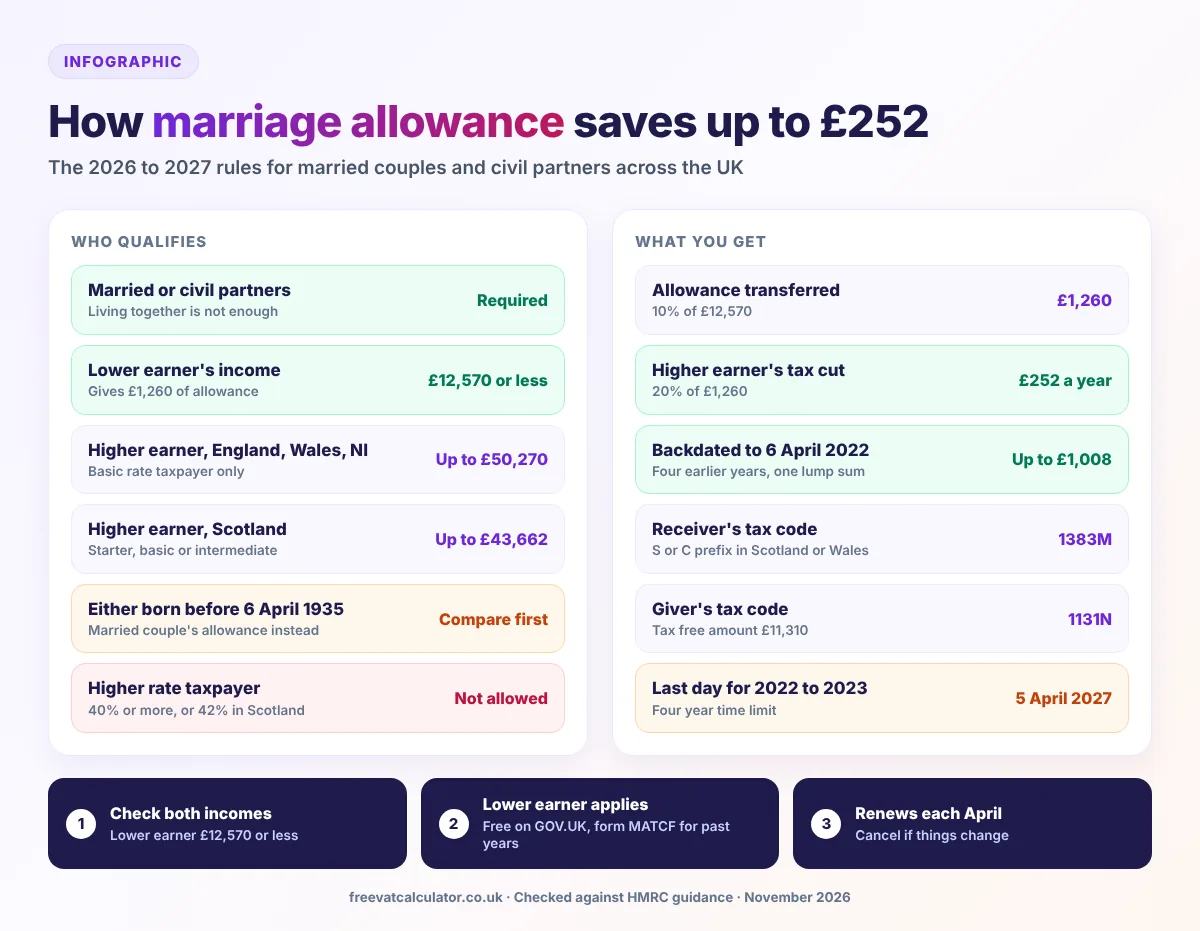
If you qualified earlier but never claimed, you can go back to 6 April 2022, the start of 2022 to 2023. Each year is tested on its own incomes, and the limits were identical in all of them: £12,570, £50,270 and £43,662 in Scotland.
| Tax year | Amount transferred | Most the couple saves | Last day to claim |
|---|---|---|---|
| 2022 to 2023 | £1,260 | £252 | 5 April 2027 |
| 2023 to 2024 | £1,260 | £252 | 5 April 2028 |
| 2024 to 2025 | £1,260 | £252 | 5 April 2029 |
| 2025 to 2026 | £1,260 | £252 | 5 April 2030 |
| 2026 to 2027 | £1,260 | £252 | 5 April 2031 |
| All five years | £6,300 | £1,260 |
The 5 April 2027 deadline for 2022 to 2023
Claims for income tax relief must be made within four years of the end of the tax year, so 2022 to 2023 drops out after 5 April 2027. A couple who qualified in all five years and claims before then can receive £1,008 for the past years plus £252 through this year’s tax code.
How the backdated money is paid
HMRC pays the earlier years to the higher earner as one lump sum, often called a marriage tax rebate, while the current year comes through a tax code or a Self Assessment return. Our guide to an HMRC tax refund explains how repayments arrive and how to spot fake refund messages.
How to claim marriage allowance
The lower earner makes the claim, because it is their allowance that moves. If either of you has savings interest or dividends, GOV.UK suggests calling the Income Tax helpline first to agree who should apply.
- Check you both qualify with the calculator above.
- Find both National Insurance numbers, your wedding date and photo ID.
- Apply for marriage allowance online at GOV.UK for this year.
- Post form MATCF to add earlier years.
- Expect a confirmation email within 24 hours.
- Check both new tax codes when HMRC writes.
Applying online, by post or by phone
The online service covers the current year onwards. To register for past years you need form MATCF, completed on screen and posted to the address on its third page. If your partner has died since 5 April 2022, or you cannot get a National Insurance number, phone the Income Tax helpline instead.
Claiming through Self Assessment
On a tax return the giver claims in the transfer section and the receiver leaves it blank, and if you both file, the giver files at least 3 days first. Our Self Assessment deadline guide lists the dates.
Free to claim: avoid claims companies
Applying through GOV.UK is free, and HMRC has said couples who claim directly keep 100% of the relief. Firms that make backdated claims for a share of the refund sell you nothing you cannot do yourself in a few minutes.
Marriage allowance tax code: M and N explained
HMRC changes both PAYE codes so the saving reaches you through pay or pension. The receiver’s code ends in M and the giver’s in N, and from the standard 1257L the number moves by 126, the transfer divided by 10.
| Where you pay tax | Receiver’s code | Giver’s code |
|---|---|---|
| England or Northern Ireland | 1383M | 1131N |
| Wales | C1383M | C1131N |
| Scotland | S1383M | S1131N |
1383M gives a tax free amount of £13,830 and 1131N gives £11,310. Other adjustments, such as a company car, change the numbers but not the letters, and our tax code guide decodes the rest.
How long the new codes take
GOV.UK warns that the new codes can take up to 2 months to arrive. Because the change is backdated to 6 April, a normal cumulative code then catches up the missed months through later pay.
How to cancel or report a change
The transfer renews every April by itself, so you must stop it when you no longer qualify. Cancel if the relationship ends, if an income change makes you ineligible, or if you no longer want it.
How to cancel
The partner who made the claim cancels online or by phone on 0300 200 3300, Monday to Friday from 8am to 6pm. When the relationship has ended, either partner can cancel, and our contact HMRC guide lists the other helplines.
If your income changes
If the giver’s income rises above £12,570 or the receiver becomes a higher rate taxpayer, cancel and the claim runs to 5 April. That can leave one of you with tax to pay, so check your next tax calculation.
Divorce, dissolution or legal separation
After a divorce, the end of a civil partnership or a legal separation, the claim must be cancelled, and the change can be backdated to 6 April of that tax year. The receiver may then owe tax for months already paid.
If your partner dies
If the receiver dies, their estate keeps the higher allowance for that year and the giver’s allowance returns to £12,570. If the giver dies, the receiver keeps the bigger allowance until 5 April and the estate is treated as having £11,310.
A claim can still be made after a death by phoning the Income Tax helpline. The law lets a personal representative make it for the year of death or earlier years.
Marriage allowance vs married couple’s allowance
Searches for a married persons tax allowance or a married couples tax allowance often land on the wrong relief. Married couple’s allowance only applies where one partner was born before 6 April 1935, so one of you is now 91 or older.
| Feature | Marriage allowance | Married couple’s allowance |
|---|---|---|
| Who can get it | Couples meeting the income tests | Couples where one was born before 6 April 1935 |
| Value | Up to £252 a year | £453 to £1,170 a year |
| Income test | Giver £12,570 or less, receiver basic rate | Cut by £1 for every £2 of income over £39,200 |
| Higher rate taxpayers | Cannot take part | Can still claim, at a reduced amount |
You cannot hold both in the same year, so couples who qualify for each should compare them. The married couple’s allowance itself rises to between £4,690 and £12,110 in 2027 to 2028, worth £469 to £1,211 off the tax bill, while the £1,260 transfer stays the same.
Other marriage tax benefits
Marriage and civil partnership change other taxes as well. These are the main spouse tax relief rules on GOV.UK.
- No Capital Gains Tax on assets you give or sell to your spouse, and after you separate this lasts until the end of the third tax year after you stop living together, or the divorce if that comes first, with no such limit for assets covered by a formal divorce agreement or court order
- No Inheritance Tax on what you leave to a spouse or civil partner
- Any unused part of the £325,000 Inheritance Tax threshold can pass to the surviving partner
Self employed or with a side income?
Our self employed tax calculator works out income tax and National Insurance on your profit for 2026 to 2027.
Marriage allowance FAQs
These are the questions couples ask most once they have run their numbers. Each answer uses the 2026 to 2027 rules on GOV.UK.
Is marriage allowance worth it?
For most eligible couples it is, since £252 a year comes from one short form and backdating can add £1,008. It is not worth it when the giver earns close to £12,570 or the receiver under about £13,830.
Can a higher rate taxpayer take part?
No, neither partner may pay tax above the basic rate, or the intermediate rate in Scotland. A receiver on £50,271 or more in England is ruled out unless Gift Aid or pension contributions extend the band.
Is there an official checker or calculator?
HMRC has a free benefit calculator on GOV.UK that asks where you live and for both incomes. The calculator on this page also shows the backdated years and new tax codes, but neither one is an application.
Which phone number do I call?
Call the Income Tax helpline on 0300 200 3300, Monday to Friday from 8am to 6pm. From outside the UK the contact number is +44 135 535 9022.
Why do so many couples miss out?
Many people have never heard of it, even though about 2.35 million claims were made for 2022 to 2023, according to a Treasury answer to Parliament in March 2026. Campaigners such as Martin Lewis of MoneySavingExpert have urged couples to check for years.
You now know whether marriage allowance suits your household, what it is worth, how far back you can go and how to apply for free. Run your figures through the calculator, apply online for this year, and post form MATCF before 5 April 2027 if 2022 to 2023 counts.
Sources: GOV.UK guide; how to apply; if your circumstances change; apply by post (MATCF); apply online; HMRC service: how it works; Income Tax rates and allowances; Scottish Income Tax; Scottish rates 2022 to 2023; what your tax code means; Married Couple’s Allowance; Budget 2025 rates; Budget 2026 rates; ITA 2007 s55B; s55C; CG21204 (s10 band extension); TMA 1970 s43; new State Pension; HMRC news, lump sum; HMRC news, claim directly; written answer HL14672; Income Tax helpline; CGT on gifts; HMRC manual CG22200, separated spouses; Inheritance Tax. This page is general information, not tax advice.