
Partial exemption guide
Partial Exemption VAT: How to Work Out Recoverable VAT and Pass the De Minimis Test
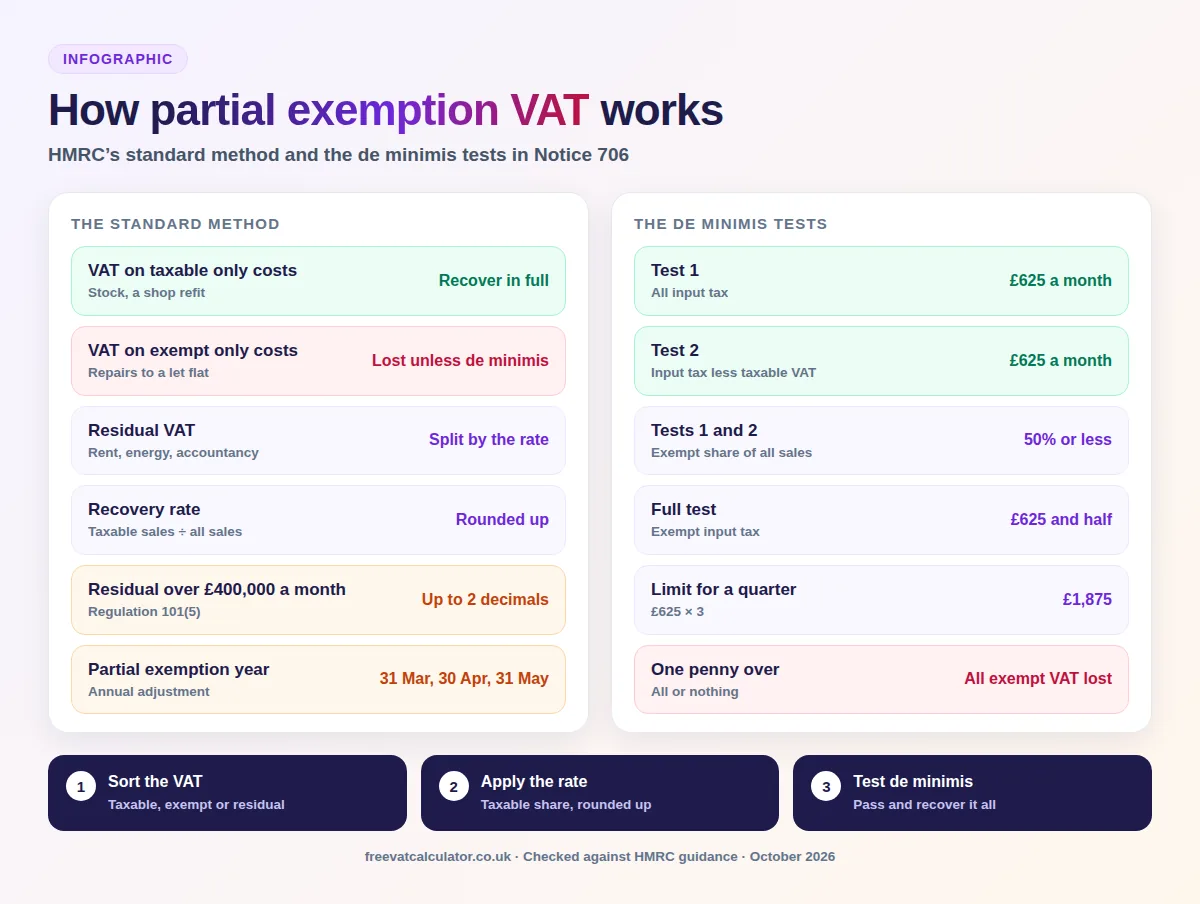
How partial exemption VAT works
- Sort input taxTaxable, exempt or residual
- Find the rateTaxable ÷ all sales
- Split residual VATRate rounded up
- Test de minimis£625 a month and half
- Adjust yearlyAnnual adjustment
Most of what you sell carries VAT, but some income is exempt: rent from a flat, insurance commission or a nursery class. Now the VAT on your rent, energy and accountant’s bill is mixed, and your software cannot tell you how much of it you may reclaim. Claim it all and HMRC can take it back with interest, but claim too little and you lose money that was yours.
This guide gives you a calculator for HMRC’s standard method and all three de minimis tests, then explains each rule in VAT Notice 706 with worked examples. By the end you can work out your partial exemption VAT position for any quarter or year in minutes.
Partial exemption VAT calculator: recovery rate and de minimis tests
Choose the period, then enter your input tax in its three groups and your sales without VAT. Leave out blocked VAT, such as business entertainment, and VAT on non business activities. The calculator applies HMRC’s rounding rule, runs tests 1 and 2 and the full test, and shows the working.
Partial exemption VAT calculator
Standard method and de minimis tests, Notice 706
De minimis: all your input tax is recoverable
You fail tests 1 and 2 but pass the full test.
- Test 1Working it outFail
- Test 2Working it outFail
- Full de minimis testWorking it outPass
The working
Use values without VAT, and leave out blocked VAT, non business VAT, capital asset sales and bank interest. Period results are provisional until the annual adjustment.
Key facts
- Recovery rate
- Taxable sales ÷ all sales, without VAT
- Rounding
- Up to a whole number, or up to 2 decimals above £400,000 a month
- De minimis limit
- Exempt input tax £625 a month or less and half or less of all input tax
- Limit per period
- £1,875 a quarter, £7,500 a year
- Year end
- 31 March, 30 April or 31 May
- Capital Goods Scheme
- Land and buildings from £600,000 since 29 July 2026
What is partial exemption VAT?
Partial exemption VAT rules apply when a business makes both taxable and exempt supplies. VAT on costs for taxable sales is recoverable, but VAT on costs for exempt sales normally is not. The law starts at regulation 101 of the VAT Regulations 1995, and HMRC explains it in VAT Notice 706.
Exempt is not the same as zero rated
Zero rated sales are taxable at 0%, so the VAT on their costs is recoverable in full, while exempt sales give no such right. A bookshop selling zero rated books is fully taxable, but one that also lets the flat upstairs is partly exempt.
Which supplies are exempt from VAT?
HMRC’s list of exempt supplies is long, but a few groups cause most cases. Check your income for these.
- insurance, and brokers arranging it
- loans, credit and other financial services
- letting land and buildings, unless opted to tax
- care by registered doctors, dentists and opticians
- education by eligible bodies other than private schools
- charity fundraising events
- betting, gaming and lotteries
Should a partly exempt business register for VAT?
Exempt sales do not count towards the £90,000 registration threshold, which uses taxable turnover only. A business with only exempt sales cannot register voluntarily, but until 31 March 2027 any services it buys from overseas under the reverse charge count towards the £90,000 threshold and can make it register. A Budget 2026 measure limits the reverse charge to VAT registered buyers from 1 April 2027, so the overseas supplier will charge UK VAT instead. A business below the threshold that makes some taxable sales can register voluntarily, as our guide on how to register for VAT explains.
Which businesses are partly exempt?
Any business with a mix of taxable and exempt income can be partly exempt, and the exempt part is often a side line. These are the most common cases.
| Business | Taxable income | Exempt income |
|---|---|---|
| Landlord | Commercial rent opted to tax | Residential rent |
| Private school | Fees, standard rated since 2025 | Nursery classes |
| Dentist or optician | Retail products | Registered health services |
| Insurance broker | Taxable consultancy fees | Commission as an intermediary |
| Charity | Merchandise and catering | Fundraising events |
| Gym or sports club | Memberships and classes | Letting an office to another business |
| Shop with a flat above | Shop sales | Rent from the flat |
Private schools since January 2025
Private school fees became standard rated at 20% on 1 January 2025, but nursery classes for children below compulsory school age stay exempt. HMRC’s Notice 701/30 covers the nursery rule, and HMRC’s separate guidance on charging and reclaiming VAT on private school fees says schools are likely to make both taxable and exempt supplies, so most are partly exempt.
Landlords and the option to tax
Letting property is exempt by default, so a landlord with homes and shops is usually partly exempt. Opting to tax a commercial building makes its rent taxable, as our guide to the option to tax explains, but an option has no effect on homes.
The three groups of input tax
Each purchase goes into one of three groups when it arrives, based on how you intend to use it. Later changes of use go through clawback and payback, covered below.
| Group | Examples | Recoverable? |
|---|---|---|
| Used only for taxable sales | Stock for resale, a shop refit | In full |
| Used only for exempt sales | Repairs to a let flat | Only if de minimis |
| Residual, used for both | Rent, energy, accountancy, software | By the recovery rate |
Residual input tax
Residual input tax is VAT on costs serving the whole business, and only this group is split by the recovery rate. HMRC applies the direct and immediate link test from the European Court’s BLP case, so a genuine link to both kinds of income makes a cost residual.
Take out blocked and non business VAT first
Blocked VAT, such as VAT on business entertainment, comes out first and does not count in the de minimis tests. VAT on non business activities is not input tax at all, and no de minimis limit applies to it.
How the standard method works
The standard method is the default, and you can use it without asking HMRC. It shares out residual VAT in the proportion your taxable sales bear to all sales, in seven steps.
- total the input tax used only for taxable supplies
- total the input tax used only for exempt supplies
- treat the rest as residual input tax
- divide taxable supplies by all supplies and round up
- apply that rate to residual input tax
- add steps 1 and 5 for the VAT you recover
- add step 2 to the unrecovered residual for exempt input tax
The partial exemption VAT calculation formula
The recovery rate is taxable supplies ÷ (taxable supplies + exempt supplies) × 100, using values without VAT. With £90,000 of taxable sales and £30,000 of exempt sales, the rate is 75%.
The rounding rule
The rate is rounded up to the next whole number, so 67.2% becomes 68%, where residual input tax is £400,000 a month or less on average, and otherwise up to two decimal places. Notice 706 speaks only of rounding to two decimal places for the larger case, but regulation 101(5) and HMRC’s manual page PE30500 both say rounded up, which the calculator follows.
Values you leave out of the fraction
Some income would distort the rate, so it comes out of both the top and the bottom of the fraction. Leave out these.
- sales of capital assets, such as a van
- incidental income such as bank interest
- self supplies, including reverse charges
- items that are not supplies, such as share issues
- supplies from establishments outside the UK
Using last year’s recovery rate
Since 1 April 2009 you can use last year’s final rate as a provisional rate on each return, if you made an annual adjustment last year. You keep that choice all year, and the annual adjustment puts in the real figures.
New businesses and the use based option
A newly registered business can recover residual VAT based on actual use, without approval, during its registration period. That period ends the day before its first partial exemption year starts, and the same choice is open in any later year that follows a period with no exempt input tax, which covers a business that becomes partly exempt for the first time.
Partial exemption VAT calculation examples
These four quarters show how the same rules give very different results. Each uses the standard method and a quarterly limit of £1,875, which is £625 × 3.
| Figure | Quarter A | Quarter B | Quarter C | Quarter D |
|---|---|---|---|---|
| Taxable supplies | £60,000 | £90,000 | £70,000 | £75,000 |
| Exempt supplies | £20,000 | £30,000 | £45,000 | £25,000 |
| Recovery rate | 75% | 75% | 61% | 75% |
| Taxable input tax | £900 | £6,000 | £5,000 | £3,000 |
| Exempt input tax, direct | £300 | £800 | £2,500 | £1,375 |
| Residual input tax | £600 | £2,000 | £3,000 | £2,000 |
| Total exempt input tax | £450 | £1,300 | £3,670 | £1,875 |
| Result | Passes test 1 | Passes full test | Fails | Passes full test |
| VAT recovered | £1,800 | £8,800 | £6,830 | £6,375 |
Example 1: passing test 1
Quarter A has total input tax of £1,800, under £1,875, and exempt sales are 25% of all sales. It passes test 1, so all £1,800 is recoverable.
Example 2: failing test 1 but passing the full test
Quarter B fails test 1 with £8,800 of input tax and test 2 with £2,800. At 75%, £500 of residual VAT is exempt, so exempt input tax is £1,300 and all £8,800 is recoverable.
Example 3: over the de minimis limit
Quarter C’s rate is 60.87%, rounded up to 61%, so £1,830 of the £3,000 residual VAT is recoverable. Exempt input tax of £3,670 is over £1,875, so the business recovers £6,830 and loses £3,670.
Example 4: exactly £625 a month
Quarter D has exempt input tax of exactly £1,875, which is not more than £625 a month, so all £6,375 is recoverable. One more penny would fail the test and lose the whole £1,875.01.
The partial exemption de minimis limit
You are de minimis, and recover all your input tax, when exempt input tax is no more than £625 a month on average and no more than half of all input tax. That means £1,875 a quarter or £7,500 a year.
HMRC’s manual calls de minimis an all or nothing test, not an allowance. Pass and you recover every penny of exempt VAT, but fail by a penny and you recover none.
| Test | Input tax condition | Second condition |
|---|---|---|
| Test 1 | All input tax £625 a month or less | Exempt sales 50% or less |
| Test 2 | All input tax less taxable input tax £625 a month or less | Exempt sales 50% or less |
| Full test | Exempt input tax £625 a month or less | Half or less of all input tax |
| Annual test | De minimis last year | £1 million input tax or less expected |
Simplified tests 1 and 2
Since 1 April 2010, passing test 1 or test 2 lets you skip the apportionment for that period. Test 2 is the one written into regulation 105A, and test 1 is a narrower version, so passing test 1 always means passing test 2.
The full de minimis test
If both simplified tests fail, run the standard method and add the exempt share of residual VAT to the exempt input tax. Capital Goods Scheme adjustments are left out of this test.
The annual test
A business that was de minimis last year can treat every return this year as de minimis, if it expects no more than £1 million of input tax and uses the test all year. If it then fails for the year, it repays the exempt VAT recovered during it.
The partial exemption annual adjustment
Every return during the year is provisional. At the year end you redo the calculation and the de minimis test with the year’s figures, and the difference from what you claimed is the annual adjustment.
When is the partial exemption year end?
The year normally ends on 31 March, 30 April or 31 May, matching your VAT quarters, and monthly filers use 31 March. You can write to HMRC to ask for a different year end.
| VAT quarters end in | Year ends | Default adjustment return |
|---|---|---|
| March, June, September, December | 31 March | Quarter to 30 June |
| April, July, October, January | 30 April | Quarter to 31 July |
| May, August, November, February | 31 May | Quarter to 31 August |
| Monthly returns | 31 March | April |
Which return the adjustment goes on
By default it goes on the first return after the year ends, or you can bring it forward to the year’s last return. If you use the VAT cash accounting scheme, input tax counts when you pay the supplier, so a bill paid after the year end joins next year.
How to do the annual adjustment
The steps mirror the quarterly calculation, using totals for the year. Our guide on how to do a VAT return covers submitting the return that carries it.
- total each group of input tax for the year
- work out the year’s rate and round it up
- apply it to the year’s residual input tax
- run the de minimis tests on the year
- enter the difference from your claims on the return
Partial exemption in Xero and other software
On 31 August 2026 Xero said native partial exemption calculations are a known gap and not on its roadmap. Xero users work out the figure themselves and post it as an adjustment.
The standard method override
Where sales values do not reflect how costs are used, the override makes you correct the result at the annual adjustment. It bites if the gap against a use based result is over £50,000, or over both 50% of residual input tax and £25,000. It only applies where residual input tax tops £50,000 a year, or £25,000 a year for a company with fellow group companies outside its VAT group.
Partial exemption special methods
If the standard method does not fit, HMRC can approve a special method, which is any other fair and reasonable calculation. You need written approval first, and a new method usually starts from the tax year in which HMRC receives your declaration.
- floor area for each activity
- staff time or staff numbers
- numbers of transactions
- separate sector calculations
How to apply for a special method
Apply through HMRC’s online service or by post, with worked examples from your own figures and a signed declaration that the method is fair. Its recovery rate must be worked out to two decimal places, and HMRC can serve an override notice if the method stops being fair.
Capital Goods Scheme, clawback and payback
The Capital Goods Scheme adjusts VAT on large assets over several years. Under Revenue and Customs Brief 7 (2026), computers bought on or after 29 July 2026 are outside the scheme, and for land bought, or buildings and civil engineering works bought, built or improved, from that date the threshold rose from £250,000 to £600,000, excluding VAT. Items already in the scheme on that date stay in it until their adjustment periods end. Ships and aircraft of £50,000 or more are unchanged, and outstanding adjustments go on your final return if you deregister from VAT.
Clawback and payback
Clawback means repaying VAT you reclaimed for a taxable use if the purchase goes to exempt use within six years. Payback works the other way, letting you claim VAT you held back if the use turns taxable.
Moving goods from Great Britain to Northern Ireland
Moving your own goods from Great Britain to Northern Ireland is not a sale, but it brings an import VAT charge, so a restriction already applied to their VAT can bite twice. If the goods move within 12 months of that VAT being incurred and are unused or kept for the same use, HMRC lets you recover the VAT first held back in your annual adjustment, or on the same return if the move falls in a later partial exemption year.
Common partial exemption mistakes HMRC looks for
If HMRC opens a VAT compliance check, expect it to ask for your partial exemption working. These errors come up most.
- claiming all the VAT on shared overheads
- reusing one rate with no annual adjustment
- counting blocked VAT in the de minimis tests
- missing that partial exemption VAT rules catch a let flat
- treating zero rated sales as exempt
- testing de minimis only quarter by quarter
Keeping partial exemption records
Your records must show the recoverable input tax for each VAT period and each partial exemption year. You must also keep any other records you use to work it out, such as the sales figures behind your recovery rate.
How to correct a partial exemption error
From 1 April 2028 a Budget 2026 measure will oblige you to correct an error in a return once you find it, or tell HMRC, and an error you knowingly leave is treated as deliberate for penalties. Annual adjustments made accurately and on time are not errors. A wrong one is, and net errors up to £10,000, or 1% of box 6 up to £50,000, can go on your next return, as our guide on how to correct VAT errors explains.
What partial exemption costs your business
VAT you cannot recover is a real cost, so build it into your prices. Running the calculator each quarter shows the likely annual adjustment in time to plan for it.
Filing the return next?
Our guide on how to do a VAT return shows how to complete and submit the return that carries your partial exemption figures.
Partial exemption VAT FAQs
These are the questions partly exempt businesses ask most. The sections above give the detail.
What is the de minimis limit for VAT partial exemption?
Exempt input tax of no more than £625 a month on average and no more than half of all input tax. That is £1,875 a quarter or £7,500 a year.
Is the partial exemption percentage rounded up or down?
Always up. It goes to the next whole number, or to two decimal places where residual input tax averages over £400,000 a month.
Do I need a partial exemption calculation on every VAT return?
Yes, unless you pass test 1 or 2 or use the annual test. You can also use last year’s rate provisionally and correct it at the year end.
Are zero rated sales treated as exempt?
No. They are taxable at 0%, so they raise your recovery rate.
Do I need HMRC approval for the standard method?
No, it is the default. Only special methods need written approval.
You now have a calculator, the rounding rule, four worked examples and the year end dates for every stagger. All the information you need to work out how much VAT your partly exempt business can recover is above, and Notice 706 or a VAT adviser can confirm an unusual case.
Sources: HMRC VAT Notice 706; VAT Regulations 1995, regulations 101, 105A, 106 and 106ZA; HMRC manual PE24500, PE30500 and PE31200; Revenue and Customs Brief 7 (2026); HMRC Notices 706/2, 701/30 and 700/45; HMRC VAT rates; HMRC exemption guidance; HMRC VAT registration. This page is general information, not tax advice.