
Self employment guide
Register as Self Employed: HMRC Sole Trader Registration, the 5 October Deadline and Your UTR
How to register as self employed in five steps
- Check your takingsOver £1,000 a tax year
- Note the deadline5 October after the tax year
- Sign in on GOV.UKGateway or One Login
- Fill in the formDetails and start date
- Get your UTRWithin 72 hours online
You have started earning on your own, from cleaning jobs, freelance design or a market stall that is finally paying, and nobody is taking tax off the money. Then someone mentions a deadline, a fine or a form with a code for a name, and it is hard to tell whether any of it applies to you yet.
This guide starts with a checker that gives your verdict, your exact deadline and what else follows, such as VAT or Making Tax Digital. After it come the GOV.UK steps, what to have ready and how long the UTR takes, so you can register as self employed once, correctly and on time.
Do I need to register as self employed? Check your deadline
Enter the date you started, or will start, and your takings for that tax year before any costs. The checker applies HMRC’s rules for that year and shows your deadline, your first return date and anything else that applies.
Do I need to register, and by when?
Your verdict, deadline, first return date and whether VAT or MTD apply
You need to register by 5 October 2027
Your takings of £4,800.00 are over the £1,000 trading allowance for 2026 to 2027, so register for Self Assessment as a sole trader by 5 October 2027.
Based on GOV.UK guidance checked on 11 November 2026. Nothing you enter is stored or sent.
Key facts
- Register if takings are over
- £1,000 a tax year, £3,000 from 6 April 2027
- Deadline
- 5 October after the tax year you start
- UTR
- Online within 72 hours, by post in 15 working days
- Class 4 National Insurance
- 6% from £12,570, 2% above £50,270
- Self Assessment helpline
- 0300 200 3310, weekdays 8am to 6pm
- Fee to register
- None listed on GOV.UK
What being self employed means
You are self employed when you run your own business instead of working for an employer, and most people who set up as a sole trader start this way. GOV.UK describes a sole trader as someone who makes the decisions and keeps the profit after tax, but is personally liable for the business’s debts.
Signs that you are running a business
HMRC looks at how you work, not at your job title. You are probably in business if several of these are true.
- you carry the risk if the business fails
- you have several customers at once
- you decide how, where and when you work
- you provide the main equipment
- you put right poor work in your own time
- you charge a fixed price or sell for profit
Freelance, contractor or employee?
A freelance writer, a plumber and a dog walker are all self employed if they pass these tests. If a client controls your hours like an employer, use HMRC’s Check Employment Status for Tax tool, which HMRC stands by if your answers are accurate.
Self employed and employed at the same time
You can keep a job and run a business on the side. Payroll only taxes your wages, so the business income still needs registering.
Pros and cons of working for yourself
Working for yourself brings freedom and extra paperwork. These trade offs show up first.
| Pros | Cons |
|---|---|
| You choose your work, hours and prices | No sick pay, holiday pay or employer pension |
| You keep all the profit after tax | You are personally liable for business debts |
Who must register with HMRC
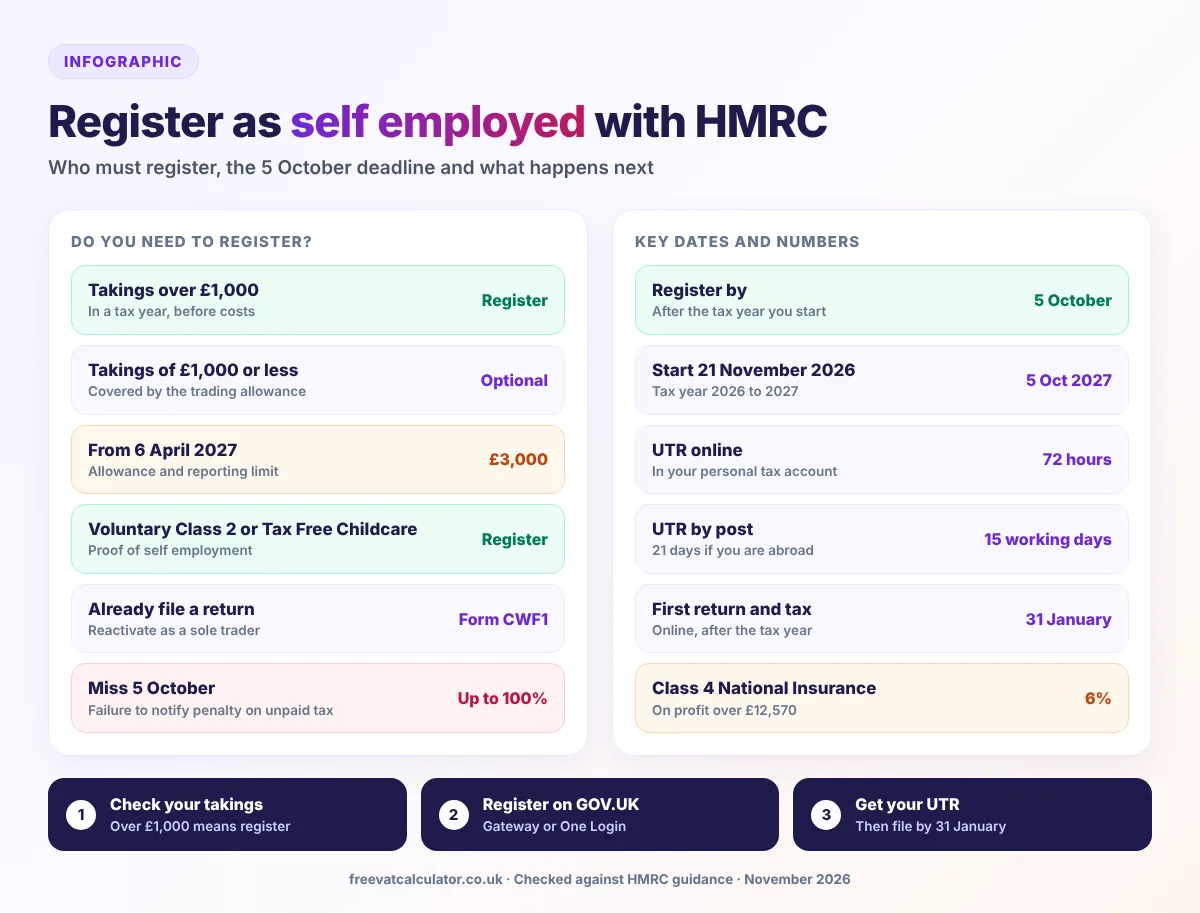
You must register for Self Assessment as a sole trader once you earn more than £1,000 from self employment in a tax year, which runs from 6 April to 5 April. GOV.UK lists other reasons too, so check the table even if your takings are small.
| Your situation | Register? | Why |
|---|---|---|
| Takings over £1,000 in 2026 to 2027 | Yes | Above the trading allowance |
| Takings of £1,000 or less | Optional | The allowance covers it |
| Takings over £3,000 from 6 April 2027 | Yes | The limit rises to £3,000 |
| You want voluntary Class 2 National Insurance | Yes | Protects your State Pension record |
| You need proof, such as for Tax Free Childcare | Yes | Registration is the evidence |
| Construction subcontractor | Yes | CIS registration follows |
| You already file returns for another reason | Yes, as a sole trader | Adds Class 2 to your record |
The £1,000 test is on takings, not profit
GOV.UK measures the £1,000 before you deduct anything you could claim tax relief on. Selling £1,600 of cakes made from £900 of ingredients leaves £700 of profit, but you still register because the takings are over £1,000. Our trading allowance guide explains how the allowance can then cut the tax.
If you already send a tax return
People who file for rental income or another reason must still tell HMRC about a new business. GOV.UK says you register again as a sole trader, by reactivating your record with form CWF1, so that HMRC also registers you for Class 2.
The 5 October deadline: when to register
The deadline is 5 October after the end of the tax year in which you started trading. Tax years begin on 6 April, so you get anywhere from 6 to 18 months.
| You started trading | Tax year | Register by | First return and tax due |
|---|---|---|---|
| 6 April 2025 to 5 April 2026 | 2025 to 2026 | 5 October 2026 | 31 January 2027 |
| 6 April 2026 to 5 April 2027 | 2026 to 2027 | 5 October 2027 | 31 January 2028 |
| 6 April 2027 to 5 April 2028 | 2027 to 2028 | 5 October 2028 | 31 January 2029 |
So a start on 21 November 2026 gives you until 5 October 2027. GOV.UK says you can trade before registering or register early, and if you missed 5 October 2026 for a 2025 to 2026 start, register now.
What happens if you miss the deadline?
Missing 5 October can bring a failure to notify penalty, a share of the tax the delay puts at risk. HMRC’s manual defines that amount for income tax as the tax still unpaid on 31 January after the tax year, so registering late but filing and paying in full by then leaves nothing to penalise. Nor is there a penalty if you had a reasonable excuse, the failure was not deliberate and you put it right promptly.
| Behaviour | You tell HMRC first | HMRC finds out first |
|---|---|---|
| Not deliberate, within 12 months of the tax being due | 0% to 30% | 10% to 30% |
| Not deliberate, 12 months or more after it was due | 10% to 30% | 20% to 30% |
| Deliberate | 20% to 70% | 35% to 70% |
| Deliberate and concealed | 30% to 100% | 50% to 100% |
A late tax return is a separate matter, with £100 due as soon as it is late. Our Self Assessment deadline guide covers those penalties.
How to register as self employed online, step by step
The online route is the quickest, and you can save your progress and return later. Follow these steps.
- Open Register for Self Assessment on GOV.UK and say you are self employed.
- Say whether this is your first time or you have registered before.
- Sign in, or create sign in details if you have never used HMRC online.
- Prove your identity if asked, usually with a passport or driving licence.
- Enter your details, your start date and the work you do.
- Submit, then look for your UTR in your personal tax account.
Use only the GOV.UK service. GOV.UK lists no fee for registering, and sites that charge simply fill in the same form for you.
What you need before you start
Gather these first. If you have no National Insurance number, apply for one on GOV.UK.
- your National Insurance number
- your name, address and date of birth
- the date you started trading
- a short description of your work
Government Gateway or GOV.UK One Login?
Since 9 February 2026, HMRC has offered new customers GOV.UK One Login, which uses an email address and password instead of a Government Gateway user ID. If you already have a Government Gateway ID for HMRC, keep using it until HMRC contacts you, even if you have a One Login for another service.
If you have registered before
If you were self employed before or have filed returns in the past, you reactivate your record instead of starting again. Sign in to the online CWF1 with the details you used before.
Registering by post with the CWF1 form
If you cannot use the online service, print the CWF1 form and post it to the address on it. HMRC’s manual says it processes only original forms, not photocopies, and returns any form without a valid National Insurance number.
Living abroad, other income and getting help
If you live outside the UK, the online service is closed to you, so register with the paper form instead. If your return is for rental or other income rather than a business, the form is SA1, which HMRC titles Register for Self Assessment if you are not self employed. For help, HMRC’s digital assistant handles registering questions, and the Self Assessment helpline is 0300 200 3310.
After you register: your UTR and first return
Registering gives you a Unique Taxpayer Reference, or UTR, a 10 digit number for every return. You do not need to apply for a UTR separately.
How long does it take to get a UTR?
Online, the UTR should appear in your personal tax account within 72 hours, and you can also see it in the HMRC app. By post it usually takes 15 working days, or 21 days if you are abroad.
Your first deadlines
Nothing is due until the tax year ends. These dates apply if you start in 2026 to 2027.
| Date | What happens |
|---|---|
| 5 October 2027 | Last day to register |
| 30 December 2027 | File online by now to pay a bill under £3,000 through your tax code |
| 31 January 2028 | Online return, tax and any first payment on account |
| 31 July 2028 | Second payment on account, if due |
Sole trader, partner or limited company?
Registering as self employed and registering as a sole trader are the same step on GOV.UK. Partnerships and companies follow different routes.
Choosing a business name
You can trade under your own name or a business name, and both must appear on invoices. The name must not include limited, Ltd, LLP or plc, be offensive or be too close to a trade mark.
Registering in a partnership
Each partner registers for Self Assessment and Class 2 with form SA401. Only the nominated partner can do this online, and the others register by post.
Limited companies
A limited company registers with Companies House and pays Corporation Tax, so these steps do not apply to it. Our sole trader vs limited company comparison shows how the tax differs.
What you pay once you are registered
Tax is worked out on your profit, not on registering. These are the 2026 to 2027 rates outside Scotland, which has its own income tax bands.
| Profit | Income Tax | National Insurance |
|---|---|---|
| Under £7,105 | 0% | None; voluntary Class 2 at £3.65 a week |
| £7,105 to £12,570 | 0% | Class 2 treated as paid |
| £12,571 to £50,270 | 20% | Class 4 at 6% |
| £50,271 to £125,140 | 40% | Class 4 at 2% |
| Over £125,140 | 45% | Class 4 at 2% |
The personal allowance shrinks by £1 for every £2 of income over £100,000. Our self employed tax calculator works out the bill on your own profit.
Class 2 and your State Pension
Nobody has to pay Class 2 any more, but it still counts. With profit of £7,105 or more it is treated as paid for each week you are self employed, so a full year gives you a qualifying year for the State Pension.
Payments on account
If your bill is £1,000 or more, HMRC usually asks for two advance payments towards the next year, each half the last bill, on 31 January and 31 July. Unless over 80% of your tax was collected at source, your first January can hold a full year’s tax plus half as much again.
Paying through your tax code if you also have a job
If you are employed as well, owe less than £3,000 and file online by 30 December, HMRC can collect the bill through your tax code. That spreads the cost over the next tax year.
Your responsibilities after you register
Once registered, HMRC expects a return every year until you tell it you have stopped. Two habits keep that simple.
Keep records from day one
Record every sale and business cost with the paperwork behind it. Keep records for at least 5 years after the 31 January deadline for the return they support.
- sales invoices and money received
- receipts for business costs
- bank statements for the account you use
- mileage and working from home records
Insurance, licences and taking on staff
Some trades need a licence. Employers’ liability cover of at least £5 million is compulsory once you employ someone, with fines of £2,500 for every day without it.
Making Tax Digital and VAT
Two more registrations can follow as you grow, both based on takings. Neither applies on the day you register as self employed.
Making Tax Digital for Income Tax
Making Tax Digital for Income Tax means digital records and quarterly updates through software. It starts once qualifying income, your gross self employment and property income combined, passes a threshold on a return HMRC has seen.
- over £50,000 in 2024 to 2025: from 6 April 2026
- over £30,000 in 2025 to 2026: from 6 April 2027
- over £20,000 in 2026 to 2027: from 6 April 2028
HMRC writes to tell you when to start, so a new business’s first return sets its date. See our Making Tax Digital for Income Tax guide, or the wider Making Tax Digital overview.
VAT registration at £90,000
You must register for VAT as a sole trader when taxable turnover passes £90,000 in any rolling 12 months, or is expected to in the next 30 days alone. Our VAT threshold guide explains the test, and VAT for sole traders and freelancers covers voluntary registration.
Once you have a VAT number, you add VAT to your HMRC online account and file through software. Our HMRC VAT login guide shows how to sign in.
Construction workers: registering for CIS
If you work for building contractors, register for the Construction Industry Scheme too, or contractors deduct 30% from your pay instead of 20%. HMRC’s manual says ticking the construction box on the online Self Assessment form registers you for CIS as well. You can later apply for gross payment status to be paid without deductions.
What changes from April 2027
The Budget on 28 October 2026 announced several changes for anyone starting next year, and the trading allowance rise will be legislated in the next Finance Bill. These are the ones that affect registering.
- the trading allowance and reporting threshold rise to £3,000 on 6 April 2027
- the Class 2 small profits threshold rises to £7,355, and voluntary Class 2 to £3.80 a week
- Making Tax Digital starts above £30,000, with no late submission points for quarterly updates in 2027 to 2028
HMRC estimates that up to 1.4 million people could benefit, and about 100,000 will no longer need to report their trading income. The Budget also confirmed more regular Self Assessment payments from April 2029 for people who make payments on account.
How to stop being self employed
When you stop trading, tell HMRC through its online service for ending self employment, then send a final return. If you were VAT registered you must also deregister from VAT.
If you stop because takings have dropped to £1,000 or less, tell HMRC after the tax year ends, so stopping on 3 March 2027 means reporting after 5 April 2027. A loss in the final year can be set against the previous three years’ profits through terminal loss relief.
Common mistakes when registering
Most registration problems come from a few avoidable slips. Check these before you submit.
- using form SA1 when you need to register as self employed, which skips Class 2
- testing the £1,000 against profit instead of takings
- creating new sign in details when you already have a user ID
- paying a website to fill in the free GOV.UK form
- failing to declare a side business because you already file a return
Registered and wondering what you will owe?
Our free self employed tax calculator shows the income tax and Class 4 National Insurance on your profit, and how much to set aside.
Register as self employed FAQs
These are the questions people ask most when they first register. The answers use the rules for 2026 to 2027.
How much can I earn before registering as self employed?
You can take up to £1,000 in a tax year without registering, rising to £3,000 from 6 April 2027. Above that, register by 5 October after the tax year ends.
Does it cost anything to register?
No. GOV.UK lists no fee, and the official routes are the GOV.UK service and the paper CWF1.
Can I register myself, or do I need an accountant?
You can register yourself on GOV.UK, and you can save your progress and finish later. An accountant can do it as your agent, which helps if your affairs are complicated or they will file your returns.
How do I re register as self employed after a break?
Reactivate your old record with the online CWF1, signing in with the details you used before. If you post the paper version instead, include your UTR.
Do I need a National Insurance number to register?
Yes, and a paper CWF1 without a valid number is sent back. Apply for one on GOV.UK first if you do not have one.
You now know if you need to register, the 5 October date that applies to you and the GOV.UK steps from sign in to UTR. Run your dates through the checker at the top, register once takings pass £1,000, and keep records from the first sale so your first return is straightforward.
Sources: GOV.UK and HMRC: Register for Self Assessment; First time; Reactivating; Sole trader registration; Sole traders; Business names; Working for yourself; CEST; Who must file; CC/FS11; CH72700; SAM100130; Late filing; One Login news; Find your UTR; SA401; Helpline; National Insurance; Income Tax rates; Payments on account; Tax code payment; Keeping records; Employers’ liability; MTD for Income Tax; Register for VAT; CIS subcontractors; Trading allowance TIIN; Budget 2026 Annex A; Budget 2026 OOTLAR; Stopping. This page is general information, not tax advice.