Business rates guide
Small Business Rate Relief: Who Pays Nothing, the New Multipliers and What Changes in 2027
How to work out your business rates bill
- Find your rateable valueOn the Valuation Office list
- Check the useRetail, hospitality or leisure?
- Pick the multiplier38.2p to 50.8p
- Take off relief100% up to £12,000
- Check with your councilIt sends the final bill
Your business rates bill for 2026 to 2027 probably looks nothing like last year’s. The revaluation on 1 April 2026 gave most properties a new rateable value, the 40% discount for shops, pubs and cafés ended, and two multipliers became five, so the figure on the council’s letter is hard to check.
This guide puts a calculator first, then explains each rule behind it: who pays nothing, the taper, the second property rule, the lower retail, hospitality and leisure rates and the Budget changes from April 2027. If you run a small shop, café, salon, office or workshop in England, this is how small business rate relief works for you.
Business rates calculator: estimate your 2026 to 2027 bill in England
Enter the rateable value shown on the Valuation Office list, say how the property is used and answer the one property test. The calculator picks the right multiplier, takes off any relief and shows the working.
Business rates calculator for England
Estimate your 2026 to 2027 bill with the right multiplier and small business rate relief
Tapered relief of 33.33%
Relief falls evenly from 100% at £12,000 to nothing at £15,000, so at £14,000 you get 33.33% off.
Multiplier used: 44.2p
The small business multiplier of 43.2p, plus the 1p supplement, because the rateable value is below £51,000.
The working
£14,000 × 44.2p = £6,188.00 before relief. Relief is £6,188.00 × (£15,000 minus £14,000) ÷ £3,000 = £2,062.67, so the bill is £6,188.00 minus £2,062.67 = £4,125.33.
From 1 April 2027
The Budget raises full relief for retail, hospitality and leisure properties to £18,000.
An estimate for an occupied property in England from 1 April 2026 to 31 March 2027, before transitional relief, supporting small business relief, pubs relief, charitable relief and local supplements. The City of London has its own multipliers. Your council’s bill is final, and nothing you enter is stored or sent.
The estimate is for an occupied property and adds the 1p transitional relief supplement unless you leave it out. Your council’s bill is final, and transitional relief or supporting small business relief can cap it below this figure.
Key facts
- Full relief
- Rateable value of £12,000 or less, one property
- Tapered relief
- £12,001 to £15,000, falling to nothing
- Small business multiplier
- 43.2p, or 38.2p for retail, hospitality and leisure
- Standard multiplier
- 48.0p, or 43.0p for retail, hospitality and leisure
- High value multiplier
- 50.8p from £500,000
- From 1 April 2027
- Full relief to £18,000 for retail, hospitality and leisure
Small business rate relief in 2026 to 2027: who pays nothing
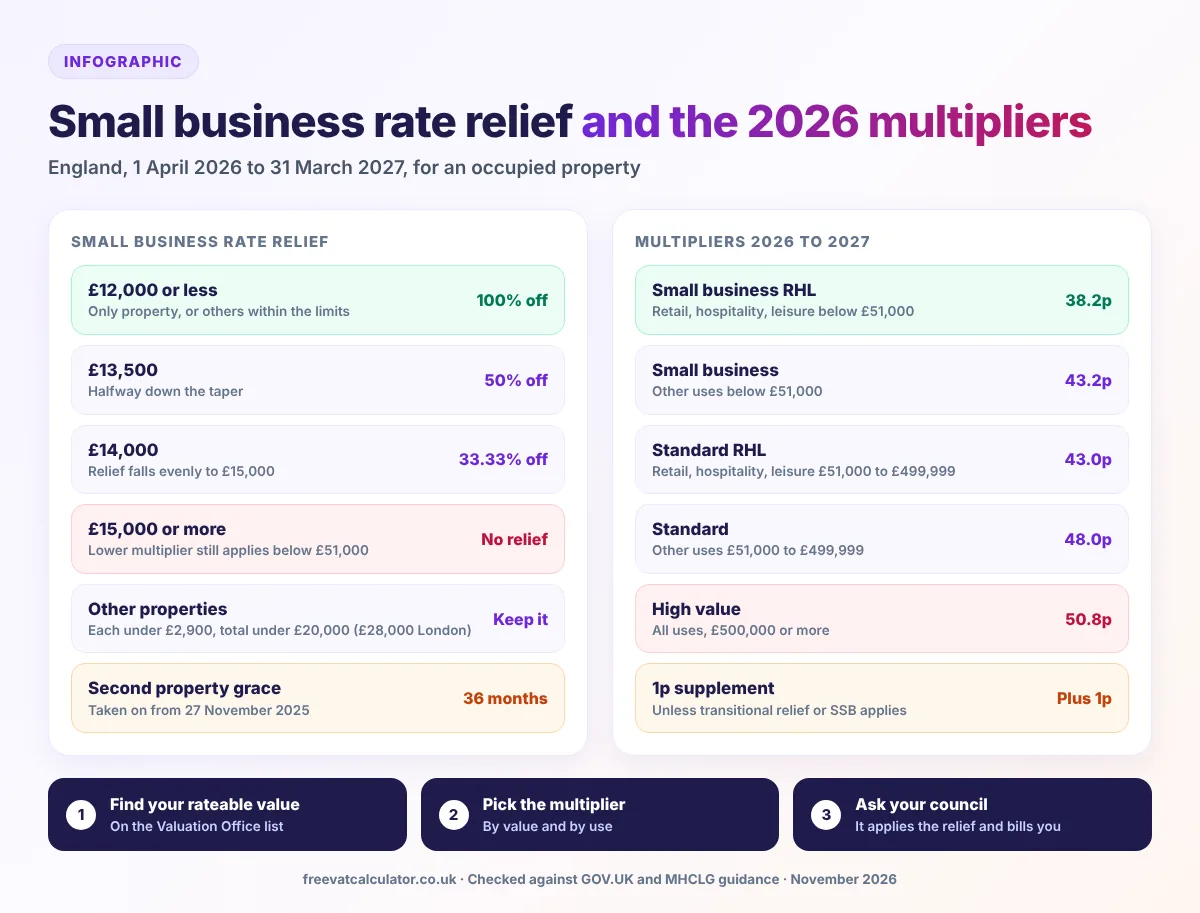
In England you pay no business rates on a property with a rateable value of £12,000 or less, as long as it is the only property your business uses. Between £12,001 and £15,000 the relief falls evenly from 100% to nothing, and from £15,000 upwards there is none.
The Valuation Office’s statistics show that 58.4% of properties on the 2026 lists for England and Wales have a rateable value of £12,000 or less. The full relief band therefore covers a large share of small premises, provided the business passes the one property test.
| Rateable value | Relief | Other uses at 44.2p | Retail, hospitality or leisure at 39.2p |
|---|---|---|---|
| £12,000 or less | 100% | £0.00 | £0.00 |
| £13,000 | 66.67% | £1,915.33 | £1,698.67 |
| £13,500 | 50% | £2,983.50 | £2,646.00 |
| £14,000 | 33.33% | £4,125.33 | £3,658.67 |
| £15,000 | None | £6,630.00 | £5,880.00 |
| £20,000 | None | £8,840.00 | £7,840.00 |
How the taper works between £12,000 and £15,000
For every £1,000 of rateable value above £12,000 you lose a third of the relief, so the percentage is £15,000 minus your rateable value, divided by £3,000. At £13,500 that gives 50% off, matching GOV.UK’s own example, and Test Valley Borough Council’s 2026 to 2027 table still gives 98.33% at £12,050. Councils work relief out day by day, so a real bill can differ by a few pence.
How business rates are worked out
Business rates are a local tax on most non domestic property, from shops, offices and pubs to warehouses and holiday lets. You will probably pay them if you use a building, or part of one, for business, and your council bills you each February or March.
The bill starts with the rateable value, which the Valuation Office sets as the open market annual rent on a fixed date. That value is multiplied by a multiplier set by the government, and any relief is then taken off.
The 2026 revaluation and your rateable value
The current list took effect in England and Wales on 1 April 2026 and uses rental values at 1 April 2024. Total rateable value in England rose by 19.6% against the 2023 list, so some small properties crossed the £12,000 or £15,000 lines for the first time, and the next revaluation is due in 2029.
You can look up and compare any property on GOV.UK’s find a business rates valuation service, and challenge yours through your business rates valuation account. The same account handles temporary reductions for severe local disruption, such as flooding or nearby roadworks, which the Valuation Office decides.
Business rates multiplier 2026: the five rates in England
England had two multipliers until 31 March 2026 and has five from 1 April 2026, under the Non Domestic Rating (Multipliers and Private Schools) Act 2025. Which one you use depends on your rateable value and, below £500,000, on how the property is used.
| Multiplier | Rateable value | Pence in the pound | With the 1p supplement |
|---|---|---|---|
| Small business retail, hospitality and leisure | Below £51,000 | 38.2p | 39.2p |
| Small business | Below £51,000 | 43.2p | 44.2p |
| Standard retail, hospitality and leisure | £51,000 to £499,999 | 43.0p | 44.0p |
| Standard | £51,000 to £499,999 | 48.0p | 49.0p |
| High value, all uses | £500,000 or more | 50.8p | 51.8p |
The retail, hospitality and leisure rates sit 5p below their national equivalents, and the high value multiplier is 2.8p above the standard one. The small business multiplier applies to every property below £51,000, even one that gets no small business rate relief, which on a £30,000 office is £1,440 a year less than the standard rate, while the City of London sets its own figures.
Which properties count as retail, hospitality or leisure
A property qualifies only if it is occupied and wholly or mainly used for retail, hospitality or leisure by visiting members of the public. Your council decides using the legal definition, and selling online as well, or using memberships, tickets or appointments, does not stop a shop or gym qualifying.
- Shops, supermarkets, chemists, florists, petrol stations and car showrooms
- Hairdressers, beauty salons, garages, launderettes and post offices
- Restaurants, cafés, pubs, bars and takeaways open to the public
- Hotels, guest houses, holiday homes and campsites
- Cinemas, theatres, gyms, nightclubs, museums and live music venues
Which uses are left out
Professional, financial and medical services stay on the national multipliers even when customers visit. An empty shop also goes back to the national rate once its empty property relief runs out.
- Banks, building societies and other financial services
- Dentists, physiotherapists and other medical services
- Solicitors, accountants and estate agents
- Online sales warehouses, betting shops and car parks
- Schools, nurseries, colleges and conference centres
The 1p transitional relief supplement
Ratepayers who get neither transitional relief nor supporting small business relief pay an extra 1p in the pound, so 43.2p becomes 44.2p and a £30,000 property pays £300 more. It was set for 2026 to 2027 only, but the October 2026 Budget keeps it for two more years, and properties new to the list from 1 April 2026 do not pay it. It is added before reliefs, which is why GOV.UK’s worked example for a £14,000 property starts from £6,188 rather than £6,048.
Who qualifies for small business rate relief
You can get the relief if your property’s rateable value is below £15,000 and your business uses only one property, although some businesses with more than one still qualify. You cannot have it and charitable rate relief at the same time, and your council decides which relief you get.
The second property rule and the 36 month grace period
If a second property would normally end your relief, you keep it on your main property for 12 months when you took the second one on before 27 November 2025, or for 36 months when you took it on that date or later. After that you keep it only if no other property is worth more than £2,899 and all of them together come to less than £20,000, or £28,000 in London.
From 1 April 2027 that combined limit becomes a single £29,999 for the whole of England, until 31 March 2029. Tell your council before you sign for a second property, because reporting it late can mean a backdated increase in your bill.
How to apply for small business rate relief
The relief is run by your local council, not by HMRC or the Valuation Office. Councils handle it in different ways, so GOV.UK tells you to contact yours to check you are eligible and how to get it.
- Find your rateable value on GOV.UK’s find a business rates valuation service.
- Check it is below £15,000 and that any other properties fit the limits above.
- Use GOV.UK’s council finder to reach your council’s business rates team or relief form.
- Ask at the same time which other reliefs you can get on top.
- Check your next bill shows the relief, and contact the council if it does not.
Tell your council if the property becomes empty, you take on another property, you extend it or your business changes or moves. You usually pay the new amount from the day the change happened, so a late report can bring a backdated bill or leave you overpaying.
Retail, hospitality and leisure relief: what replaced the 40% discount
In 2025 to 2026, retail, hospitality and leisure relief took 40% off eligible bills, up to £110,000 per business. The government called it interim support, and it ended on 31 March 2026, when the permanently lower multipliers took its place.
The new rates have no cash cap, but for most small properties they are worth less than the old discount. A 5p lower multiplier saves £1,500 a year on a £30,000 shop, while the old relief took 40% off the whole bill, so supporting small business relief now covers those who lost it.
Pubs and live music venues relief
Pubs and live music venues get a further 15% off in 2026 to 2027, with no cash limit, applied after transitional relief and supporting small business relief. A pub must be open to the public with free entry, except for occasional entertainment, let people drink without eating and sell drinks at a bar, so restaurants, hotels, nightclubs and theatres are left out. The October 2026 Budget raises the relief to 35% for the next two years, except for live music venues worth £1 million or more.
Transitional relief and supporting small business relief
Transitional relief limits how much a bill can rise each year because of the revaluation. Your council applies it automatically, with caps that depend on rateable value.
| Rateable value | 2026 to 2027 | 2027 to 2028 | 2028 to 2029 |
|---|---|---|---|
| Up to £20,000, or £28,000 in London | 5% | 10% plus inflation | 25% plus inflation |
| Above that, up to £100,000 | 15% | 25% plus inflation | 40% plus inflation |
| Over £100,000 | 30% | 25% plus inflation | 25% plus inflation |
Supporting small business relief: the £800 cap
If the revaluation cost you some or all of your small business rate relief, rural rate relief or the 40% retail discount, your increase is limited to £800 a year or the transitional relief cap, whichever is greater. It lasts up to three years, and charities and community amateur sports clubs cannot get it.
Take a café worth £11,500 that paid nothing in 2025 to 2026 and is now valued at £16,000. Its full bill at 38.2p would be £6,112, but supporting small business relief should limit it to £800, with no 1p supplement added while it is on the scheme.
Business rates 2027: what the October 2026 Budget changed
The Budget on 28 October 2026 left this year’s rules alone, and its changes start on 1 April 2027. The business rates information letter of the same day sets out the detail.
- Small business rate relief for retail, hospitality and leisure: full relief up to £18,000, tapering to nothing at £21,000, until 31 March 2029
- Other properties and adult gaming centres keep the £12,000 and £15,000 thresholds
- Vape shops lose the relief and the lower multipliers, and adult gaming centres lose the lower multipliers
- Pubs and live music venues relief rises from 15% to 35%
- Other retail, hospitality and leisure bills rise no faster than CPI inflation for two years, except where your own improvements raise the value
The government expects a further 70,000 retail, hospitality and leisure businesses to pay no business rates at all. It is paying for this by making online marketplaces collect VAT on UK sellers’ sales and by raising Machine Games Duty, as our Budget 2026 summary and online marketplace VAT guide explain. For 2027 to 2028 the retail, hospitality and leisure multipliers sit 5.2p below the national ones, up from 5p.
- £18,000Full relief for qualifying shops, pubs and cafés from April 2027
- £21,000Where the new taper ends
- 70,000More retail, hospitality and leisure businesses paying nothing
| Multiplier | 2026 to 2027 | 2027 to 2028 |
|---|---|---|
| Small business retail, hospitality and leisure | 38.2p | 39.5p |
| Small business | 43.2p | 44.7p |
| Standard retail, hospitality and leisure | 43.0p | 44.5p |
| Standard | 48.0p | 49.7p |
| High value | 50.8p | 52.5p |
Worked example: a shop with a rateable value of £16,000
In 2026 to 2027 a shop worth £16,000 is above the £15,000 limit, so it pays £16,000 × 39.2p, which is £6,272 with the supplement. From 1 April 2027 it sits inside the new £18,000 full relief band, so if nothing else changes it pays nothing.
A café worth £19,500 would get half the relief, because the new taper runs evenly from £18,000 to £21,000. An accountant’s office at the same value still gets no relief, because offices are not retail, hospitality or leisure, and its multiplier rises from 43.2p to 44.7p.
Other business rates relief you can claim
Small business rate relief is one of several reliefs in England, and some can be added on top of it. These are the ones small firms meet most often, and your council decides each of them.
Charitable rate relief
Charities and registered community amateur sports clubs get up to 80% off when the property is mainly used for charitable purposes, and the council can top this up to 100%. Private schools lost charitable rate relief with effect from 1 April 2025.
Rural rate relief
In a rural area with fewer than 3,000 people, the only general store, food shop or post office with a rateable value up to £8,500 pays nothing. The same applies to the only pub or petrol station worth up to £12,500, as long as it is occupied.
Empty property relief
An empty property pays no business rates for three months, industrial premises such as warehouses get six, and listed buildings or properties worth under £2,900 stay exempt until used again. Since 1 April 2024 a property must be occupied for at least 13 weeks, up from six, before a fresh empty period can start.
Improvement relief
If you extend a property or add something new, such as heating, air conditioning or CCTV, you pay nothing extra on the resulting rise in rateable value for one year. The works must have finished on or after 1 April 2024 and you must have occupied the property during and after them.
Hardship relief and exempt buildings
Your council can reduce or cancel a bill if you would be in financial difficulty without help and helping you is in the interests of local people. Agricultural land and buildings, fish farms, places of public religious worship and buildings for the training or welfare of disabled people pay nothing at all.
Business rates in Scotland, Wales and Northern Ireland
Business rates are devolved, so each nation sets its own rates and reliefs. Between them the three nations have about 684,000 private sector businesses, as our guide to how many businesses are in the UK shows.
| Nation | Scheme | Full relief up to | Relief ends at |
|---|---|---|---|
| England | Small business rate relief | £12,000 | £15,000 |
| Scotland | Small Business Bonus Scheme | £12,000 | £20,000 |
| Wales | Small business rates relief | £6,000 | £12,000 |
| Northern Ireland | Small Business Rate Relief | None, 50% up to £2,000 | £15,000 |
Scotland
The Small Business Bonus Scheme gives 100% relief on a single property worth up to £12,000, tapering to 25% at £15,000 and to nothing at £20,000. With more than one property, each gets 100% only if all of them total £12,000 or less, while each one worth up to £15,000 gets 25% when they total £35,000 or less. Mainland retail, hospitality and leisure properties worth up to £100,000 also get 15% off, or 40% for licensed hospitality and music venues, as the Scottish Government explains.
Wales
Wales gives 100% relief up to a rateable value of £6,000, tapering to nothing at £12,000, on up to two properties per business in each council area. Its three multipliers are 35.0p for smaller shops below £51,000, 50.2p for most property and 51.5p above £100,000, as Business Wales sets out.
Northern Ireland
Bills are based on net annual value times a regional rate and a district rate, and relief is 50% up to £2,000, 25% to £5,000 and 20% to £15,000, but not for more than three properties. The Finance Minister stopped the planned revaluation on 29 January 2026, so check nibusinessinfo for the current position.
How to reduce your business rates bill
Most savings come from checking the details rather than from special schemes. Work through this list once a year, and again when your business changes.
- Compare your rateable value with similar properties and challenge it if it looks wrong
- Make sure your council knows the property is used for retail, hospitality or leisure
- Confirm small business rate relief is on your bill if you have one property under £15,000
- Report a second property early so the grace period starts on time
- Ask to spread the bill over 12 monthly instalments instead of the usual 10
Business rates on business premises are an allowable expense, so the bill also reduces the profit you pay income tax or corporation tax on. That is the same for a sole trader and a company, and our sole trader vs limited company guide compares the other taxes.
Need the VAT on a rent or service charge invoice?
Our main VAT calculator adds or removes VAT at 20%, 5% or 0% in seconds.
Small business rate relief FAQs
These are the questions owners ask most about relief on business rates in England. Each answer reflects the 2026 to 2027 rules and the October 2026 Budget.
Is small business rate relief automatic?
Not always. Councils award it, and GOV.UK tells you to contact your council to check you are eligible, so look for it on your bill and ask if it is missing.
Is small business rate relief ending?
No. It continues in 2026 to 2027 on the £12,000 and £15,000 thresholds, and from 1 April 2027 full relief for retail, hospitality and leisure properties goes up to £18,000 until 31 March 2029.
Is there VAT on business rates?
No. Business rates are a tax paid to your council, not a charge for goods or services, so the bill carries no VAT and there is nothing to reclaim on your VAT return. Our guide to what VAT is explains what it does apply to.
Do I pay business rates if I work from home?
Not usually, if you use a small part of your home, such as a bedroom office, or sell goods by post. You may pay them as well as council tax if you live above your shop, see customers at home, employ people there or have converted a room or garage for the business.
Do vape shops get small business rate relief?
Yes in 2026 to 2027, on the normal terms. From 1 April 2027 the Budget removes the relief and the lower multipliers from vape shops, and the government will set out later exactly which premises count as a vape shop.
Do I pay business rates on a holiday let?
In England a holiday let is rated if it was available for short lets for at least 140 nights and actually let for at least 70 nights in the last 12 months. If it is your only let and is worth under £15,000, you may get the relief.
You now know if your property pays nothing, which multiplier applies and what changes in April 2027. All the information you need to check your 2026 to 2027 bill is above, and the calculator at the top turns it into a figure to compare with your council’s demand.
Sources: GOV.UK, small business rate relief; GOV.UK, business rates relief; GOV.UK, estimate your business rates; MHCLG, business rates information letter 5/2025; letter 2/2026, multipliers for 2026 to 2027; letter 8/2026, Budget package and 2027 to 2028 multipliers; HM Treasury, qualifying retail, hospitality or leisure; GOV.UK, transitional relief; GOV.UK, supporting small business relief; 2026 supporting small business relief guidance; 2025 to 2026 retail, hospitality and leisure scheme; pubs and live music venues relief guidance; VOA, 2026 revaluation statistics; HM Treasury, Budget 2026; rural rate relief; charitable rate relief; empty property relief; SI 2024/323; improvement relief; hardship relief; working at home; holiday lets; allowable expenses; Test Valley Borough Council, relief table; Scottish Government, Finance Circular 7/2026; Business Wales, small business rates relief; Department of Finance, Reval 2026. This page is general information, not tax advice.