
Books and publications VAT guide
VAT on Books: What Is Zero Rated, from Ebooks and Newspapers to Audiobooks
How to find the VAT on any publication
- Name the itemBook, ebook or audio?
- Is it for reading?Read or looked at
- Spot the exceptionsStationery, posters, audio
- Split any bundleA fair share at each rate
- Apply the rate0% or 20%
A paperback goes through the till with no VAT, the audiobook of the same title carries 20% VAT, and your planner comes back from the printer with VAT added. Add a book sold with a toy or a magazine with a free gift, and the rules seem to change from shelf to shelf.
This guide starts with a checker that gives the rate, the VAT and the reason for ten common items. Every rule below is checked against HMRC’s VAT Notice 701/10 and the law on 6 November 2026, so you will know exactly how VAT on books applies to your sale or purchase.
Book VAT checker: the rate on any book, ebook or bundle
Pick the item, enter the price and say whether it includes VAT. For a book sold with a toy or a CD, add each part’s normal selling price and the checker splits the price between 0% and 20%.
Book VAT checker
Find the VAT on books, ebooks, audiobooks, magazines, stationery and bundles, with the reason and the working
Zero rated: no VAT on a printed book
Books and booklets are zero rated under Group 3 of Schedule 8 to the VAT Act 1994, in any language, whether new, second hand or antique. School workbooks and exam papers count too.
The working
Zero rated, so the VAT is £0.00 and the price of £12.99 is the same with or without VAT.
This checker covers sales in the UK. For a bundle it assumes the extra goods are standard rated and the items are a mixed supply; if the extra is only a minor part of the book, the whole price is zero rated. Enter both part values on the same basis as the price, with or without VAT. Figures are rounded to the nearest penny, and nothing you enter is stored or sent.
Key facts
- Printed books
- 0%, new, second hand or antique
- Ebooks and digital editions
- 0% since 1 May 2020
- Newspapers and magazines
- 0% in print or digital
- Audiobooks
- 20% on CD, download or stream
- Diaries and planners
- 20%, as stationery
- Book and toy bundles
- Price split between 0% and 20%
Is there VAT on books in the UK?
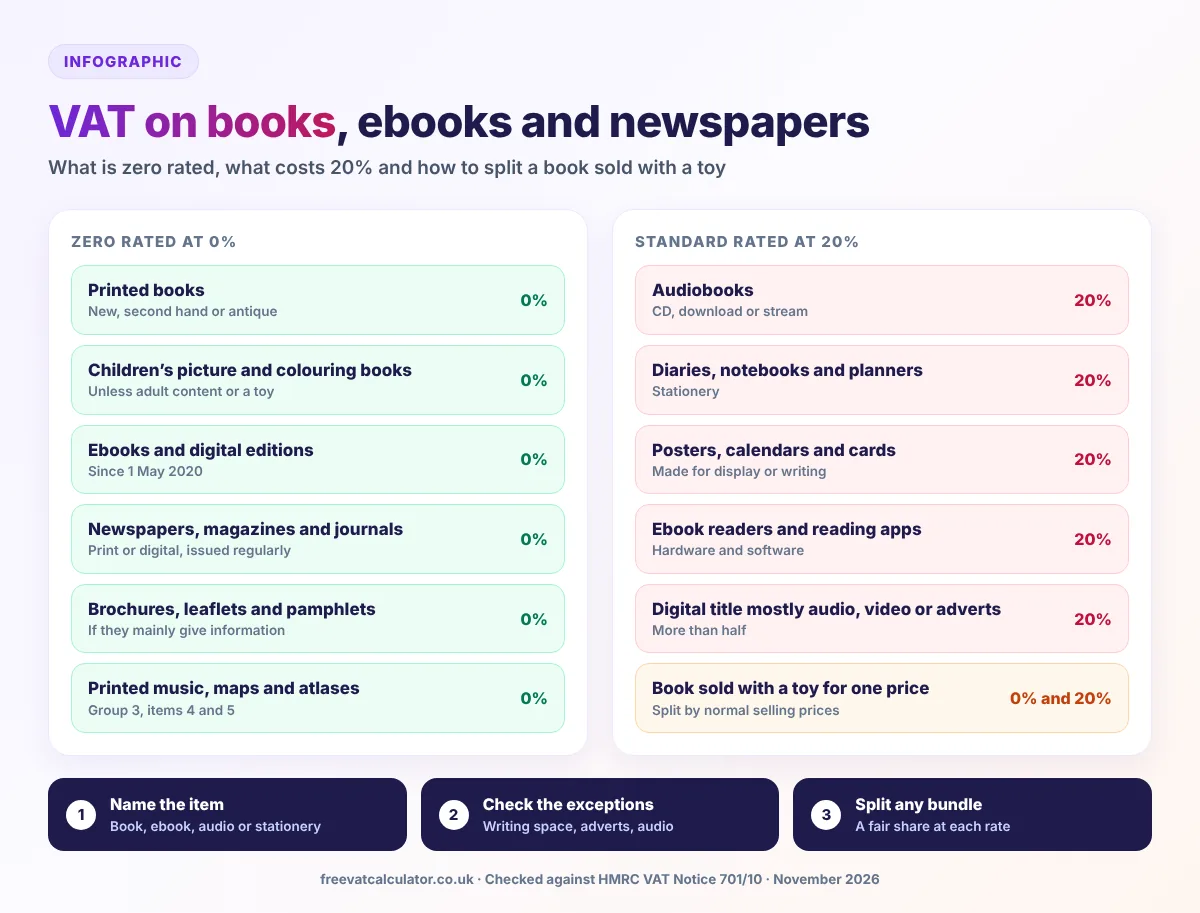
No, not on most of them. Printed books, newspapers, magazines, children’s picture books, music and maps are zero rated under Group 3 of Schedule 8 to the VAT Act 1994, and ebooks and digital editions joined them on 1 May 2020.
- 0%Printed books, ebooks, newspapers and magazines
- 20%Audiobooks, diaries, planners and posters
- 1 May 2020The date ebooks joined the zero rate
Zero rated means VAT at 0%, so the buyer pays none, while the seller still reports the sale and, unlike an exempt seller, can reclaim VAT on its costs under VAT Notice 700. The exceptions are items made to be written in or displayed, such as diaries and posters, and audiobooks.
| Item | VAT rate |
|---|---|
| Printed books, new, second hand or antique | 0% |
| Children’s picture, colouring and activity books | 0% |
| Ebooks and digital newspapers or magazines | 0% |
| Newspapers, magazines and journals in print | 0% |
| Brochures, pamphlets and leaflets | 0% |
| Printed music, maps and atlases | 0% |
| Audiobooks on CD, download or stream | 20% |
| Diaries, notebooks, planners and exercise books | 20% |
| Posters, calendars and greetings cards | 20% |
| Ebook readers and reading apps | 20% |
| Book sold with a toy or CD for one price | 0% and 20% |
Why books carry no VAT
Books, newspapers and magazines were already zero rated in October 1973, when a minister told the House of Lords there were no plans to tax them. Ebooks waited until the Treasury’s announcement of 30 April 2020, which moved their zero rate forward from 1 December to 1 May 2020 for readers staying at home.
Which books and printed matter are zero rated?
HMRC’s VAT Notice 701/10 explains each item, and the words keep their everyday meaning. The text must be on paper or similar material, or supplied electronically, so a book on microfiche or audio cassette is standard rated.
Books and booklets
A book or booklet is text or pictures in a cover stiffer than its pages, in any language, including Braille. Novels, catalogues, school workbooks, exam papers and second hand books all qualify, but stamp and picture card albums need real reading matter and no more than 25% of space for mounting.
Brochures, pamphlets and leaflets
Brochures and pamphlets qualify if they inform, carry real text, come complete and are not made mainly to hold other items, even when they advertise. A leaflet is usually a single sheet up to A4 on limp paper, supplied in at least 50 copies, and a laminated sheet is not one.
Children’s picture, colouring and activity books
Picture books, rag books and painting, colouring, dot to dot and activity books are zero rated. Cut out model books need related text on at least 25% of their pages, game board books are toys at 20%, and adult colouring books are standard rated, so HMRC says shops should shelve them apart.
Music, maps and charts
Printed or manuscript music is zero rated in any notation, but blank manuscript paper is not. Maps, atlases and charts qualify, while globes, decorative framed maps, wall charts and industrial or architectural plans do not.
Covers, bookmarks and cases
A dust jacket, slip case or bookmark supplied with a book and not charged separately shares its zero rate. Sold on their own, bookmarks and book covers are standard rated.
What is standard rated: diaries, stationery and posters
The zero rate is for things people read, so items made to be written in, displayed or used as a voucher carry 20%. These are the ones most often charged wrongly.
- unused diaries, address books and albums
- exercise books and account books
- posters, calendars and wall charts
- greetings cards, stickers and wrapping paper
- admission tickets and discount vouchers
- forms, invoices and letterheads
Diaries, journals and planners
Diaries, address books and account books are stationery, and blank journals and planners usually fall on the same side. A completed diary or ship’s log can become zero rated, because it then reads like a book.
Books with space to write in: the 25% rule
A publication is not treated as made for completion if writing space, plus any part to tear off and return, is 25% or less of its area. A workbook with answer boxes can pass that test, but anything designed to be filled in and returned whole is always standard rated.
A planner with a printed cover is still a planner. If more than 25% of its area is for writing, price it with 20% VAT in mind.
Posters, calendars, tickets and vouchers
Posters are made for display, so they carry 20% even when full of information, unless they are a poster magazine issued regularly. Calendars, tickets and discount vouchers are not leaflets either.
Photocopies, letters and part works
Letters, loose pages and photocopies are standard rated unless they form a complete book or leaflet. Part works that build into a book are zero rated under a concession in VAT Notice 48 that is still in force.
VAT on newspapers, magazines and journals
Newspapers, journals and periodicals are zero rated in print and, since 1 May 2020, in digital form. These tests decide whether a title counts.
What counts as a newspaper
A newspaper must appear at least weekly under one title and carry a substantial amount of news. HMRC’s VAT Books manual adds that an online news service under editorial control and updated regularly can also qualify.
VAT on magazines, journals and periodicals
Magazines and journals must be issued at regular intervals more often than once a year. A title that mainly promotes the publisher’s own products is not a periodical, though it may pass as a brochure.
Free gifts on the cover
Notice 701/10 still says a cover mounted CD or sample can be zero rated with the magazine if there is no extra charge and it costs the publisher no more than 20% of the total cost and £1, before VAT. That test came from the linked goods concession, which Revenue and Customs Brief 1 (2026) said was no longer needed, and HMRC withdrew it with effect from 8 January 2026. HMRC says case law gives the same result, so a small free gift still shares the magazine’s zero rate.
Membership subscriptions that include a magazine
A subscription buying only the magazine can be wholly zero rated, but a club fee that also gives discounts or other rights must be apportioned. The law also blocks the zero rate where a publication is tied to a standard rated or exempt supply by a different business.
VAT on ebooks and e publications
Ebooks, digital newspapers, magazines and journals have been zero rated since 1 May 2020. Item 7 was added to Group 3 by a statutory instrument made on 29 April 2020, which came into force two days later.
What qualifies
A digital version of any book, newspaper, periodical or children’s picture book that would be zero rated in print qualifies, even if never printed. Single purchases, day passes and print and digital subscriptions are zero rated, but a subscription that adds standard rated content, such as video courses, must be apportioned.
What is still standard rated
A digital publication is standard rated if it is predominantly advertising, audio or video, which HMRC reads as more than half. Reading apps, fillable digital diaries, standalone digital maps and licences of copyright carry 20% too, as do ebook readers unless sold as part of an assistive technology system under the VAT relief for disabled people.
Digital newspapers before May 2020: the News Corp case
News Corp argued that its digital editions were zero rated before the law changed. The Supreme Court dismissed the appeal unanimously on 22 February 2023 in [2023] UKSC 7, holding that newspapers in the zero rate meant printed papers only.
VAT on audiobooks
Audiobooks are standard rated at 20% on CD, as downloads and through streaming, because the zero rate covers only books that can be read or looked at. Sold together at a discount, a printed book and its audiobook are two supplies, so the book stays at 0% and the audio takes 20%.
The Budget of 28 October 2026 made no change for audiobooks. The only relief is narrow: Group 4 of Schedule 8 zero rates talking book tapes and players supplied to the Royal National Institute for the Blind or a similar charity.
Books sold with toys, CDs or other goods
A children’s book with a soft toy or a language course with a CD often causes errors. First decide whether you are making one supply or two.
The three possible outcomes
- The extra is ancillary to the book, such as a slip case, so the whole price is zero rated.
- The book is ancillary to the goods, such as a washing machine manual, so it is all standard rated.
- The items are distinct and work on their own, so it is a mixed supply and the price is split.
HMRC treats a book with a film and a colouring book with felt tip pens as mixed supplies, because each part works alone. Children’s activity packs are judged one by one.
How to split a bundle price
HMRC’s VAT Valuation Manual accepts a split based on normal selling prices or on costs. Its guidelines for compliance, GfC2, prefer separate selling prices where every item is sold alone, with any bundle discount spread in proportion.
| Part | Price alone | Share of £15.00 | VAT |
|---|---|---|---|
| Picture book at 0% | £10.99 | £9.17 | £0.00 |
| Soft toy at 20% | £6.99 | £5.83 | £0.97 |
| Bundle | £17.98 | £15.00 | £0.97 |
The toy’s £5.83 share includes VAT, so its VAT is one sixth of that. GfC2 warns that loading the discount onto the standard rated item raises the risk of a challenge.
School textbooks and personal books
School textbooks and exam papers
Textbooks, question and answer workbooks and exam papers are zero rated, whoever buys them. Exercise books are stationery, so a school order mixing the two needs both rates.
Ghostwritten and vanity published books
In Story Terrace Ltd v HMRC [2025] UKFTT 1554 (TC), decided on 11 December 2025, ghostwritten life stories priced from £1,950 were held to be zero rated books, not writing services. Paying a publisher to print your own book is zero rated if every copy comes to you, but partly standard rated if the publisher keeps most of them.
VAT on delivery charges for books
When your terms include delivery, the charge is part of one supply of delivered goods and takes the zero rate of the books, even if postage is shown separately. Optional delivery charged as a separate service is standard rated, as VAT Notice 700/24 explains.
Selling books abroad and importing them
Exports and EU customers
Printed books sent from Great Britain to buyers abroad, including in the EU, are exports and carry no UK VAT, though the buyer’s country may charge its own import VAT. Ebooks are digital services, so sales to EU consumers carry the customer’s EU rate from the first sale, as our guide to selling digital services to EU customers explains.
Importing books
Import VAT is normally charged at the same rate as a UK sale of the same goods, so printed books come in with no import VAT. Our import VAT and customs duty calculator works out the charges on anything else in the shipment.
VAT for authors, publishers and bookshops
Reclaiming VAT as a zero rated seller
A VAT registered bookshop, publisher or self publisher can reclaim the VAT on its standard rated costs, such as equipment, design and advertising, so a mainly book business often gets money back from HMRC. Repayments normally arrive within 30 days of the return, and a regular repayment trader can ask for monthly returns when it registers.
Do authors and self publishers need to register?
You must register once taxable turnover passes £90,000 in any rolling 12 months, and zero rated book sales count towards it. Royalties from a publisher or platform based outside the UK are outside the scope of UK VAT and do not count, but a publisher based abroad that sells from UK stock has no threshold.
An author sells a licence of copyright or a writing service, not a book, so a VAT registered author adds 20% to fees and royalties from a UK publisher. A self publisher can register voluntarily to reclaim VAT on editing, design and advertising or, with mainly zero rated sales above the threshold, ask for exemption under VAT Notice 700/1 and give up reclaiming. Our guide on how to register for VAT covers both routes.
Printing and production services
A printer producing new zero rated books, leaflets or magazines can zero rate the job, including the preparation and finishing that is part of it. Typesetting bought on its own and repairing an old book are standard rated.
Common VAT mistakes with books
These errors come up again and again. Each is easy to avoid once you know the rule.
- calling books exempt and missing the VAT you could reclaim on costs
- zero rating planners, journals and diaries that are mostly blank
- zero rating an audiobook because the ebook of the same title is 0%
- charging one rate on the whole price of a book and toy bundle
- charging VAT on books just because they are posted to the customer
- charging 20% on a magazine because of a small free gift
Net errors up to £10,000, or up to £50,000 if within 1% of your box 6 figure, can go on your next return under VAT Notice 700/45. Our guide to correcting VAT errors explains both methods.
Need the VAT on a mixed invoice?
Our main VAT calculator adds or removes VAT at 20%, 5% or 0% and shows the working.
VAT on books FAQs
These are the questions buyers, booksellers and authors ask most. Each answer reflects HMRC guidance on 6 November 2026.
Are books VAT free in the UK?
Yes, printed books are zero rated, so no VAT is added to the price. A VAT registered seller still reports the sale and can reclaim VAT on its costs, as our guide to current UK VAT rates explains.
Is there VAT on ebooks?
No, ebooks have been zero rated since 1 May 2020. The exception is a digital title that is more than half advertising, audio or video.
Is there VAT on audiobooks?
Yes, audiobooks carry 20% on CD, as downloads and through streaming. Only talking book tapes and players supplied to the RNIB or a similar charity are zero rated.
Is there VAT on second hand books?
No, a second hand or antique book is still a book. It is zero rated just like a new copy.
Do I charge VAT on postage for books?
Not when delivery is part of the sale, because it then follows the zero rate of the books. Optional delivery charged as a separate service is standard rated.
You came here unsure whether a book, ebook, magazine or bundle carries VAT, and the checker, tables and rules above give the rate and the reason for each. In short, there is no VAT on books, ebooks, newspapers or magazines, while audiobooks, stationery and posters carry 20%, so split any bundle fairly.
Sources: HMRC VAT Notice 701/10; HMRC, zero rate for electronic publications; VAT Act 1994, Schedule 8, Groups 3 and 4; SI 2020/459; HM Treasury, 30 April 2020; Hansard, 25 October 1973; VBOOKS8504; VBOOKS5500; Revenue and Customs Brief 1 (2026); VAT Notice 48; VATVAL03700; HMRC GfC2; VAT Notice 700; VAT Notice 700/1; VATREG21320; VAT Notice 700/24; VAT Notice 700/45; VAT Notice 741A; VAT Notice 703; HMRC, VAT on imports; HMRC, VAT repayments; VAT registration thresholds; News Corp [2023] UKSC 7; Story Terrace [2025] UKFTT 1554 (TC); online marketplace liability extension; Budget 2026 OOTLAR. This page is general information, not tax advice.