
VAT relief guide
VAT Relief for Disabled People: What You Can Buy VAT Free and How to Claim
How to buy without VAT
- Check you qualifyLong term condition or illness
- Check the itemDesigned solely for disabled people
- Sign a declarationFor the supplier, not HMRC
- Pay without VAT0%, or 5% if aged 60 or over
- Keep a copyWith your receipt
A stairlift, a riser recliner or a level access shower can cost thousands of pounds, and 20% of that bill is VAT. Many disabled people and their families pay it without realising they never had to, or they are put off by talk of forms and proof and do not ask the supplier at all.
This guide includes a quick eligibility checklist, then explains who qualifies, what you can buy without VAT, the 5% rate for people over 60, and how to claim with a simple declaration. The rules come from HMRC’s VAT Notice 701/7 and were checked in October 2026, so you can claim VAT relief for disabled people with confidence.
VAT relief eligibility checklist
Tick each statement that is true for you. The checklist tells you whether the purchase is likely to be VAT free, charged at 5%, or charged at the full 20%.
VAT relief eligibility checklist
Tick what applies, then add the price to see your saving
Tick the statements that apply
The result updates as you tick.
This is a guide to the rules in HMRC VAT Notice 701/7, not a decision. The supplier decides whether to zero rate a sale, and nothing you enter here is stored or sent.
Key facts
- Rate for disabled people
- 0% on qualifying goods, services and building work
- Rate for people 60 or over
- 5% on six types of mobility aid, supplied and installed
- Who qualifies
- Long term impairment, chronic or terminal illness
- Proof
- A signed declaration; no doctor’s letter needed
- How to claim
- Through the supplier at the point of sale
- Already paid VAT
- Ask the supplier; HMRC cannot refund you
VAT relief for disabled people at a glance
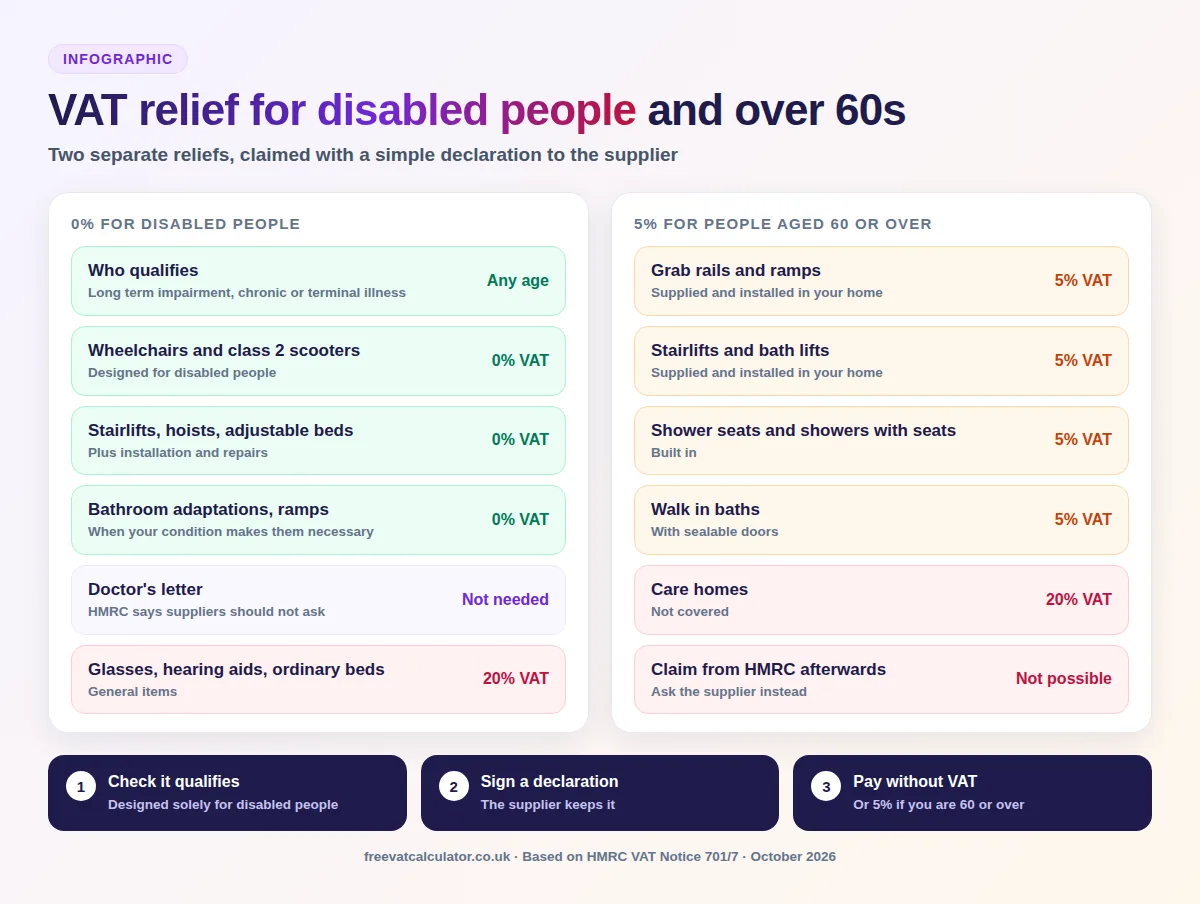
There are two separate reliefs, and the one you get depends on why you need the item. This table compares them.
| Relief for disabled people | Relief for people aged 60 or over | |
|---|---|---|
| VAT rate | 0%, so no VAT at all | 5% instead of 20% |
| Who qualifies | Anyone chronically sick or disabled, of any age | Anyone aged 60 or over, disabled or not |
| What it covers | Goods designed solely for disabled people, plus some services and building work | Six types of mobility aid, supplied and installed in the home |
| How to claim | Sign a declaration for the supplier | Sign a declaration confirming your age |
People often call this VAT exemption, but strictly it is zero rating. The difference matters to suppliers rather than to you: either way, you pay no VAT on qualifying items.
Who qualifies for VAT relief for disabled people?
You qualify if you are chronically sick or disabled. HMRC means a physical or mental impairment that has a long term and substantial effect on your ability to carry out everyday activities, or a condition the medical profession treats as a chronic sickness, such as diabetes. People who are terminally ill also qualify.
You do not need to be registered disabled, receive any benefit or pass a means test. The relief depends on your condition and on what you buy, not on your income.
Who does not qualify
Elderly people who are not disabled or chronically sick do not qualify for the 0% relief, though they may get the 5% rate described below. Temporary conditions, such as a broken leg, do not count either, because the impairment has to be long term.
Do you need proof or a doctor’s letter?
No. HMRC’s own guidance says no medical proof is needed, and suppliers should not ask you for a doctor’s certificate. You simply sign a declaration describing your condition, and if you are unsure whether you qualify, your GP or a specialist can help you decide.
Buying for someone else
A parent, partner, guardian or carer can buy on behalf of a disabled person, and the purchase is treated as if the disabled person made it. The declaration is still about the disabled person’s condition.
VAT exemption list for disabled people: what you can buy VAT free
To be VAT free, goods must be designed solely for disabled people and be for your personal or domestic use. Only the manufacturer can confirm an item is designed solely for disabled people, so a good supplier will already know which products qualify.
Mobility scooters and wheelchairs
Wheelchairs qualify, along with class 2 mobility scooters. Class 3 scooters qualify only if they are designed solely for disabled people, and golf buggies never do. Parts and accessories for qualifying items, and hiring or leasing them, can also be VAT free.
Beds, chairs, lifts and hoists
Electrically or mechanically adjustable beds qualify when they are clearly specialised for a disabled person, but ordinary or orthopaedic beds do not. Chair lifts, stairlifts, hoists and lifters qualify, and a riser recliner chair can qualify, while a recliner without a lift mechanism does not.
Bathroom aids and sanitary devices
Sanitary devices designed for disabled people, such as commodes and specialist toilet aids, can be bought VAT free. Larger bathroom changes are building work, covered in the next section.
Computers, hearing and sight aids
Computers are only VAT free when they are supplied as part of an assistive technology system designed for a disabled person. Aids for people who are hard of hearing and low vision aids can qualify, but standard hearing aids, glasses, contact lenses and dentures do not.
Incontinence products
Incontinence products designed for disabled people are zero rated, and online or mail order sellers may need a declaration for larger orders. Plasters and bandages are not covered.
Items that do not qualify
General items that anyone might use stay at the normal rate, even if a disabled person needs them. These include:
- ordinary or orthopaedic beds and standard furniture
- standard hearing aids, glasses, contact lenses and dentures
- plasters, bandages and general first aid items
- most computers, ordinary phones and general batteries
- air conditioning, intruder alarms and CCTV
Prescription medicines are a separate matter. Medicines dispensed by a pharmacist on a prescription are zero rated under their own rules.
Services and building work you can get VAT free
Some work on your home can be VAT free when your condition makes it necessary and the work is in your own private home. The builder or installer applies the relief after you sign a declaration.
VAT relief for disabled bathrooms
Extending or adapting a bathroom, washroom or toilet can be zero rated if your condition makes the work necessary, for example a level access wet room. A like for like replacement of an ordinary bathroom suite does not qualify, because the work must be needed because of the disability.
Ramps, doorways and lifts
Building a ramp, widening an existing doorway or passage, and installing a lift between floors of your home all qualify. Preparation work and making good afterwards are included, along with goods the builder supplies as part of the job.
Building work that does not qualify
Kitchens, bedrooms, living rooms, boilers, replacement windows and doors, new doorways and driveways stay at the normal rate. Architects’ fees are standard rated too, unless the builder provides a design and build service.
Installation, repairs and maintenance
Installing, repairing and maintaining qualifying goods, such as servicing a stairlift, is VAT free. If a general item is adapted for you, only the adaptation work is zero rated, not the item itself.
Emergency alarm call systems
Alarm systems that let you call for help, and the monitoring service at the control centre, can be VAT free for disabled people. Ordinary telephones and intruder alarms are not included.
VAT relief for over 60s: the 5% reduced rate
If you are 60 or over, you can pay 5% VAT instead of 20% on six types of mobility aid, even if you are not disabled. The item must be supplied and installed by the same business, in your own home or a home you share with family or friends, and you must be 60 when the supply is made.
- grab rails
- ramps
- stairlifts
- bath lifts
- built in shower seats, or showers containing a built in seat
- walk in baths with sealable doors
Repairs and general adaptations are not covered, and nor are care homes. A council or charity can pay for the work and the 5% rate still applies, as long as you sign the age declaration. If you are both over 60 and disabled, the 0% relief is usually the better choice.
How to claim VAT relief for disabled people
You never claim from HMRC. The supplier removes the VAT at the point of sale, and the process takes a few minutes:
- Check the item or work qualifies, using the checklist and lists above.
- Tell the supplier before you buy that you want VAT relief.
- Sign their eligibility declaration, or HMRC’s own form, describing your condition.
- Pay the price without VAT, or with 5% VAT for the over 60s relief.
- Keep a copy of the declaration with your receipt.
The supplier decides whether to zero rate the sale and keeps the declaration, so you do not send anything to HMRC. You need a declaration for each supplier you buy from.
The VAT exemption form for disabled people
HMRC publishes a two page eligibility declaration that any supplier can use, although many have their own version. It asks for your name and address, a description of your condition, and your signature, and it must be separate from the order form.
Buying online
Online shops that sell disability products usually let you tick a VAT relief box at checkout and complete an electronic declaration, which HMRC accepts. The price then drops by the VAT before you pay.
If you were charged VAT by mistake
HMRC cannot refund VAT to you directly. If you qualified but paid VAT, go back to the supplier, who can correct the invoice and refund you if they agree the sale should have been zero rated.
Disabled car VAT exemption: adapted vehicles
A car or van can be bought without VAT if you usually use a wheelchair or stretcher and the vehicle is designed for you, or substantially and permanently adapted. Occasional wheelchair use does not count, mobility scooters are not treated as wheelchairs, and the vehicle must have 12 seats or fewer.
You can get one zero rated vehicle every three years, unless the vehicle is stolen, written off or your condition changes. You sign declaration form VAT1615A, and the dealer reports the sale to HMRC.
Motability changes from July 2026
From 1 July 2026, Motability scheme leases are no longer zero rated in full. The part paid from your mobility benefit still carries no VAT, but advance payments on new cars now carry 20% VAT, and most new leases carry insurance premium tax. Wheelchair accessible vehicles keep their relief, and buying an adapted vehicle outright is unchanged.
VAT relief for charities buying for disabled people
Charities and other eligible bodies can buy certain medical equipment and goods for disabled people, such as adapted vehicles, without VAT when they use charitable or donated funds. The rules are in HMRC’s VAT Notice 701/6, and the charity, not the individual, signs the declaration.
What happens if a declaration is wrong
Suppliers must not zero rate a sale if they believe a declaration is untrue, and there are penalties for knowingly accepting a false one. For adapted vehicles and the over 60s relief, anyone who gives an incorrect certificate can be charged a penalty equal to the VAT lost, unless they had a reasonable excuse. If you are honestly unsure whether you qualify, ask before you sign.
How much VAT relief can save you
The saving from VAT relief for disabled people is the VAT you no longer pay. These examples use typical prices to show the difference between full VAT, the over 60s rate and full relief.
| Item | Price before VAT | With 20% VAT | With 5% VAT | With 0% relief |
|---|---|---|---|---|
| Straight stairlift, installed | £2,500 | £3,000 | £2,625 | £2,500 |
| Riser recliner chair | £800 | £960 | Not covered | £800 |
| Wet room adaptation | £6,000 | £7,200 | Not covered | £6,000 |
| Grab rails, installed | £150 | £180 | £157.50 | £150 |
Prices are examples only. Our VAT calculator works out the VAT on any quote at 20% or 5%.
Checking a quote for VAT?
Work out the VAT on any price at 20% or 5% with the free VAT calculator.
VAT relief for disabled people FAQs
These are the questions people ask most about buying disability products without VAT. The sections above give the full rules for each.
What disabilities qualify for VAT exemption?
Any physical or mental impairment with a long term, substantial effect on everyday activities, or a chronic illness such as diabetes. Terminal illness also qualifies, but temporary injuries do not.
Do I need a doctor’s letter to buy VAT free?
No. You sign a declaration, and HMRC says suppliers should not ask for medical proof.
Can I claim VAT back from HMRC if I paid it?
No. Only the supplier can correct the sale and refund the VAT, so contact them with your declaration.
Are mobility scooters VAT free?
Class 2 scooters are, if bought by a disabled person for personal use. Class 3 scooters qualify only if designed solely for disabled people.
Can over 60s get VAT relief?
Yes, at 5% rather than 0%, on grab rails, ramps, stairlifts, bath lifts, built in shower seats and walk in baths, when supplied and installed in their own home. They sign a short declaration confirming their age.
Is a disabled bathroom VAT free?
Adapting or extending a bathroom can be, if your condition makes it necessary and the work is in your own home. A standard bathroom refit is not.
For anything not covered here, HMRC’s VAT Notice 701/7 sets out the full rules, and the supplier can usually tell you whether a product qualifies. Charities such as Disability Information Scotland and LITRG also publish free guides.
You now know who qualifies, what you can buy without VAT, how the 5% rate for over 60s works and how to claim with a simple declaration. All the information you need to stop paying VAT you do not owe is above.
Sources: HMRC VAT Notice 701/7; HMRC, VAT relief on certain goods if you have a disability; GOV.UK, VAT relief for disabled people; HMRC eligibility declaration; HMRC manual VRDP44000; HMRC VAT Notice 1002; HMRC VAT Notice 701/6; HM Treasury, Motability scheme reliefs. This page is general information, not tax advice.