
EV charging VAT guide
VAT on EV Charging: Home, Public and Workplace Rates and What You Can Reclaim
How to work out the VAT on a charge
- Where you chargedHome, public or work
- Find the rate0%, 5% or 20%
- Take out the VAT÷ 6 at 20%, ÷ 21 at 5%
- Who got the supplyYou, the business or staff
- Keep the proofVAT receipt and mileage log
You plug in at a rapid charger and pay far more per kWh than the same electricity costs on your driveway, and part of that gap is VAT. A tribunal says public charging could be 5%, the Budget says 20% and home electricity has dropped to 0%, so it is hard to tell which rate is on your receipt or what your business can claim back.
Below is a calculator that finds the VAT in any charge, then the rate for each place you charge, the law that took effect on 1 November 2026 and what businesses can reclaim. Each rate is checked against HMRC guidance and the Budget of 28 October 2026, so you can see the VAT on EV charging for your own situation in seconds.
EV charging VAT calculator
Enter the kWh from your app or receipt, or the miles you drove, then the price and where you charged. You get the VAT, the price without it, the rate used and why, and what a VAT registered business could reclaim.
EV charging VAT calculator
Find the VAT in a charge at home, in public or at work, and what a business can reclaim
Rate used: 20%
Electricity from a charger the public can use is standard rated from 1 November 2026, whatever its speed and however little you take.
Nothing to reclaim
Only a VAT registered business can reclaim VAT on charging, and only for business use.
The working
40 kWh × 75p = £30.00 including VAT. The price without VAT is £30.00 ÷ 1.2 = £25.00, so the VAT is £30.00 minus £25.00 = £5.00.
A price shown to drivers normally includes VAT, so leave it on includes VAT unless your receipt adds VAT on top. The business share is your business miles as a percentage of all miles, from your mileage log. Figures are rounded to the nearest penny, and nothing you enter is stored or sent.
Key facts
- Public chargers
- 20% from 1 November 2026, at any speed
- Home charging in Great Britain
- 0% to 30 June 2027, then 5%
- Home charging in Northern Ireland
- 5%, with relief expected from April 2027
- Workplace chargers
- 20% when staff pay for the electricity
- Buying a home charger
- 20%, as it is not an energy saving material
- Employee charging at home
- The employer cannot reclaim the VAT
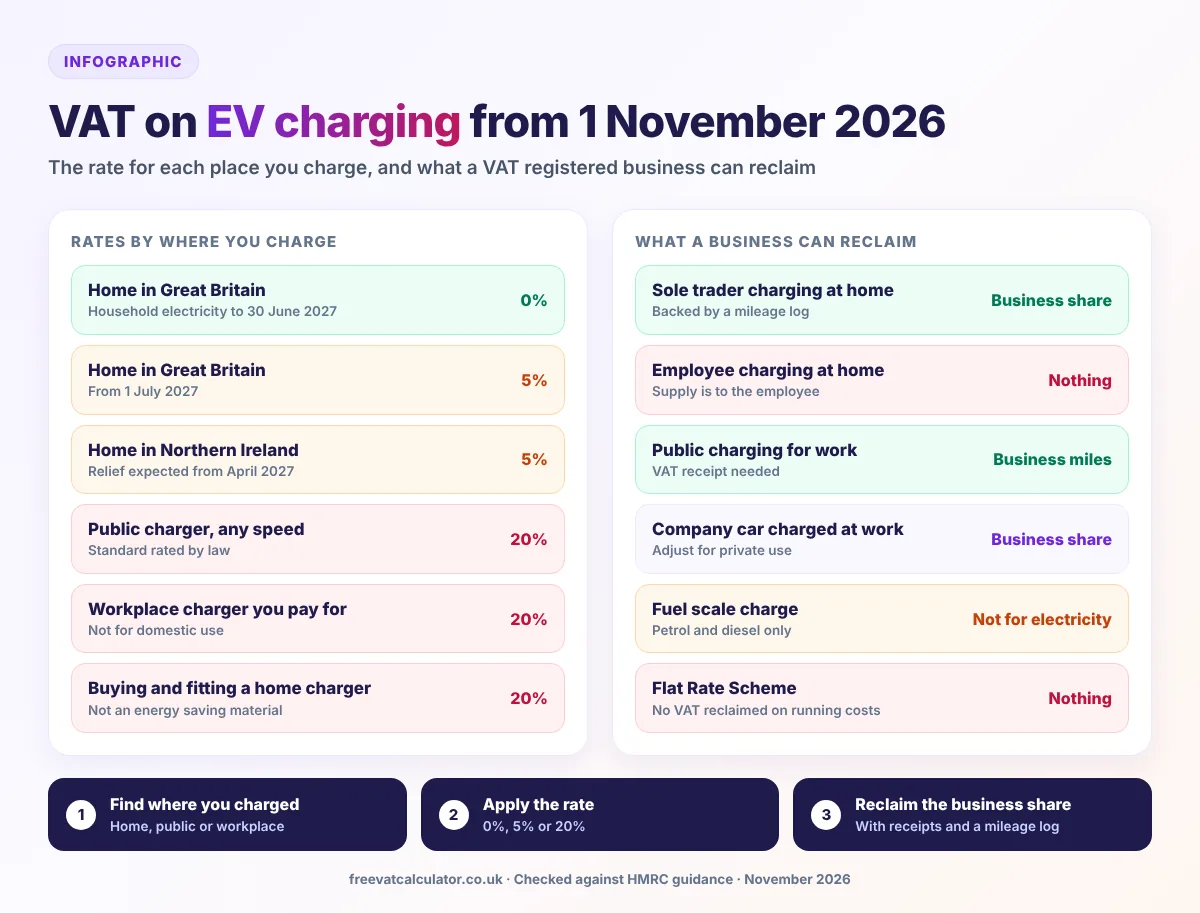
VAT on EV charging rates at a glance
The rate depends on how the electricity reaches the car, not on the car or the charger’s speed. HMRC’s fuel and power notice now treats any charger the public or staff can use as standard rated, whatever the amount of electricity.
- 0%Home charging in Great Britain to 30 June 2027
- 5%Home charging in Northern Ireland
- 20%Public and workplace chargers
| Where you charge | VAT rate | Why |
|---|---|---|
| Home in Great Britain | 0% to 30 June 2027, then 5% | Household electricity |
| Home in Northern Ireland | 5% | Household electricity |
| Charger only residents of a building can use | Can get the home rate | Not open to the public |
| Public charger of any speed | 20% | Standard rated by law |
| Workplace charger staff pay to use | 20% | Not for domestic use |
| Buying and fitting a home charger | 20% | Not an energy saving material |
| Charger fitted in a new build home | Can be 0% | Part of zero rated construction |
VAT on public EV charging: why it is 20%
Every public charger adds 20% VAT, from a street socket to an ultra rapid hub, so one sixth of a VAT inclusive price is tax. A £30.00 charge therefore holds £5.00 of VAT.
The new law from 1 November 2026
The Budget confirmed law in the Finance Bill for 2026 to 2027 making electricity from a publicly accessible charging point standard rated, and Revenue and Customs Brief 13 (2026) confirms it applies from 1 November 2026. It covers chargers open to the public, to a section of the public, or to employees and contractors at work, but not one only residents of a building can use. HMRC’s policy paper adds that the 1,000 kWh a month domestic limit no longer helps these supplies, and the Climate Change Levy follows the same rule. Our Autumn Budget 2026 VAT guide lists the other VAT changes from 28 October.
The Charge My Street ruling and HMRC’s appeal
The law answers Charge My Street Ltd v HMRC [2026] UKFTT 318 (TC), decided on 26 February 2026 for a community owned operator focused on Cumbria. The tribunal held that premises need not be a building, so a public car park can count, and a driver taking no more than 1,000 kWh from the same charge point in a calendar month could pay 5%. HMRC rejected this in Revenue and Customs Brief 4 (2026) and now has permission to appeal to the Upper Tribunal.
What happens to charges already paid
The new law is not retrospective, and HMRC’s view is that earlier charges were correctly standard rated, so the 20% you paid stands for now. If Charge My Street wins, the operator, not the driver, could claim overpaid VAT for up to four years. Under section 80 of the VAT Act 1994, HMRC can refuse a claim that would unjustly enrich an operator who passed the VAT on.
Rapid chargers, subscriptions, idle fees and roaming apps
Slow, fast, rapid and ultra rapid public chargers all carry 20%, and subscriptions, session fees and idle fees are not household electricity either, so expect 20% on them. If you pay through a roaming app or fuel card, the business you pay should give you the VAT receipt. The Public Charge Point Regulations 2023 make public chargers show the total price in pence per kWh, and it cannot rise once charging starts.
The Budget also gives £100 million over two years to cut costs at local, lower powered public chargers. From spring 2027 it expects this to save the average driver with no home charger who charges on the street about £150 a year.
VAT on charging an electric car at home
Charging at home uses your household supply, so it gets the domestic rate. VAT Notice 701/19 says household electricity used to charge a car at home is not an electric vehicle charging supply.
Great Britain: 0% until 30 June 2027
Household electricity in England, Scotland and Wales has carried 0% VAT since 1 October 2026, and the Budget extended this to 30 June 2027. The 5% rate returns on 1 July 2027, and our guide to 0% VAT on household electricity shows how bills crossing either date are split.
Northern Ireland: still 5%
Home charging in Northern Ireland still carries 5% VAT. The Budget says extended VAT relief is expected there from April 2027, but no rate or end date has been published.
EV tariffs, smart chargers and shared chargers
An overnight EV tariff, a smart charger or a separate meter does not change the rate, because Brief 13 says a charge point for private residential use at a home can still qualify for relief. At a block of flats, a charger only residents can use can qualify too, but once the public can use it, 20% applies.
VAT on a home EV charger: buying and installing one
Buying and fitting a charger at an existing home costs 20% VAT. Chargers are not energy saving materials under VAT Notice 708/6, so the 0% rate for solar panels and batteries to 31 March 2027 does not cover them, and a charger fitted alongside them is normally a separate supply at 20%.
Chargers in new homes
On 26 August 2026 HMRC added electric vehicle charge points to the zero rated items in VAT Notice 708. A charger the developer fits while building a new home can therefore carry 0%.
Grants for home and workplace chargers
Office for Zero Emission Vehicles grants for renters, flat owners, on street parking households, landlords and workplaces run to 31 March 2027, at up to £500 a socket since 1 April 2026. The renters and flat owners grant covers 75% of the cost of one socket, and the Workplace Charging Scheme covers up to 40 sockets. Under the April 2026 rules for the home grants, do not fit the charger until eligibility is confirmed, which can take up to 10 working days.
VAT on workplace charging
A charger for staff or contractors at work is a workplace charging point, so any charge you make for the electricity carries 20% VAT. That output tax goes in box 1 of your return, however little each driver uses.
Free charging for employees
Free charging at or near the workplace, open to employees generally, is not a taxable benefit under section 237A of the Income Tax (Earnings and Pensions) Act 2003, as EIM01035 confirms from 6 April 2018. The employer reclaims the VAT on the site’s electricity under the normal rules. Where staff charge their own cars for private trips at no cost, take advice before reclaiming all of that VAT.
Company cars and vans charged at work
For business cars or vans charged at your premises and also used privately, you can reclaim all the VAT and pay output tax on private use, or reclaim only the business share from mileage records. For income tax, electricity is not fuel, so EIM23900 confirms no car fuel benefit charge for an electric company car.
How to reclaim VAT on EV charging as a business
Who can reclaim depends on who receives the electricity, not who pays the bill. VAT Notice 700/64 sets out these cases.
| Situation | Supply made to | Business can reclaim? |
|---|---|---|
| Sole trader or partner charging at home | The owner | Yes, the business share |
| Employee charging at home | The employee | No |
| Employer paying back home charging | The employee | No, HMRC is still reviewing |
| Employee at a public charger for work | The employer | Yes, for business miles |
| Company car or van charged at work | The business | Yes, with private use adjusted |
| Business on the Flat Rate Scheme | The business | No |
An employer cannot reclaim VAT on charging at an employee’s home, even for business miles, because the electricity is supplied to the employee. HMRC said in January 2022 it was reviewing reimbursed home charging, and the notice still says so, while our Flat Rate Scheme guide explains why scheme users reclaim nothing.
No fuel scale charge for electricity
The fuel scale charge covers private road fuel, and its 2013 Order uprates the figures using petrol and diesel prices. Electricity is split between business and private use instead, so no scale charge applies, and our fuel scale charge guide covers buying or leasing the car itself.
Splitting home charging for sole traders
A sole trader or partner reclaims the business share of home charging VAT, found from mileage records, as our guide to VAT for sole traders explains. There is no VAT on home charging in Great Britain until 30 June 2027, so nothing to reclaim until then. From 1 July 2027, £126.00 of home charging including 5% holds £6.00 of VAT, and 60% business miles means £3.60 back.
The advisory electricity rate and VAT
HMRC’s advisory electricity rate for company cars is 7p a mile at home and 15p at public chargers from 1 September 2026, with the next review on 1 December 2026. The VAT notice gives no rule for it, and the home rate carries no reclaimable VAT for the employer. Some advisers treat one sixth of the public rate, 2.5p a mile, as reclaimable when backed by a public charging receipt.
Invoices and records you need
For charges up to £250 including VAT, VAT Notice 700/21 accepts a simplified invoice showing the supplier’s name, address and VAT number, the date, a description, the rate and the total. Our guide to what a valid VAT invoice must include has the full list, and you have four years to claim input tax you missed.
- a VAT receipt for each public or workplace charge
- a mileage log of business and private trips
- the kWh used at home, from an app or meter
- a claim for VAT on EV charging limited to business use
Worked examples of the VAT in a charge
These examples use round prices, not market averages. Divide a VAT inclusive price by 6 for the VAT at 20%, or by 21 at 5%.
| Charge | Price with VAT | VAT | Without VAT |
|---|---|---|---|
| 40 kWh at home in Great Britain at 25p | £10.00 | £0.00 | £10.00 |
| 40 kWh at home in Northern Ireland at 30p | £12.00 | £0.57 | £11.43 |
| 20 kWh at a workplace charger at 36p | £7.20 | £1.20 | £6.00 |
| 40 kWh at a public charger at 75p | £30.00 | £5.00 | £25.00 |
| 50 kWh at a rapid charger at 85p | £42.50 | £7.08 | £35.42 |
Need VAT on fuel or a company car?
Our fuel scale charge guide covers petrol, diesel, leases and mileage, and the main VAT calculator works at any rate.
VAT on EV charging FAQs
These are the questions drivers and business owners ask most. Each answer reflects the rules on 2 November 2026.
Is there VAT on EV charging?
Yes, except home charging in Great Britain, which is at 0% until 30 June 2027. Public and workplace chargers carry 20%, and home charging in Northern Ireland carries 5%.
Can I claim VAT on EV charging as a sole trader?
Yes, for the business share at home, at work or in public, backed by mileage records and VAT receipts. Home charging in Great Britain has no VAT to reclaim until 1 July 2027.
Can my employer reclaim VAT on my home charging?
No. The electricity is supplied to you, so your employer cannot reclaim it even for business miles.
Will drivers get VAT back if Charge My Street wins?
No claim lies from drivers to HMRC, because the operator paid that VAT over. Any refund to customers would be up to the operator.
Is a home EV charger zero rated like solar panels?
No. Fitting one at an existing home costs 20% VAT, although a charger fitted while a new home is built can be zero rated.
You now have the rate for each place you charge, the reason public and workplace charging is 20% and what your business can reclaim. Use the calculator whenever you need the VAT in a charge, and keep the receipts that back up every claim.
Sources: HMRC, Revenue and Customs Brief 13 (2026); HMRC policy paper on EV charging points; VAT Notice 701/19; Revenue and Customs Brief 4 (2026); Charge My Street Ltd v HMRC [2026] UKFTT 318 (TC); HMRC, list of VAT appeals updates; VAT Act 1994, section 80; Public Charge Point Regulations 2023; Budget 2026; Budget 2026 overview of tax legislation and rates; VAT Notice 708/6; VAT Notice 708; GOV.UK, chargepoint grant for renters and flat owners; OZEV grant changes from 1 April 2026; EIM01035; EIM23900; VAT Notice 700/64; Revenue and Customs Brief 7 (2021); Revenue and Customs Brief 1 (2022); SI 2013/2911; HMRC advisory fuel rates; VAT Notice 700/21; VAT Notice 700; GOV.UK, VAT Flat Rate Scheme; Price Marking Order 2004. This page is general information, not tax advice.