
VAT motoring guide
Fuel Scale Charge 2026 to 2027: Calculator, VAT on Fuel, Leases and Mileage
How the scale charge works
- Company carFuel paid by the business
- Reclaim fuel VATAll of it, in box 4
- Find the bandCO2 rounded down to 5
- Pick the period12, 3 or 1 month
- Pay it backVAT in box 1, net in box 6
Your company car does client visits on Monday and the school run on Saturday, and every fuel receipt goes through the business. Then your bookkeeper asks: scale charge or mileage log, and why is only half the lease VAT coming back?
Below is a calculator for all of it and HMRC’s full table for 2026 to 2027. You will see whether the fuel scale charge saves your business money or costs it, and where each figure goes on your return.
Fuel scale charge calculator for 2026 to 2027
This fuel VAT calculator covers the charge, fuel options, the 50% lease rule and mileage. Its figures were checked against GOV.UK on 23 October 2026.
Fuel scale charge calculator
HMRC figures from 1 May 2026
145g/km band on a quarterly return
Add £51.83 to box 1 and £259.17 to box 6, and reclaim all the fuel VAT in box 4.
Best: reclaim the business share only
You recover £240.00 with a full mileage log, which is £47.50 more than the next best option.
Half the rental VAT is blocked
You reclaim half of the £960.00 rental VAT plus all £72.00 of maintenance VAT.
Reclaim £34.00 of VAT
Only the 17p fuel element carries VAT, not the whole allowance.
Key facts
- Lowest charge
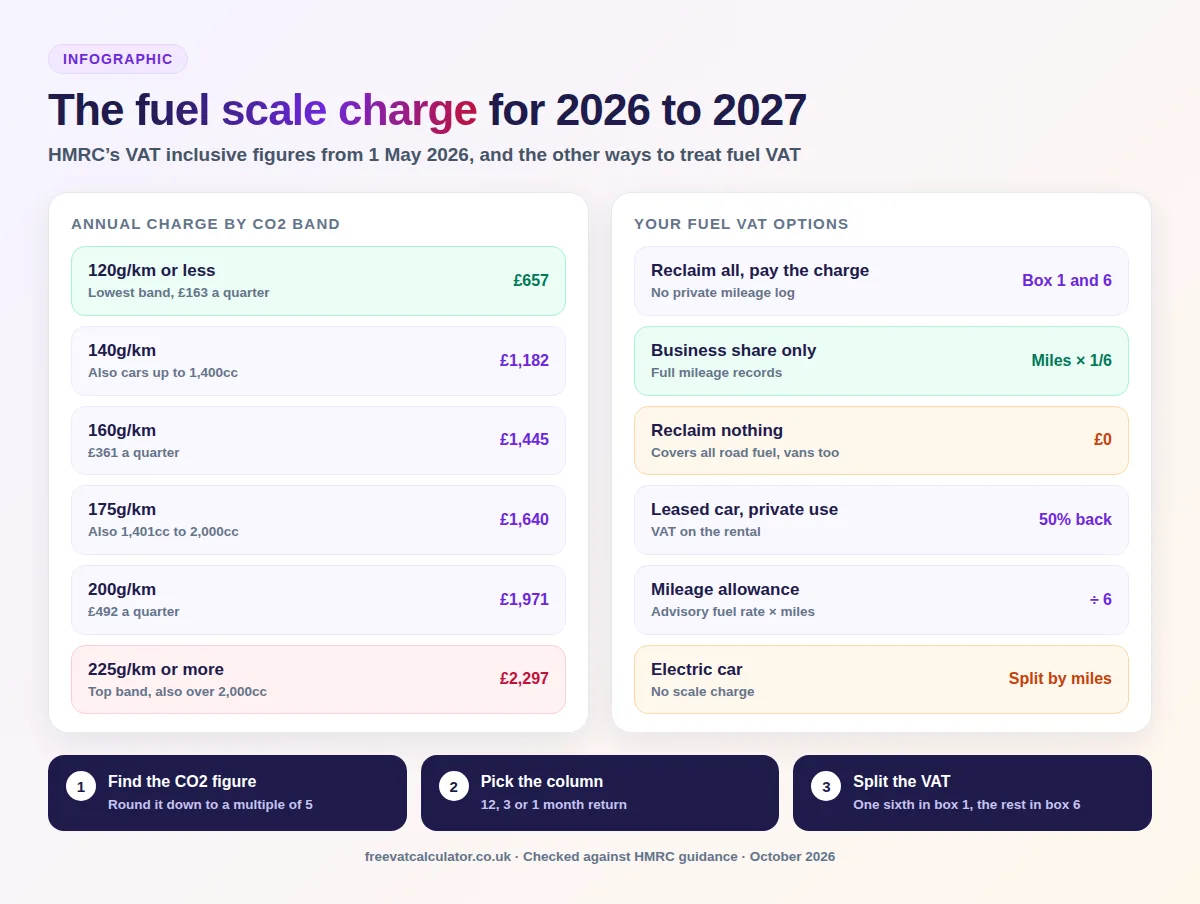
- £657 a year at 120g/km or less
- Highest charge
- £2,297 a year at 225g/km or more
- VAT element
- One sixth, in box 1
- CO2 rounding
- Down to a multiple of 5
- Leased cars
- Half the rental VAT blocked
- Mileage
- Fuel element ÷ 6
What is the fuel scale charge?
It is a fixed amount of output VAT a business pays when it reclaims all the fuel VAT on a car also driven privately. HMRC sets these road fuel scale charges, often called VAT scale charges, by CO2 band and VAT period.
The table comes from the VAT (Flat rate Valuation of Supplies of Fuel for Private Use) Order 2013 and is uprated yearly in line with fuel costs. It covers company car drivers, partners and sole traders, and a sole trader cannot escape it by billing themselves.
When the scale charge does not apply
The charge only covers cars with private fuel paid for by the business. These cases are outside it.
- vans and other commercial vehicles
- genuine pool cars with no private use
- fully electric cars
- businesses that reclaim no road fuel VAT
- drivers who pay for all private fuel
- businesses on the Flat Rate Scheme
Fuel scale charges from 1 May 2026 to 30 April 2027
Each amount includes VAT. The last column shows the VAT inside a quarterly charge.
| CO2 (g/km) | 12 months | 3 months | 1 month | VAT in 3 months |
|---|---|---|---|---|
| 120 or less | £657 | £163 | £54 | £27.17 |
| 125 | £983 | £246 | £81 | £41.00 |
| 130 | £1,051 | £261 | £86 | £43.50 |
| 135 | £1,114 | £278 | £92 | £46.33 |
| 140 | £1,182 | £294 | £98 | £49.00 |
| 145 | £1,245 | £311 | £103 | £51.83 |
| 150 | £1,314 | £328 | £109 | £54.67 |
| 155 | £1,377 | £344 | £114 | £57.33 |
| 160 | £1,445 | £361 | £119 | £60.17 |
| 165 | £1,508 | £377 | £125 | £62.83 |
| 170 | £1,576 | £393 | £130 | £65.50 |
| 175 | £1,640 | £409 | £136 | £68.17 |
| 180 | £1,708 | £426 | £142 | £71.00 |
| 185 | £1,771 | £442 | £146 | £73.67 |
| 190 | £1,839 | £459 | £152 | £76.50 |
| 195 | £1,902 | £475 | £158 | £79.17 |
| 200 | £1,971 | £492 | £163 | £82.00 |
| 205 | £2,034 | £509 | £169 | £84.83 |
| 210 | £2,102 | £524 | £174 | £87.33 |
| 215 | £2,165 | £541 | £180 | £90.17 |
| 220 | £2,233 | £557 | £185 | £92.83 |
| 225 or more | £2,297 | £574 | £190 | £95.67 |
HMRC published the table on 17 April 2026, and every row matches its GOV.UK page. Each value covers one person in one car for one period.
What changed from 2025 and when it starts
Every band is £4 to £17 a year cheaper, so the lowest fell from £661 to £657 and the top from £2,314 to £2,297. The new figures apply from your first VAT period beginning on or after 1 May 2026, so a quarter from 1 April to 30 June 2026 kept the old ones.
How to calculate the fuel scale charge
The calculator does these four steps for you. This is the order HMRC expects.
- Find the car’s CO2 figure and round it down to a multiple of 5.
- Find that band in the column for your return period: 12, 3 or 1 month.
- Divide the charge by 6 to get the VAT, and the rest is the net amount.
- Put the VAT in box 1 and the net amount in box 6.
Find and round the CO2 figure
The figure is on the V5C log book or the DVLA vehicle enquiry service. Round it down, so 163g/km becomes 160, and a bi fuel car uses the lower of its two figures.
Cars with no CO2 figure
Some older cars have no CO2 figure, because no UK approval certificate or certificate of conformity was issued for them. The law then uses engine size.
| Engine size | Band to use | Annual charge |
|---|---|---|
| 1,400cc or less | 140 | £1,182 |
| Over 1,400cc up to 2,000cc | 175 | £1,640 |
| Over 2,000cc | 225 or more | £2,297 |
Where the scale charge goes on your VAT return
HMRC’s VAT return notice puts the scale charge VAT in box 1 and its net value in box 6. The fuel VAT you reclaim stays in box 4.
| Box | What goes in | Example |
|---|---|---|
| Box 1 | VAT on the scale charge | £51.83 |
| Box 4 | VAT on £720 of fuel | £120.00 |
| Box 6 | Scale charge excluding VAT | £259.17 |
| Box 7 | Fuel excluding VAT | £600.00 |
This car’s net recovery is £68.17 for the quarter rather than £120. Our guide on how to do a VAT return explains every box.
Changing cars in a period
If a driver switches band mid period, apportion the charges by time or pay the higher one. One month at 140g/km and two at 170g/km gives £294 × 1/3 plus £393 × 2/3, which is £360, and your records should show each car’s band and the change date.
VAT on fuel: four ways to treat business fuel
Road fuel is standard rated, so VAT on fuel is 20% at the pump. VAT Notice 700/64 gives four ways to handle it.
| Option | What you do | Suits |
|---|---|---|
| Business fuel only | Reclaim all the VAT, with no private use | Pool cars, vans |
| Reclaim all and pay the scale charge | Reclaim the VAT for fuel, then pay the charge | Heavy private use |
| Reclaim the business share | Keep mileage logs and reclaim business fuel VAT | Mostly business driving |
| Reclaim nothing | Claim no road fuel VAT and pay no charge | Very low business mileage |
Two rules tie these options together. The scale charge must cover every car with private fuel, and reclaiming nothing must cover all road fuel, vans included.
Reclaim the business share with mileage records
You log every journey and reclaim VAT on the business share only. In HMRC’s example, 3,165 business miles out of 4,290 on £368 of fuel gives £271.49 of business fuel and £45.25 of VAT.
Charging drivers for private fuel
You can charge drivers for private fuel, account for VAT on the charge and keep claiming VAT on fuel in full. A nominal charge will not do, and below cost VAT is due on the full market value.
Partly exempt businesses
A partly exempt business can cut the scale charge to its recovery rate, so 80% recovery means paying 80% of the charge. Our guide to partial exemption VAT explains that rate.
Advantages of the scale charge
- no private mileage log to keep
- every fuel receipt reclaimed in full
- one fixed figure per car
Disadvantages of the scale charge
- costs more than it saves on low fuel spend
- must cover every car with private fuel
- low private mileage still pays in full
Worked example: scale charge or mileage records?
A petrol car at 145g/km on annual returns has a charge of £1,245, holding £207.50 of VAT. The business buys £2,400 of fuel in the year, holding £400 of VAT, and 6,000 of its 10,000 miles are for business.
| Option | VAT reclaimed | VAT paid back | Net VAT recovered |
|---|---|---|---|
| Reclaim all, pay scale charge | £400.00 | £207.50 | £192.50 |
| Business share (60%) | £240.00 | £0.00 | £240.00 |
| Reclaim nothing | £0.00 | £0.00 | £0.00 |
Keeping mileage records wins here by £47.50. For this car and spend, the scale charge only comes out ahead when business use is below about 48%.
Petrol VAT, diesel VAT and fuel duty
Petrol VAT and diesel VAT are both 20%, as the VAT on fuel rates match for all road fuel, so the VAT for petrol is one sixth of the pump price. VAT is charged after duty, so the 52.95p duty carries 10.59p of VAT.
| Part of the price | Amount |
|---|---|
| Fuel duty | 52.95p |
| VAT, one sixth of £1.40 | 23.33p |
| Fuel, delivery and retail margin | 63.72p |
Duty has been 52.95p a litre since 23 March 2022, and the Budget on 28 October 2026 extended the 5p cut to 30 June 2027. That cancels the rises planned for January and March 2027, and from 1 July 2027 duty goes back to its level before the cut, uprated by RPI.
Claiming VAT on mileage with advisory fuel rates
Reclaiming VAT on mileage allowances means claiming only the fuel element, using HMRC’s advisory fuel rates or current AA or RAC rates. With the advisory fuel rates VAT is quick to find: miles times rate, divided by 6.
Advisory fuel rates from 1 September 2026
HMRC reviews the rates each quarter, and the old rates may be used for a month after a change. Electric cars get 7p a mile at home and 15p at a public charger.
| Engine size | Petrol | Diesel | LPG |
|---|---|---|---|
| Up to 1,400cc (diesel up to 1,600cc) | 14p | 15p | 11p |
| Up to 2,000cc (diesel 1,601cc to 2,000cc) | 17p | 16p | 13p |
| Over 2,000cc | 27p | 22p | 20p |
Reclaim VAT on mileage paid to employees
To reclaim VAT on mileage paid to employees, record each person’s miles, trip purpose, engine size, rate paid and VAT claimed. Fuel receipts must cover at least the business fuel and cannot be dated after the period you claim for, though one receipt may cover more than one period. You need not keep them if the employee paid with a fuel, credit or debit card that you provided.
When you reclaim VAT on mileage allowance payments, use the fuel element, not the 55p approved rate. So 1,200 miles in a 1,800cc petrol car costs £660, but the VAT is a sixth of the £204 fuel element, £34.00. The allowance must be based on miles actually driven, and the VAT is always a sixth of the fuel element of what you pay.
Reclaiming VAT on business mileage as a sole trader
A sole trader reclaims VAT on the business share of the fuel actually bought, using a mileage log and fuel receipts as in the mileage records method above. See our guides to VAT for sole traders and VAT on train tickets for other travel costs.
VAT on car lease: the 50% restriction on leased cars
If a leased car is available for private use, you reclaim only half the VAT on the rental. This 50% VAT restriction on leased cars applies whatever the actual private mileage.
What the 50% block covers
The block covers the rental, excess mileage and, since 1 April 2022, early termination fees. Separately invoiced maintenance is fully reclaimable, so £400 rental plus £30 maintenance a month, both before VAT, returns £552 of VAT a year.
When you can claim VAT on lease car rentals in full
You can claim VAT on lease car rentals in full for taxis, driving school cars, self drive hire or cars never available privately. A hire of up to 10 days for a specific business trip escapes too, unless it replaces a company car that is off the road.
Claiming VAT on company car purchases
As a rule you cannot reclaim VAT on car purchases, because HMRC tests whether a car is available for private use. You can only reclaim VAT on company car purchases for dealer stock, taxis, self drive hire, driving schools or cars used only for business, and any other company car VAT reclaim is refused.
Pool cars
A pool car must be kept at your main premises, not allocated to one person and never kept at anyone’s home. If it later goes home with one employee, a self supply makes VAT due.
Vans, pickups and commercial vehicles
Vans are not cars for VAT, so neither the purchase block nor the scale charge applies. The same goes for vehicles with a payload of one tonne or more, 12 or more seats, 3 tonnes unladen weight or a special purpose, such as a hearse.
Adding side windows or rear seats can make a van a car. For a van’s private fuel, reclaim only the business share or no road fuel VAT.
Double cab pickups
A double cab pickup with a payload of at least one tonne is a commercial vehicle for VAT, though a hard top can tip it under. HMRC confirms the April 2025 company car tax change left the VAT position untouched.
Electric cars: how to claim VAT on electric car charging
HMRC’s notice does not apply the scale charge to electricity. You split charging costs between business and private use, for example by mileage.
Charging at work or at a public charger
A business can reclaim VAT on charging for business trips at work or at public points. Public charging is standard rated at 20%, and Revenue and Customs Brief 13 (2026) explains legislation that treats public and workplace charging as not for domestic use from 1 November 2026. The tribunal in Charge My Street had said some public charging could be 5%, and HMRC is appealing that decision.
Charging at home
Electricity an employee uses at home is supplied to them, so the employer cannot reclaim its VAT, and HMRC is still reviewing reimbursed charging. Sole traders can reclaim the business share, but household electricity in Great Britain is at 0% VAT from 1 October 2026 to 30 June 2027, after the Budget extended the relief. With no VAT on those bills there is nothing to reclaim until the 5% rate returns on 1 July 2027.
Repairs, accessories and selling a car
Repair VAT is reclaimable when the business pays, even with some private use. Accessories bought with a blocked car share the block, while later ones with a business use are reclaimable.
Selling a company car
The VAT on a sale follows how you bought the car. There are three outcomes.
- You reclaimed the VAT: charge VAT on the full price.
- VAT was blocked: the sale is exempt, with no VAT invoice.
- No VAT was charged: you may use the VAT margin scheme.
The Flat Rate Scheme and fuel
On the Flat Rate Scheme you reclaim no VAT on fuel or lease rentals, so there is no scale charge. Capital purchases of £2,000 or more including VAT, such as a van, are the exception, though the car block still applies to cars, and our flat rate VAT calculator compares both methods.
Fuel scale charge and fuel benefit charge: the difference
The VAT fuel scale charge is paid by the business on its VAT return. The car fuel benefit charge is income tax for the employee and Class 1A National Insurance for the employer. It falls to nil if the employee must repay all private fuel and does so by 6 July after the end of the tax year.
Common fuel scale charge mistakes
Most errors come from the wrong table or wrong car details. Check these before you file.
- using last year’s table after 1 May 2026
- rounding the CO2 figure up instead of down
- applying the fuel scale charge to a van
- mixing scale charges and mileage logs
- leaving the net amount out of box 6
Need VAT on other costs?
Our main VAT calculator adds or removes VAT at any rate.
Fuel scale charge FAQs
These are the questions businesses ask most. The sections above give the detail.
Is the fuel scale charge compulsory?
No. You can reclaim only the business share with mileage logs, reclaim no fuel VAT, or reclaim it all if there is no private fuel.
When do the new charges start?
From the start of your first VAT period beginning on or after 1 May 2026. HMRC publishes a new table every year.
Can I reclaim VAT on a van?
Yes. Vans are not caught by the car block, though you should restrict the claim if there is real private use.
How much is the fuel scale charge for 2026 to 2027?
It runs from £657 a year at 120g/km or less to £2,297 at 225g/km or more. On quarterly returns the range is £163 to £574, and one sixth is VAT.
How do I work out VAT on a mileage allowance?
Multiply business miles by the advisory fuel rate and divide by 6. At 17p a mile, 1,000 miles gives £170 of fuel and £28.33 of VAT.
Did the Budget change the scale charge?
No. HMRC revises the scale charges each year from 1 May, and the Budget on 28 October 2026 left the current table in place until 30 April 2027. It did extend the 5p fuel duty cut to 30 June 2027 and the 0% rate on household electricity to the same date.
You now have the 2026 to 2027 charge for every CO2 band, a calculator to compare your options and the rules for leases, vans, electric cars and mileage. All the information you need to decide how to treat car and fuel VAT is above.
Sources: HMRC, road fuel scale charges 2026 to 2027; VAT Notice 700/64; VAT Notice 700/12; VIT55400; VIT56600; EIM23151; advisory fuel rates; Revenue and Customs Brief 4 (2026); Brief 10 (2026); fuel duty rates; OBR, fuel duties; SI 2013/2911; Revenue and Customs Brief 13 (2026); Budget 2026 overview of tax legislation and rates. This page is general information, not tax advice.