
Food VAT guide
VAT on Food: What Is Zero Rated, What Costs 20% and Why
How VAT on food is decided
- Find the itemFood or drink?
- Excepted item?Snacks, sweets, drinks
- Is it hot?Five hot food tests
- Eaten in?Premises means catering
- The rate0% or 20%
You buy a sandwich, crisps and a bottle of water, and the receipt shows VAT on two of them but not the third. Sit down at the café’s table with the same sandwich and VAT is due on that too. The rules feel random because the law was written item by item, and it still turns on details like a chocolate coating, a heat lamp or a chair.
This guide starts with a checker for over 50 common items and a table of what is zero rated and what costs 20%. Below that are the reasons, the hot food tests, the court cases and the 2026 changes, so VAT on food makes sense for shoppers, café owners and anyone checking a restaurant bill.
Food VAT checker: is there VAT on this item?
Search for an item or pick it from the list, then say whether it is taken away or eaten where you bought it. The checker shows the rate, the reason and the VAT inside the price you paid.
Food VAT checker
Find the VAT rate on over 50 food and drink items
Standard rated: 20% VAT
Biscuits wholly or partly covered in chocolate count as confectionery.
Based on HMRC VAT Notices 701/14 and 709/1. Borderline products depend on their ingredients and how they are sold.
Key facts
- Most food
- Zero rated at 0%
- Excepted items
- Crisps, sweets, ice cream, most drinks and pet food at 20%
- Eating in
- Always 20%, hot or cold
- Hot takeaway
- 20% if hot and one of five tests is met
- Cakes and biscuits
- Cakes 0%, chocolate covered biscuits 20%
- 5% rate
- No food at 5% since 2 September 2026
VAT on food at a glance: zero rated and standard rated items
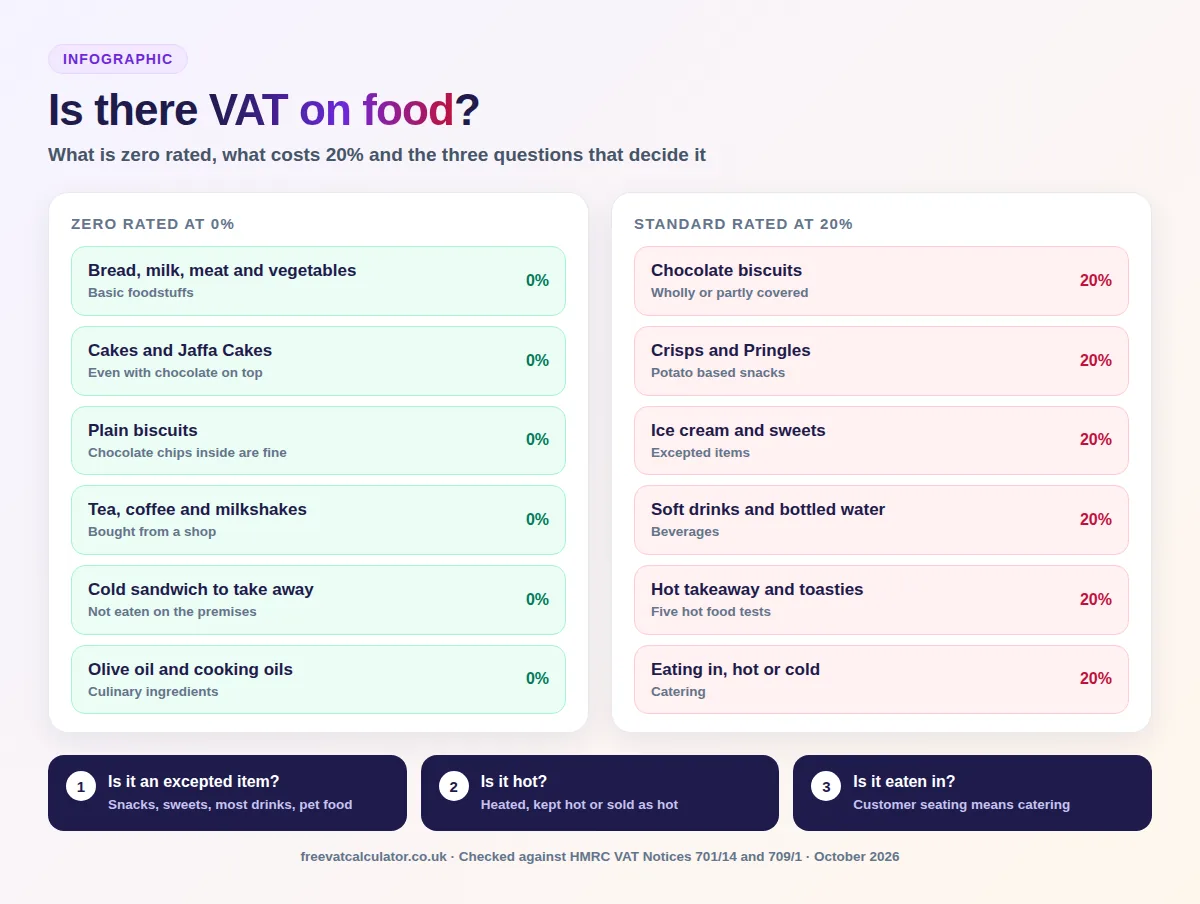
Most food is zero rated, so no VAT is added at the till. A set list of excepted items, plus anything sold as catering or hot takeaway, is standard rated at 20%.
| Item | VAT rate | Why |
|---|---|---|
| Bread, milk, eggs, meat, fruit and vegetables | 0% | Basic foodstuffs |
| Cakes, including Jaffa Cakes | 0% | Cakes are not confectionery |
| Plain biscuits and chocolate chip cookies | 0% | No chocolate on the outside |
| Chocolate biscuits, chocolates and sweets | 20% | Confectionery |
| Crisps, Pringles and popcorn | 20% | Savoury snacks |
| Ice cream and frozen yoghurt | 20% | Frozen products |
| Soft drinks, fruit juice and bottled water | 20% | Beverages |
| Milk, milkshakes, tea and coffee for home | 0% | Overriding exceptions |
| Olive oil and cooking oils | 0% | Culinary ingredients |
| Mince pies and pastries sold cold | 0% | Bakery products |
| Cold sandwich to take away | 0% | Cold takeaway |
| Hot takeaway, toasties and hot drinks | 20% | Hot food is catering |
| Anything eaten on the premises | 20% | Catering |
| Cat food, dog food and wild bird food | 20% | Pet food |
| Alcohol and home brewing kits | 20% | Excepted items |
How VAT on food works in the UK
The rules come from Schedule 8, Group 1 of the VAT Act 1994. It zero rates food for people, animal feed, seeds and live food animals, takes some items back out as excepted items, then restores a few such as milk, tea and coffee. Food uses only two of the three current VAT rates, and our guide to what VAT is covers the basics.
Zero rated, exempt and standard rated are not the same
Zero rated food is still taxable at 0%, so a grocer can reclaim VAT on its costs and its sales count towards the £90,000 registration threshold. Food is rarely exempt, apart from meals a school gives its own pupils and food given to hospital patients as part of their care. Similar item by item rules apply elsewhere, as our guide to VAT on train tickets shows.
Why some foods carry VAT: a short history
When VAT started on 1 April 1973, almost all food apart from pet food was zero rated. From 1 April 1974 ice cream, confectionery, soft drinks, crisps and nuts were taxed, largely because they had carried purchase tax, and hot takeaway food followed on 1 May 1984.
Which food is zero rated?
The zero rate covers the everyday food people buy to eat at home. HMRC’s VAT Notice 701/14 treats these as zero rated when they are not sold hot or as catering.
Everyday groceries
- meat, poultry and fish
- fruit, vegetables, herbs and spices
- bread, rolls and most bakery products
- milk, cheese, butter and eggs
- rice, pasta, flour and cereals
- tea, coffee and cocoa for home
- chilled and frozen ready meals
- jam, honey and chocolate spread
Cooking ingredients, including olive oil
Ingredients with real nutritional value sold for home cooking are zero rated, including olive oil and other culinary oils, sugar, salt, baking powder and culinary chocolate. Linseed oil, aromatherapy oils and ice cream mixes are standard rated, and bicarbonate of soda is only zero rated in small tubs sold for baking.
Gluten free foods, health foods and supplements
Gluten free bread, flour and cakes are zero rated like ordinary food, but a gluten free chocolate biscuit is standard rated. Vitamin tablets, herbal capsules and appetite suppressants are standard rated, because they are not normally eaten as food.
Food that always has VAT: the excepted items
Excepted items are standard rated wherever they are sold. A packet of crisps carries 20% VAT in a supermarket, a petrol station or a vending machine alike.
Ice cream and frozen yoghurt
Ice cream, ice lollies, sorbets and frozen yoghurt made to be eaten frozen are standard rated. Frozen yoghurt you thaw before eating is zero rated, as is other frozen food such as frozen peas.
Confectionery, chocolates and sweets
Confectionery covers chocolates, sweets, chewing gum, marshmallows and any sweetened prepared food normally eaten with the fingers, which is why cereal bars and coated nuts are standard rated. Cakes, chocolate spread and biscuits covered only in icing or caramel stay zero rated.
Crisps, savoury snacks and popcorn
Potato crisps, savoury popcorn and puffed cereal snacks are standard rated, and sweet popcorn is standard rated as confectionery. Popping corn kernels, including microwave popcorn, are zero rated, as are tortilla chips and Twiglets. The Court of Appeal held in 2009 that Pringles, about 42% potato flour, are similar to crisps, and in May 2025 the Upper Tribunal ruled the same way on Walkers Sensations Poppadoms.
Nuts
Raw nuts and nuts still in their shells, such as pistachios, are zero rated. Shelled nuts that are roasted or salted are standard rated, even sold loose.
Pet food, including cat food
Is there VAT on cat food? Yes, packaged or prepared pet food is standard rated, along with dog biscuits and packaged wild bird food. Food for farm animals and horses is usually zero rated unless it is sold as pet food, under VAT Notice 701/15.
Home brewing kits
Ingredients packed for making beer, cider or wine at home are standard rated, even though the same malt would otherwise be food. Alcohol itself is covered under drinks below.
Cakes vs biscuits: the Jaffa Cake case
Cakes are zero rated even with chocolate on top, but a biscuit wholly or partly covered in chocolate is standard rated. In 1991 McVitie’s maker United Biscuits won its appeal against HMRC’s view that Jaffa Cakes were chocolate biscuits. The tribunal weighed ingredients, texture, size and marketing, and noted that a stale Jaffa Cake goes hard like a cake rather than soft like a biscuit.
Chocolate biscuits and chocolate chip cookies
The chocolate has to be on the outside, so chocolate chip cookies and Bourbon style biscuits are zero rated. A chocolate decorated gingerbread man is standard rated unless the chocolate is no more than a couple of dots for eyes.
Mince pies, flapjacks and cereal bars
Notice 701/14 does not name mince pies, but it zero rates pastries, flapjacks and marshmallow teacakes, so cold mince pies are zero rated. A mince pie heated to order is standard rated, and cereal bars are standard rated unless they qualify as cakes.
VAT on drinks: what is zero rated and what is 20%
Almost every beverage is standard rated, and the law then brings back a short list led by milk, tea and coffee. Sports drinks have been standard rated since 1 October 2012, even when they are based on milk.
Milk and milkshakes
Milk is zero rated, and so are drinks substantially based on milk such as milkshakes and Horlicks. HMRC’s VAT Food manual uses no fixed milk percentage, after a tribunal called its old 45% guide wholly arbitrary. It also accepts oat, almond and other plant milks as zero rated, although Notice 701/14 still names only plain soya and rice milk.
Soft drinks, fruit juice, water and alcohol
Fizzy drinks, squash, fruit juice, smoothies, bottled water and all alcohol are standard rated, and so is alcohol free beer. Fruit pulp is zero rated as a cooking ingredient, but once it is made into a smoothie it becomes a beverage.
Tea, coffee and hot drinks
Tea bags, instant coffee and coffee beans are zero rated, apart from laxative teas such as senna. A hot drink made for you in a café is standard rated whether you sit down or take it away.
VAT on hot food and takeaways
Hot takeaway food is standard rated because the law treats it as catering. Since 1 October 2012 food counts as hot if it is above the air temperature when handed over and meets at least one of five tests.
The five tests for hot food
HMRC’s VAT Notice 709/1 says a business rarely needs a thermometer, because it is usually obvious. The food is standard rated if it meets any one of these tests.
- It has been heated so that it can be eaten hot.
- It has been heated to order.
- It has been kept hot, for example under heat lamps.
- It is supplied in packaging that keeps it hot.
- It is advertised or marketed as supplied hot.
Calling something freshly baked does not count as marketing it as hot. Heating includes reheating, so a microwaved pasty is hot food.
Food cooling after baking and the 2012 pasty tax
The 2012 Budget plans for hot food became known as the pasty tax. Under the rules in force since 1 October 2012, pies, pasties and bread that are only warm because they have just been baked are zero rated if none of the five tests apply.
Pizza, sandwiches and toasties
A chilled pizza you cook at home is zero rated, while a pizza baked to order and handed over hot is standard rated. Cold sandwiches are zero rated but toasties are not, as the Court of Appeal confirmed in June 2014 in the Subway case, Sub One Ltd.
Cold takeaway food
A cold sandwich or salad to take away is zero rated, while crisps and drinks in the same bag are standard rated. Eat that sandwich at the shop’s own tables and it becomes catering at 20%.
VAT on food eaten in restaurants, cafés and pubs
All food and drink eaten on the seller’s premises is standard rated, hot or cold, because it is catering. That is why a café till asks whether you are eating in or taking away.
What counts as the premises
Premises include any area set aside for the seller’s customers to eat, such as pavement tables or shared food court tables. Public seating the business does not provide, such as shopping centre benches, does not count.
Your restaurant bill, service charges and tips
VAT is already inside menu prices, so a £60 restaurant bill contains £10 of VAT, one sixth of the total. A compulsory service charge carries VAT, while an optional service charge or a tip is outside the scope of VAT, as HMRC has accepted since May 1982.
Delivered meals, events and vending machines
Ready to eat meals delivered to your door and catering for weddings or meetings are standard rated. Food you still have to cook or reheat is zero rated even when delivered, and vending machines in canteens are usually standard rated.
VAT on supermarket food and groceries
Most groceries are zero rated, so the VAT in a weekly shop comes mainly from drinks, snacks, sweets and alcohol. Hot counter food, such as a rotisserie chicken kept hot, is standard rated.
Meal deals and mixed baskets
A meal deal is a mixed supply, so the shop must split the single price fairly between zero rated and standard rated items. HMRC withdrew its 20% and £1 linked goods concession for small extras in January 2026, so a small item now shares the main item’s rate only where case law treats them as one supply. Free extras such as salt, pepper and vinegar can still be ignored.
Worked example: VAT on one café order
Prices include any VAT, and the VAT inside each 20% item is one sixth of its price. Only the sandwich changes between the two columns.
| Item | Price | VAT if taken away | VAT if eaten in |
|---|---|---|---|
| Cold cheese sandwich | £4.20 | £0.00 | £0.70 |
| Packet of crisps | £1.20 | £0.20 | £0.20 |
| Bottle of water | £1.50 | £0.25 | £0.25 |
| Latte | £3.60 | £0.60 | £0.60 |
| Total | £10.50 | £1.05 | £1.75 |
Has VAT on food ever been 5%?
Yes, twice, but only for catering, never for groceries. Neither cut applies now, so VAT for food in the UK is either 0% or 20%.
The 2020 to 2022 hospitality cut
During the pandemic, food and soft drinks sold as catering or hot takeaway were cut to 5%, then raised to 12.5%. Alcohol was never included.
- 5%15 July 2020 to 30 September 2021
- 12.5%1 October 2021 to 31 March 2022
- 20%From 1 April 2022
The summer 2026 children’s meals rate
From 25 June to 1 September 2026, children’s meals eaten in restaurants and cafés were charged at 5%, with anyone under 18 treated as a child. Takeaways did not qualify, and children’s menus have been back at 20% since 2 September 2026.
The campaign for 10% VAT on hospitality
The #VATsTheProblem petition for 10% VAT on hospitality had 401,250 supporters when it reached Downing Street on 14 October 2026. The Autumn Budget on 28 October 2026 did not cut VAT for hospitality, so food eaten in and hot takeaways are still charged at 20%.
Recent tribunal cases on food VAT
A single product ruling can be worth millions. These are the leading cases and the latest decisions.
| Case | Year | Product | Outcome |
|---|---|---|---|
| United Biscuits | 1991 | Jaffa Cakes | Cakes, zero rated |
| Procter and Gamble | 2009 | Pringles | Similar to crisps, 20% |
| Sub One (Subway) | 2014 | Toasted subs | Hot food, 20% |
| Walkers Snack Foods | 2025 | Sensations Poppadoms | Potato snack, 20% |
| Innovative Bites | 2026 | Mega Marshmallows | Not confectionery, zero rated |
| Minerva Research Labs | 2026 | Collagen drinks | Not food, 20% |
In March 2026 a tribunal found giant marshmallows sold for roasting are not normally eaten with the fingers, cancelling assessments of £472,928. In September 2026 another held that collagen drinks sold as beauty products are not food, defeating a claim of about £3.6 million.
VAT on food for businesses
If you sell food, the rate on each line decides your prices and what you owe HMRC. These points catch food businesses out most.
Registering for VAT when you sell food
You must register once taxable turnover passes £90,000 in a rolling 12 months, and zero rated food sales count towards it. A business selling mainly zero rated food often gains from registering, because it can reclaim VAT on costs, and our VAT threshold calculator shows how close you are.
The Flat Rate Scheme for caterers and food shops
Flat rate percentages are 12.5% for catering, including restaurants and takeaways, 6.5% for pubs and 4% for retailing food. The rate applies to all turnover, so a shop selling mostly zero rated food can pay more than under normal accounting, which our flat rate VAT calculator will show.
Reclaiming VAT on food as a business expense
VAT on staff events and on meals for employees travelling on business is usually recoverable with a valid VAT invoice. VAT on entertaining UK clients, or on entertainment only for directors, is blocked, although VAT on reasonable hospitality for overseas customers can be reclaimed.
Importing food
Import VAT is normally charged at the rate that would apply in the UK, so zero rated food generally comes in free of import VAT. Our import VAT and customs duty calculator works out both charges.
Common mistakes and how to correct them
The same errors come up again and again in HMRC checks. These are the ones to watch.
- assuming all VAT on food is zero, when eat in and hot sales are 20%
- zero rating cold food eaten at your own tables
- missing the hot food tests on items kept warm
- not splitting meal deals and hampers
Net errors up to £10,000, or up to £50,000 if within 1% of box 6 sales, can go on your next return. Our guide to correcting VAT errors explains both methods.
Need the VAT inside a price?
Our main VAT calculator adds or removes VAT at 20%, 5% or 0% and shows the working.
VAT on food FAQs
These are the questions shoppers and food businesses ask most. Each is covered in more detail above.
Is there VAT on food in the UK?
Most food is zero rated, so everyday groceries carry no VAT. VAT at 20% applies to excepted items like crisps, sweets and most drinks, and to food eaten in or sold hot.
Are cakes and biscuits VAT free?
Cakes are zero rated even if covered in chocolate. Biscuits are zero rated unless they are wholly or partly covered in chocolate.
Is there VAT on hot food?
Yes. Hot takeaway food is standard rated if it is above air temperature and meets one of the five hot food tests.
Is there VAT on milk?
No, milk and milkshakes are zero rated. Milk based sports and protein drinks are the exception.
What are the VAT rates on food in 2026?
The VAT rates on food are 0% for most groceries and 20% for excepted items, catering and hot takeaways. No food has been charged at 5% since 2 September 2026.
You came here to find out whether a food item has VAT, and the checker and tables above give the rate and the reason for every common case. For a borderline product, Notice 701/14 and Notice 709/1 hold HMRC’s full lists, and the VAT helpline can confirm the treatment.
Sources: HMRC VAT Notice 701/14, food products; HMRC VAT Notice 709/1, catering and takeaway food; HMRC VAT Notice 701/15, animals and animal food; VAT Act 1994, Schedule 8; HMRC VAT Food manual; Revenue and Customs Brief 5 (2026); HMRC, reduced rate for hospitality; HMRC, Flat Rate Scheme; HMRC, when to register for VAT; HMRC VAT Notice 700/45; HMRC VAT Notice 700/65. This page is general information, not tax advice.