
Travel expenses guide
VAT on Train Tickets: Uber, Taxis, Flights, Hotels and What You Can Reclaim
How to check VAT on train tickets and travel
- Find the costTrain, taxi, hotel or meal
- Check the rate0%, 20% or local VAT
- Get the receiptVAT number and VAT amount
- Confirm business useA trip away from your base
- Reclaim itBox 4 of your VAT return
Month end arrives and the expense pile is a mix: a rail ticket to Manchester, an Uber from the station, two nights in a hotel and a sandwich bought on the train. Some receipts show VAT, some show nothing at all, and your bookkeeping software may have coded the lot at 20%. Get it wrong and you either lose VAT you were entitled to or claim VAT that was never charged.
This guide starts with a checker that gives the VAT rate on each travel cost, whether a VAT registered business can reclaim it and which document to keep. Every type of travel is then explained in turn, including the 2026 changes to Uber and minicab fares that most guides have missed. We begin with the question people search first, VAT on train tickets, and then work through taxis, flights, hotels and meals.
Travel VAT checker: is there VAT and can you reclaim it?
Pick the travel cost, enter what you paid and say how your business accounts for VAT. The checker shows the VAT rate, how much VAT a VAT registered business could reclaim and the document HMRC expects you to keep.
Travel VAT checker
Is there VAT on this travel cost, and can your business reclaim it?
No VAT to reclaim
UK rail fares are zero rated, so there is no VAT to reclaim.
Uses the rules in force on 23 October 2026. VAT at 20% is one sixth of a VAT inclusive price. Only costs for your business, backed by valid evidence, can be reclaimed.
The table gives the same answers at a glance. Rates are those in force on 23 October 2026, and the reclaim column assumes a business trip and standard VAT accounting.
| Travel cost | VAT rate | Can a business reclaim it? | What to keep |
|---|---|---|---|
| UK train ticket | 0%, zero rated | No, there is no VAT | Ticket or receipt |
| Bus, coach, Tube or tram | 0% | No | Ticket or receipt |
| Ferry | 0% in UK waters | No | Ticket or receipt |
| Uber or minicab in London | 20% on the full fare | Yes | VAT invoice |
| Uber or minicab outside London | 20% on the full fare if the operator acts as principal, otherwise usually none | Only the VAT shown | VAT invoice |
| Black cab | 20% only if the driver is VAT registered | Only if VAT is shown | Receipt with VAT number |
| Scheduled flight | 0% | No | Booking confirmation |
| Eurostar | 0% for the UK part | No | Booking confirmation |
| UK hotel | 20% | Yes, on business trips | VAT invoice |
| Hotel abroad | Local VAT | Not on a UK return | Local invoice |
| Meals while travelling | 20% in most cafes and restaurants | Yes, at actual cost | VAT receipt |
| Client meals and hospitality | 20% | No, the VAT is blocked | Receipt for your accounts |
| Off street car park | 20% | Yes | VAT receipt |
| Council street parking or a parking fine | No VAT | No | Receipt for your accounts |
| Booking fee, such as Trainline | 20% | Yes | Expense receipt |
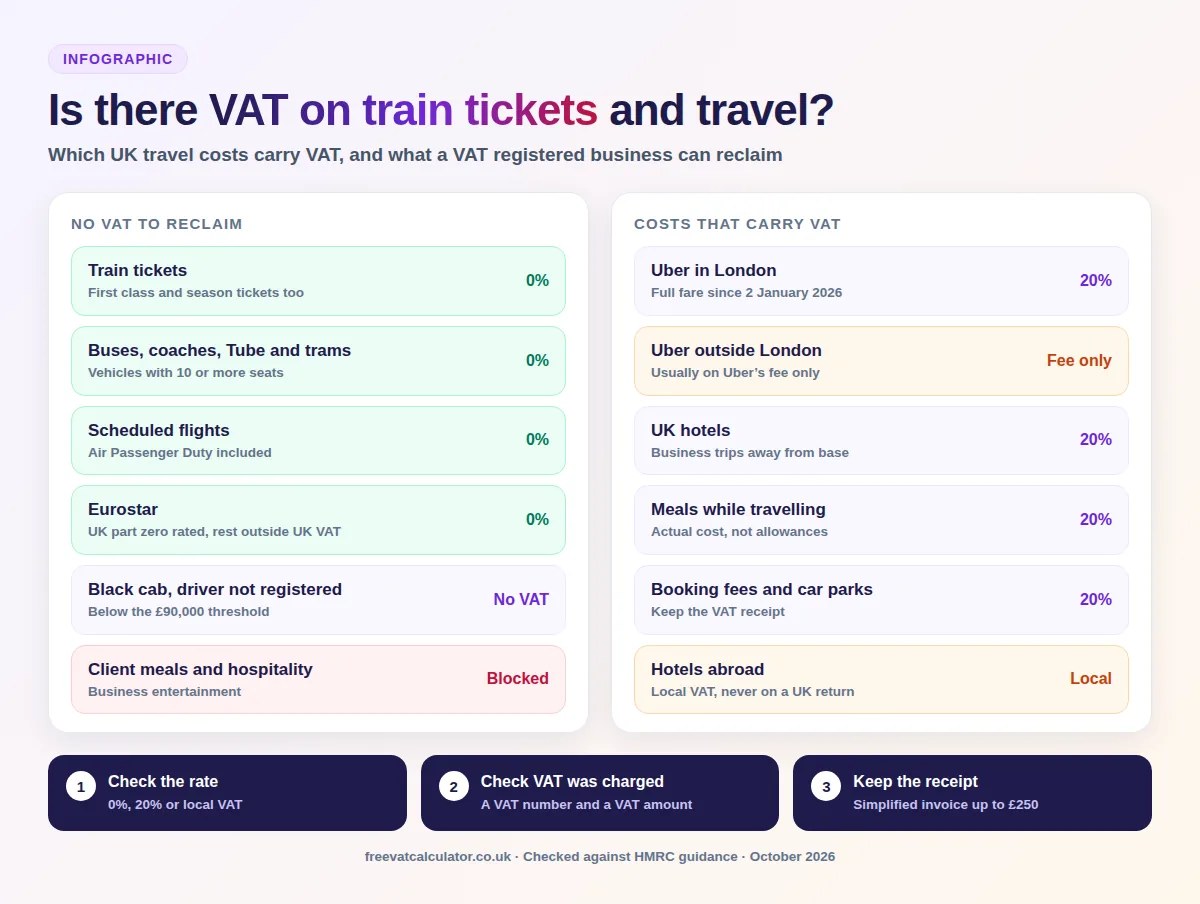
Key facts
- UK train tickets
- 0%, so there is nothing to reclaim
- Buses, Tube, trams and ferries
- 0% in vehicles with 10 or more seats
- Uber in London
- 20% on the full fare since 2 January 2026
- Flights
- 0% on scheduled flights, Air Passenger Duty included
- UK hotels
- 20%, reclaimable on business trips
- Client entertaining
- VAT blocked, even with an invoice
Is there VAT on train tickets?
No. Passenger transport in a vehicle designed or adapted to carry 10 or more passengers is zero rated under Schedule 8, Group 8 of the VAT Act 1994, and HMRC’s Notice 744A confirms that trains count as vehicles for this rule. Every UK rail fare is charged at 0%, whether it is an Anytime, Off Peak or Advance ticket, a season ticket or a first class seat.
So the short answer on VAT on train tickets is that there is none to reclaim, even when the journey is entirely for business. The fare is still a business expense for income tax or corporation tax, so keep the ticket with your records.
The 10 seat test counts the seats for the driver and crew, and HMRC looks at the physical capacity of the vehicle actually used rather than its licence. So a coach booking that is carried out in a seven seat car is standard rated, because the vehicle actually used has fewer than 10 seats.
Zero rated is not the same as exempt
A zero rated supply is taxable at 0%, so the train company can still reclaim VAT on its own costs. An exempt supply, such as most insurance, sits outside that system. For the passenger both mean the same: no VAT on the price and none to reclaim.
| Point | Zero rated rail fare | Exempt cost, such as insurance |
|---|---|---|
| VAT added to the price | 0% | None |
| Seller reclaims VAT on its costs | Yes | No |
| Counts towards the seller’s VAT threshold | Yes | No |
| Buyer can reclaim VAT | No | No |
First class, season tickets and seat reservations
The class of travel makes no difference, so first class is zero rated just like standard class. HMRC treats seat reservations, Pullman supplements, accompanied luggage and bicycles, pets, duplicate season tickets and sleeper berths on ordinary services as part of the same supply, so they take the fare’s 0% rate. The notice does not mention railcards, so if the receipt shows no VAT, there is nothing to claim.
What on a rail journey does carry VAT
Anything sold separately from the journey is normally standard rated at 20%. Notice 744A names catering, car parking, cycle storage, left luggage, lost property, platform tickets and sending luggage on its own. A coffee from the trolley therefore has VAT in it even though the ticket does not.
Booking fees and ticket agents
Booking fees are where VAT most often hides on a rail booking. Trainline charges VAT on its booking fee but not on UK rail fares, and shows that VAT on the expense receipt in your account. A newsagent that simply sells tickets for the operator is different, because HMRC zero rates commission for arranging zero rated transport.
Charter trains, heritage railways and tourist trains
Hiring a whole train or coach is still zero rated if the vehicle has 10 or more seats. Transport tied to an attraction is different: if the fare includes entry to a museum or theme park, or the same business runs both, the transport is standard rated. A timetabled heritage railway between stations stays zero rated.
Why your ticket shows no VAT
Some receipts print VAT at 0% and others say nothing about VAT, and both mean the same. Trainline does not issue VAT invoices for UK rail or coach fares, because there is no VAT to show.
VAT on buses, coaches, the Tube, trams and ferries
The same zero rate covers buses, coaches, the Tube, the Overground, trams and the transport part of park and ride schemes, because all use vehicles with 10 or more seats. Ferries are zero rated too, while a small water taxi with fewer than 10 seats normally carries 20%.
Two details from Notice 744A are easy to miss. Cable cars, ski lifts and chairlifts with fewer than 10 seats are charged at the reduced rate of 5%, not 20%. On a cross border ferry, such as Liverpool to Dublin, only the part of the crossing in UK waters is zero rated, and the rest is outside UK VAT.
Eurostar and international train travel
UK VAT only reaches the part of an international journey that takes place in the UK. On a Eurostar to Paris or Brussels, the UK leg is zero rated and the rest is outside the scope of UK VAT, so there is no UK VAT to reclaim. The same applies to an international coach or a through ticket to Europe bought in the UK.
Rail travel abroad
Fares inside other countries follow local rules, and some include VAT. Trainline says any VAT invoice for the fare with operators such as SNCF or Deutsche Bahn comes from the operator itself. Foreign VAT on those fares can never go on a UK VAT return.
VAT on taxi fares and minicabs
Taxis and private hire cars are standard rated at 20%, unless the vehicle has 10 or more seats, in which case the ride is zero rated like a bus. The catch is that VAT is only charged if whoever supplies the ride is VAT registered. A driver whose taxable turnover stays below the £90,000 registration threshold does not charge VAT, so their receipt gives you nothing to reclaim.
Black cabs
Many black cab drivers are self employed and below the £90,000 threshold, so a black cab fare often has no VAT in it. Metered fares are set by the licensing authority, such as Transport for London, so a driver who registers has to find the VAT out of the same fare. You can only reclaim VAT on a black cab if the receipt shows the driver’s VAT number and the VAT charged.
Minicab firms: principal or agent
With a minicab firm, the VAT depends on who legally supplies the ride. If the firm acts as principal, it charges VAT on the whole fare. If it acts as a disclosed agent for the driver, the fare is the driver’s own supply, and any VAT on the firm’s commission is charged to the driver, not to you. The invoice shows which model applies, so reclaim only the VAT printed on it.
Claiming VAT on taxi fares
You need a VAT receipt showing the supplier’s name, address and VAT number, the date, the fare and the VAT rate. For fares of £250 or less including VAT, a simplified invoice with those details is enough. A card slip or bank statement proves you paid, but not that VAT was charged.
Uber and VAT: London versus the rest of the UK
Uber VAT changed more than any other travel cost in 2026, and the answer now depends on where the trip happens. From 2 January 2026, private hire and taxi operators can no longer use the Tour Operators’ Margin Scheme for journeys, which had let some operators pay VAT only on their margin. Journeys a driver supplies directly to a passenger are not affected.
The courts have also settled the history. On 29 September 2026 the Supreme Court refused Bolt permission to appeal a Court of Appeal ruling that ride hailing services do not fall within the margin scheme, so HMRC’s view stands for past periods too.
VAT on Uber trips in London
Transport for London’s licensing rules require London operators to contract with passengers as principal, as HMRC confirms. Since 2 January 2026, that means VAT at 20% on the full fare of an Uber taxi ride in London, so a £30 fare includes £5 of VAT. A VAT registered business can reclaim that £5 with the trip’s VAT invoice.
VAT on Uber trips outside London
In July 2025 the Supreme Court decided that private hire operators elsewhere in England and Wales do not have to contract with passengers as principal, and from January 2026 Uber moved its trips there to an agency model. Uber now acts as a booking agent there, so the ride is the driver’s own supply and only carries VAT if the driver is VAT registered, which most are not.
In practice, an Uber receipt for a trip in Manchester or Bristol will usually show no VAT at all. Wherever the trip is, reclaim exactly the VAT the invoice shows and nothing more. The Autumn Budget on 28 October 2026 confirmed that from 2 January 2028, larger operators working as agents will be treated as supplying the ride themselves, so they will charge VAT on the full fare. The government will consult on the turnover threshold, with £50 million of annual fare turnover as the lead option.
How to get an Uber VAT invoice
The receipt emailed after a ride is not always the full invoice. These steps work for most business riders.
- Add a business profile in the Uber app and enter your company details in the tax section.
- Choose the business profile before you request each work trip.
- Open the trip in the trips section of the Uber website or app and download the invoice.
- Check that the invoice shows a VAT number and a separate VAT amount.
- Save it with your other VAT receipts, or let your expenses app import it.
Uber VAT number and VAT receipt checks
A VAT number printed on an Uber VAT receipt does not by itself mean you can reclaim anything. An invoice that shows a VAT number but no VAT amount gives you nothing to claim. You can check that any UK VAT number is genuine with our UK VAT number checker.
VAT on flights, air fare and airline tickets
Every scheduled flight is zero rated whatever the size of the aircraft, and so are other flights in aircraft with 10 or more seats. That covers almost all domestic and international airline tickets, so a London to Edinburgh air fare has no VAT to reclaim. VAT does apply to charters in aircraft with fewer than 10 seats and to pleasure flights, such as hot air balloon rides.
Air Passenger Duty is not VAT
The taxes line on a ticket is mostly Air Passenger Duty, a duty charged to the airline and usually passed on. HMRC treats it as part of the fare for VAT, so it takes the same 0% rate and cannot be reclaimed as VAT. From 1 April 2026 the duty on a domestic flight in the lowest class is £8 per passenger.
Seat selection, luggage and airport costs
Reserved seats, checked bags and airport passenger charges supplied with the flight take the fare’s 0% rate. Meals bought separately, airport parking and the shuttle bus from a car park run by the same company are standard rated, so keep a VAT receipt for those.
Flight tickets booked through travel agents
When an agent books flight tickets on your behalf, its commission for arranging zero rated transport is zero rated too. A package bundling flights with hotels bought in by the seller falls under the Tour Operators’ Margin Scheme instead, so ask for a breakdown before assuming any VAT is reclaimable. HMRC is now reviewing the scheme through a call for evidence that runs from 28 October 2026 to 31 January 2027, so the rules for packages may change.
VAT on hotels and hotel rooms
Hotel VAT is a tax at the standard rate of 20% on UK rooms, back at that level since 1 April 2022 after the temporary cuts to 5% and then 12.5% ended. A VAT registered business can reclaim it when you or an employee stay away from the normal place of work on business. A £180 night including VAT contains £30 of VAT.
Stays longer than 28 nights
From the 29th night of a stay, the reduced value rule applies. The hotel then charges VAT only on the part of the price for facilities, which must be at least 20% of the charge after meals are taken out. On a long contract placement this can cut the effective VAT on the room to as little as 4%.
Meeting rooms, deposits and no shows
A meeting room hired from a hotel is usually exempt unless the hotel has opted to tax, and simple refreshments go with the exempt hire. If the hotel keeps your deposit or charges your card for a no show, VAT is still due on that amount, so ask for a VAT invoice.
Hotels abroad
A hotel room abroad is taxed where the hotel is, so its VAT can never go on a UK VAT return. A UK business can sometimes claim it from the country concerned, using that country’s refund process for businesses based outside it, with its own forms and deadlines. Since 2021, no UK business can use the EU online refund portal for hotel VAT, because businesses in Northern Ireland may only use it for VAT on goods.
Overseas visitors face the opposite question. Our guide to claiming a VAT refund as a foreigner covers what tourists and overseas businesses can get back from the UK.
Hotels booked through travel websites
When you book through a travel website, check who actually supplies the room. If the site acts as the hotel’s agent, the VAT invoice should come from the hotel and name your business.
Subsistence VAT: meals and drinks while travelling
Subsistence is what you spend on food, drink and overnight stays while travelling for work. A business can reclaim VAT on meals it pays for when an employee is away on a business trip, and a sole trader, partner or director can do the same on a trip away from their normal place of work. Lunch near the office on a normal day does not qualify.
Claiming VAT on subsistence: actual cost or allowance
How you pay the employee decides the claim. If you reimburse the actual cost against a VAT receipt, you can reclaim the VAT, and if you repay part of the bill, you can claim the VAT fraction of what you paid. If you pay a flat rate allowance instead, you cannot reclaim any VAT on those expenses.
HMRC also allows claims for self employed people who work for you on the same basis as employees, at a fixed rate and reimbursed at cost through your accounts. If you block book hotel rooms for a team, the business can claim the VAT even when some travellers are VAT registered themselves.
Business entertainment is blocked
Free hospitality for anyone who is not an employee is business entertainment, and the VAT Input Tax Order 1992 blocks the VAT on it, even when the meal wins you work. When an employee hosts a client dinner, none of the VAT can be claimed, not even on the host’s own meal. If the employee is on a business trip and the entertaining is only secondary to it, the VAT on their own meal can still be claimed.
Two exceptions help. HMRC does not restrict VAT on entertaining overseas customers under the Input Tax Order, and staff entertainment is reclaimable to the extent that it serves the business.
Food and drink bought on trains
Food sold on board is a separate purchase from the ticket and normally standard rated. On a business trip it counts as subsistence, so the VAT is reclaimable with a VAT receipt. Our food and drink VAT guide explains why the same sandwich can be zero rated in a shop.
Parking, car hire, mileage and other travel expenses
Several travel costs sit outside the passenger transport rules. These two appear most often on expense claims.
Car parking
Off street parking is standard rated, and HMRC says this applies even when a council runs the car park. On street parking provided by a council as highway authority carries no VAT, and a penalty charge for illegal parking is outside the scope of VAT.
Mileage, fuel and hired cars
Hiring a car without a driver is not passenger transport, so the hire charge normally carries VAT at 20%. Special rules can restrict how much of that VAT a business reclaims when a hired car is also available for private use. Fuel and mileage follow separate rules, which our guide to fuel and mileage VAT explains.
How to reclaim VAT on travel expenses
VAT on travel expenses can only be reclaimed when the business is VAT registered, the cost is for the business, VAT was actually charged and you hold the right evidence. Run through this checklist before each claim.
- the trip was for business, not a private journey
- the receipt shows VAT and the supplier’s VAT number
- it was not hospitality for clients or suppliers
- your business is not on the Flat Rate Scheme
- the VAT is UK VAT, not VAT charged abroad
- you claim only the business share of a mixed cost
What counts as a VAT receipt
For costs over £250 including VAT you need a full VAT invoice. At £250 or less, a simplified invoice is enough if it shows the supplier’s name, address and VAT number, the date of supply, a description, the total including VAT and the VAT rate. Our guide to what a valid VAT invoice must include lists every detail.
Recording travel on your VAT return
Only VAT you are entitled to reclaim goes in box 4, so a zero rated train fare adds nothing there. Box 7 holds the total value of purchases and expenses excluding VAT, so the fare goes in at full value, while spending outside the scope of VAT, such as a parking penalty, is left out. Our guide on how to do a VAT return covers every box.
Flat Rate Scheme users
On the Flat Rate Scheme you pay a fixed percentage of turnover and cannot reclaim VAT on purchases, apart from certain capital assets over £2,000. That means no VAT back on hotels, taxis or meals, although they still count as business expenses for income tax or corporation tax. Our Flat Rate Scheme guide explains the percentages.
Lost tickets and missing receipts
If an employee loses an electronic ticket or receipt, get a replacement first. Trainline lets you download an expense receipt from the booking in your account, and Uber lets you download trip invoices from your trips page. HMRC accepts other evidence only in exceptional cases, and you must keep VAT records for at least six years.
Common mistakes with VAT on travel expenses
Most travel VAT errors come from assuming every receipt works the same way. These come up again and again in expense claims.
- reclaiming VAT on train tickets because software coded them at 20%
- claiming 20% of an Uber fare outside London when the receipt shows no VAT
- treating a VAT number on a receipt as proof that VAT was charged
- putting hotel VAT from abroad on the UK return
- claiming VAT on client dinners and hospitality
- reclaiming VAT on meals covered by a flat rate allowance
- using a card statement instead of a VAT receipt
Bookkeeping apps often apply the standard rate to anything that looks like travel. Check the VAT code on every rail, bus, Tube and flight transaction before you submit, because a zero rated fare coded at 20% overstates your reclaim by a sixth of the fare.
Worked example: VAT on a business trip
Here is how the rules combine on a trip from Leeds to London with one night in a hotel, for a VAT registered company on standard VAT accounting. Each VAT figure is one sixth of a price that includes VAT at 20%.
| Cost | Paid | VAT rate | VAT reclaimable |
|---|---|---|---|
| Return train ticket, Leeds to London | £150.00 | 0% | £0.00 |
| Trainline booking fee | £1.80 | 20% | £0.30 |
| Uber from King’s Cross to the client | £24.00 | 20% on the full fare | £4.00 |
| Hotel room for one night | £210.00 | 20% | £35.00 |
| Dinner alone while away | £33.00 | 20% | £5.50 |
| Lunch with the client | £72.00 | 20%, blocked | £0.00 |
| Tube fares | £8.60 | 0% | £0.00 |
| Total | £499.40 | Mixed | £44.80 |
Out of almost £500 of spending, only £44.80 is reclaimable, and the train fare adds nothing. For a meeting in Manchester, the Uber receipt would usually show no VAT, so nothing could be claimed on that ride.
Need the VAT inside a receipt?
Our main VAT calculator works out the VAT in any price at 20% or 5%. It shows the working, so you can check a receipt line by line.
VAT on train tickets FAQs
These are the questions people ask most about VAT on travel costs. The sections above give the detail behind each answer.
Is there VAT on train tickets bought through Trainline?
No, the rail fare is zero rated wherever you buy it. Trainline does charge VAT on its booking fee, which you can reclaim using the expense receipt in your account.
Is there VAT on Uber?
It depends on the trip. In London, VAT at 20% applies to the full fare since 2 January 2026, while elsewhere in England and Wales Uber usually acts as a booking agent, so the receipt often shows no VAT.
Can I claim VAT on taxi fares?
Only if the driver or taxi firm is VAT registered and the receipt shows its VAT number and the VAT charged. Many black cab drivers are below the £90,000 threshold, so their fares contain no VAT.
Is there VAT on flights from the UK?
No, scheduled flights are zero rated, including domestic flights. Air Passenger Duty takes the fare’s 0% rate, so there is nothing to reclaim.
Can I reclaim VAT on a hotel?
Yes, if you are VAT registered, the stay is a business trip away from your normal place of work and you hold a VAT invoice. VAT on hotels abroad can only be claimed from the country where the hotel is.
Can a sole trader reclaim subsistence VAT?
Yes, on meals taken on a business trip away from the normal place of work. Everyday meals near your usual base do not count.
Travel VAT comes down to three checks: the rate, whether VAT was actually charged and whether you hold the right receipt. You now have the answer on VAT on train tickets and every other common travel cost, plus a checker for any receipt, so all the information you need for your next expense claim is above.
Sources: HMRC VAT Notice 744A, passenger transport; HMRC manual VTRANS040000; HMRC policy paper, private hire operators and the Tour Operators’ Margin Scheme; Revenue and Customs Brief 8 (2025); UK Supreme Court, Bolt Services UK Ltd v HMRC; HMRC VAT Notice 709/3; HMRC VAT Notice 700, section 12; HMRC manual VIT13400; HMRC manual VIT43200; HMRC VAT Notice 700/21; HMRC VAT Notice 742; HMRC manual VATGPB8640; HMRC, Air Passenger Duty rates; HMRC, VAT registration threshold; HMRC, Flat Rate Scheme; HMRC VAT Notice 700/12; Trainline, expense receipts and VAT invoices. This page is general information, not tax advice.