
Refunds and credit notes guide
VAT on Refunds: Credit Notes, Returns, Discounts and Who Adjusts What
How to handle VAT on refunds
- Pay the refundOr set it off
- Find the VAT÷ 6 at 20%
- Issue a credit noteWithin 14 days
- Adjust the returnBox 1 or Box 4
- Keep the recordsFor six years
A customer sends back a £120 order, or you agree to knock £300 off an invoice that has already gone out, and the money leaves your account. The sale already sits on a VAT return, so you are left wondering whether to cut your VAT, change the old return or issue a credit note, and a wrong guess means overpaying HMRC or an error to fix later.
This guide starts with a calculator that works out the VAT to adjust on any full or part refund and the return boxes that change. It then covers what a valid credit note must show, the 14 day rule, returns, deposits, discounts and what the buyer must do, all checked against HMRC’s VAT guide and its records manual, so you can handle VAT on refunds correctly the first time.
Refund and credit note VAT calculator
Enter the original price, the VAT rate and how much you refunded, then say whether you are the seller or the buyer. The calculator shows the VAT to adjust, the net and gross refund, the boxes that change and the working behind each figure.
Refund and credit note VAT calculator
Find the VAT to adjust on a full or part refund, and the VAT return boxes that change
Box 1 down by £50.00, Box 6 down by £250.00
Take £50.00 off Box 1 (VAT on sales) and £250.00 off Box 6 (net sales) on the return for the VAT period in which you pay the refund. Issue a credit note within 14 days of paying it, at the 20% rate of the original sale.
The working
£1,200.00 including VAT at 20% is £1,000.00 plus £200.00 of VAT. The refund of £300.00 including VAT is 25% of the price, and the VAT inside it is £300.00 × 20 ÷ 120 (one sixth) = £50.00, leaving £250.00 net.
This treats the refund as a change in price, as HMRC does for returns, cancellations and agreed price cuts; wrong VAT on an invoice is an error instead. Flat Rate Scheme users follow the scheme section below. Figures are rounded to the nearest penny, and nothing you enter is stored or sent. If your original invoice rounded the VAT down, credit no more VAT than it showed.
Key facts
- Credit note deadline
- Within 14 days of paying the refund
- VAT in a refund at 20%
- One sixth of the gross refund
- When to adjust
- The VAT period in which the refund is paid
- Seller
- Box 1 down by the VAT, Box 6 by the net
- Buyer
- Box 4 down by the VAT, Box 7 by the net
- No refund paid
- No VAT change, even with a credit note
VAT on refunds: the rules in brief
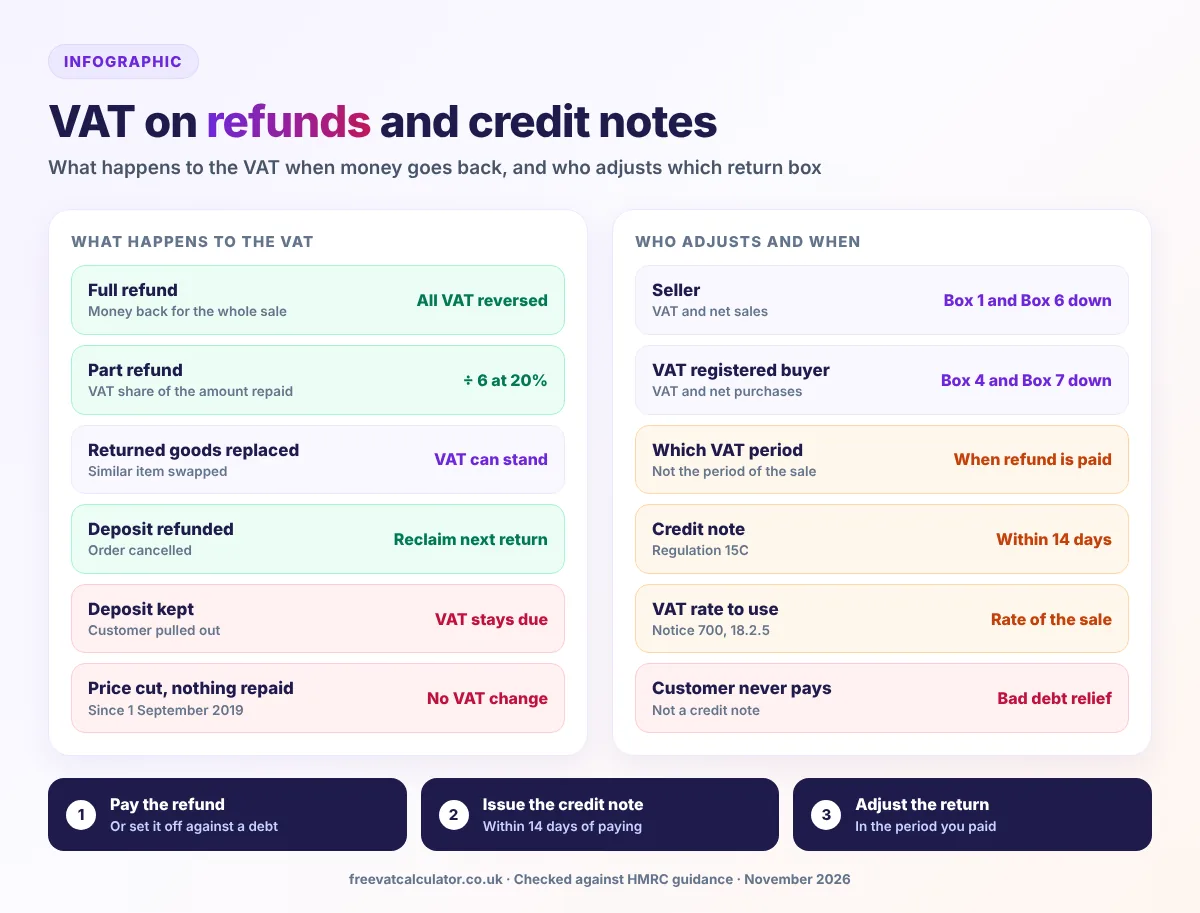
When you refund a customer for a genuine reason, the price of the sale has gone down, so the VAT on it goes down by the same share. Since 1 September 2019 the law ties that cut to money actually going back, so the VAT changes in the period you pay the refund or set it off against what the customer owes you.
| Situation | What happens to the VAT | Document |
|---|---|---|
| Full refund of a sale | Reverse all the VAT you charged | Credit note |
| Part refund or agreed price cut, paid back | Reverse the VAT share of the amount repaid | Credit note |
| Goods returned and swapped for the same item | The original VAT can stand | None, or a credit note and a new invoice |
| Cancelled order, deposit refunded | Reclaim the VAT on the deposit in your next return | Credit note |
| Cancelled order, deposit kept | VAT stays due on what you keep | None |
| Price cut agreed, nothing repaid yet | No change until you refund or set it off | None yet |
| Prompt payment discount taken | VAT due on the amount actually paid | Credit note or invoice wording |
| Customer never pays | Bad debt relief after six months | Bad debt records |
| Wrong VAT shown on the invoice | An error, fixed under the error rules | Credit note or new invoice |
A refund never moves the tax point of the original sale. HMRC’s time of supply manual says those rules do not apply to credit notes at all, which is why VAT on refunds is adjusted in a later return instead of reopening the return the sale was on.
What a VAT credit note must show
A VAT credit note is the document that records the price cut and lets both sides adjust their VAT. Regulation 15C of the VAT Regulations 1995 lists what it must contain, and VAT Notice 700 adds the quantity and amount for each item.
- a unique number and the date of issue
- your name, address and VAT registration number
- the customer’s name and address
- the number and date of the original VAT invoice
- a description of the goods or services credited
- the quantity and amount for each item
- the total credited, excluding VAT
- the VAT rate and the credit note VAT in sterling
If returned goods cannot be matched to one invoice, Notice 700 lets you leave out the invoice reference as long as you can show HMRC by other means that you accounted for VAT on the original sale. Zero rated or exempt items on the same note must be totalled separately, with a clear statement that no VAT is credited on them. Our guide to what a valid VAT invoice must include covers the matching invoice details.
When you must issue a credit note
A credit note is due no later than 14 days after the refund is paid, and a debit note no later than 14 days after a price rise is agreed. You can issue the credit note before you pay the refund, but the VAT only changes once the money goes back.
Shops get an exception. Where no VAT invoice was needed for the sale, such as a retail sale to a private customer, you only need a credit note if the customer is VAT registered and asks for one, and then within 14 days of the request.
Credit notes without VAT
Where the customer can reclaim all the VAT on your sale, Notice 700 lets you both agree not to adjust the VAT at all. The note must then say “This is not a credit note for VAT”, and you both still adjust your sales and purchase records for the lower price. That rules it out for a partly exempt customer, one on the Flat Rate Scheme or a private buyer, so in most cases VAT on credit notes must be shown and adjusted.
The genuine reason test
HMRC only accepts a credit note that corrects a real mistake or overcharge, or records a lower price that you and the customer agreed. It must also give real value to the customer, as a refund or as credit against future sales, be issued in good faith and not be used to cover a debt the customer has simply not paid.
In Inventive Tax Strategies Ltd v HMRC [2019] UKUT 0221 (TCC), credit notes went to customers who were never repaid because the companies were in liquidation or administration. The Upper Tribunal held that output tax could not be cut on what it saw as a paper reduction with no commercial substance.
Credit note, refund or debit note
A credit note is the paperwork and a refund is the money. A credit can be paid out, set against the customer’s next invoice or kept on account, and HMRC’s records manual confirms that setting it off against money already owed counts as paying it.
A debit note works the other way, for a price rise agreed after the invoice. The seller adds the extra VAT in the period of the agreement, and the buyer can only reclaim it once it holds the debit note.
How to refund VAT to a customer, step by step
The same five steps work for any refund, whether it covers a whole order or a single line. The VAT always follows the share of the price you give back, at the rate charged on the original sale.
- Check the reason is genuine: VAT on refunds only changes for a return, a mistake or an agreed price cut, not an unpaid invoice.
- Work out the VAT inside the refund at the original rate, one sixth of a gross refund at 20%.
- Pay the refund, or set it against an amount the customer owes you.
- Issue a credit note within 14 days of paying, quoting the original invoice.
- Reduce Box 1 and Box 6 on the return for the period in which you paid.
Keep the credit note with the original invoice and the record of the payment. VAT Notice 700/21 lists credit and debit notes among your VAT records, which must generally be kept for at least six years.
Full refunds
A full refund reverses the whole sale, so the VAT you take off equals the VAT you charged. Refund £1,200 on a £1,000 plus VAT invoice and you cut Box 1 by £200 and Box 6 by £1,000.
Part refunds
For a part refund, find the VAT inside the amount you repay at the original rate. At 20% the VAT in a VAT inclusive refund is one sixth and at 5% it is one twenty first, so a £300 refund at 20% holds £50 of VAT and a £42 refund at 5% holds £2.
- ÷ 6The VAT in a refund at 20%
- ÷ 21The VAT in a refund at 5%
- 14 daysTo issue the credit note
Taking 20% off a gross refund overstates the VAT you can cut, and it is an easy slip to make in refund sums. If the price excluded VAT, add the rate instead, so a £250 net refund at 20% carries £50 of VAT and costs you £300 in total.
Orders with more than one VAT rate
When a refund covers an order with mixed rates, such as zero rated food and standard rated drinks, work out the VAT on each line you refund. Share an order level discount or refund across the lines in proportion to their value, so each part carries its own rate.
VAT on returned goods
VAT on returned goods depends on what the customer gets back: money, a replacement or credit. If you give the money back, it is an ordinary refund, and the VAT comes off in the period you repay the customer, not on the day the parcel arrives.
HMRC’s records manual cites the Kwik Fit case, where a binding duty to repay the price of returned baby seats meant the credit note cancelled the original sale. A refund the customer is legally owed, such as one for faulty goods, is the clearest case for adjusting the VAT.
Replacing returned goods
If you swap a returned item for a similar one, Notice 700 lets you leave the original VAT in place and charge nothing on the replacement, or cancel the first sale with a credit note and charge VAT on the replacement. If the replacement is cheaper, a credit note can cut the VAT on the difference, and if it costs more, you account for the extra VAT.
Restocking fees and money you keep
If you keep part of the payment, such as a restocking fee or the postage, you only adjust the VAT on the amount you actually repay. Regulation 24A treats the price as falling only by the amount the supplier pays back, so VAT stays due on whatever you keep.
Say a £120 order including VAT comes back and you refund £108 after a £12 restocking fee. The VAT to adjust is £18, one sixth of £108, and £2 of VAT stays on the £12 you kept.
Cancelled orders and refunded deposits
Most deposits are part payments, so VAT is due when you receive them even if they might be refunded later. HMRC’s time of supply manual says a refundable deposit still creates a tax point, as the tribunal found in Moonraker’s case about a refundable booking deposit.
If the order is cancelled and you refund the deposit, Notice 700 lets you reclaim the VAT you accounted for on it in your next return. If you keep the deposit because the customer pulled out, VAT stays due on it, and you cannot reclassify it as compensation outside the scope of VAT.
A deposit taken only as security, such as one for the safe return of hired equipment, creates no tax point and needs no VAT adjustment. If you invoiced an order that was cancelled before anything was supplied or paid, HMRC’s records manual says there was no supply, so you cancel the invoice with a credit note and correct any VAT declared under the error rules.
VAT on discounts and price cuts after the sale
VAT on discounts follows what the customer actually pays. A discount given at the time of sale simply lowers the price you charge VAT on, while a discount agreed later works like a part refund.
Discounts at the time of sale
An unconditional discount, such as 10% off for a trade customer, comes off before VAT is worked out. A £500 job with a £50 discount is £450 plus £90 of VAT, and there is nothing to adjust later.
Prompt payment discounts since April 2015
Since 1 April 2015, VAT on a prompt payment discount is due on the amount the customer actually pays, a rule some broadcasting and telecoms suppliers have followed since 1 May 2014. You can issue a credit note when the discount is taken, or skip it if the invoice shows the discount terms and says the customer may only reclaim the VAT actually paid, as HMRC’s valuation manual explains.
For example, a £1,000 plus £200 VAT invoice offers 2% off for payment within 10 days. If the customer pays early, the price is £980 plus £196 VAT, so the VAT falls by £4 and the customer may only reclaim £196.
Volume rebates and retrospective discounts
A rebate earned later, for example for buying a set volume in a year, is a contingent discount. VAT is due on the full price at first, and once the rebate is paid or set off against what the customer owes, you reduce the VAT and issue a credit note.
Price cuts without a refund
Agreeing a lower price does not cut your VAT on its own. Revenue and Customs Brief 6 (2019) explains that from 1 September 2019 the VAT only falls once you refund the customer or set the amount off against a debt they owe you.
No refund means no VAT cut. If you issue a credit note but the customer is never repaid and nothing is set off, you keep paying VAT on the full price.
Manufacturer refunds and money off coupons
A manufacturer or importer sometimes refunds the end customer directly, for a recall, faulty goods or a cashback offer, or repays a shop for a money off coupon. Regulation 38ZA, in force since 1 April 2014, lets that first supplier cut its own output tax, and it only needs to give a credit note if the customer asks.
Who adjusts what: the seller and the buyer
A refund changes the VAT on both sides of the sale, so the seller and a VAT registered buyer each make an adjustment. Regulation 38 puts the seller’s cut in output tax and the buyer’s cut in input tax, for the same amount of VAT.
| Who | VAT box | Net value box | When |
|---|---|---|---|
| Seller giving the refund | Box 1 down by the VAT | Box 6 down by the net refund | Period the refund is paid |
| VAT registered buyer getting it | Box 4 down by the VAT | Box 7 down by the net refund | Period the refund is paid |
| Buyer that used the reverse charge | Box 1 and Box 4 both down | Same boxes as the original entries | The buyer’s own period |
| Buyer not VAT registered | No VAT return | Nothing to adjust | Not needed |
The cut belongs in the VAT period in which the refund is paid, whatever the date of the original sale. A price rise is the opposite, because it goes in the period the seller and buyer agree it.
Which VAT return boxes change
VAT Notice 700/12 tells sellers to deduct the VAT on credit notes they issue from Box 1, and buyers to deduct the VAT on credit notes they receive from Box 4. The net value comes off Box 6 for the seller and Box 7 for the buyer, and HMRC’s own checklist asks whether you have adjusted Box 1 and Box 4 for credit notes before you submit.
If you are the buyer
A buyer who gets a refund must cut the VAT it reclaimed, even though the seller started the change. When HMRC officers test a run of credits in a seller’s records, their assurance guidance lets them ask the customer to confirm it reduced its input tax.
Buyers on the Flat Rate Scheme reclaim no VAT on most purchases, so they have nothing to take off Box 4. The exception is a single purchase of capital goods costing £2,000 or more including VAT, where the VAT is reclaimed outside the scheme, so a refund on it must come off Box 4.
Time limits and late credit notes
A genuine adjustment for VAT on refunds has no four year cap of its own. HMRC removed the old cap on 1 April 2009 after the General Motors Acceptance Corporation case, so a price that changes years later can still be adjusted in the period it changes.
The catch is timing. If you miss the period in which the refund was paid, HMRC treats it as an error that must be corrected within four years of that period.
Net errors up to £10,000, or up to £50,000 if they are no more than 1% of your Box 6 figure, can go on your next return. Anything larger, or anything deliberate, must be reported to HMRC separately, and our guide on how to correct VAT errors covers both methods.
The Budget on 28 October 2026 confirmed a new legal duty to correct errors once you find them, from 1 April 2028. HMRC’s policy paper says it covers returns and documents given to HMRC and adds a power to issue Customer Correction Notices.
After you deregister or become insolvent
A credit note issued after your registration is cancelled, or by an insolvent business, takes effect on the date the price actually falls. If that comes after your final VAT return, Notice 700 sends you to the error correction rules to account for it.
Overcharged VAT and unjust enrichment
Charging the wrong amount of VAT is not a refund in the legal sense, because the price itself has not changed. The refund rules do not apply where VAT was charged on a zero rated or exempt sale, at the wrong rate, or as the wrong figure on the invoice.
If your invoice showed too much VAT, you must pay HMRC the higher amount unless you correct it with the customer by a credit note. Claims for VAT paid over in error are limited to four years, and section 80 of the VAT Act 1994 lets HMRC refuse one that would unjustly enrich you because your customers bore the cost and you will not repay them.
To avoid this, VAT Notice 700/45 sets out a reimbursement scheme: you sign an undertaking, repay every affected customer within 90 days and return anything left over to HMRC within 14 days. A buyer charged too much must ask the supplier for the money, not HMRC.
Refunds on the Cash Accounting and Flat Rate schemes
Two widely used small business schemes change when a refund counts and how much VAT it moves. The basic credit note rules still apply to both.
Cash Accounting Scheme
On cash accounting, VAT on refunds follows the money, so a refund reduces your VAT when you pay it out and goes in your payment records like any other payment. VAT Notice 731 says any change in price must still be backed by a credit or debit note.
If you agree a lower price before the customer pays anything, there is nothing to adjust, because you only record the lower amount received. You can join with expected taxable turnover up to £1.35 million and must leave once it passes £1.6 million, as our VAT Cash Accounting Scheme guide explains.
Flat Rate Scheme
On the Flat Rate Scheme you pay a fixed percentage of your VAT inclusive turnover, so a refund lowers that turnover by the gross amount repaid. The VAT you save is your flat rate of the refund, not the VAT on the credit note, which you still issue at the normal rate. Our flat rate VAT calculator shows the percentage for your trade.
A 12% flat rate business that refunds £600 including VAT cuts its turnover by £600 and its VAT by £72, while the credit note shows £100 of VAT for the customer. Retailers on the scheme can take refunds for faulty or unsuitable goods and accidental overcharges straight off their daily takings, as VAT Notice 733 allows.
Foreign currency, rate changes and e invoicing
A few refunds need extra care because of the currency, the VAT rate or the way you invoice. These rules sit alongside the basic credit note rules rather than replacing them.
Credit notes in a foreign currency
You can issue a credit note in euros or dollars, but the VAT credited must be shown in sterling. HMRC’s compliance guidance adds that a credit note should never credit more VAT than the original invoice charged, so converting at the exchange rate you used for that invoice keeps the two in step.
VAT rate changes
A credit note always uses the VAT rate in force at the tax point of the original sale, even if the rate has changed since. Household electricity in Great Britain has been at 0% since 1 October 2026, so a refund on a bill charged at 5% before then still reverses VAT at 5%.
E invoicing from April 2029
From 1 April 2029, VAT invoices between VAT registered businesses in the UK must be e invoices, with Peppol as the network. HMRC’s policy paper of 28 October 2026 does not yet say how credit notes will be handled, but the Peppol billing standard already carries credit notes alongside invoices. Our e invoicing UK guide covers the timetable.
Refunds compared with bad debt relief
A refund and an unpaid invoice can look alike in your books, but VAT on refunds and bad debt relief work very differently. VAT Notice 700/18 rules out raising a credit note just because an invoice is still unpaid.
| Question | Refund with a credit note | Bad debt relief |
|---|---|---|
| When it applies | The price falls and money goes back | The customer does not pay |
| Earliest timing | The period you pay the refund | Six months after the later of the due date and the sale |
| Where the seller’s VAT goes | Box 1 down | Box 4 up |
| What the buyer does | Cuts Box 4 now | Repays its input VAT once six months unpaid |
| Time limit | None for a genuine adjustment made on time | Claim within four years and six months |
Our VAT bad debt relief calculator works out the claim once those conditions are met. Under the Cash Accounting Scheme you do not need it, because you never paid VAT on money you were not given.
Refunds to customers are not VAT refunds from HMRC
People searching for VAT refunds often mean something else: a repayment from HMRC, or tax free shopping for visitors. A repayment happens when Box 4 on your return is larger than Box 3, the total VAT due, and HMRC pays you the difference.
The VAT Retail Export Scheme for overseas visitors ended in Great Britain on 31 December 2020, according to Revenue and Customs Brief 21 (2020), although shops in Northern Ireland can still offer it. Our guide on how to claim a VAT refund as a foreigner covers what visitors can still do.
Worked examples of VAT on refunds
These examples use round figures to show the method. Divide a VAT inclusive refund by 6 to find the VAT at 20%, or by 21 at 5%.
| Refund | Gross refund | VAT to adjust | Net refund |
|---|---|---|---|
| Full refund of a £1,200 sale at 20% | £1,200.00 | £200.00 | £1,000.00 |
| Part refund of £300 at 20% | £300.00 | £50.00 | £250.00 |
| 25% off a £1,000 plus VAT invoice | £300.00 | £50.00 | £250.00 |
| £108 refund after a £12 restocking fee | £108.00 | £18.00 | £90.00 |
| £42 refund on a 5% sale | £42.00 | £2.00 | £40.00 |
| £80 refund on a zero rated sale | £80.00 | £0.00 | £80.00 |
| 2% prompt payment discount on £1,000 plus VAT | £24.00 | £4.00 | £20.00 |
Need to check the original invoice?
Our invoice VAT calculator splits any invoice into net, VAT and gross. Use it to match each credit note to the sale it reverses.
VAT on refunds FAQs
These are the questions sellers and buyers ask most about refunds and credit notes. Each answer reflects the rules on 5 November 2026.
Is there VAT on refunds?
Yes, a refund carries the same share of VAT as the original sale, so it reduces the VAT the seller owes and the VAT the buyer reclaimed. On a sale made at 20%, one sixth of the gross refund is VAT.
Do I need to issue a credit note for every refund?
For a customer who received a VAT invoice, yes, within 14 days of paying the refund. For retail sales that needed no VAT invoice, you only need one if a VAT registered customer asks.
Can I just change the original invoice instead?
No. Leave the original invoice as it is and issue a credit note, because the VAT adjustment belongs in the period the refund is paid, not the period of the sale.
What if I refund a sale from a previous VAT quarter?
Adjust it on the return for the quarter in which you pay the refund. You do not change the earlier return, and the adjustment is not an error as long as you make it in the right period.
Does a refund reduce my VAT if the customer is not VAT registered?
Yes. Your output tax falls in the same way, and only the customer’s side has nothing to adjust because it never reclaimed any VAT.
Everything you need on VAT on refunds is above: how much VAT a refund moves, which document to issue, which boxes change and when, and how returns, deposits, discounts and the main schemes fit in. Use the calculator at the top whenever you give or receive a refund, and keep each credit note with its original invoice.
Sources: HMRC VAT Notice 700, sections 7, 8, 14, 18 and 19; VAT Regulations 1995, regulation 15C; regulation 24A; regulation 38; regulation 38ZA; HMRC VAT Traders’ Records Manual, VATREC13000; Revenue and Customs Brief 6 (2019); VATTOS5230; VATTOS5125; VATVAL08500; VAT Notice 700/12; VAT Notice 700/45; VAT Notice 700/18; VAT Notice 700/21; VAT Notice 731; VAT Notice 733; VAT Act 1994, section 80; Inventive Tax Strategies Ltd v HMRC [2019] UKUT 0221 (TCC); HMRC, modernising the correction of errors; HMRC e invoicing policy paper, 28 October 2026; Revenue and Customs Brief 21 (2020). This page is general information, not tax advice.