
E invoicing guide
E Invoicing UK: What the April 2029 Mandate Means for Your VAT Invoices
From roadmap to mandate
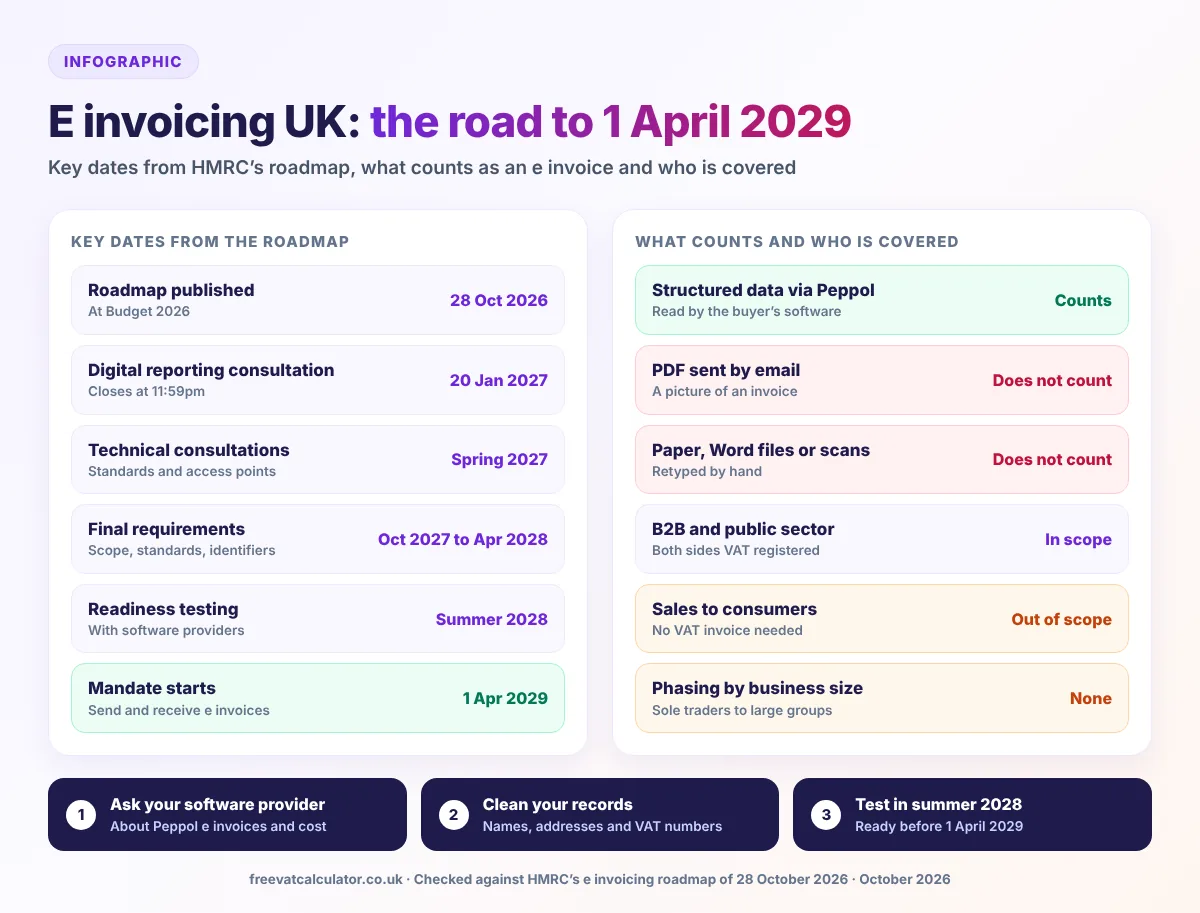
- Roadmap published28 October 2026
- Technical consultationsSpring 2027
- Final requirementsOctober 2027 to April 2028
- Readiness testingSummer 2028
- Mandate starts1 April 2029
Your accountant says PDF invoices will stop counting in 2029, your software keeps mentioning Peppol, and a large customer wants to know if you are ready. It is hard to tell what applies to a small VAT registered business, what it will cost, and whether anything needs doing yet.
HMRC published its implementation roadmap on 28 October 2026, so the main dates are now set. This guide starts with a checker that turns your situation into dates and steps, then explains what counts as an e invoice, who is in scope, how Peppol works and the likely costs. It is the plain English version of the e invoicing UK rules, checked against the roadmap and HMRC’s policy paper.
E invoicing timeline and readiness checker
Choose the options that describe your business. The checker shows when the requirement starts for you, how you are likely to connect to Peppol, and what to do at each stage.
Your e invoicing dates and steps
Pick your situation to see when the rules start for you and what to do at each stage
Working it out
Dates come from HMRC’s e invoicing roadmap of 28 October 2026 and could still move before the final rules are set. Nothing you choose here is stored or sent.
Key facts
- Start date
- 1 April 2029 for VAT invoices
- Who
- VAT registered businesses and public bodies
- Not covered
- Sales to consumers and cross border invoices
- Network
- Peppol, through access points
- Phasing
- None; one date for every business size
- PDF invoices
- Do not count as e invoices
E invoicing UK timeline: key dates from the HMRC roadmap
The HMRC roadmap sets out every step between now and the start date. HMRC does not plan to change the requirements after April 2028 unless feedback shows it must, which gives businesses a fixed target for the final year.
| When | What happens |
|---|---|
| 26 November 2025 | Budget 2025 confirms that VAT invoices must be e invoices from April 2029 |
| 23 June 2026 | Peppol confirmed as the core framework |
| 28 October 2026 | Roadmap and digital reporting consultation published |
| 20 January 2027 | Digital reporting consultation closes |
| Spring 2027 | Finance Bill powers expected to become law; technical consultations on standards and access points |
| Autumn 2027 | Guidance on EDI and legacy systems |
| October 2027 to April 2028 | Final requirements on scope, standards and business identifiers |
| By April 2028 | Digital exclusion details and updated VAT guidance |
| Summer 2028 | Readiness testing with software providers |
| Winter 2028 | Network infrastructure goes live |
| 1 April 2029 | VAT invoices must be sent and received as e invoices |
Is there phasing by business size?
No. Unlike Germany and France, the UK has one start date for every VAT registered business, from a sole trader to a listed group. The roadmap says many smaller firms will not need separate e invoicing software, because the accounting or MTD software they already use may cover it.
What is an e invoice?
An e invoice is a VAT invoice sent as structured data, so the buyer’s software can read every field without anyone typing it in. It carries the same details as today, such as the VAT number, rate and totals, but as data rather than a picture of a page.
A PDF attached to an email is not an e invoice, even though it is electronic. The roadmap says invoices shared as digital files, but not as structured data, are not classed as e invoices.
Formats that will not count from April 2029
The 2025 consultation response listed the formats that fall short. None of these will meet the requirement.
- PDF invoices sent by email
- Word files and other documents
- Image files such as JPEG photos and scans
- HTML invoices in a web page or email
- Invoices read by optical character recognition
- Faxed images of an invoice
Paper, PDF and e invoices compared
The real difference shows up after the invoice arrives. The UK data standard itself will build on Peppol with limited UK additions, and it goes out to consultation in spring 2027.
| Feature | Paper | PDF by email | E invoice |
|---|---|---|---|
| Format | Printed page | Picture of a page | Structured data, usually XML |
| How it travels | Post | Peppol access points | |
| Read by the buyer’s software | No, it is retyped | Only after scanning or retyping | Yes, field by field |
| Meets the 2029 rule | No | No | Yes |
Electronic invoicing in the UK today
Until 1 April 2029, sending e invoices to other businesses is voluntary. Current law and VAT Notice 700/63 allow an electronic invoice only if your customer agrees.
HMRC’s own research shows how far small firms have to go. In a 2025 survey of 800 VAT registered businesses with fewer than 250 staff, 59% were familiar with e invoicing, but only 10% both sent and received e invoices.
Public sector and NHS suppliers
The public sector is further ahead, because public bodies have had to accept electronic invoices that meet the European standard since the Public Procurement (Electronic Invoices etc.) Regulations 2019. The NHS was an early Peppol user, and the roadmap notes that NHS e invoices are paid on average 26 days faster than paper or email invoices.
The e invoicing mandate explained
The decision came at Budget 2025 on 26 November 2025, after a consultation that ran from 13 February to 7 May 2025 and drew 342 responses. The Finance Bill 2026 to 2027 will let HMRC set, through regulations, when a VAT invoice must be electronic, its structure and the networks used to send it, and the roadmap expects it to become law in spring 2027.
- 342responses to the 2025 consultation
- £19mHMRC’s own cost to put e invoicing in place
- £140mextra tax expected in 2029 to 2030
Why the government wants e invoicing
The policy paper says the main aim is to close the tax gap through fewer errors, with faster payment between businesses as a further benefit. Error and failure to take reasonable care made up 22% of the VAT gap in 2022 to 2023.
No real time reporting to HMRC in 2029
The 2029 rule covers invoices passing between businesses, not reporting to HMRC. A separate digital reporting consultation, open until 11:59pm on 20 January 2027, asks whether selected e invoice data could later be shared with HMRC, and HMRC stresses that no decision has been taken.
Who is in scope, and who is not
The requirement follows the VAT invoice. If you are VAT registered and supply a customer who is also VAT registered, the invoice must be an e invoice from 1 April 2029, and you must be able to receive e invoices from your own suppliers.
| Situation | In scope? |
|---|---|
| Sale between two VAT registered UK businesses | Yes |
| Sale to a VAT registered public body | Yes |
| Overseas business registered for UK VAT | Yes, same rules as UK firms |
| Sale to a consumer | No |
| Sale to, or by, a business that is not VAT registered | No, but e invoices can be used by choice |
| Cross border sale | No, because no UK VAT invoice is required |
| Digitally excluded person | Exempt, details by April 2028 |
Sales to consumers
Shops and restaurants need not send e invoices to the public, because consumers do not need VAT invoices. They are still in scope as buyers, so a VAT registered shop must be able to receive e invoices from its suppliers.
Exemptions and digital exclusion
Exemptions will be tightly defined. People who are digitally excluded will be exempt on the same grounds as Making Tax Digital for VAT, such as age, health, disability, location or a religious objection.
What stays the same for VAT invoices
The roadmap says the change does not alter when a VAT invoice must be issued or what it must contain. Only the format and the route the invoice takes will change.
- the details a valid VAT invoice must include
- the VAT rates of 20%, 5% and 0%
- the rules on when you must issue a VAT invoice
- how you report VAT on your VAT return
- keeping invoices as part of your VAT records
- penalties, which HMRC plans to base on the existing VAT invoicing penalty rules
Your figures still need to be right before they become data. Our invoice VAT calculator checks the VAT on each line while you still type invoices by hand.
Peppol and access points explained
Peppol is an international framework for sending business documents, such as orders and invoices, over an open network. It began in 2008 as a pilot funded by the European Commission and has been run since 2012 by OpenPeppol, a non profit association under Belgian law.
How the four corner model works
Peppol links buyers and sellers through accredited service providers, so the two sides do not need the same software. Each invoice passes through four corners.
- You raise the invoice in your accounting software.
- Your software passes it to your Peppol access point.
- Your access point sends it to your customer’s access point.
- That access point delivers it into your customer’s software.
If digital reporting were ever added, selected invoice data could also be shared with HMRC, but no decision on that has been taken. That is not part of the 2029 rules.
Do you need your own access point?
No. Most businesses will reach Peppol through the access point their software provider uses. Access points must be certified against OpenPeppol and UK rules, with a consultation on certification due in spring 2027.
HMRC as the UK Peppol Authority
Every country using Peppol needs a national Peppol Authority to govern it locally. HMRC will take over the UK role from Supply Chain Coordination Limited, which runs NHS Supply Chain, on a date not yet set, and the roadmap says the Authority will not receive copies of business invoices.
EDI and legacy systems
Large businesses that swap invoices by electronic data interchange (EDI) can keep doing so. They must also be able to exchange e invoices within the new framework, and HMRC guidance is due in autumn 2027.
What it means for small businesses and sole traders
There is no small business exemption and no later date for smaller firms. A VAT registered sole trader who invoices VAT registered customers is in scope on 1 April 2029, just like a large company.
If you are not VAT registered, your invoices are not VAT invoices, so you do not have to send e invoices. That changes once your taxable turnover passes the £90,000 VAT registration threshold and you register.
Using the software you already have
In HMRC’s 2025 survey, 95% of the small and medium businesses asked already used accounting software, and the roadmap says free or low cost invoicing products exist. Several providers of MTD software offer e invoicing, and some have promised it at no extra cost once it becomes compulsory.
How much will e invoicing cost?
The government has not yet put a figure on business costs and will publish estimates with the secondary legislation. Its policy paper expects one off costs for software, set up, training and process changes, plus ongoing subscriptions.
| Year | Expected yield |
|---|---|
| 2027 to 2028 | £10 million |
| 2028 to 2029 | £55 million |
| 2029 to 2030 | £140 million |
| 2030 to 2031 | £160 million |
| 2031 to 2032 | £150 million |
Savings for businesses
New Zealand figures quoted in the consultation response put the cost of processing an e invoice at 38% of a paper invoice and 43% of a PDF. Sage research cited by the government estimated an annual saving of £11,300 for small firms.
Benefits and challenges
Advisers, software firms and HMRC broadly agree on what e invoicing offers and where it can go wrong. These points come up most often.
Benefits
- faster payment, as invoices land straight in approval
- no retyping, so fewer mistakes in amounts and VAT
- a lower cost to process each invoice
- harder to fake, because senders are identified
Challenges
- the cost and effort of changing software
- customers and suppliers who are not ready
- legacy and EDI systems that need a link to Peppol
- messy records, such as missing VAT numbers
How e invoicing links with Making Tax Digital
All VAT registered businesses have had to follow Making Tax Digital for VAT since April 2022, keeping digital records and filing through compatible software. E invoicing takes the same idea back to the invoice itself, and the digital exclusion test will follow the one used for MTD for VAT.
April 2029 also brings mandatory Direct Debit for VAT, so from April 2029 most VAT registered businesses must have a Direct Debit mandate in place, though they can still pay another way before a cut off date that HMRC has yet to set. Our guide on how to pay VAT to HMRC covers the methods you can use today.
How France, Germany and Belgium did it
Several EU countries already require e invoicing, and their choices show the options the UK weighed. Germany and France phased in by business size, while Belgium, like the UK, used one date for everyone.
| Country | Must receive from | Must send from |
|---|---|---|
| Belgium | 1 January 2026 | 1 January 2026 |
| Germany | 1 January 2025 | 1 January 2027 if 2026 turnover is over €800,000; 1 January 2028 for the rest |
| France | 1 September 2026 | 1 September 2026 for large and intermediate sized firms; 1 September 2027 for small, medium and micro firms |
| UK | 1 April 2029 | 1 April 2029 |
Belgium
Belgium made structured e invoices compulsory for local B2B sales from 1 January 2026, using Peppol access points as the UK will. A three month period of tolerance ended on 1 April 2026.
Germany
Germany made every business able to receive e invoices from 2025, then phased in sending by turnover. Low value invoices are left out of the rules.
France
France phased in sending by company size from 1 September 2026. Every invoice passes through a state approved platform, which also handles reporting of transaction data.
The EU’s ViDA rules from 2030
The EU’s VAT in the Digital Age package, adopted on 11 March 2025, adds digital reporting for cross border B2B sales within the EU from 1 July 2030. UK firms that hold an EU VAT registration and sell between EU countries may meet those rules alongside the e invoicing UK framework.
How to prepare: steps to take now
You do not need new software today, but starting early leaves time to tidy your records and test before 1 April 2029. These steps follow the order of the roadmap.
- Check whether you are in scope with the checker above.
- Ask your software provider whether it will send and receive Peppol e invoices, and at what cost.
- List how invoices come in and go out today, including PDFs, paper and EDI.
- Clean your customer records, using our UK VAT number checker for doubtful VAT numbers.
- Test a real e invoice during the summer 2028 readiness phase.
- Read the updated e invoicing UK guidance on GOV.UK by April 2028.
If your turnover is close to the VAT threshold, plan with the 2029 rules in mind. The requirement follows VAT registration, so a business that registers after 1 April 2029 should expect to send e invoices once it is registered, although HMRC has not yet published the detail.
The roadmap was one of several VAT announcements at the 28 October 2026 Budget. Our VAT Autumn Budget guide covers the other VAT changes.
Check the VAT before it becomes data
Our invoice VAT calculator works out the VAT on every line of an invoice in seconds.
E invoicing UK FAQs
These are the questions business owners ask most about the new rules. Each answer reflects the roadmap of 28 October 2026.
When does e invoicing become mandatory in the UK?
From 1 April 2029, for VAT invoices between VAT registered businesses, including VAT registered public bodies. There is one date for everyone, with no phasing by size.
Is a PDF invoice an e invoice?
No. A PDF is a picture of an invoice, while an e invoice is structured data that software can read without retyping.
Do sole traders need e invoicing?
Only if they are VAT registered. A VAT registered sole trader must send e invoices to VAT registered customers and be able to receive e invoices from suppliers. A sole trader who is not registered can keep using paper or PDF invoices.
Do I need to join Peppol myself?
No. Your accounting software provider will normally connect you through a Peppol access point. You send and receive e invoices from inside the software.
What is the penalty for not sending e invoices?
Penalties are not set yet. HMRC plans to base them on the existing VAT invoicing penalty rules and will publish taxpayer obligations by April 2028.
You now know when e invoicing reaches your business, what counts as an e invoice, how Peppol works and what to ask your software provider. All the information you need to plan for 1 April 2029 is above, and the checker at the top turns it into steps for your own situation.
Sources: HMRC, Roadmap for e invoicing implementation; HMRC, E invoicing requirements; HMRC, E invoicing digital reporting consultation; HMRC, Electronic invoicing consultation response; HMRC, SME e invoicing research; OpenPeppol; Public Procurement (Electronic Invoices etc.) Regulations 2019; Belgian e invoicing portal; IHK Köln, E Rechnung; Service Public, facturation électronique; European Commission, VAT in the Digital Age. This page is general information, not tax advice.