
Entertainment VAT guide
VAT on Staff Entertainment: Christmas Parties, Client Hospitality and Business Gifts
How to work out VAT on staff entertainment
- List who cameStaff, directors and guests
- Find the VATA 20% bill ÷ 6
- Split by headcountStaff share only
- Block the restClients and partners of staff
- Keep the proofVAT invoice and guest list
The Christmas party is booked, the venue wants a deposit, and someone has asked whether partners and a couple of key clients can come too. Then the finance question lands on your desk: can the business reclaim the VAT on the bill, and does a longer guest list change the answer? HMRC says yes for staff and no for clients, so one invoice can end up with two different VAT treatments.
This guide starts with a Christmas party calculator that splits the VAT between staff and guests in seconds. It then explains what HMRC counts as entertainment, who is an employee after the June 2026 update to Notice 700/65, client hospitality, business gifts, the £150 income tax exemption and the records to keep. Every rule is checked against HMRC guidance as at October 2026, so you can claim VAT on staff entertainment with confidence and leave the blocked part alone.
Christmas party VAT calculator
Enter the total bill including VAT and the number of people on each side of the guest list. The calculator splits the VAT by headcount, the method HMRC’s own manual uses, and checks the cost per head against the £150 income tax exemption.
Christmas party VAT calculator
Split the VAT between staff and guests, then test the £150 exemption
The working
The VAT is £4,800.00 ÷ 6 = £800.00.
Within the £150 exemption
Staff pay no tax on this party.
Guests include clients, suppliers, freelancers and the partners, relatives or friends of staff. If your staff are there only to host clients, all the VAT is blocked, so use this calculator for staff events that guests join. It assumes the whole bill carries 20% VAT and that you hold a valid VAT invoice. For the £150 test, add any transport or hotel cost for each person to the cost per head shown, and remember the limit covers all your annual events in the tax year. Nothing you enter is stored or sent.
Key facts
- Staff only events
- VAT reclaimable in full
- UK clients and contacts
- VAT blocked as business entertainment
- Mixed events
- Reclaim the staff share, usually by headcount
- Partners of staff
- Guests, not employees
- Business gifts
- No output tax up to £50 a person in 12 months, excluding VAT
- £150 a head
- An income tax exemption, not a VAT limit
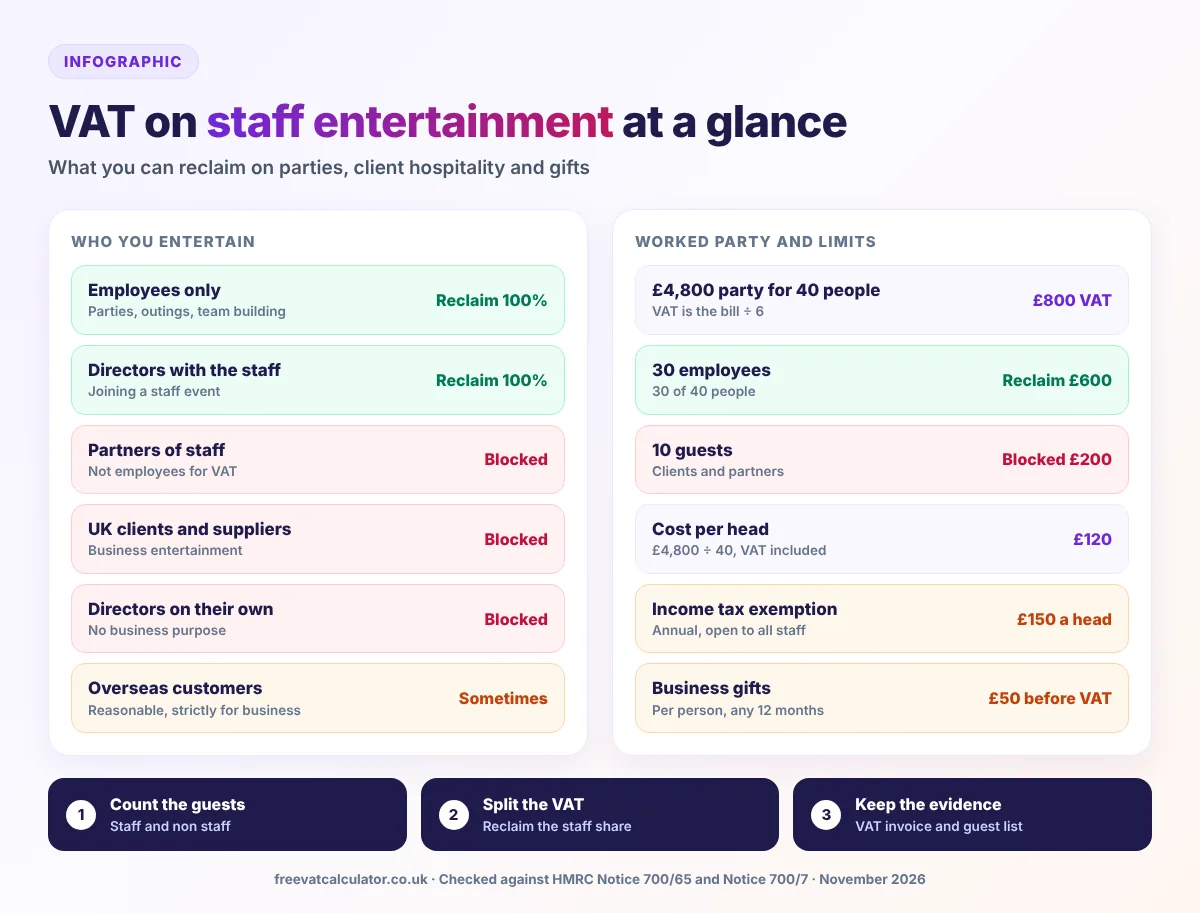
VAT on staff entertainment at a glance
Who receives the hospitality decides if the VAT comes back, not what the hospitality is. This table sums up the main rules from HMRC VAT Notice 700/65, Notice 700/7 and the VAT Input Tax manual.
| Spending | Can you reclaim the VAT? | The rule behind it |
|---|---|---|
| Staff Christmas party or summer event | Yes, in full | Treated as wholly for business purposes |
| Team building day or staff outing | Yes, in full | The same rule as any staff event |
| Directors joining a staff party | Yes, in full | HMRC normally needs no split |
| Party with staff and guests | Staff share only | Apportion, usually by headcount |
| Partners, relatives and friends of staff | No | They are not employees |
| UK clients, suppliers and contacts | No | Business entertainment is blocked |
| Overseas customers | Sometimes | Must be reasonable; output tax may cancel it |
| Directors or partners on their own | No | No business purpose for VAT |
| Meals and hotels on a business trip | Yes | Subsistence, not entertainment |
| Gifts up to £50 a person in 12 months | Yes, with no output tax | Business gift rules |
HMRC updated Notice 700/65 on 3 June 2026 to confirm who is and is not an employee for these rules. The notice says self employed people count as employees only for subsistence, so a freelancer at your party is a guest for VAT purposes.
What counts as business entertainment for VAT?
HMRC defines entertainment as hospitality of any kind. Business entertainment is that hospitality given free to anyone who is not an employee, and article 5 of the Value Added Tax (Input Tax) Order 1992 stops you reclaiming the VAT on it. This block is what accountants mean when they talk about VAT on business entertainment.
Three conditions must all apply before the block bites: there is entertainment, it goes to people who are not employees, and they do not pay for it. Notice 700/65 lists these as typical forms of entertainment.
- food and drink
- hotel and other accommodation
- theatre and concert tickets
- entry to sporting events and facilities
- entry to clubs and nightclubs
- use of yachts, aircraft and similar assets
Who counts as an employee
Hospitality for the people below is staff entertainment, not business entertainment. HMRC’s manual adds temporary and casual staff to the list in the notice.
- people you employ, including temporary and casual staff
- directors and anyone managing the business, including partners in a partnership
- self employed workers, but only for subsistence when you treat them like staff
- helpers and stewards essential to running sporting or similar events
Who counts as a guest
Everyone else is a non employee, so the VAT on their share of any hospitality is blocked. HMRC’s notice and manual point to these groups, and a freelancer at a party is a guest because the notice counts the self employed as staff only for subsistence.
- pensioners and former employees
- job applicants and interviewees
- shareholders who do not also work in the business
- partners, relatives and friends of employees
- clients, customers, suppliers and other contacts
- self employed contractors at a social event
Can you reclaim VAT on staff entertainment?
Yes. HMRC treats entertainment for employees, such as a reward for good work or a way to keep morale up, as wholly for business purposes, so the VAT is input tax and is not blocked. Staff parties, team building days and staff outings all qualify, and HMRC’s manual says the VAT on them can be recovered in full.
It was not always this generous. Between 1993 and 1997 HMRC usually allowed only 50% recovery on staff entertainment, until it accepted the Ernst and Young tribunal decision and changed its policy.
Christmas parties, team building and staff outings
A Christmas party, summer barbecue, team dinner or day out for employees is the classic case of reclaimable VAT on staff entertainment. The VAT on the venue, food, drink, entertainment and transport all counts, as long as you hold a valid VAT invoice addressed to the business. VAT law sets no limit per head, so the £150 figure you may have heard about is an income tax rule.
Directors, partners and sole traders on their own
Entertainment provided only for directors or partners is not treated as having a business purpose, so the VAT is not input tax at all. HMRC’s reasoning is that the people running a business do not need to reward or motivate themselves. Notice 700/65 puts sole proprietors in the same position.
The answer changes when directors join the team. If directors or partners attend a staff party with other employees, HMRC accepts the VAT is input tax and normally sees no need to apportion it.
Self employed workers and freelancers
Freelancers who work alongside your team often get an invitation to the Christmas party. Notice 700/65, as updated on 3 June 2026, treats self employed people as employees only for subsistence expenses, so at a social event they count as guests and their share of the VAT is blocked.
Staff who act as hosts
When employees take a client to dinner, their own meals are not staff entertainment. HMRC says the whole cost is incurred to entertain the client, so the VAT on the full bill, including the staff share, is blocked. The exceptions are an overseas customer and an employee working away on a business trip, both covered below.
Who can reclaim the VAT
Only VAT registered businesses can reclaim VAT on any spending, and a claim must be made within 4 years of the due date of the return for the period it relates to. If you use the Flat Rate Scheme, you cannot reclaim VAT on purchases at all apart from certain capital assets over £2,000, so party costs make no difference to your return.
Partly exempt businesses have one more step. VAT on staff entertainment still passes through your partial exemption method like your other general overheads, so you may keep less than the full amount.
VAT on client entertainment
Client entertainment is the clearest case of blocked VAT. Taking a UK customer to lunch, hosting a golf day, buying tickets for a match or filling a hospitality box all count as business entertainment, so the VAT stays as a cost even when the spending helps win work. The same applies to suppliers, prospects and anyone else you entertain to build a relationship.
HMRC also takes the view that there is usually a private benefit to the guest whenever entertainment is provided. That explains why the few exceptions below are narrow and why HMRC checks them closely.
Overseas customers
Entertaining an overseas customer is the main exception. An overseas customer is any customer not ordinarily resident or carrying on a business in the UK or the Isle of Man, and the VAT may be recoverable if the spending is for business purposes and reasonable in scale and character.
There is a catch. The private benefit creates an output tax charge that cancels the VAT you reclaimed, unless the hospitality was necessary and for strict business purposes, and hospitality offered because it is polite, expected or good for the relationship fails that test. HMRC lets you simply treat the VAT as non deductible instead of claiming it and paying it back.
This exception exists because of a court ruling. HMRC extended the block to overseas customers in 1988 and withdrew that extension in November 2010, after the Danfoss and AstraZeneca judgment.
Meetings and working lunches
HMRC’s examples for overseas customers show where it draws the line. Basic refreshments in your office during a meeting, such as sandwiches and soft drinks so the meeting can carry on without a break, do not create a private use charge, and a meeting held elsewhere allows only similar basic provision. Drinks with alcohol or hospitality after the meeting fail the strict business purpose test, and HMRC says a restaurant lunch is very likely to create a private use charge.
These examples sit in the notice’s section on overseas customers. For UK clients the safer reading is that food and drink you provide is business entertainment, so the VAT on it is blocked.
Hospitality with a separate business use
Some spending entertains guests and does something else at the same time. HMRC lets you apportion the VAT when the other use is tangible, such as a hospitality suite with a working office area, sponsorship that also advertises to a wider audience, or a yacht that is also chartered out.
Promotion or goodwill is not a separate use, because HMRC says all business entertainment is a form of marketing. Where a genuine second use exists, HMRC accepts any apportionment method that gives a fair and reasonable result.
When guests pay to attend
Business entertainment must be free, so a genuine charge changes the answer. If guests pay a real price to attend, the hospitality is not business entertainment and the VAT on it is not blocked, but you account for VAT on what they pay as on any other sale.
HMRC’s manual gives similar examples where hospitality is part of something the customer pays for. A restaurant that offers free drinks to diners who buy a meal is treated as including the drinks in the price, and entertainment open to every club member is part of the membership.
Mixed events: splitting the VAT between staff and guests
When staff and non employees attend the same event, VAT on staff entertainment is reclaimable only for the employees’ share. The share for guests is blocked, and HMRC’s manual says that if staff and guests attend in roughly equal numbers, only 50% of the VAT can be recovered.
- 100%Staff only, including directors who join them
- 75%30 staff and 10 guests
- 0%Clients only, or directors on their own
Headcount is the usual method because most party costs are charged per person. HMRC still applies this split, and it says the KPMG tribunal decision fully supports its policy.
- Take the VAT from the invoice, or divide a 20% VAT inclusive total by 6.
- Count everyone who attended, staff and guests together.
- Divide the number of employees by the total headcount.
- Multiply the VAT by that fraction to find the amount you can reclaim.
- Treat the rest of the VAT as part of the cost of the event.
| Step | Figure |
|---|---|
| Total bill including VAT | £4,800.00 |
| VAT at 20% (£4,800 ÷ 6) | £800.00 |
| Employees attending | 30 |
| Guests (partners and clients) | 10 |
| Staff share (30 ÷ 40) | 75% |
| VAT you can reclaim | £600.00 |
| VAT blocked | £200.00 |
| Cost per head for the £150 test (£4,800 ÷ 40) | £120.00 |
Partners and families of staff
Partners, spouses and family members of staff are not employees, even at the staff Christmas party. HMRC’s manual lists a partner, relative or friend of an employee as a non employee, so each of their places counts as a guest in the split.
Overseas customers at a staff event
If an overseas customer comes to a staff event, their share of the VAT is not blocked in the same way as a UK guest’s. Output tax may still be due on the private benefit, so HMRC allows you to treat that share as non deductible instead.
Christmas party VAT and the £150 tax exemption
The £150 figure has nothing to do with VAT on staff entertainment. It comes from section 264 of the Income Tax (Earnings and Pensions) Act 2003 and decides whether staff pay income tax on the party, while VAT decides what the business can reclaim. The two tests use different numbers, so run both before you book.
How the £150 annual event exemption works
A party or other function is free of income tax and National Insurance for staff when it meets every condition below. HMRC sets them out in its guidance on social functions and parties.
- it is annual, such as a Christmas party or summer barbecue
- it is open to all employees, or all staff at one location
- it costs £150 or less a head, including VAT
- online and virtual parties qualify too
The cost per head includes VAT, transport and any overnight accommodation, divided by everyone who attends, guests included. If you hold several annual events, they stay exempt as long as their combined cost is no more than £150 a head.
What happens above £150
The £150 is an exemption, not an allowance, so a party costing £160 a head is taxable in full rather than on the extra £10. Where you hold more than one event, HMRC exempts whichever events use the £150 best and taxes the rest.
A taxable party goes on each employee’s P11D, and the employer pays Class 1A National Insurance on the full cost. Many employers instead settle the tax for their staff through a PAYE Settlement Agreement, which HMRC says can cover staff entertainment that is not exempt, so the party stays a true gift.
How the VAT and income tax rules interact
VAT and income tax look at the same party from different angles. VAT asks who attended and blocks the guest share, while income tax asks what the party cost per head and whether every employee was invited.
| Question | VAT | Income tax and NIC |
|---|---|---|
| What is tested | Who receives the hospitality | Cost per head and who was invited |
| Treatment of VAT | Reclaimed on the staff share | Included in the £150 a head |
| Guests | Their share of VAT is blocked | Their places count in the per head cost |
| Directors only party | No VAT to reclaim | Not exempt if other staff were left out |
| Over £150 a head | No effect on the VAT claim | The whole cost is taxable |
One practical point follows from this. Because the £150 includes VAT, a party that costs £125 plus VAT a head sits exactly on the limit, and anything more tips the whole event into tax.
Virtual parties and hampers
Online parties count as annual functions for the exemption. HMRC’s own example is a virtual party where each employee receives a hamper, at a total cost of £100 a head, which is within the £150 limit. For VAT, hampers are goods given to staff, so the business gift rules below decide whether output tax is due.
VAT on business gifts
A business gift is a gift of goods made in the course of your business, on which you were entitled to reclaim the VAT, as VAT Notice 700/7 explains. Giving goods away is normally a supply, but HMRC ignores small gifts so that a calendar, a bottle of wine or a hamper does not create a VAT bill.
The £50 rule
You do not account for output tax when the total cost of gifts to the same person is £50 or less, excluding VAT, in any 12 month period. You can use any 12 month period that includes the day of the gift, and the limit applies to each person who receives a gift.
Once the total for one person goes over £50, output tax is normally due on the full cost of all the gifts to that person, not just the excess. The old rule that a series or succession of gifts was always taxable no longer applies, because only the value limit has counted since 1 October 2003.
| Gifts in 12 months | Cost excluding VAT | Output tax due |
|---|---|---|
| One bottle of wine | £30.00 | None |
| Wine plus a box of chocolates | £30.00 plus £15.00 = £45.00 | None |
| Wine plus a £30 hamper | £30.00 plus £30.00 = £60.00 | £12.00, which is 20% of £60.00 |
VAT on staff gifts
The £50 rule covers staff as well as clients, so a Christmas hamper or bottle of wine for each employee costing £50 or less before VAT creates no output tax. HMRC treats rewards and perks for staff as a legitimate business expense, so the VAT on buying them is input tax.
Larger rewards for one person are different. HMRC’s example is a car dealer who gives a top salesperson a crate of champagne: the dealer reclaims the VAT on the purchase but must account for output tax when the gift is made.
Staff may also face income tax on gifts. A gift costing £50 or less is a tax free trivial benefit if it is not cash or a cash voucher, not a reward for work and not in the employee’s contract, and directors of close companies can receive no more than £300 of these in a tax year.
Long service awards
Long service and retirement gifts are business gifts for VAT, so the same £50 test decides whether output tax is due. For income tax, a non cash award is exempt if the employee has worked for you for at least 20 years, it is worth less than £50 for each year of service, and they have not had a long service award in the last 10 years.
Gifts of services and samples
A service you provide free of charge is usually not a supply, so no VAT is due on it. If you buy in a service and pass it on free, the VAT you paid may be reclaimable, but output tax is then due on what you give away.
A sample is a specimen of a product given away to promote sales of that product, and genuine free samples given for marketing are not liable to VAT. HMRC warns that a case of 12 bottles points to something more than a sample.
Subsistence is not entertainment
Meals and hotels for staff travelling on business are subsistence, not entertainment, so the business entertainment block does not touch them. If the business pays the actual cost of an employee’s meal or hotel on a business trip, the VAT is input tax.
Fixed allowances are different: if you pay staff a flat rate for their expenses, you cannot reclaim any VAT on what they spend. Directors, partners and sole traders can treat the VAT on meals as input tax only when they take them on a business trip away from their normal place of work.
When a client joins a working meal
HMRC draws the line by purpose. If an employee is working away and entertainment is only secondary to the business of the trip, the VAT on the employee’s own meal can be claimed, but nothing can be claimed if the trip is made solely to entertain. The client’s share of the meal stays blocked either way.
Is entertainment deductible for corporation tax?
Corporation tax, and income tax for sole traders, follow their own rules, and they line up with VAT more closely than the £150 test does. Business entertainment and gifts are not allowable against profits, while staff entertainment is an exception, so a client dinner costs the business the full bill with no tax relief and no VAT back.
Staff entertainment
The cost of entertaining employees is deductible unless it is incidental to entertaining customers or other people who are not employees. HMRC’s test asks if you would have paid for the event with no guests there, so an employee’s canteen lunch with a visitor stays allowable while a restaurant lunch with a customer is business entertainment in full.
Gifts to clients
Gifts to clients are disallowed unless they meet three conditions. The gift must carry a conspicuous advert for your business on the item itself, it must not be food, drink, tobacco or a voucher for goods, and gifts to one person must total no more than £50 in the accounting period, or the tax year for a sole trader.
Records HMRC expects for VAT on staff entertainment
HMRC looks closely at entertainment during compliance checks, so keep the evidence for each event together. These records support a claim if HMRC asks.
- a VAT invoice addressed to the business, not just a card slip
- the guest list, showing who was staff and who was not
- the purpose of the event, such as a staff reward
- your working for any split between staff and guests
- a log of gifts to each person, to track the £50 limit
Keep VAT records for at least 6 years. A supplier can issue a simplified invoice for a sale of £250 or less including VAT, which still supports a claim, but a card statement is not a VAT invoice. Our guide to what a valid VAT invoice must include lists every detail to check.
If you find you claimed blocked VAT in an earlier return, put it right. The Autumn Budget on 28 October 2026 confirmed that a legal duty to correct errors in returns will start on 1 April 2028, and our guide to fixing past VAT mistakes explains the current limits.
Worked examples
These examples show how VAT on staff entertainment and client hospitality works on real bills. Each one assumes a VAT registered business with a valid VAT invoice and all costs at 20%.
A staff only Christmas party
A firm spends £3,600 including VAT on a party for its 30 employees. The VAT is £600, all of it reclaimable, and the cost per head is £120, so staff pay no tax if it is the firm’s only annual event.
A party with partners invited
A business invites 25 employees and their 25 partners to a £6,000 dinner. The VAT is £1,000, but only half relates to staff, so £500 is reclaimed and £500 is blocked. The cost per head is £120, which keeps the event inside the £150 exemption if it is the only annual event.
A client golf day
A company spends £2,400 including VAT on a golf day for 8 UK clients, with 4 sales staff as hosts. All £400 of VAT is blocked, including the staff share, because the staff are there to entertain the clients.
A directors’ dinner
Three directors spend £540 including VAT on a celebration dinner without the rest of the team. The £90 of VAT cannot be reclaimed, and because other staff were not invited, the dinner is a taxable benefit for each director.
Common mistakes with entertainment VAT
Many errors in this area come from treating every event in the same way. Watch for these in your own records.
- reclaiming all the VAT on a party where partners or clients came
- treating a directors only dinner as VAT on staff entertainment
- counting freelancers as staff at a social event
- claiming the staff share of a client meal
- reclaiming VAT on gifts without tracking the £50 limit per person
- assuming the £150 exemption is a VAT limit
- claiming from a card statement with no VAT invoice
Need the VAT on a single receipt?
Our free VAT calculator takes the VAT out of any bill at 20% or 5% in seconds.
VAT on staff entertainment FAQs
These are the questions business owners ask most about entertaining staff, clients and contacts. Each answer reflects HMRC guidance as at October 2026.
Can you claim VAT on a staff party?
Yes, if the party is for employees and the business is VAT registered and not on the Flat Rate Scheme. If partners, clients or other guests attend, you reclaim only the staff share.
Can I reclaim VAT on a Christmas party if partners come?
Only on the employees’ share. Partners of staff are not employees, so with 30 staff and 30 partners you reclaim half of the VAT.
Is VAT on client entertainment ever reclaimable?
Rarely. VAT on entertaining overseas customers may be recoverable if it is reasonable, and hospitality that guests pay for is not business entertainment. VAT on free hospitality for UK clients is always blocked.
Does the £150 Christmas party limit apply to VAT?
No. The £150 a head exemption is an income tax and National Insurance rule for staff, and VAT on staff entertainment has no limit per head.
Can a sole trader reclaim VAT on entertaining?
Not on entertaining themselves, because HMRC sees no business purpose in it. A sole trader can reclaim VAT on entertaining employees, and on their own meals on a business trip away from their normal place of work.
Do I charge VAT on gifts to clients?
Not if the gifts to one person cost £50 or less, excluding VAT, in any 12 month period. Above that, output tax is normally due on the full cost of the gifts to that person.
How far back can I claim VAT I missed on a staff party?
You have 4 years from the due date of the return for the period you could first have claimed it. You need the original VAT invoice to support the claim.
You now know when VAT on staff entertainment can be reclaimed, how to split a mixed event, how the £50 gift rule and the £150 exemption work, and what to keep on file. Run your next party bill through the calculator at the top and claim the staff share with confidence.
Sources: HMRC VAT Notice 700/65, Business entertainment; HMRC manual VIT43200; VIT43300; VIT43400; VIT43600; VIT43700; HMRC VAT Notice 700/7, Business promotions; VATSC03323; HMRC VAT Notice 700; VAT Notice 700/21; GOV.UK, VAT Flat Rate Scheme; GOV.UK, social functions and parties; EIM21690 and EIM21691; GOV.UK, trivial benefits; GOV.UK, long service awards; GOV.UK, PAYE Settlement Agreements; BIM45034 and BIM45070; Budget 2026, overview of tax legislation and rates. This page is general information, not tax advice.