
Self employed tax tool
Self Employed Tax Calculator 2026 to 2027: Income Tax and National Insurance on Your Profit
How your self employed tax is worked out
- Find your profitIncome minus expenses
- Apply income taxUK or Scottish bands
- Add Class 46% then 2%
- Note the dates31 January and 31 July
- Set money asideA share of every payment
Money lands in your account from clients, but part of it already belongs to HMRC, and nobody sends you a payslip to say how much. Many people starting out put aside 20%, then meet Class 4 National Insurance on top, and in the first January a bill that is half as big again because of payments on account.
This page works out the real figure from your own numbers: income tax by band, Class 4, any student loan, a monthly amount to set aside and the dates to pay. Use the self employed tax calculator below first, then the guide explains every rate it uses for 2026 to 2027.
Self employed tax calculator for 2026 to 2027
The results update as you type. It covers 2026 to 2027 and also 2025 to 2026, the year whose return is due by 31 January 2027.
Self employed tax calculator
Income tax, Class 4, student loan and payment dates on your profit
| Part of the bill | Amount | Tax |
|---|---|---|
| Personal allowance 0% | £12,570.00 | £0.00 |
| Basic rate 20% | £17,430.00 | £3,486.00 |
| Class 4 at 6% | £17,430.00 | £1,045.80 |
| Total through Self Assessment | £4,531.80 |
Payments on account apply
Your income tax and Class 4 of £4,531.80 are £1,000 or more, so HMRC asks for two payments on account of £2,265.90 towards 2027 to 2028. In a first year, pay £6,797.70 by 31 January 2028 (the £4,531.80 bill plus the first payment) and £2,265.90 by 31 July 2028.
Class 2 treated as paid
Your profit is at least £7,105, so Class 2 counts as paid and 2026 to 2027 is a qualifying year for your State Pension at no cost.
The working
Profit: £40,000.00 income minus £10,000.00 expenses is £30,000.00. After the £12,570.00 personal allowance, £17,430.00 is taxed: £17,430.00 at 20% is £3,486.00. Class 4 is £1,045.80 at 6%. The total of £4,531.80 leaves £25,468.20 of the profit, an effective rate of 15.1%, or £377.65 to set aside each month.
An estimate for one person under State Pension age. A salary is assumed to be taxed through PAYE on the 1257L code, and payments on account assume none were made for this year. Nothing you enter is stored or sent.
How to use the calculator
Enter your income and expenses, or your profit with expenses left blank, then add where you live, any salary and any student loan. HMRC’s online return works out the same tax as you file, so this shows the bill months earlier.
What the calculator includes and leaves out
It covers UK and Scottish income tax, the taper above £100,000, Class 4, student loans and first year payments on account. It leaves out savings, dividends, rent, pensions and capital gains, and assumes you are under State Pension age.
Key facts
- Personal allowance
- £12,570, frozen until April 2031
- Income tax on profit
- 20%, 40% and 45%, or 19% to 48% in Scotland
- Class 4 National Insurance
- 6% from £12,570 to £50,270, then 2%
- Class 2
- Treated as paid from £7,105 of profit
- Payments on account
- Half the bill each, 31 January and 31 July
- 2026 to 2027 bill due
- 31 January 2028
How self employed tax is worked out
From turnover to taxable profit
You pay tax on profit, which is business income minus allowable expenses. Since 6 April 2024 the cash basis has been the standard method, so you count income when the money arrives and costs when you pay them.
Two charges on the same profit
The same profit is taxed for income tax and again for Class 4 National Insurance, each with its own bands. Both go through your Self Assessment return, and HMRC includes Class 4 in your payments on account.
Income tax rates on self employed profit for 2026 to 2027
England, Wales and Northern Ireland use these bands, as Welsh rates match for 2026 to 2027. HMRC confirmed on 26 November 2025 that the allowance and higher rate threshold stay frozen until 5 April 2031.
| Band | Income | Rate |
|---|---|---|
| Personal allowance | Up to £12,570 | 0% |
| Basic rate | £12,571 to £50,270 | 20% |
| Higher rate | £50,271 to £125,140 | 40% |
| Additional rate | Over £125,140 | 45% |
The personal allowance and the £100,000 taper
Above £100,000 of adjusted net income the allowance falls by £1 for every £2, so it is gone at £125,140. Section 35 of the Income Tax Act 2007 rounds what is left up to a whole pound, and pension contributions lower adjusted net income.
Scottish income tax rates for 2026 to 2027
If you live in Scotland, the Scottish Parliament sets the bands on your profit. Savings and dividends still use UK rates, and Class 4 is the same everywhere.
| Band | Income | Rate |
|---|---|---|
| Starter | £12,571 to £16,537 | 19% |
| Basic | £16,538 to £29,526 | 20% |
| Intermediate | £29,527 to £43,662 | 21% |
| Higher | £43,663 to £75,000 | 42% |
| Advanced | £75,001 to £125,140 | 45% |
| Top | Over £125,140 | 48% |
Self employed National Insurance for 2026 to 2027
The calculator also works as a self employed national insurance calculator, because it shows Class 4 by band. These are the GOV.UK figures it uses.
| Charge | Profit | Rate |
|---|---|---|
| Class 4 main rate | £12,570 to £50,270 | 6% |
| Class 4 additional rate | Over £50,270 | 2% |
| Class 2 | £7,105 or more | Treated as paid |
| Voluntary Class 2 | Under £7,105 | £3.65 a week |
Class 4 National Insurance
Class 4 is 6% of profit between £12,570 and £50,270 and 2% above, so £30,000 of profit costs £1,045.80. It ends from the 6 April after you reach State Pension age, so someone reaching it on 6 September 2026 stops from 6 April 2027.
Class 2: voluntary since April 2024
Since 6 April 2024 nobody has to pay Class 2. With profit of £7,105 or more it is treated as paid, so the year counts for your State Pension at no cost, and below that you may pay £3.65 a week.
Is voluntary Class 2 worth paying?
Usually, if the year would not count for your State Pension another way, because a full year costs £189.80 against £956.80 for Class 3 at £18.40 a week. You normally need 35 qualifying years for the full new State Pension.
How much tax do I pay self employed? Results at nine profit levels
These figures assume England, Wales or Northern Ireland, no other income and no student loan. The effective rate is the total as a share of profit.
| Profit | Income tax | Class 4 | Total | You keep | Rate |
|---|---|---|---|---|---|
| £10,000 | £0 | £0 | £0 | £10,000.00 | 0% |
| £12,570 | £0 | £0 | £0 | £12,570.00 | 0% |
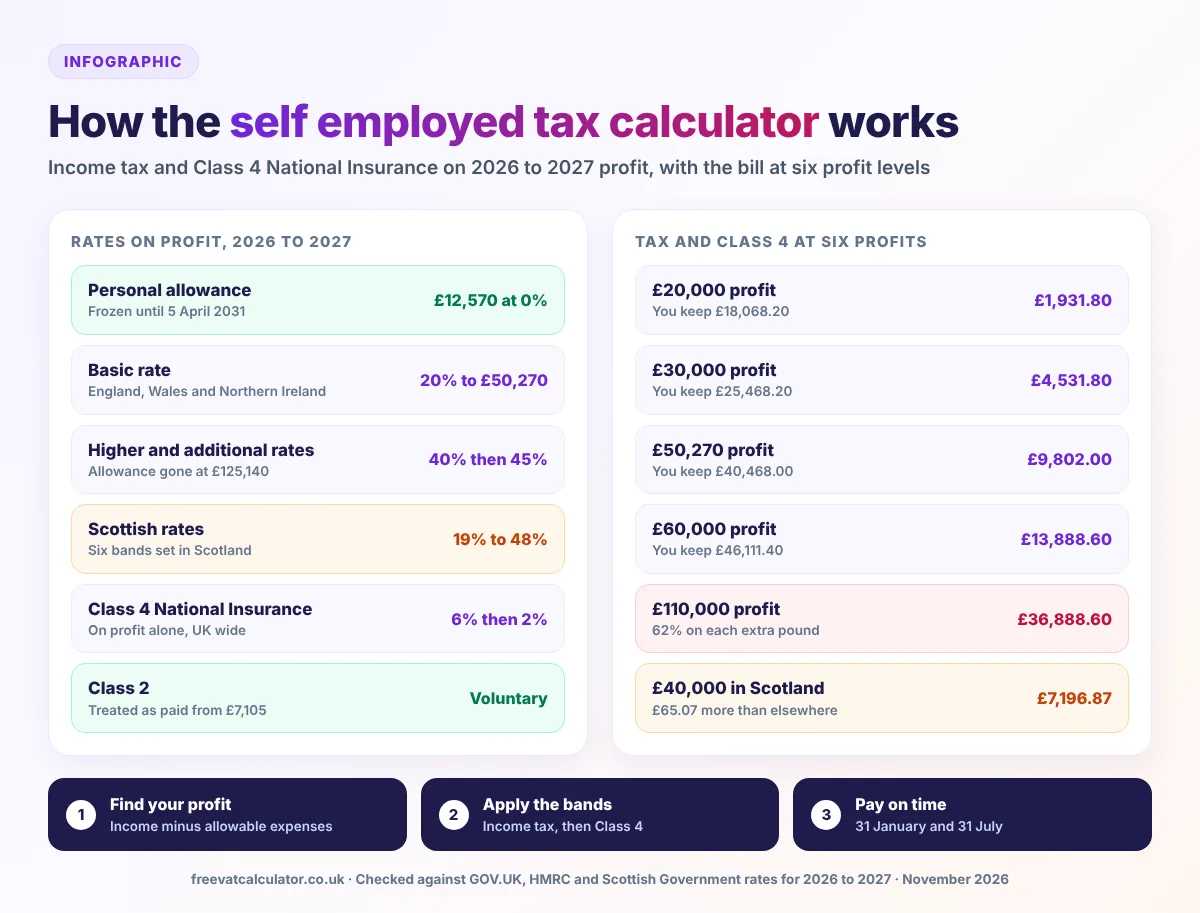
| £20,000 | £1,486.00 | £445.80 | £1,931.80 | £18,068.20 | 9.7% |
| £30,000 | £3,486.00 | £1,045.80 | £4,531.80 | £25,468.20 | 15.1% |
| £50,270 | £7,540.00 | £2,262.00 | £9,802.00 | £40,468.00 | 19.5% |
| £60,000 | £11,432.00 | £2,456.60 | £13,888.60 | £46,111.40 | 23.1% |
| £80,000 | £19,432.00 | £2,856.60 | £22,288.60 | £57,711.40 | 27.9% |
| £110,000 | £33,432.00 | £3,456.60 | £36,888.60 | £73,111.40 | 33.5% |
| £130,000 | £44,703.00 | £3,856.60 | £48,559.60 | £81,440.40 | 37.4% |
A Scottish example at £40,000
On £40,000 a Scottish taxpayer pays £753.73 at 19%, £2,597.80 at 20% and £2,199.54 at 21%, so £5,551.07 of income tax. With Class 4 of £1,645.80 the bill is £7,196.87, which is £65.07 more than elsewhere in the UK.
A £20,000 salary plus £25,000 of profit
The salary uses the allowance and lower bands first, so income tax on the full £45,000 is £6,486, of which PAYE has already taken £1,486. The return shows £5,000 on the profit plus Class 4 on the profit alone of £745.80, a total of £5,745.80.
Why profit between £100,000 and £125,140 costs 62%
Each extra £2 here is taxed at 40% and also removes £1 of allowance, which is then taxed at 40% too. That is 60% income tax plus 2% Class 4, and the 45% Scottish advanced rate pushes it to 69.5%.
- 62%Marginal rate on profit from £100,000 to £125,140
- 69.5%The same band for a Scottish taxpayer
- £12,570Profit you can make before income tax or Class 4
Allowable expenses that reduce your profit
You can claim costs that are only for the business, and only the business share of anything you also use privately. The main groups on GOV.UK are these.
- Office costs, stationery and phone bills
- Travel, fuel and parking for business trips
- Staff, subcontractors and stock you sell on
- Bank charges, insurance and accountancy
- Rent, rates and power for business premises
- Advertising, subscriptions and training
Simplified expenses and mileage
Instead of real motoring costs, you can claim 55p a mile for the first 10,000 business miles in 2026 to 2027, up from 45p, then 25p. Working from home earns a flat £10, £18 or £26 a month for 25 to 50, 51 to 100, or 101 or more hours, but phone and internet are claimed separately.
The trading allowance instead of expenses
If your costs are tiny, you can deduct the £1,000 trading allowance in place of them, rising to £3,000 from 6 April 2027. Our trading allowance guide shows which choice leaves less to tax.
If your costs are more than your income
When expenses beat income you have a trading loss, with no income tax or Class 4 on the business. HMRC helpsheet HS227 explains how a loss can be set against other income or carried forward.
Student loans and pension contributions
Student loan repayments through Self Assessment
HMRC adds repayments to your return, based on profit and salary together, minus anything your payroll already took. The rate is 9% over the threshold, or 6% for a Postgraduate Loan.
| Plan | Usually for | Threshold |
|---|---|---|
| Plan 1 | England or Wales before September 2012, or Northern Ireland | £26,900 |
| Plan 2 | England from September 2012 to July 2023, or Wales from September 2012 | £29,385 |
| Plan 4 | Scotland | £33,795 |
| Plan 5 | England from 1 August 2023 | £25,000 |
| Postgraduate Loan | Postgraduate courses in England or Wales | £21,000 |
How pension contributions cut the bill
With a personal pension the provider adds basic rate relief, so £800 you pay becomes £1,000. Higher rate payers claim the rest on the return, and relief stops at 100% of your earnings.
Payments on account and your first tax bill
Payments on account are two advance payments towards next year, each half of this year’s income tax and Class 4. Student loans and voluntary Class 2 go in the January balancing payment instead. For a first year with 2026 to 2027 profit, the dates are these.
- By 31 January 2028, the full 2026 to 2027 bill plus the first payment on account for 2027 to 2028.
- By 31 July 2028, the second payment on account.
Payments on account catch most people in year one, when January asks for one and a half times the tax. On £30,000 of profit that is £6,797.70 in January and £2,265.90 in July.
When payments on account do not apply
You skip them if last year’s Self Assessment bill was under £1,000, or if more than 80% of all your tax was collected at source. A £60,000 salary with £5,000 of profit leaves a £2,000 bill, but PAYE took £11,432 of £13,432, about 85%, so none are due.
Lowering payments on account
If profit falls you can reduce them online or on form SA303, but interest runs on any shortfall. HMRC late payment interest is 7.75% until 23 November 2026 and 8% from 24 November, after Bank Rate rose to 4% on 5 November 2026. Our Self Assessment deadline guide has every date and penalty.
How much to set aside from each payment
When income is uneven, saving a share of every payment works better than a monthly sum. From the table above that is about 10% of profit at £20,000, 15% at £30,000, 20% at £50,000 and 28% at £80,000.
In your first year, keep another half of the bill for January. A Budget Payment Plan lets you pay HMRC weekly or monthly by Direct Debit towards the next bill, and you can pause it for up to 6 months.
Registering, filing and paying
Registering for Self Assessment
You must register once self employed income passes £1,000 before expenses in a tax year. For 2026 to 2027, tell HMRC by 5 October 2027 to avoid a penalty, then file online by 31 January 2028.
If you cannot pay in full
Contact HMRC before the deadline, because you may be able to agree a payment plan. Interest still runs on anything unpaid, so a plan costs more than paying on time.
Making Tax Digital and VAT
Making Tax Digital for Income Tax
Qualifying income over £50,000 in 2024 to 2025 meant starting on 6 April 2026, over £30,000 in 2025 to 2026 means April 2027, and over £20,000 in 2026 to 2027 means April 2028. It is your self employment and property income before expenses, as our Making Tax Digital for Income Tax guide explains.
When VAT registration applies
VAT is a separate tax on sales, and you must register once taxable turnover passes £90,000 in any rolling 12 months. See our VAT threshold guide and VAT for sole traders and freelancers.
What the Budget of 28 October 2026 changed
The Budget kept income tax and Class 4 on trading profit the same for 2027 to 2028. The higher rates for savings and rent do not touch self employed profit.
| Change | From | Effect |
|---|---|---|
| Trading allowance £1,000 to £3,000 | 6 April 2027 | More side income tax free |
| Voluntary Class 2 £3.80 a week, threshold £7,355 | 6 April 2027 | Small rise for low profits |
| Mileage above 10,000 miles 25p to 35p | 6 April 2027 | Bigger claim for high mileage |
| Savings and property income 24%, 44%, 49% | 6 April 2027 | None on trading profit |
| More regular payments for those on payments on account | April 2029 | Automated, with a PAYE option |
Self employed, employed or a limited company
Against an employee on the same pay
An employee on £30,000 pays the same £3,486 of income tax but £1,394.40 of Class 1 at 8%, against £1,045.80 of Class 4. You do, however, fund your own holidays, sick days and pension.
When a limited company could cost less
A company can help if you leave profit in the business, since you pay personal tax only on what you draw. Our sole trader vs limited company comparison and dividend tax calculator run those numbers.
Common mistakes that skew the figures
- Typing turnover into a self employed tax calculator as profit
- Saving 20% and forgetting Class 4
- Using UK bands while living in Scotland
- Missing the first payment on account
- Leaving out student loan repayments
- Claiming the trading allowance and expenses together
Filing your 2025 to 2026 return?
Our Self Assessment deadline guide has every date before 31 January 2027. It also has a calculator for the January and July payments.
Self employed tax calculator FAQs
These are the questions sole traders ask most about tax for 2026 to 2027. Each answer uses the rates above.
Is a sole trader tax calculator different from this one?
No, a sole trader is self employed, so the same rates apply. Partners use them too, on their share of the profit.
Do I pay National Insurance on profit under £12,570?
No Class 4 is due below £12,570. With profit of £7,105 or more, the year still counts towards your State Pension.
What if I have a job as well?
Your salary uses your allowance first through PAYE, and the return collects the rest on your profit. Enter the salary above to see the extra tax.
Can I use the calculator for 2025 to 2026?
Yes, choose 2025 to 2026 for the return due by 31 January 2027. That year had narrower Scottish starter and basic bands, and a Class 2 threshold of £6,845 with voluntary Class 2 at £3.50 a week.
When is my 2026 to 2027 tax due?
The bill and any first payment on account are due by 31 January 2028, then a second payment on account by 31 July 2028. The 2025 to 2026 bill is due by 31 January 2027.
You now have your income tax, Class 4, student loan and payment dates, with the rates behind each one. Run the self employed tax calculator again whenever profit changes, and move the monthly figure into a separate account so January holds no surprises.
Sources: GOV.UK income tax rates; Scottish income tax; Scottish rate resolution; self employed National Insurance; National Insurance rates; thresholds 2026 to 2027; thresholds 2025 to 2026; payments on account; SAM121665; Self Assessment deadlines; trading allowance; trading allowance increase; MTD qualifying income; Budget 2026 overview; property and savings rates. This page is general information, not tax advice.