Self Assessment guide
Self Assessment Deadline: 31 January 2027, Payments on Account and Penalties
From tax year end to paid in full
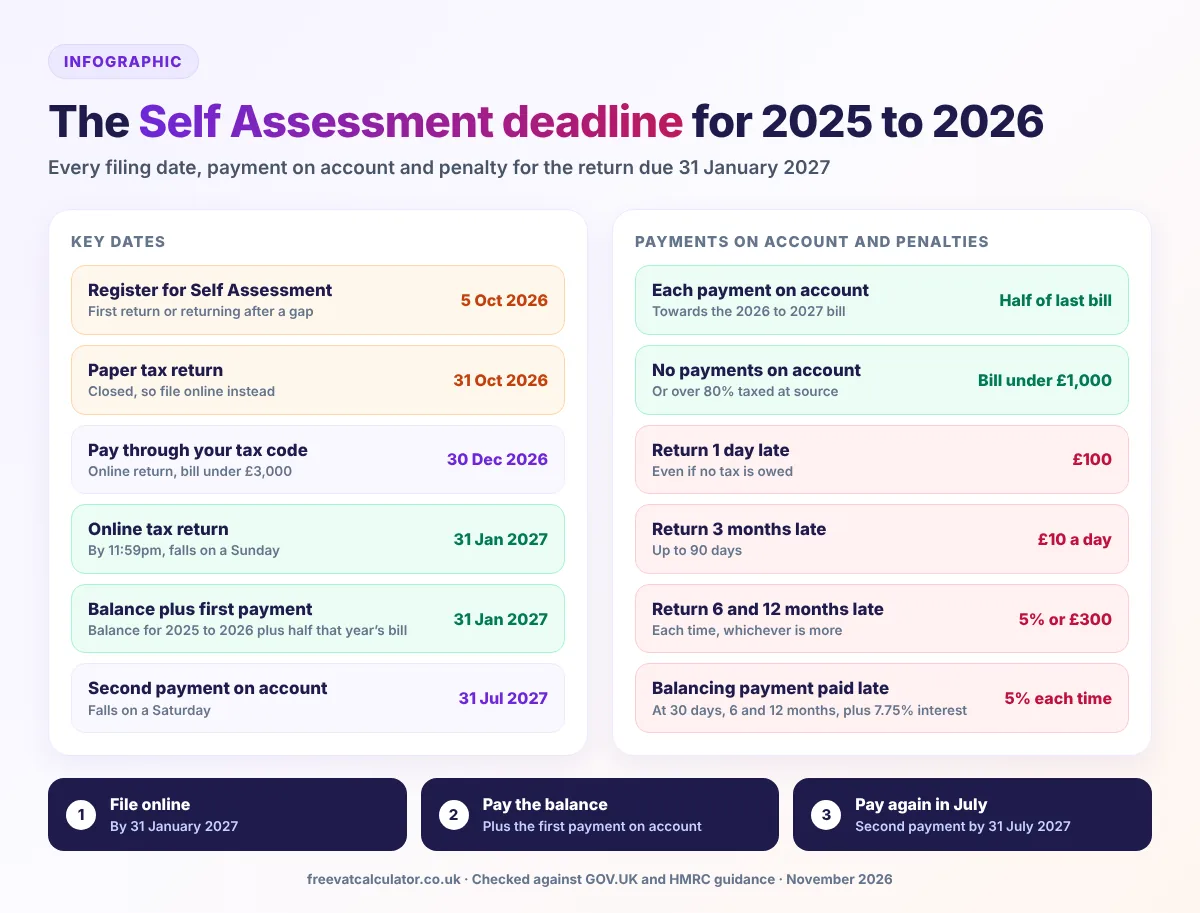
- Tax year ends5 April 2026
- RegisterBy 5 October 2026
- File onlineBy 31 January 2027
- PayBalance plus first payment on account
- Pay againSecond payment by 31 July 2027
The paper deadline has gone, the reminder emails are getting sharper, and your tax return is still waiting to be opened. Then someone mentions that January brings a bigger bill than expected, because HMRC wants part of next year’s tax in advance as well.
This guide gives you every date for the 2025 to 2026 tax return, a calculator that works out what you pay in January and July 2027, and a plain explanation of payments on account, the balancing payment and the penalties. By the end you will know the self assessment deadline that applies to you, how much money to set aside, and what to do if you cannot pay in full.
Self Assessment deadline and payments on account calculator
Enter the income tax and Class 4 National Insurance due through Self Assessment for 2025 to 2026, which is the figure left after tax already taken off at source, such as through PAYE. Leave out any Capital Gains Tax or student loan repayment, because neither counts towards payments on account, and add it to the January figure yourself. Add the tax collected at source, any payments on account you made in January and July 2026, and your best estimate for 2026 to 2027. The calculator shows whether payments on account apply, what to pay on each date and the balancing payment due on 31 January 2028.
Self Assessment deadline and payments on account calculator
What to pay on 31 January 2027, 31 July 2027 and 31 January 2028
Working it out
Enter your figures above.
The working
Nothing to work out yet.
31 January 2027 is a Sunday and 31 July 2027 is a Saturday. Faster Payments and card payments still count on those days, but other methods must reach HMRC by the Friday before. Capital Gains Tax and student loan repayments are added to the January balancing payment and never to payments on account, so leave them out of the first box and add them to January yourself. Each payment on account is half the bill, and this calculator rounds it down to the penny.
Key facts
- Online return
- 11:59pm on 31 January 2027
- Tax payment
- 31 January 2027, then 31 July 2027
- Payments on account
- Each half of last year’s Self Assessment bill
- No payments on account
- Bill under £1,000 or over 80% taxed at source
- Late filing
- £100, then £10 a day after 3 months
- Late payment interest
- 7.75% a year, then 8% from 24 November 2026
Self Assessment deadline dates for the 2025 to 2026 tax year
The 2025 to 2026 tax year ran from 6 April 2025 to 5 April 2026, and every date in this table belongs to that year’s return. Two of them have already passed, so most people now have one filing date and two payment dates left.
| What | Deadline | Good to know |
|---|---|---|
| Register for Self Assessment | 5 October 2026 | Passed, but you can still register late |
| Paper tax return | 31 October 2026 | Passed, so file online instead |
| Online return if you want the tax collected through your tax code | 30 December 2026 | Bills under £3,000 only |
| Online tax return | 31 January 2027, 11:59pm | Falls on a Sunday |
| Balancing payment for 2025 to 2026 and first payment on account for 2026 to 2027 | 31 January 2027 | The Self Assessment payment deadline |
| Second payment on account for 2026 to 2027 | 31 July 2027 | Falls on a Saturday |
| Last day to amend your 2025 to 2026 return | 31 January 2028 | 12 months after the filing deadline |
When is the online tax return deadline?
Your online return for 2025 to 2026 must reach HMRC by 11:59pm on 31 January 2027, and the tax you owe is due by the same moment. HMRC has accepted returns since 6 April 2026, and filing early does not bring the payment forward, so you can file in November and still pay in January.
31 January 2027 falls on a Sunday, and the self assessment deadline does not move to Monday. GOV.UK says a payment made by any method other than Faster Payments or a card must reach HMRC on the last working day before, which is Friday 29 January 2027.
Paper tax return deadline: 31 October 2026
Paper returns for 2025 to 2026 had to reach HMRC by 11:59pm on 31 October 2026, so that route has now closed. Posting a paper form now would make the return late and bring a £100 penalty. Filing online instead keeps you on time as long as HMRC receives the return by 31 January 2027.
A few filers cannot use the online service at all. Trustees of registered pension schemes and non resident companies file on paper only, and their paper deadline is 31 January 2027.
Registering late: the 5 October deadline
Anyone filing for the first time had to tell HMRC by 5 October 2026 that they needed a 2025 to 2026 return. The same rule applied if you were registered before but did not have to file for 2024 to 2025.
If you register now, HMRC gives you three months from the date of its letter or email to file the return. The payment date does not move, so the tax is still due by 31 January 2027, and paying it in full by then keeps you clear of a penalty for telling HMRC late.
Who needs to file a tax return?
You usually need to send a return for 2025 to 2026 if any of the points below applied between 6 April 2025 and 5 April 2026. HMRC can also ask anyone to file, and once it has written to you, you must file by the date in that letter.
- you were a self employed sole trader and earned more than £1,000 before expenses
- you were a partner in a business partnership
- you owed Capital Gains Tax on something you sold or gave away
- you had to pay the High Income Child Benefit Charge and did not pay it through PAYE
- you had untaxed income such as rent, tips, commission, savings interest, dividends or foreign income, which may also mean a return
- you were an off payroll worker repaying a student or postgraduate loan
The GOV.UK tax return checker tells you whether you need to file for 2025 to 2026. If you believe you no longer need to file, contact HMRC and explain why rather than ignoring the notice, because an ignored notice still leads to late filing penalties.
Selling online or letting through Airbnb
Since the start of 2024, platforms such as eBay, Vinted and Airbnb have had to send HMRC details of sellers who make at least 30 sales or earn about £1,700 (€2,000) in a year. HMRC is clear that there is no new tax for selling online, and clearing out your own unwanted belongings is not trading. Buying goods to resell or selling services online is different, and you may need to register once that income passes £1,000 before expenses in a tax year.
That £1,000 trading allowance is changing. The Budget on 28 October 2026 raised the trading allowance from £1,000 to £3,000 from the 2027 to 2028 tax year, and the Self Assessment reporting threshold for trading income rises to £3,000 with it.
How payments on account work
Payments on account are two advance payments towards next year’s tax, each worth half of the bill you have just worked out. For 2026 to 2027 the first is due on 31 January 2027 and the second on 31 July 2027, and together they cover income tax plus Class 4 National Insurance if you are self employed.
HMRC bases them on last year because it does not yet know this year’s figures. If you earn more, you top up with a balancing payment, and if you earn less, you can ask for money back or reduce the payments before they fall due.
Who does not have to make payments on account?
You do not make them if your last Self Assessment bill was under £1,000. You also skip them if more than 80% of all the tax you owed was collected at source, for example through the PAYE tax code on your wages or pension.
The 80% test looks at all your tax, not just the Self Assessment part. If PAYE collected £8,500 and your return shows another £1,500, then £8,500 is 85% of the £10,000 total, so no payments on account are due even though the £1,500 is over £1,000.
What payments on account do not cover
Capital Gains Tax and student loan repayments are never split into payments on account. They are paid in full with the balancing payment on 31 January, so a large gain in 2025 to 2026 adds to January’s bill without raising July’s payment.
Worked example: your first January bill
The first year with payments on account is the one that catches people out. Say your 2025 to 2026 bill is £4,800 and you made no payments on account before, because this was your first year of self employment.
| Date | What you pay | Amount |
|---|---|---|
| 31 January 2027 | 2025 to 2026 bill in full | £4,800.00 |
| 31 January 2027 | First payment on account for 2026 to 2027 | £2,400.00 |
| 31 January 2027 | Total due on the day | £7,200.00 |
| 31 July 2027 | Second payment on account for 2026 to 2027 | £2,400.00 |
| 31 January 2028 | Balancing payment if the 2026 to 2027 bill is £5,400 | £600.00 |
So the first January payment is one and a half times the bill itself. From the second year on, January usually brings a smaller balancing payment plus the next first payment on account, which is why many self employed people move a fixed share of every invoice into a separate savings account.
The balancing payment
The balancing payment is your total Self Assessment tax for the year minus the payments on account you already made. For 2025 to 2026 it is due by 31 January 2027, and it can also include Capital Gains Tax and student loan repayments.
GOV.UK’s own example uses a £3,000 bill with £1,800 already paid on account, which leaves a balancing payment of £1,200. Add the first £1,500 payment on account for the next year and the January total comes to £2,700.
How to reduce payments on account with SA303
If your income has fallen, you can ask HMRC to lower your payments on account. Sign in to your online account, open your latest return and choose the option to reduce them, or send form SA303 to HMRC by post with the amount you now expect to owe.
Reduce with care: if your final bill turns out higher than the reduced payments, HMRC charges interest on the shortfall. At 8% a year, the rate HMRC charges from 24 November 2026, a £3,000 shortfall costs about £20 for every month it is outstanding.
What if you paid too much?
If your payments on account came to more than the final bill, you are in credit with HMRC. You can claim the money back through your online account or leave it to cover your next bill. HMRC adds repayment interest on overpaid tax, currently 2.75% a year and 3% from 24 November 2026.
How to pay your Self Assessment bill
Your payment reference is your 10 digit Unique Taxpayer Reference followed by the letter K, so it is 11 characters long. How quickly the money reaches HMRC depends on the method, and a payment that lands after the deadline is late even if you sent it before.
| Method | Time to reach HMRC | Good to know |
|---|---|---|
| Faster Payments by online or telephone banking | Same or next day | Counts even on a weekend deadline |
| Approve a payment through your bank account | Same or next day | Started from the GOV.UK payment page |
| Debit card or corporate credit card online | Same or next day | Counts even on a weekend deadline |
| CHAPS | Same or next day | Working days only |
| At your bank or building society | Same or next day | Needs an HMRC paying in slip |
| Bacs | 3 working days | Send it well before Friday 29 January 2027 |
| Direct Debit already set up with HMRC | 3 working days | Arrange it through your online account |
| New Direct Debit | 5 working days | Set it up early in January |
HMRC bank details for Self Assessment
For a bank transfer, use sort code 08 32 10 with account number 12001039 for HMRC Cumbernauld or 12001020 for HMRC Shipley. If you have no bill or are not sure which to use, either account is fine. Payments from an overseas account can go to HMRC Cumbernauld at IBAN GB62 BARC 2011 4770 2976 90 with BIC BARCGB22.
Paying through your tax code
If you are employed or get a company pension, HMRC can collect a bill under £3,000 through your tax code instead of taking one lump sum. File online by 30 December 2026 and HMRC does this automatically, unless you asked it not to on the return.
It will not work if the tax would take more than 50% of your PAYE income or more than double your usual tax. You also cannot pay part of a bigger bill to bring it under £3,000.
Budget Payment Plan
If you are up to date with last year’s bill, you can pay towards the next one by weekly or monthly Direct Debit with a Budget Payment Plan. You choose the amount and can pause it for up to 6 months, and any shortfall is still due by the usual 31 January and 31 July dates.
What happens if you miss the Self Assessment deadline?
Miss the self assessment deadline for the 2025 to 2026 return and the current penalty rules apply, with the first one charged even if you owe no tax. The exception is anyone signed up voluntarily to Making Tax Digital for Income Tax for 2025 to 2026, who is already under the newer points and percentage penalties. Filing late and paying late are penalised separately, so one slip can cost you twice.
| How late | Penalty | Charged from |
|---|---|---|
| 1 day | £100 fixed penalty | 1 February 2027 |
| 3 months | £10 a day for up to 90 days, a maximum of £900 | 1 May 2027 |
| 6 months | 5% of the tax due or £300, whichever is more | 1 August 2027 |
| 12 months | Another 5% of the tax due or £300, whichever is more | 1 February 2028 |
Late payment penalties and interest
If tax is still unpaid 30 days after 31 January 2027, HMRC adds a penalty of 5% of the unpaid amount, then another 5% at 6 months and again at 12 months. These penalties apply to the 2025 to 2026 balancing payment, not to the first payment on account for 2026 to 2027 due the same day, which only attracts interest. Late payment interest runs on top from the deadline at 8% a year, the Bank of England base rate of 4% plus 4%, which HMRC charges from 24 November 2026.
- £100Fixed penalty for a return one day late
- 5%Of the unpaid balancing payment at 30 days, 6 months and 12 months
- 8%Yearly late payment interest from 24 November 2026
The interest rate moves whenever Bank Rate changes, and the Bank of England’s next decision is due on 5 November 2026. If you ask HMRC for a Time to Pay arrangement before the 30 day point and HMRC agrees it, no late payment penalty is charged on that tax for as long as you keep to the plan.
Can you appeal a penalty?
You can appeal if you had a reasonable excuse, such as the death of a partner or close relative shortly before the deadline, an unexpected stay in hospital, or a failure of your computer or HMRC’s online services. You usually have 30 days from the date the penalty was issued to appeal, and you must still file or pay as soon as you are able. Running short of money, finding the online system too hard or not getting a reminder from HMRC will not count.
How many people miss the deadline?
HMRC expected 12,029,168 returns for 2024 to 2025 and received 11,489,825 by 31 January 2026, but that total includes returns it was not expecting, and HMRC estimates that about 1 million people missed the deadline. Another 475,722 people waited until deadline day itself, and the busiest hour was 5pm to 6pm. For 2025 to 2026, HMRC expects about 12 million people to file by 31 January 2027.
Can’t pay by the Self Assessment payment deadline?
Do not wait for the penalty letters to arrive. If you owe £30,000 or less, are up to date with your returns, have no other tax debts and no other HMRC payment plan, you can usually set up a Time to Pay arrangement online and spread the bill into monthly instalments.
Above £30,000, or if the online service turns you down, you need to call HMRC to agree a plan. HMRC will expect you to use savings or other assets to reduce the debt first, and interest keeps running on the unpaid tax for as long as the plan lasts.
How to file your tax return online on time
Filing online goes much faster once all your paperwork is in one place. Work through these steps in order and leave a margin before the deadline.
- Find your Unique Taxpayer Reference on HMRC letters or in your online account, plus your Government Gateway user ID and password.
- Gather your P60 or P45, any P11D, bank interest, dividend and pension statements, and records of rent or other income.
- If you are self employed, total your income and allowable expenses for the year to 5 April 2026.
- Sign in to HMRC’s online service, complete each section and check the tax calculation before you submit.
- Keep the submission reference, then pay or schedule the payment so it reaches HMRC by 31 January 2027.
HMRC’s own online service is free and works out the tax for you as you go. Commercial software that is recognised by HMRC can file the return too, which suits people who already keep their records digitally.
Common mistakes to avoid
Most problems in January come from a short list of slips. Check you are not making any of these before you press submit.
- forgetting that January includes the first payment on account
- leaving the K off the end of the payment reference
- missing savings interest, dividends or a small side income
- claiming expenses that were not wholly for the business
- posting a paper return after 31 October
- leaving everything until the Self Assessment deadline day itself
Fixing a mistake after you file
You can usually change a filed return within 12 months of the deadline, so the 2025 to 2026 return can be amended until 31 January 2028. Online, you must wait 72 hours after filing before you can open the return again and make the change. If you filed on paper, send the corrected pages with the word amendment written on each one, plus your name and UTR.
From 1 April 2028 the Budget creates a legal duty to correct inaccurate returns and documents. HMRC also gets a new power to issue Customer Correction Notices when it spots something wrong.
What changes after the January 2027 deadline
The 31 January 2027 deadline works exactly as it has for years, but the system around it is changing. These are the confirmed changes, including those announced in the Budget on 28 October 2026.
Making Tax Digital for Income Tax
Sole traders and landlords with qualifying income over £50,000 in 2024 to 2025 had to start Making Tax Digital for Income Tax on 6 April 2026. The threshold falls to £30,000 from 6 April 2027 and £20,000 from 6 April 2028. People already using it still file their 2025 to 2026 return in the usual way and pay by 31 January 2027.
The Budget gave April 2027 joiners a break, with no late submission penalty points for quarterly updates in 2027 to 2028. The updates are still needed before the tax return for that year can be filed.
New penalties for everyone from April 2027
GOV.UK says that from April 2027 the newer points based penalties will apply to everyone who files a personal Self Assessment return. Instead of an instant £100, a late return earns a point, and for someone who files once a year a £200 penalty follows when they reach 2 points. It works much like the points system VAT has used since 2023, which our guide to VAT penalties explains.
Late payment penalties change as well, and for 2027 to 2028 HMRC’s guidance shows 4% of the tax unpaid at day 15, another 4% at day 30, then 10% a year on what is still owed. These changes do not touch your 2025 to 2026 return, or a 2026 to 2027 return filed outside Making Tax Digital, because both stay under the current rules shown above.
Budget 2026 changes for Self Assessment
The Budget did not move any Self Assessment deadline. It did announce these changes for later tax years.
- the trading allowance rises from £1,000 to £3,000 from the 2027 to 2028 tax year
- income tax on savings, and on property income in England, Wales and Northern Ireland, rises to 24%, 44% and 49% from 6 April 2027
- people who make payments on account will make more regular, automated payments during the year from April 2029, with an option to pay through PAYE
- the £2,500 Self Assessment threshold for claiming employment expenses goes from April 2028, so more claims move to PAYE
- a legal duty to correct errors in returns starts on 1 April 2028
Self Assessment deadlines for 2026 to 2027 and other tax dates
The next self assessment deadline follows the same pattern, one year later. The 2026 to 2027 tax year runs from 6 April 2026 to 5 April 2027, and its return is due by 31 January 2028.
| What | Deadline |
|---|---|
| Tax year ends | 5 April 2027 |
| Register for Self Assessment | 5 October 2027 |
| Paper tax return | 31 October 2027 |
| Online return to pay through your tax code | 30 December 2027 |
| Online tax return and balancing payment | 31 January 2028 |
| First payment on account for 2027 to 2028 | 31 January 2028 |
| Second payment on account for 2027 to 2028 | 31 July 2028 |
Other tax dates for small businesses
If you also run a VAT registered business, your VAT return and payment are usually due one calendar month and seven days after each VAT period ends. Our guide to VAT return deadlines lists every quarter, and paying VAT to HMRC covers the payment side.
Turnover over £90,000 in any 12 months also means registering for VAT, which our guide to VAT for sole traders and freelancers explains. If you are weighing up a limited company instead, the sole trader vs limited company comparison shows how the tax and deadlines differ.
Getting help from HMRC
The Self Assessment helpline is 0300 200 3310, open 8am to 6pm on weekdays, but January is its busiest month. HMRC’s digital assistant can pass you to a webchat adviser, and you can pay your bill in the HMRC app. Its help and support page lists free videos and webinars, including one on your Self Assessment calculation and payments on account.
If your income is low and your tax is complicated, charities such as TaxAid and the Low Incomes Tax Reform Group offer free help and guides. A qualified accountant can file for you too, but HMRC needs your authority before it will deal with them as your agent.
Moving to Making Tax Digital?
See who has to join Making Tax Digital for Income Tax, when, and what changes for your tax return.
Self Assessment deadline FAQs
These are the questions people ask most as the January deadline gets closer. The answers use the dates for the 2025 to 2026 tax return.
What is the deadline for the 2025 to 2026 tax return?
The online return and the tax you owe are both due by 11:59pm on 31 January 2027. The paper deadline was 31 October 2026.
Do I have to pay by 31 January if I file early?
Yes, the payment date stays 31 January 2027 however early you file. Filing early simply tells you the amount sooner, which gives you more time to save or arrange a plan.
Why is my January bill so much higher than my tax?
It usually includes the first payment on account for the next tax year, worth half of this year’s bill. In your first year that makes the January payment one and a half times the bill, as the worked example above shows.
Is the deadline extended because 31 January 2027 is a Sunday?
No, the deadline stays 31 January 2027 and online filing works at weekends. Payments by Faster Payments or card still count on the day, but other methods must reach HMRC by Friday 29 January 2027.
Can I still send a paper return?
A paper return arriving now would be late and would bring a £100 penalty. File online by 31 January 2027 instead, unless you are a pension scheme trustee or a non resident company that must file on paper.
What is the penalty for filing one day late?
A fixed £100, even if you owe no tax or have already paid. Daily penalties of £10 start after 3 months, and further penalties follow at 6 and 12 months.
Do I still file if I use Making Tax Digital for Income Tax?
Yes, the 2025 to 2026 return is filed in the usual way by 31 January 2027. Quarterly updates replace the old routine from the year you join, but a tax return is still needed at the end of each year.
Can I pay my tax bill in instalments?
Yes, before the deadline through a Budget Payment Plan, or afterwards through a Time to Pay arrangement. Debts of £30,000 or less can usually be set up online without calling HMRC.
You now have every date for the 2025 to 2026 return, a calculator for your January and July payments, and a plan if paying in full is not possible. File online before 31 January 2027, pay the balancing payment and the first payment on account together, and none of the penalties above will touch you.
Sources: GOV.UK, Self Assessment deadlines; GOV.UK, payments on account; GOV.UK, Self Assessment penalties; GOV.UK, pay your Self Assessment bill; HMRC interest rates; GOV.UK, penalties for MTD for Income Tax; Budget 2026, overview of tax legislation and rates; HMRC, 2026 deadline figures. This page is general information, not tax advice.