
VAT registration guide
Pre Registration VAT: How to Reclaim VAT on Goods and Services Bought Before You Registered
How a pre registration VAT claim works
- Find your dateYour effective date of registration
- List purchasesGoods and services apart
- Test the dates4 years goods, 6 months services
- Gather evidenceVAT invoices and a stock account
- Claim itBox 4 of your first return
Before your VAT number arrived you probably spent real money getting ready: a laptop, tools or stock, an accountant, perhaps a website. Every invoice carried VAT you could not reclaim at the time, so it is easy to assume that money has gone for good.
Much of it has not. This guide opens with a checker that tests each purchase against HMRC’s time limits, then covers the rules, evidence and special cases, so you can put every penny of pre registration VAT you are owed on your first return.
Pre registration VAT claim checker
Enter your effective date of registration, then up to five purchases with the date, type, VAT and business use. The checker shows what you can claim on each line, the total and the reason for any refusal.
Pre registration VAT claim checker
Test up to five purchases against the 4 year rule for goods and the 6 month rule for services
Purchase 1
Purchase 2
Purchase 3
Purchase 4
Purchase 5
You can claim £368.00 on your first VAT return
3 of your 5 purchases qualify. Put the total in box 4 of the first return starting 1 October 2026, and keep the invoices and a stock account in case HMRC asks.
Line by line
- Laptop: £200.00 claimable, goods bought on 15 September 2023, 3 years before registration, inside the 4 year limit and still held.
Based on regulation 111 of the VAT Regulations 1995 and section 11 of VAT Notice 700. Goods made into other goods you still hold count as still held. It assumes each purchase was supplied to the business now registered, for taxable sales, with a valid VAT invoice, and it does not apportion for exempt sales or apply the Capital Goods Scheme. A guide, not a ruling, and nothing you enter is stored or sent.
Key facts
- Goods
- Up to 4 years before registration, if still held
- Services
- Up to 6 months before registration
- When to claim
- On your first VAT return
- Evidence
- VAT invoices, a stock account and a services list
- Late claims
- Only if HMRC agrees, within 4 years of the first return’s due date
- The law
- Regulation 111 of the VAT Regulations 1995
What is pre registration VAT?
It is the VAT you paid on business purchases before your registration took effect. Regulation 111 of the VAT Regulations 1995 lets HMRC treat it as input tax once you are registered, so it can be set against your output VAT or repaid.
Do you pay VAT before you are registered?
Yes, because suppliers charge VAT whatever your status, and nothing is reclaimable until you register. Equipment costing £6,000 before VAT carries £1,200 of VAT that a correct claim can recover.
The 4 year rule and 6 month rule at a glance
Goods and services have different time limits, and mixing them up is a common error. The table summarises section 11 of VAT Notice 700.
| Rule | Goods | Services |
|---|---|---|
| How far back | 4 years before registration | 6 months before registration |
| Still held? | Yes, or goods made from it | Must not relate to goods already gone |
| Examples | Stock, tools, laptops, vans | Accountancy, legal fees, rent, advertising |
| Record | Stock account with dates | List of services with dates |
| Where to claim | First VAT return | First VAT return |
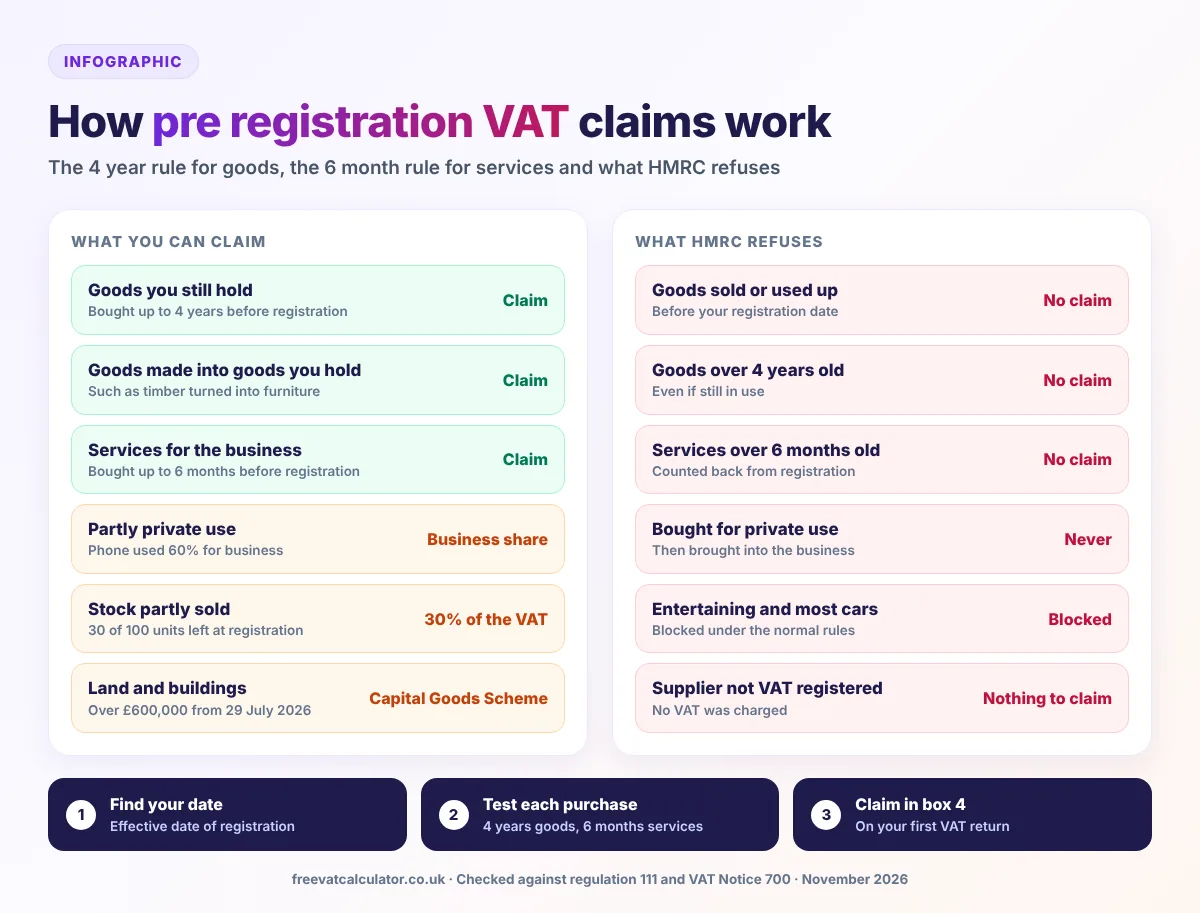
Claiming VAT on goods: the 4 year rule
Goods qualify if they were supplied to you no more than 4 years before registration, bought for the business and still on hand when registration began. Goods made into other goods you still hold also count, such as timber turned into furniture awaiting sale.
Equipment and assets you still use
A laptop, van or machine still in use qualifies in full, and Notice 700 needs no reduction for the time you used it beforehand. A laptop bought three years earlier for £1,000 plus £200 of VAT gives a £200 claim.
Stock sold or used up before registration
Nothing is claimable on stock sold, or on fuel, electricity and materials used up, before registration. If you paid £400 of VAT on 100 units and 30 were left on registration day, you claim 30%, which is £120.
Count your stock on the day registration begins. A dated count proves what you still held and feeds the stock account regulation 111 requires.
Capital items under the Capital Goods Scheme
Very large purchases go through the Capital Goods Scheme, where HMRC’s manual lets recovery reach back up to ten years for land and buildings. From 29 July 2026 the land and buildings threshold rose from £250,000 to £600,000 before VAT and computers left the scheme.
Claiming VAT on services: the 6 month rule
Services qualify if supplied to you no more than 6 months before registration, for the business and for taxable sales made after registering. There is nothing to hold, so dates and purpose decide it.
Services that usually qualify
Set up fees from accountants and solicitors, web design, branding, advertising and software plans are the usual examples. Commercial rent counts too where the landlord has opted to tax and charges VAT.
Services linked to goods you no longer have
A service relating to goods gone before registration cannot be claimed. HMRC’s example is a repair to a machine sold before registration, which fails even inside the 6 months.
Services used before and after registration
HMRC’s manual allows full recovery where the services are used wholly for taxable supplies. Where a business made exempt supplies before registering, HMRC expects a fair split instead, and its private schools guidance gives 67% for a 12 month subscription used for 8 months of taxable supplies.
Services from overseas suppliers
Today an unregistered business pays no UK VAT on most services bought from abroad, so nothing is reclaimable. From 1 April 2027 overseas suppliers must charge UK VAT to unregistered UK businesses, and that VAT is worth testing against the 6 month window.
Conditions every pre registration VAT claim must meet
Each purchase must also pass the tests for any input tax. HMRC can refuse a line that fails one of them.
- Supplied to the person or company now registered
- Bought for the business, not for private use
- Used for taxable sales, not exempt or non business activity
- Backed by a valid VAT invoice or evidence HMRC accepts
- Not blocked, as business entertaining and most cars are
Bought for private use first
VAT on something bought for private purposes can never be claimed under regulation 111. HMRC’s manual gives the example of a van bought for private use and used only in the business three years later, and its VAT stays lost.
Exempt, charity and non business use
Charities and businesses with exempt sales claim only the taxable share, using the first partial exemption period, and the de minimis limits do not apply. In Aspire in the Community Services Ltd v HMRC, decided on 13 February 2026, the First tier Tribunal found no legal basis for counting use before registration, but that decision binds no other tribunal.
Cars and business entertaining
Because the VAT is treated as input tax once you register, the usual blocks still apply. VAT on entertaining business contacts is normally blocked, and VAT on a car only comes back if the car is used solely for business.
How your registration date sets the windows
Both limits count back from your effective date of registration, not the day you applied or your certificate arrived. For a registration from 1 October 2026, goods bought from 1 October 2022 and services bought from 1 April 2026 can qualify. Registering before you trade, covered in our guide on how to register for VAT, makes later costs ordinary input tax.
- 4 yearsBack from registration for goods you still hold
- 6 monthsBack from registration for services
- 4 yearsThe most HMRC will backdate a voluntary registration
Backdating a voluntary registration
HMRC may backdate a voluntary registration by up to 4 years, moving both windows, so 1 July 2026 would open the services window on 1 January 2026. Each extra month also adds sales you owe VAT on, and the agreed date is normally final.
Registering late
If you registered late, Notice 700 counts back from the date you were required to register. VAT on sales since then is due too, as our VAT threshold guide explains, so the claim only softens the bill.
Invoices and records HMRC expects
Regulation 111 says a claim must be backed by invoices and any other evidence HMRC requires. Gather it before you file, because HMRC usually repays within 30 days but may check the return first.
Valid VAT invoices
Each purchase needs a VAT invoice showing the supplier’s VAT number, the date, a description and the VAT. A till receipt of £250 or less can be a simplified invoice, but a bank statement alone is not enough, as our guide to what a valid VAT invoice must include explains.
The stock account and services list
The stock account shows quantities bought, quantities used to make other goods and the date and manner of each disposal. The services list gives a description, the purchase date and any disposal date.
If an invoice is missing
Ask the supplier for a copy first. Failing that, Notice 700 lets HMRC accept other evidence if it is satisfied the taxable supply was made to you, case by case.
How to claim pre registration VAT on your first return
There is no separate form. The claim goes on the first return you must make, which runs from your registration date to the end of your first VAT period.
- Find your effective date of registration on your VAT certificate.
- List business purchases from the 4 years before it, marked goods or services.
- Strike out goods no longer held, services over 6 months old and anything private or blocked.
- Work out the business share of anything with private or exempt use.
- Add the VAT to box 4 with the rest of your input tax.
- File through Making Tax Digital software and keep the records for at least 6 years.
The claim adds to box 4, which raises the repayment or cuts the bill in box 5. Our guide on how to do a VAT return explains the other boxes.
Using accounting software
Some packages can pull purchases dated before registration into your first return. Check how far back yours looks and remove any service older than 6 months, since software cannot always tell goods from services.
If you missed something on the first return
Regulation 111 allows a later claim only if HMRC agrees, within 4 years of the first return’s due date. A missed item is an underclaim, and Notice 700/45 lets net errors up to £10,000, or 1% of box 6 capped at £50,000, go on a later return.
Special cases for companies, sole traders and schemes
A few situations follow their own rules. These come up most often for new registrations.
Costs paid before a company was incorporated
A company can claim only if the item was bought for its business by someone who became a member, officer or employee, was repaid in full or promised repayment, and was not a taxable person at the time. The 4 year and 6 month limits count from the company’s registration date.
Moving from sole trader to limited company
Notice 700 needs the supply made to the person now registered, and a company is a separate person, so a sole trader’s VAT usually stays with the sole trader. A registered sole trade can pass its number to the company on form VAT68, with unclaimed input tax and any VAT owed, as our sole trader vs limited company guide outlines.
Partly private use
Claim only the business share and note how you worked it out. A phone bought for £400 plus £80 of VAT and used 60% for business gives a claim of £48.
The Flat Rate Scheme first period
Joining the Flat Rate Scheme at registration does not stop the claim, because Notice 733 tells you to record eligible VAT for your first return. Selling a claimed capital asset later means VAT at the standard rate, and you take 1% off your flat rate until the day before your first registration anniversary.
Worked examples: what a first claim looks like
This is the checker’s starting case, a business registered from 1 October 2026. Of £1,050.00 of VAT paid, £368.00 goes in box 4 and £682.00 cannot be reclaimed.
| Purchase | Bought | VAT paid | Claimable | Why |
|---|---|---|---|---|
| Laptop, still used | 15 September 2023 | £200.00 | £200.00 | Goods within 4 years, still held |
| Stock, all sold | 10 March 2026 | £150.00 | £0.00 | Sold before registration |
| Accountancy fees | 1 June 2026 | £120.00 | £120.00 | Services within 6 months |
| Website build | 1 February 2026 | £500.00 | £0.00 | Services over 6 months before |
| Phone, 60% business | 5 May 2026 | £80.00 | £48.00 | Business share only |
Common mistakes that cost new registrants money
Most refused or missed claims come down to a few errors. Check your list against these before you file.
- Applying the goods limit to services
- Claiming stock sold before registration
- Claiming from suppliers that were not VAT registered
- Counting from the day the certificate arrived
- Putting a sole trader’s costs on a company return
- Leaving the pre registration VAT claim off the first return
Did the Autumn Budget 2026 change pre registration VAT?
No. The Budget on 28 October 2026 left these rules and the £90,000 threshold alone, though the overseas reverse charge change from 1 April 2027 and e invoicing between VAT registered businesses from 1 April 2029 will affect many new registrants. A new duty to correct errors in returns sent to HMRC also starts on 1 April 2028.
Not registered yet?
Our VAT threshold calculator tracks your rolling turnover against the £90,000 limit. Use it to plan a registration date that keeps more of your start up VAT in reach.
Pre registration VAT FAQs
These are the questions new registrants ask most. Each answer reflects HMRC guidance as at 6 November 2026.
Can I reclaim VAT on purchases before registration?
Yes, within limits. Goods from the last 4 years that you still hold and services from the last 6 months can go on your first return, with VAT invoices.
How far back can I claim VAT before registration?
Four years for goods and 6 months for services, counted back from your effective date of registration. A backdated registration moves both windows back.
Can I claim VAT on pre registration expenses I paid personally?
A sole trader can, because owner and business are the same person. A company can only if it has repaid, or promised to repay, the full cost to the future member, officer or employee who paid, and the other conditions above are met.
What other 4 year and 6 month rules are there in VAT?
Four years is the usual limit for claiming missed input tax and for backdating a voluntary registration. Six months is the wait before bad debt relief and the point at which you repay input tax on a supplier bill you have not paid.
What happens if I later sell the assets or deregister?
You charge VAT on a sale under the normal rules. On cancelling your registration, stock and assets you still hold trigger VAT if the total due is over £1,000, as our guide on how to deregister from VAT explains.
You came here not knowing if your start up VAT was lost, and now you know what you can claim and what HMRC needs. Run your purchases through the checker, gather the invoices and a stock account, and put the total in box 4 of your first return.
Sources: VAT Regulations 1995, regulation 111; VAT Regulations 1995, regulation 6; HMRC VAT Notice 700, sections 10, 11, 16 and 19; VAT Notice 700/1, sections 3.9 and 5.2; HMRC VAT Input Tax Manual, VIT32000; GOV.UK, reclaim VAT on business expenses; GOV.UK, keeping VAT records; VAT Notice 733, paragraphs 4.7 and 7.6; VAT Notice 700/12; VAT Notice 700/45; VAT Notice 700/9; VAT Notice 700/18; HMRC, VAT on goods and services related to private school fees; Aspire in the Community Services Ltd v HMRC [2026] UKFTT 263 (TC); Revenue and Customs Brief 7 (2026); HMRC, reverse charge on supplies received from abroad; GOV.UK, VAT repayments; GOV.UK, cancel your VAT registration; Budget 2026, overview of tax legislation and rates; Budget 2026, Annex A rates and allowances. This page is general information, not tax advice.