
Insurance tax guide
VAT on Insurance: Why Premiums Are Exempt and How Insurance Premium Tax Works
How to work out the tax on any policy
- Check the coverInsurance or a service?
- Find the IPT rate12%, 20% or none
- Take out the IPT× 12 ÷ 112, or ÷ 6 at 20%
- Reclaim nothingNo VAT on a premium
- Claim net of VATIf you can reclaim it
Your business insurance renewal shows a tax of 12%, the travel policy adds 20%, and your bookkeeping software wants to reclaim one sixth of both as VAT. Then a claim comes in, the insurer pays less than the garage bill and asks whether you are VAT registered, and you cannot tell who owes the VAT or whether you have been short changed.
This guide starts with a calculator that shows the tax inside any premium and how a repair bill and its excess are split on a claim. It then covers the Insurance Premium Tax rates, exempt cover, warranties, broker fees and the rules for insurers, all checked against HMRC guidance on 5 November 2026. By the end you will know how VAT on insurance works for your own policy and your next claim.
Insurance tax calculator: the IPT in a premium and the VAT on a claim
Enter the premium, say whether it already includes the tax, and choose the type of cover. You get the Insurance Premium Tax inside the price, the premium without it and the working, and you can add a repair claim to see who pays the VAT and the excess.
Insurance Premium Tax calculator
Find the IPT inside a premium, confirm the VAT position and check how a claim and its excess are split
No VAT to add and none to reclaim
Insurance is exempt from VAT, so this premium holds no VAT and nothing goes in box 4 of a VAT return. The £60.00 of IPT is not VAT and cannot be reclaimed either.
Rate used: 12% standard rate
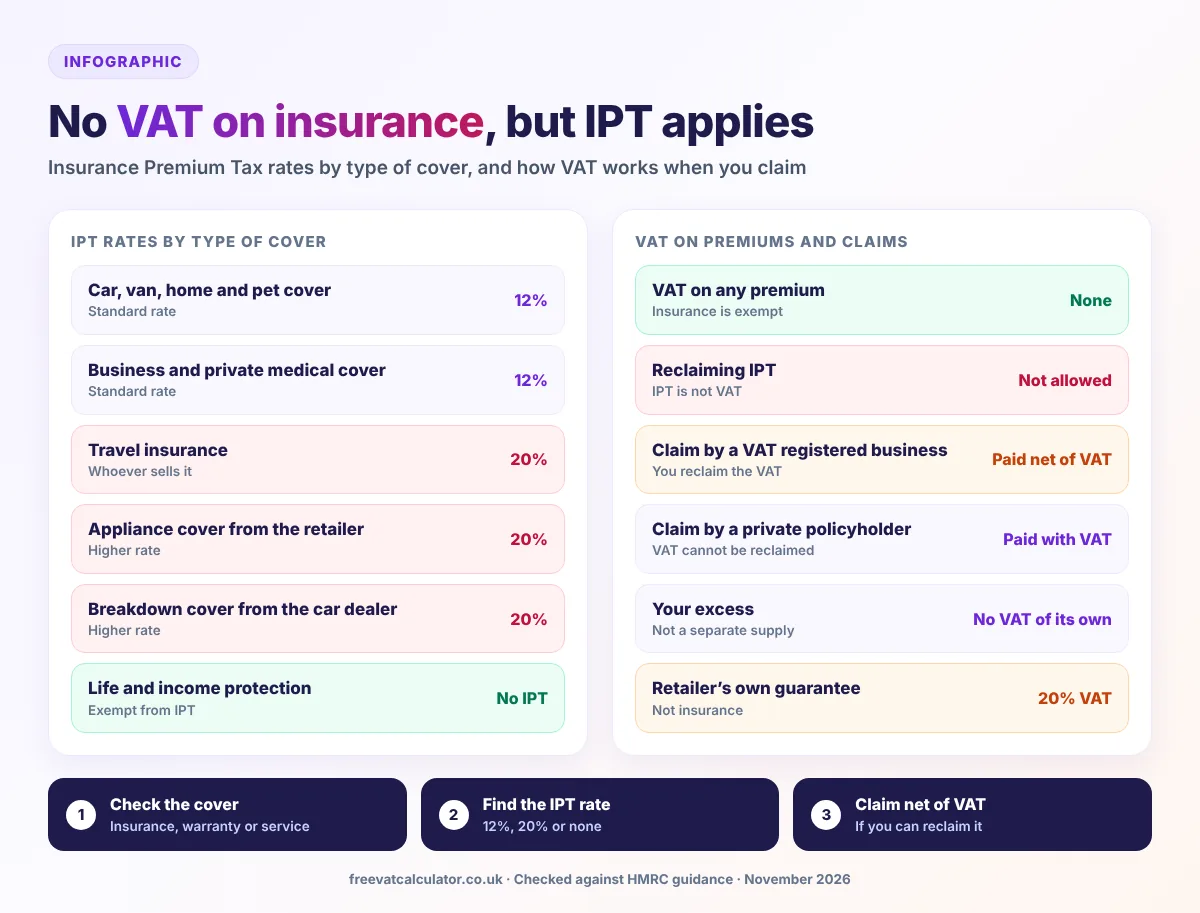
Most general insurance, including car, van, home, pet, business and private medical cover, carries the 12% standard rate.
The working
£560.00 × 12 ÷ 112 = £60.00 of IPT, so the premium without IPT is £560.00 minus £60.00 = £500.00.
Insurer pays £950.00, you pay £250.00
The repair bill of £1,200.00 includes £200.00 of VAT.
Most quotes already include IPT, so leave the premium on includes IPT unless your schedule adds it on top. The claim check assumes the repair bill carries VAT at 20% and that a VAT registered claimant can reclaim all of it; your policy wording decides the final settlement. Figures are rounded to the nearest penny, and nothing you enter is stored or sent.
Key facts
- VAT on any premium
- None, as insurance is exempt
- IPT standard rate
- 12% since 1 June 2017
- IPT higher rate
- 20% on travel, and on appliance or breakdown cover from a retailer or dealer
- No IPT
- Life, income protection and reinsurance
- Reclaiming
- Neither VAT nor IPT on a premium
- Claims
- Usually paid net of VAT to a VAT registered business
Is there VAT on insurance?
No. Insurance and reinsurance are exempt from VAT under item 1 of Group 2 in Schedule 9 to the VAT Act 1994, and brokers and agents acting as intermediaries are exempt under item 4. HMRC’s VAT Notice 701/36 adds that, because the supply is exempt, an insurer normally cannot reclaim the VAT on its own costs either.
| Type of cover | VAT | Insurance Premium Tax |
|---|---|---|
| Car, van, home and pet insurance | Exempt | 12% |
| Business cover and private medical insurance | Exempt | 12% |
| Mobile phone insurance | Exempt | 12% |
| Travel insurance | Exempt | 20% |
| Appliance cover sold by the retailer | Exempt | 20% |
| Breakdown cover sold by the car dealer | Exempt | 20% |
| Life and income protection insurance | Exempt | None |
| A manufacturer’s or retailer’s own guarantee | 20% VAT | None, as it is not insurance |
Exempt is not the same as zero rated
A zero rated supply carries VAT at 0%, so the seller can still reclaim VAT on its costs, while an exempt seller usually cannot. Our guide to current VAT rates shows which supplies fall into each group.
What counts as insurance for VAT
There is no statutory definition, so HMRC uses the Card Protection Plan and United Biscuits cases: the insurer takes a premium in advance and promises a payment or a service if a covered risk happens. Breakdown cover counts as insurance, and so does cover from an insurer the regulator has not authorised, while a funeral plan that is simply a prepayment for the funeral does not.
What is Insurance Premium Tax?
Insurance Premium Tax, or IPT, is a separate tax on general insurance premiums that began on 1 October 1994, so that insurance is still taxed even though it is exempt from VAT. The insurer pays it to HMRC, but the cost is built into your premium, and Notice 701/36 warns that IPT, unlike VAT, cannot be recovered.
How the IPT rate has changed since 1994
The standard rate began at 2.5% and has risen six times. A higher rate of 17.5% was added on 1 April 1997, mainly to stop VAT avoidance, for insurance sold through car and appliance suppliers and through travel agents and tour operators, and from 1 August 1998 it covered all travel insurance.
| From | Standard rate | Higher rate |
|---|---|---|
| 1 October 1994 | 2.5% | None |
| 1 April 1997 | 4% | 17.5% |
| 1 July 1999 | 5% | 17.5% |
| 4 January 2011 | 6% | 20% |
| 1 November 2015 | 9.5% | 20% |
| 1 October 2016 | 10% | 20% |
| 1 June 2017 to date | 12% | 20% |
Annex A of the Budget of 28 October 2026 keeps both rates for 2026 to 2027 and 2027 to 2028, and IPT is not among the changes our Autumn Budget 2026 VAT guide covers. HMRC’s IPT bulletin puts receipts for 2025 to 2026 at £9,037 million, up 1.7% on the year before.
IPT rates: the standard 12% and the higher 20%
Section 51 of the Finance Act 1994 sets the standard rate at 12% and the higher rate at 20%. The higher rate is a short list of exceptions, so most cover a household or business buys carries 12%.
- 12%Standard rate: car, home, pet and business cover
- 20%Higher rate: travel, and appliance or breakdown cover from a retailer or dealer
- NilExempt: life, income protection, reinsurance
What the 12% standard rate covers
The standard rate applies to car, van, home and pet insurance, private medical cover and business policies such as public liability. It also covers gap insurance that can only be used to clear car finance, cover given away free with a vehicle or appliance, and phone insurance, because Notice IPT1 leaves phones out of its appliance list.
What the 20% higher rate covers
- All travel insurance, whoever sells it, including cover given free
- Cover for boilers, cookers, washing machines, computers and other household appliances arranged by a business that sells such appliances, even if you bought yours elsewhere
- Mechanical breakdown, roadside and similar cover for a car, small van or motorbike arranged by a motor dealer, even if you did not buy the vehicle there
- Any motor insurance arranged by a car hire business
- Fees a taxable intermediary charges on one of these policies
Travel insurance here means cover for trips abroad, UK flights and linked journeys, or UK trips with a night away. A rail fare is zero rated, as our guide to VAT on train tickets explains, but travel cover for a UK rail trip carries 20% IPT when it includes a night away or links to a flight or a journey abroad.
Free, discounted and mixed policies
If a seller subsidises an appliance or vehicle policy, only the part the customer pays takes the higher rate, while free or discounted travel cover is always at 20%. A policy mixing travel with other risks is split between the rates, unless the travel part is no more than 10% of the premium and covers only one travel element.
Insurance that is exempt from IPT
Every insurance contract is taxable unless the law exempts it, and an exemption beats the higher rate. Notice IPT1 lists these exempt types.
- Life, permanent health, income protection and other long term cover, except medical insurance
- Reinsurance
- Commercial ships of 15 tons or more and commercial aircraft of 8,000kg or more
- Lifeboats, spacecraft and international railway rolling stock
- Goods in international transit and export finance
- Risks located outside the UK
- Leased vehicles adapted for wheelchair or stretcher users
Motability leases and other 2026 changes
From 1 July 2026, insurance for a new lease under a disability scheme such as Motability is taxed at 12% unless the vehicle is substantially and permanently adapted for a wheelchair or stretcher user, according to HMRC’s policy paper. Leases that started earlier stay exempt until they end. From 1 August 2026, buildings and contents cover for embassies in the UK also became taxable, as contracts are renewed.
How IPT is worked out on a premium
IPT is charged on the premium excluding the tax, and Notice IPT1 treats the price you pay as tax inclusive. To find the IPT inside a price at 12%, multiply by 12 and divide by 112, and at 20%, divide by 6.
| Policy | Price you pay | IPT inside | Premium without IPT |
|---|---|---|---|
| Car insurance at 12% | £560.00 | £60.00 | £500.00 |
| Business liability at 12% | £1,120.00 | £120.00 | £1,000.00 |
| Annual travel cover at 20% | £120.00 | £20.00 | £100.00 |
| Washing machine cover from the retailer at 20% | £72.00 | £12.00 | £60.00 |
| Life insurance, exempt | £300.00 | £0.00 | £300.00 |
Taking 12% of a price that already includes IPT is an easy slip to make. A £560 premium holds £60 of tax, not £67.20, because the tax is 12% of the £500 premium.
Is IPT included in your quote?
Almost always, as GOV.UK says IPT is usually included in the price. If your schedule shows a tax figure, it is IPT, not VAT, and it is part of the cost of the policy.
Fees, monthly payments and changes in the year
For IPT, the premium is every payment due under the insurance contract, including the insurer’s admin charges, broker commission and instalment interest under that contract. Interest under a separate credit agreement falls outside it, while an extra premium for a change during the year carries IPT like the rest.
Can a business reclaim VAT or IPT on insurance?
No VAT goes in box 4 for a premium, as our guide on how to do a VAT return explains. What you can and cannot reclaim comes down to four points.
- No VAT on insurance premiums, so nothing to reclaim
- No IPT reclaim, because IPT is not VAT
- VAT on a claim’s repair invoice, if you are VAT registered
- VAT on a standard rated fee shown on a VAT invoice
Do not reclaim one sixth of an insurance bill as input VAT. Software set to 20% on every purchase can do this unnoticed, and HMRC can assess the overclaim with interest and possibly a penalty.
Insurance in your accounts and tax return
The full premium, IPT included, is an ordinary business cost. GOV.UK lists insurance among the allowable expenses for the self employed, so for a car or van with private use you claim the business share.
Insurance recharged by a landlord
When a landlord insures a building in its own name and recharges the premium to a tenant who cannot claim under the policy, HMRC’s insurance manual treats the recharge as part of the rent. So it carries 20% VAT if the landlord has opted to tax the property and is exempt if not, even though the premium itself had no VAT.
VAT on insurance claims: repairs, payouts and net settlements
A claim is where VAT does matter, because a repair or replacement is an ordinary taxable supply. HMRC’s input tax manual says the repairer supplies you, the policyholder, even when the insurer pays directly, so the insurer cannot reclaim that VAT but you may be able to.
Why claims are settled net of VAT
If you are VAT registered and the claim is for your business, Notice 701/36 says the insurer normally pays the net amount less your excess. You pay the VAT and excess to the repairer and reclaim the VAT, so your real cost is the excess. The Financial Ombudsman backed this for a VAT registered van owner whose write off was settled without VAT.
Answering yes to “Are you VAT registered?” does not by itself prove you can reclaim the VAT, as HMRC’s manual notes. Tell the insurer if your recovery is restricted.
When the insurer should pay the VAT too
A private policyholder or an unregistered business cannot reclaim anything, so the insurer pays the VAT inclusive cost less the excess. A partly exempt business recovering 70% of its VAT should ask for the other 30%, and because VAT Notice 700/64 blocks the VAT on buying a car with private use, a write off of such a car should be settled including VAT.
VAT on insurance excess
The excess carries no VAT of its own. Paid to the repairer, it is simply part of the price of the repair, which bears VAT on the whole job, and paid to or deducted by the insurer, HMRC’s supply and consideration manual says it is not payment for anything.
Cash payouts and replacement goods
A cash settlement is compensation, so it is outside VAT. Replacement goods are normally supplied to you, and an insurer that takes damaged goods may owe VAT when it sells them.
VAT on car insurance, vans and breakdown cover
There is no VAT on car insurance, and ordinary motor cover carries IPT at 12% even when a dealer sells it with the car. Van, fleet and electric vehicle policies follow the same rules, with no IPT exemption for electric cars and nothing to reclaim.
Breakdown cover and gap insurance
Breakdown cover is insurance, so the insurance part of a separate breakdown subscription is exempt from VAT and carries 12% IPT, or 20% when a motor dealer arranges it. Gap insurance sold by a dealer stays at 12% only when any payout can be used solely to clear the car finance, because HMRC then treats it as credit protection.
Extended warranties and insurance sold with goods
The first question with a warranty is whether it is insurance at all. Notice 701/36, updated on 25 March 2026, says a guarantee from the manufacturer or retailer is very unlikely to be insurance and is standard rated, while a warranty written under an insurance contract is exempt.
Warranty or insurance: the practical test
A warranty from a third party provider, sold separately for its own price, is almost always insurance, so it is exempt from VAT and carries 20% IPT when a car dealer or appliance retailer arranges it, or 12% for other goods such as phones. A plan where the seller itself promises to repair the goods is very unlikely to be insurance, and one that mixes cover with regular servicing is also unlikely to be, so these usually carry 20% VAT and no IPT. HMRC’s guidance updated on 2 November 2026 keeps a used car dealer’s separately charged warranty out of the VAT margin scheme.
When a retailer or dealer charges a fee for the insurance
A seller of taxable goods that arranges insurance can treat its fee as exempt only if it gives the customer a document showing the premium and every other amount charged, at or before the time the insurance is taken out. Otherwise the fee is taxed at the same rate as the goods, although for phone or online sales the details can be given at the time and the document sent afterwards.
VAT on broker fees and admin charges
Most fees around a policy carry no VAT. A broker’s fee for finding cover, helping run the policy, handling a claim or collecting the premium is exempt when the broker acts as an intermediary, and an insurer’s admin charge under the contract is part of the premium, so it carries IPT instead.
Fees that are standard rated
- Market research, product design and advertising for an insurer
- Valuation or inspection services
- Loss adjusters and motor assessors without written authority to settle the claim
- A dealer’s fee where the premium and fee were not disclosed in writing
- Secretarial or computer services that are only incidental to insurance
On travel, appliance or dealer arranged vehicle cover, a fee a taxable intermediary charges when the policy is taken out can also carry 20% IPT. That intermediary must register for IPT, while a separate fee on a standard rate policy usually falls outside IPT altogether.
VAT and IPT rules for insurers and brokers
Insurers and brokers make exempt supplies, so they normally cannot reclaim the VAT on related costs and need a method from our partial exemption VAT guide if they also make taxable sales. The exception is cover for customers belonging outside the UK, or linked to the export of goods, where the Input Tax (Specified Supplies) Order 1999 allows recovery.
After Hastings Insurance Services Ltd [2025] UKFTT 275 (TC), Revenue and Customs Brief 6 (2025) lets brokers serving overseas insurers recover VAT incurred before 1 January 2024, even for UK customers. The four year time limit applies.
Registering for IPT and filing returns
An insurer that receives taxable premiums must register for IPT within 30 days of forming the intention to receive them, mostly online, while Lloyd’s syndicates, partnerships, groups and anyone using an agent send the postal form IPT1. Returns cover three month periods, usually ending in March, June, September and December, and the tax is due one month after each period ends.
Overseas insurers and who pays in practice
An insurer with no UK establishment must still register, and an agent it appoints is not liable for the tax. Where its territory has no IPT arrangements with the UK, section 65 of the Finance Act 1994 lets HMRC make the UK policyholder jointly liable.
Need the VAT on a repair invoice?
Our main VAT calculator takes the VAT out of any bill at 20%, 5% or 0%.
VAT on insurance FAQs
These answers cover common questions about VAT and insurance. Each answer reflects HMRC guidance and the rates in force on 5 November 2026.
Is insurance VAT exempt?
Yes. Insurance and the intermediary services of brokers and agents are exempt from VAT, so no VAT is added to a premium and none can be reclaimed on it.
What is the IPT rate on car insurance?
Ordinary car insurance carries the 12% standard rate, even from a dealer. Breakdown or warranty cover the dealer arranges, and hire car insurance, carry 20%.
Can I claim back Insurance Premium Tax?
No. IPT is not VAT, so it cannot go on a VAT return, but it is part of the premium, which is an allowable business expense.
Is there VAT on home or pet insurance?
No, but both carry IPT at 12%. Contents cover stays at 12% even though it protects your appliances.
Why did my insurer pay my claim without the VAT?
Because you told it you are VAT registered, so it expects you to reclaim the VAT on the repair invoice yourself. If you cannot reclaim all of it, tell the insurer and ask it to pay the part you cannot recover.
You now have the full picture of VAT on insurance: premiums never carry VAT, most cover takes 12% IPT, or 20% for travel and for appliance or breakdown cover arranged by a retailer or dealer, and registered businesses are usually paid net of VAT on a claim. Use the calculator whenever a renewal or repair bill arrives, and keep each claim’s VAT invoice for your return.
Sources: HMRC VAT Notice 701/36; Notice IPT1; VAT Act 1994, Schedule 9; Finance Act 1994, section 51; section 65; historical IPT rates; IPT bulletin, July 2026; GOV.UK, IPT; IPT registration; IPT07220; Motability policy paper; VIT13500; VATSC06540; VATINS2620; VATINS3720; margin scheme and linked insurance; VAT Notice 700/64; Revenue and Customs Brief 6 (2025); Financial Ombudsman case study; Budget 2026, Annex A. This page is general information, not tax advice.