
VAT penalties guide
VAT Penalties Explained: Late Filing Points, Late Payment Charges and Interest
What one missed VAT deadline can cost
- Deadline missed1 month and 7 days after the period
- Point added£200 once you reach the threshold
- Day 153% of the VAT still unpaid
- Day 30A further 3%
- Day 31 on10% a year daily, plus interest
A letter from HMRC mentions a penalty point you did not expect, or a VAT bill is due on the 7th and the money will not be there in time. Either way you want to know what it will cost and how long it will sit on your record. The rules changed completely in 2023, the payment rates rose again in 2025, and plenty of guides still quote the old figures.
This guide starts with a tracker that counts your points and shows when they clear, then explains every charge in plain terms with worked examples. You will see how late filing points build up, how the 3% and 10% late payment penalties are worked out, what interest adds, and how to appeal or avoid VAT penalties altogether.
VAT penalty points tracker
Choose how often you file and enter the deadline of each return you sent late, including any return not sent yet. The tracker counts your active points, shows whether a £200 penalty applies, and gives the date your points expire or can reset under HMRC’s rules.
VAT penalty points tracker
Counts your late filing points, any £200 penalties and the date your points clear
Working it out
Enter the deadline of each VAT return you sent late.
Uses HMRC’s rules for VAT periods starting on or after 1 January 2023.
Key facts
- Late filing threshold
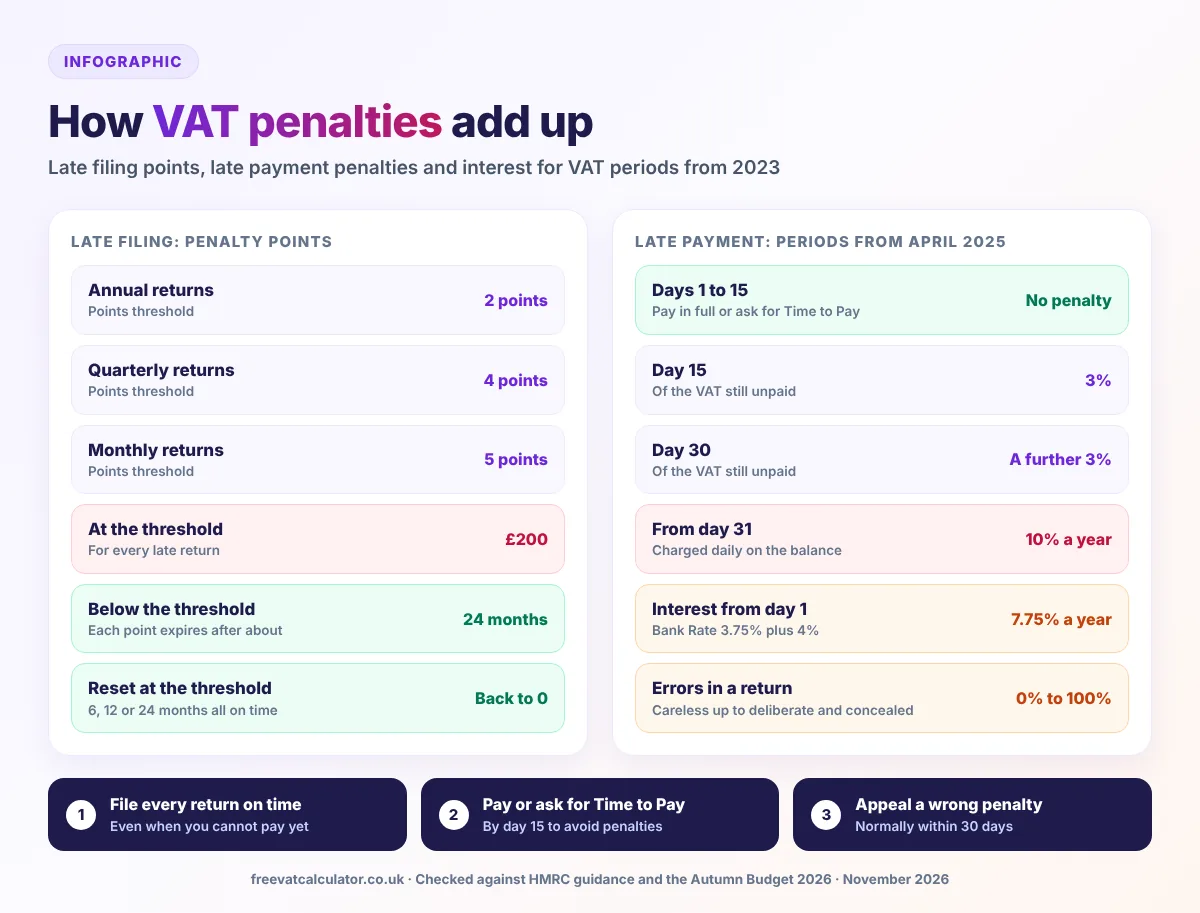
- 2 points annual, 4 quarterly, 5 monthly
- At the threshold
- £200 for every late return
- Late payment
- 3% at day 15 and a further 3% at day 30
- From day 31
- A daily penalty at 10% a year
- Interest
- 7.75% a year from the first day late
- Points expire
- About 24 months after the missed deadline
How VAT penalties work since 2023
For VAT periods starting on or after 1 January 2023, HMRC replaced the old default surcharge with separate penalties for filing late and paying late. Filing late earns penalty points, paying late earns a percentage charge, and interest runs on any unpaid VAT from the first day. One missed deadline can therefore bring all three at once.
| Penalty | What triggers it | How much |
|---|---|---|
| Late submission penalty | A late return once your points reach the threshold | £200 for each late return |
| First late payment penalty | VAT still unpaid at day 15 and at day 30 | 3% at each point |
| Second late payment penalty | VAT still unpaid from day 31 | 10% a year, charged daily |
| Late payment interest | Any VAT or penalty paid after its due date | 7.75% a year from day 1 |
| Inaccuracy penalty | A careless or deliberate error in a return | 0% to 100% of the extra tax |
| Failure to notify penalty | Registering for VAT late | 0% to 100% of the VAT due |
What replaced the VAT default surcharge
The default surcharge charged a percentage of the VAT for paying late, and the rate climbed with each further default. It still covers VAT periods that started on or before 31 December 2022, while later periods fall under the points and late payment penalties in Finance Act 2021.
The first year easement has ended
To help businesses get used to the new rules, HMRC did not charge the first late payment penalty on VAT due on or before 31 December 2023 if it was paid in full, or a payment plan was agreed, within 30 days. That easement has ended, and HMRC removed it from its guidance in July 2025, so the first penalty now applies from day 16.
VAT late filing penalty: how penalty points work
Each VAT return you send after its deadline adds one penalty point, and nothing is charged until your points reach a threshold set by how often you file. At the threshold HMRC charges a fixed £200 penalty, and your points stop rising, but every further late return costs another £200, as HMRC’s penalty points guidance explains.
Penalty point thresholds by filing frequency
| How often you file | Points threshold | Period of compliance | On time returns needed |
|---|---|---|---|
| Annually | 2 points | 24 months | 2 |
| Quarterly | 4 points | 12 months | 4 |
| Monthly | 5 points | 6 months | 6 |
If HMRC has agreed a non standard return period with you, the threshold follows its length. A period longer than 20 weeks uses the annual threshold of 2, a period over 8 weeks and up to 20 weeks uses the quarterly threshold of 4, and a period of 8 weeks or less uses the monthly threshold of 5.
When is a VAT return late?
Most VAT returns are due one calendar month and seven days after the end of the VAT period, so a quarter ending 31 December 2026 must be filed by 7 February 2027. A return sent on 8 February 2027 is late and earns a point, even if it shows nothing to pay. Our guide to VAT return deadlines lists the dates for every quarter.
Nil returns, repayment returns and returns that never get points
Nil returns and repayment returns count in exactly the same way as returns with VAT to pay, so a late nil return still earns a point. A few returns sit outside the points system altogether.
- your first VAT return after you register
- your final VAT return after you cancel your registration
- a one off return for a period that is not a month, a quarter or a year
Worked example: a quarterly filer reaches the threshold
This is how a late VAT return penalty builds up for a business that files quarterly, with a threshold of 4 points. Each row is one return deadline.
| Return deadline | Filed | Points after it | Penalty |
|---|---|---|---|
| 7 February 2026 | Late | 1 | None |
| 7 May 2026 | On time | 1 | None |
| 7 August 2026 | Late | 2 | None |
| 7 November 2026 | Late | 3 | None |
| 7 February 2027 | Late | 4 | £200 |
| 7 May 2027 | Late | 4 | £200 |
By May 2027 the business has paid £400 in late filing penalties, and every later return that misses its deadline adds £200 more. Its points only reset after 12 months of on time returns, which here runs from 1 June 2027 to 31 May 2028, and only if every return due in the previous 24 months is in.
When do VAT penalty points expire?
Below the threshold, each point expires on its own after roughly two years. At the threshold, your points freeze until you complete a full period of compliance.
Points below the threshold
A point expires on the last day of the month 24 months after the deadline you missed. If that deadline was the last day of a month, the point lasts one month longer and expires at the end of the 25th month. A return due on 7 August 2026 therefore loses its point on 31 August 2028, while an annual return due on 31 January 2027 keeps its point until 28 February 2029.
Resetting points at the threshold
Once you reach the threshold, your points reset to zero only when two conditions are both met. Condition A is a period of compliance in which every return is filed on time, and condition B is that HMRC has every return due in the previous 24 months, as set out in HMRC’s guide to removing penalty points.
The period of compliance starts on the first day of the month after the day following your last missed deadline. Miss a deadline of 7 July and the earliest start is 1 August, but miss one on 31 March and it is 1 May. A late return during the period means the count starts again after that deadline.
Meeting both conditions clears every point even if you never reached the threshold. For a quarterly filer, 12 months of on time returns can wipe a point a full year before it would expire on its own.
Changing how often you file
If you move between monthly, quarterly and annual returns, your threshold changes and HMRC adjusts the points you already hold. You cannot appeal the adjustment, and if you hold no points nothing changes.
| You move from | To | Points change |
|---|---|---|
| Annual | Quarterly | Add 2 |
| Annual | Monthly | Add 3 |
| Quarterly | Annual | Take away 2 |
| Quarterly | Monthly | Add 1 |
| Monthly | Annual | Take away 3 |
| Monthly | Quarterly | Take away 1 |
If an adjustment would take you below zero, your points simply become zero. Points also do not pass to a buyer, so a business bought as a going concern does not inherit the seller’s points, even if the buyer takes over the seller’s VAT registration number.
Late payment penalties for VAT
Paying late is penalised separately from filing late, so you can file on time and still be charged. Under HMRC’s late payment rules, the first penalty depends on what is unpaid at day 15 and at day 30, and a second daily penalty starts from day 31.
- 3%Of the VAT still unpaid at day 15
- +3%Of the VAT still unpaid at day 30
- 10%A year, charged daily from day 31
Current rates for VAT periods from 1 April 2025
| How late you pay | First penalty | Second penalty |
|---|---|---|
| Days 1 to 15 | None if you pay in full or ask for Time to Pay | None |
| Days 16 to 30 | 3% of the VAT unpaid at day 15 | None |
| Day 31 onwards | 3% of the VAT unpaid at day 15 plus 3% of the VAT unpaid at day 30 | 10% a year, charged daily on the VAT still unpaid |
The second penalty keeps running until you pay in full. If the VAT is still unpaid shortly before HMRC’s two year time limit for assessing it, HMRC assesses the penalty at that point instead.
What changed on 1 April 2025
The Finance Act 2021 (Increase in Schedule 26 Penalty Percentages) Regulations 2025 raised the rates for VAT periods starting on or after 1 April 2025. Some guides still quote the earlier rates, so check which figures a source uses before you rely on it.
| Charge | Periods before 1 April 2025 | Periods from 1 April 2025 |
|---|---|---|
| First penalty at day 15 | 2% | 3% |
| Further first penalty at day 30 | 2% | 3% |
| Second penalty from day 31 | 4% a year | 10% a year |
Worked example: £10,000 paid 40 days late
Take a quarter ending 30 September 2026 with £10,000 of VAT due by 7 November 2026, paid on day 40. The figures assume the interest rate stays at 7.75% throughout.
| Charge | Working | Amount |
|---|---|---|
| First penalty at day 15 | 3% of £10,000 | £300.00 |
| Further first penalty at day 30 | 3% of £10,000 | £300.00 |
| Second penalty, days 31 to 40 | £10,000 × 10% × 10 ÷ 365 | £27.40 |
| Late payment interest, 40 days | £10,000 × 7.75% × 40 ÷ 365 | £84.93 |
| Total cost | All four charges | £712.33 |
The penalties arrive in steps, while interest grows a little every day from day one. Our VAT late payment calculator runs the same sums for any amount and any number of days.
Payments outside the late payment penalty rules
Payments on account and instalments under the Annual Accounting Scheme do not attract late payment penalties. The balancing payment due with a return is a normal return payment, so pay that in full by the deadline.
Does paying within 15 days avoid every charge?
No, because late payment interest is charged from the first day the VAT is overdue. Paying on day 10 avoids the penalty, but you still owe 10 days of interest. On a £10,000 bill at 7.75%, that comes to about £21.23.
VAT late payment interest at 7.75%
HMRC charges late payment interest at the Bank of England base rate plus 4%, from the first day the VAT is overdue until the day it is paid in full. Set when Bank Rate was 3.75%, the rate on HMRC’s interest rates page has been 7.75% since 9 January 2026. Bank Rate rose to 4% on 5 November 2026, so the rate becomes 8% on 24 November 2026. Interest is also charged on penalties you pay late, including the £200 late filing penalty.
Why the rate is higher than it used to be
The margin above base rate rose from 2.5% to 4% on 6 April 2025, which is why older guides show lower figures. The Bank of England’s Bank Rate decision of 5 November 2026 could change this, because HMRC’s rate follows any change in Bank Rate about three weeks later, so check HMRC’s interest rates page for the latest figure.
Interest when HMRC pays you late
If HMRC owes you a VAT repayment, it adds repayment interest from the day after the later of the return deadline and the date you sent the return until it pays you, at base rate minus 1% with a lower limit of 0.5%. That gives a rate of 2.75% today.
Cannot pay your VAT bill? How Time to Pay limits penalties
If you cannot pay in full, file the return on time anyway and contact HMRC about a Time to Pay arrangement as early as you can. An agreed plan stops late payment penalties building from the date you ask, provided you keep to it, but interest carries on until the debt is cleared.
| When you ask | What it saves |
|---|---|
| Days 1 to 15 | Avoids the late payment penalties completely |
| Days 16 to 30 | Avoids the second 3% and the daily penalty from day 31 |
| Day 31 or later | Stops the daily penalty growing from the date you ask |
Keep every instalment on time once a plan is agreed, because the protection depends on it. If you break the arrangement, HMRC can cancel it and charge both penalties as if the plan had never existed.
Setting up a VAT payment plan
HMRC checks that the instalments are affordable, and if it cannot agree a plan it will ask for the full amount. Our guide on how to pay VAT to HMRC covers payment plans and payment methods.
Penalties for errors on a VAT return
A careless or deliberate mistake on a VAT return can bring an inaccuracy penalty, worked out as a percentage of the extra tax, which HMRC calls potential lost revenue. If you took reasonable care, such as keeping accurate records and asking HMRC or an adviser when unsure, there is no penalty at all.
| Behaviour | You tell HMRC first | HMRC finds it first |
|---|---|---|
| Reasonable care taken | No penalty | No penalty |
| Careless | 0% to 30% | 15% to 30% |
| Deliberate | 20% to 70% | 35% to 70% |
| Deliberate and concealed | 30% to 100% | 50% to 100% |
How telling HMRC reduces the penalty
Within each range in HMRC factsheet CC/FS7a, the penalty falls as your disclosure improves: up to 30% of the reduction is for telling HMRC, up to 40% for helping it work out the figures and up to 30% for giving access to your records. If you take a long time to tell HMRC, such as 3 years or more, it usually restricts the reduction so the penalty cannot fall below 10 percentage points above the minimum of the range.
Suspended penalties for careless errors
HMRC can suspend a penalty for a careless error for up to 2 years, with conditions designed to stop the mistake happening again. If you meet the conditions the penalty is cancelled, but a penalty for a deliberate error can never be suspended.
Correcting errors before HMRC finds them
Telling HMRC about an error before it has any reason to look counts as an unprompted disclosure, which keeps any penalty at the low end of the range. Our guide on how to correct VAT errors explains when you can fix a mistake on your next return and when you must report it separately. From 1 April 2028 the Autumn Budget adds a legal duty to correct errors in returns once you find them, with HMRC able to issue customer correction notices.
Late VAT registration: failure to notify penalties
You must register within 30 days of the end of the month in which your taxable turnover for the last 12 months goes over the £90,000 registration threshold. If you register late, HMRC backdates your registration, you owe the VAT you should have charged from the correct date, and a failure to notify penalty can be added on top.
| Behaviour | You tell HMRC first | HMRC finds it first |
|---|---|---|
| Not deliberate, told within 12 months | 0% to 30% | 10% to 30% |
| Not deliberate, told after 12 months | 10% to 30% | 20% to 30% |
| Deliberate | 20% to 70% | 35% to 70% |
| Deliberate and concealed | 30% to 100% | 50% to 100% |
The percentages, set out in HMRC factsheet CC/FS11, apply to the VAT you should have paid, so the cost grows with every month you trade unregistered. Our VAT threshold calculator shows how close you are, and our guide on how to register for VAT walks through the application.
How to appeal a VAT penalty
Every penalty point and every penalty comes with a decision letter, and that letter offers a review by HMRC. You can accept the review or appeal straight to the independent tax tribunal, and you usually have 30 days from the date the penalty was issued to do either.
How to ask for a review
- Check the point or penalty in your VAT online account and note the date on the decision letter.
- Gather evidence for your reason, such as a hospital letter.
- Ask for the review through your VAT online account, or write to Solicitor’s Office and Legal Services, HMRC, BX9 1ZT if you cannot use it.
- If the review keeps the penalty, appeal to the tax tribunal, usually within 30 days of the date on the decision letter.
Reasonable excuses HMRC may accept
A reasonable excuse is something that stopped you meeting the deadline, and once it ends you must send the return or payment as soon as you can. HMRC’s own examples include these.
- the death of a partner or close relative shortly before the deadline
- an unexpected stay in hospital or a serious or life threatening illness
- a computer or software failure while you were preparing the return
- problems with HMRC’s online services
- a fire, flood or theft that stopped you completing the return
- postal delays you could not have predicted
- someone you relied on to send the return failing to do so
Excuses HMRC does not accept
Some reasons do not work, however genuine they feel. HMRC names these in its guidance.
- a payment that failed because there was not enough money in the account
- finding HMRC’s online system too difficult to use
- not getting a reminder from HMRC
- a mistake on your return
Interest is not a penalty, so you cannot appeal it on reasonable excuse grounds. The point adjustments made when you change filing frequency cannot be appealed either.
What the Autumn Budget 2026 changed for VAT penalties
The Budget on 28 October 2026 left the penalty rates, the points thresholds and the 7.75% interest rate unchanged. It did announce several changes that will shape VAT penalties over the next few years.
- a legal duty to correct errors in returns from 1 April 2028, backed by customer correction notices
- a Direct Debit mandate for VAT from 1 April 2029, though you can still pay another way before a cut off date that HMRC has yet to set
- no late submission points in 2027 to 2028 for people who join Making Tax Digital for Income Tax in April 2027
- direct recovery of smaller tax debts from people who repeatedly ignore HMRC, from 2029
The easement covers Income Tax updates only, so VAT returns keep the full points system. Our guide to Making Tax Digital for Income Tax explains who joins in April 2027.
How to avoid VAT penalties
Almost every VAT penalty comes from a missed date rather than a hard calculation, and HMRC can look more closely at any return you send, as our guide to the HMRC VAT compliance check explains. These habits keep most businesses clear.
- file every return a few days early, even when you cannot pay yet
- pay by Direct Debit so the money leaves on time without you remembering
- send a nil return when there is nothing to declare
- ask for Time to Pay before day 15 if money is short
- keep your Making Tax Digital software connected and authorised
- check your VAT penalties and points in your VAT online account each quarter
Work out what paying late will cost
Our VAT late payment calculator adds up the 3% penalties, the daily penalty and the 7.75% interest for any bill.
VAT penalties FAQs
These are the questions business owners ask most about HMRC VAT penalties. Each answer uses the rules in force in November 2026.
How many penalty points before a VAT fine?
It depends on how often you file: 2 points for annual returns, 4 for quarterly and 5 for monthly. HMRC charges £200 when you reach the threshold and £200 for each later late return.
How much is the penalty for a late VAT return?
The first few late returns cost a point each and no money. Once you reach your threshold, each late return costs £200, however much or little VAT it shows.
Do late nil VAT returns get penalty points?
Yes. A nil return or a repayment return sent late earns a point in the same way as a return with VAT to pay.
Does a payment plan stop VAT penalties?
Asking for Time to Pay by day 15 avoids late payment penalties completely, as long as HMRC agrees the plan and you keep to it. Interest still runs until the debt is paid.
Can I get a VAT penalty cancelled?
Yes, if you had a reasonable excuse or HMRC made a mistake, such as giving a point for a return that was on time. Ask for a review through your VAT online account, usually within 30 days of the penalty being issued.
You now know how each charge is worked out, when your points expire and what to do if a return or payment will be late. Everything you need to check your record, limit the cost and challenge a wrong penalty is above, and the tracker shows where you stand today.
Sources: HMRC, Penalty points and penalties if you submit your VAT Return late; HMRC, Remove penalty points after a late VAT Return; HMRC, How late payment penalties work if you pay VAT late; HMRC, Late payment interest on VAT and penalties; HMRC interest rates for late and early payments; HMRC policy paper on the April 2025 late payment penalty increase; HMRC factsheet CC/FS7a; HMRC factsheet CC/FS11; HMRC, Time to Pay arrangements; The Finance Act 2021 (Increase in Schedule 26 Penalty Percentages) Regulations 2025; HMRC press release, 22 February 2023; GOV.UK, Appeal a penalty; GOV.UK, Reasonable excuses; GOV.UK, Appeal to the tax tribunal; Budget 2026, Overview of Tax Legislation and Rates; Bank of England, Bank Rate. This page is general information, not tax advice.