
VAT on cars and vans guide
VAT on Cars: When You Can Reclaim It on Buying, Leasing and Selling a Car or Van
How to work out the VAT you can reclaim on a vehicle
- Is it a car?Or a van, pick up or motorcycle
- Who can drive it?Any private use at all
- Any exception?Taxi, tuition, hire or pool
- Apply the rule0%, 50% or 100%
- Keep the proofInvoice, policy and log
The dealer quotes £36,000 for the car, £6,000 of it is VAT, and the salesperson says a business like yours can claim it back. Your accountant says the opposite, the van parked next to it seems to follow different rules, and the lease quote only gives you half. It is hard to know which answer is right before you sign.
This guide starts with a checker that shows how much of the VAT on a car, van or motorcycle you can reclaim, and why. It then explains what HMRC counts as a car, the exceptions, the 50% lease rule and the VAT on used cars and sales. Every rule has been checked against HMRC’s Notice 700/64, its VAT manuals and the law, so you can settle the question of VAT on cars for your own business in a few minutes.
Car VAT reclaim checker: how much can your business claim back?
Choose the vehicle, how you are getting it, whether anyone could use it privately and any exception that applies. Then enter the VAT on the invoice to see what you can reclaim, what stays a cost, the rule HMRC applies to VAT on cars, vans and motorcycles, and the working.
Car VAT reclaim checker
See how much of the VAT on a car, van or motorcycle your business can claim back
Blocked: a car available for private use
No VAT on buying a car comes back when anyone can drive it privately, even if nobody ever does.
The working
£6,000.00 of VAT × 0% = £0.00 you can reclaim.
Enter the VAT shown on the invoice, not the price. For a lease, enter the rental VAT for the period you are claiming. Exceptions depend on what you intend when you get the vehicle, and a partly exempt business may recover less. Figures are rounded to the nearest penny, and nothing you enter is stored or sent.
Key facts
- Buying a car with private use
- No VAT comes back
- Leasing a car with private use
- 50% of the rental VAT
- Taxis, driving schools, self drive hire
- All the VAT comes back
- Vans and one tonne pick ups
- All the VAT, less any real private use
- Repairs and servicing
- Reclaimable when the business pays
- Selling a car with blocked VAT
- Exempt, so no VAT is charged
Is there VAT on cars? How much of the price is tax
Yes. A new car carries VAT at the standard rate of 20%, and the price shown to a private buyer already includes it. That makes the VAT one sixth of the price you see, not a fifth, so a car advertised at £30,000 contains £5,000 of VAT.
| Price including VAT | VAT inside the price (÷ 6) | Price without VAT (÷ 1.2) |
|---|---|---|
| £18,000 | £3,000 | £15,000 |
| £24,000 | £4,000 | £20,000 |
| £30,000 | £5,000 | £25,000 |
| £36,000 | £6,000 | £30,000 |
| £45,000 | £7,500 | £37,500 |
| £60,000 | £10,000 | £50,000 |
For a private buyer, that VAT is simply part of the cost and can never be claimed back. Only a VAT registered business can reclaim VAT, and on a car only in the narrow cases below.
New and pre registered cars
A pre registered car, one the dealer has registered before selling it, is still new for VAT. HMRC’s used vehicle guidance says registration and delivery mileage do not make a vehicle used, so the dealer cannot sell it under the margin scheme and charges VAT on the full price.
What counts as a car for VAT?
The definition comes from the VAT (Cars) Order 1992 and the VAT (Input Tax) Order 1992, as HMRC’s manual page VIT50300 explains. A car is a motor vehicle normally used on public roads, with three or more wheels, that is built or adapted mainly to carry passengers, or that has roofed space behind the driver with side windows or fittings for them.
Notice 700/64 and HMRC’s manual at VIT51200 list the vehicles that are never cars. Each of these follows the van rules further down.
- vehicles with a payload of one tonne or more
- vehicles of 3 tonnes or more unladen weight
- vehicles built for one person, or for 12 or more people including the driver
- caravans, ambulances and prison vans
- special purpose vehicles such as hearses, mobile shops and recovery trucks
- motor caravans with a sink, a cooker, table seating, a bed and a water tank
Car derived vans and combi vans
A car derived van looks like a car but has its rear seat and seat belt mountings removed or disabled, a fixed cover over the rear footwells and opaque rear side windows, so it is a van under VIT50600. A combi van goes the other way: once it has rear seats, seat mountings or side windows behind the driver, HMRC’s combi van guidance treats it as a car unless its payload is still one tonne or more. HMRC publishes a list of models notified by manufacturers, but it was last updated in May 2015, so get the dealer to confirm a newer model in writing.
Double cab pick ups
A double cab pick up with a payload of one tonne or more has been a commercial vehicle for VAT since 1 December 1999, and one under a tonne is a car. Payload is the gap between the maximum gross weight and the kerb weight, so HMRC warns that accessories can push a pick up with an ex works payload of 1,000kg to 1,050kg under the line, turning it into a car and triggering a self supply.
Since 6 April 2025 most double cab pick ups count as company cars for benefit in kind, though ones bought, leased or ordered before then keep van treatment until disposal, lease end or 5 April 2029. HMRC’s employment income manual at EIM23151 states that the VAT input tax position remains unchanged, so a one tonne pick up is still a van for VAT even when its driver pays company car tax.
Motorcycles and motor caravans
A motorcycle has two wheels, so it falls outside the car definition and the car block never applies to it. HMRC’s VAT manual at VIT51500 lists motor caravans, motorcycles and double cab pick ups as commercial vehicles suitable for private use, so the VAT is reclaimable with an adjustment for private use, as for a van.
Can I claim VAT on a car bought for the business?
Usually not. Article 7 of the VAT (Input Tax) Order 1992 blocks the VAT on buying a car unless an exception applies, and Notice 700/64 explains that the test is whether the car is available for private use, not whether anyone actually drives it privately.
The courts apply this strictly. In Upton (trading as Fagomatic), a sole trader insured a car for private use and lost the claim even though it was never driven privately, because the insurance showed it was available to the owner. The rules to reclaim VAT on car purchase invoices are the same for a sole trader, a partnership and a limited company.
What available for private use means
Notice 700/64 says a car is available for private use when nothing prevents you or an employee from using it privately. HMRC treats every journey between home and the office as private, and its manual says a car kept at the home of the person who runs the business is likely to be available privately, however many other cars that person has.
The exceptions: when you can reclaim all the VAT
Full recovery is allowed only for the cars in this table, taken from article 7 and the notice. Each exception depends on what you intend when you buy the car, so record that intention at the time.
| Exception | What the law requires | Example |
|---|---|---|
| Taxi or private hire | Bought mainly to hire out with a driver to carry passengers | A licensed private hire car |
| Driving school | Bought mainly to give driving lessons in | A dual control tuition car |
| Self drive hire | Hired out mainly to customers who drive it, normally for under 30 days in a row and under 90 days in any 12 months | A car in a rental fleet |
| Motor dealer stock | Held for sale within 12 months of being acquired | A new car on a forecourt |
| Business only use | Used only for business journeys and not available to anyone for private use | A genuine pool car |
Pool cars
A pool car qualifies only if it is normally kept at your principal place of business, is not allocated to one person and is not kept at an employee’s home. If a pool car later goes home with someone or is given to one driver, that change of use is a self supply, with output tax on the car’s value at the time.
Taxis, private hire and driving schools
Taxi drivers, private hire drivers and driving instructors can reclaim all the VAT on a car bought mainly for that work, even if it is also used privately at weekends. Where a car carries a full reclaim and is then used privately, Notice 700/64 says you may have to account for output tax on that private use, so keep a log of private miles.
The Budget on 28 October 2026 also confirmed that, from 2 January 2028, private hire fares booked through an operator or app will be the operator’s supply above a turnover threshold, with £50 million the lead option. That changes who charges VAT on fares, not the rules for reclaiming VAT on the car.
Evidence HMRC looks for
If you claim the VAT on a business only car, expect HMRC to ask how private use was prevented. Its manual lists the points an officer will weigh.
- who can use the car, and when
- written rules that ban private journeys, such as a board resolution
- where the car is kept overnight
- whether the insurance covers private use
- a journey log for every trip
- what other cars the drivers have for private journeys
Paperwork can work. In Elm Milk Ltd (2006), the court accepted that suitable contractual restraints can make a car unavailable for private use, but HMRC will check that the restriction is actually followed.
Hire purchase and PCP deals
Hire purchase is treated as buying the car, so the purchase rules and the block apply. Since 1 June 2019, Revenue and Customs Brief 1 (2019) treats a PCP as a lease when the final optional payment is set at or above the car’s expected market value, and as a purchase with separate exempt credit when it is set below it. A lease style PCP can get the 50% rule below, while a purchase style PCP is fully blocked if anyone can drive the car privately.
VAT on car lease deals: the 50% rule
If you lease or hire a car that is available for private use, you can normally reclaim 50% of the VAT on the rental. Article 7(2H) of the Input Tax Order blocks the other half as a fixed stand in for private use, however much or little private driving there is.
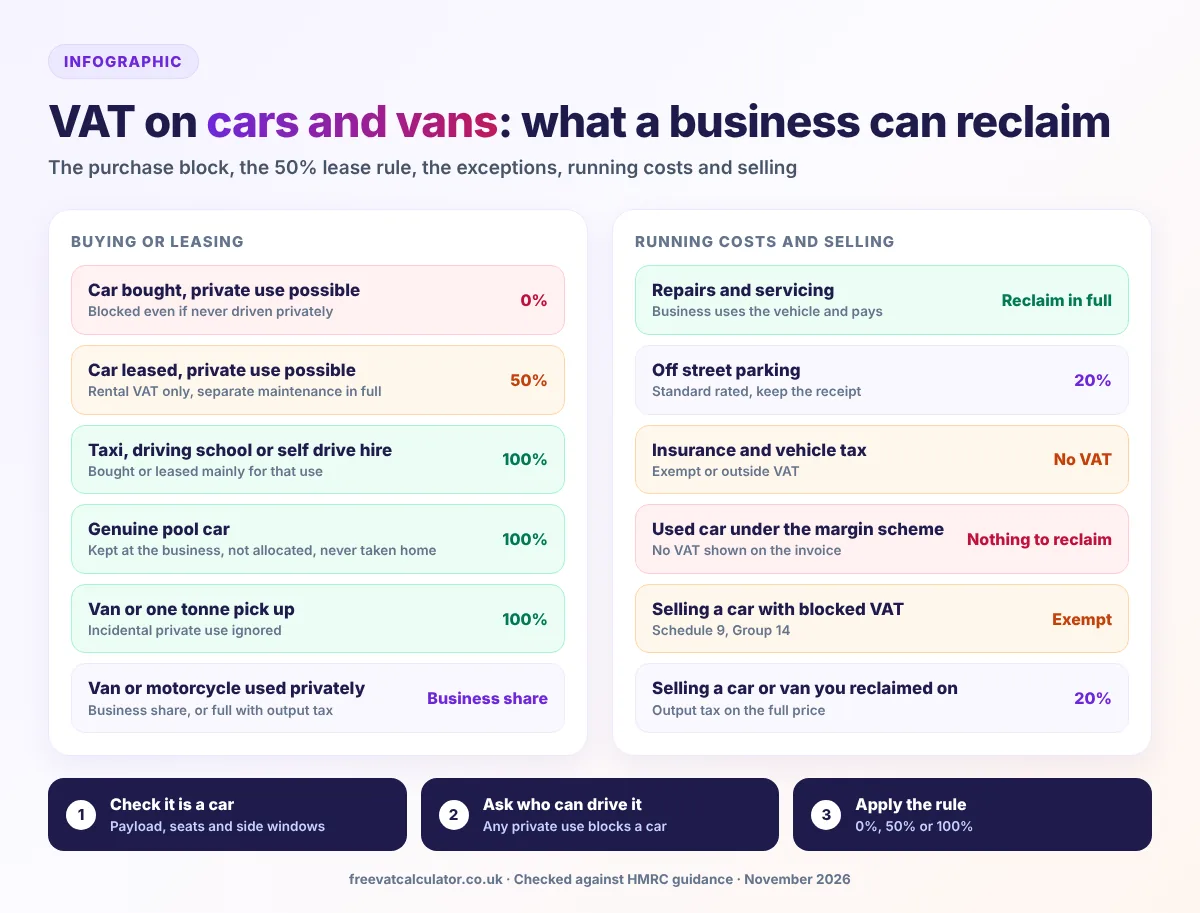
- 0%Buying a car anyone can drive privately
- 50%Leasing a car anyone can drive privately
- 100%Taxis, tuition cars, hire fleets and pool cars
The block covers the rental, optional services bundled into it, excess mileage charges that form part of the lease and, since 1 April 2022, early termination fees. Maintenance shown separately on the lease invoice is not blocked, so its VAT comes back in full, and our fuel scale charge guide has a lease calculator alongside its fuel options.
When you can reclaim all the lease VAT
The 50% block does not apply to a car leased mainly for use as a taxi, for driving instruction or for self drive hire, or one used only for business and kept away from private use. A partly exempt business applies its recovery rate to the half that is left, so it may get back less than 50%, as our partial exemption VAT guide explains.
Short term hire and replacement cars
Under an agreement with the British Vehicle Rental and Leasing Association, HMRC does not apply the 50% block to a business hire of 10 days or fewer, and evening or weekend use can be ignored if the car was hired for a specific business trip. The block applies from the first day if the hire car simply replaces a company car that is off the road. Each hire is judged separately, with no averaging across a quarter.
Leasing or buying a car: a worked example
Take a car with private use that costs £36,000 including £6,000 of VAT to buy, or £450 a month plus £90 of VAT to lease for 36 months, with maintenance of £40 a month plus £8 of VAT shown separately. The table compares what comes back.
| Item | Buying outright | Leasing for 36 months |
|---|---|---|
| VAT charged | £6,000.00 on the car | £3,240.00 on rentals and £288.00 on maintenance |
| VAT reclaimed | £0.00 | £1,620.00 plus £288.00 = £1,908.00 |
| VAT that stays a cost | £6,000.00 | £1,620.00 |
| Rule applied | Purchase blocked by private use | 50% of the rental VAT, maintenance in full |
On these figures the lease recovers £1,908 of VAT over three years and the purchase nothing, though the total cost and the car’s value at the end also matter. When the VAT on a bought car is blocked, HMRC’s business income manual at BIM31545 adds it to the car’s cost for capital allowances, so it still counts for income tax or corporation tax.
VAT on vans and other commercial vehicles
Vans, lorries and other commercial vehicles are outside the car block, so a VAT registered business can reclaim the VAT on buying or leasing one under the normal rules. HMRC ignores incidental private use of most commercial vehicles, so a builder who calls at the shops on the way home still reclaims all the VAT on the van.
Where private use is more than incidental, you can reclaim only the business share, or reclaim it all and pay output tax on the private use each VAT period over the van’s life. That second route, known as Lennartz accounting, cannot be used for cars caught by the block, for land and buildings, or for boats and aircraft.
Leasing a van
There is no 50% rule for vans. The rental VAT on a business van comes back in full, or only the business share if private use is more than incidental.
Turning a van into a car, or a car into a van
Fitting side windows behind the driver, or rear seats even without windows, turns a van into a car, and output tax is due on the vehicle’s value, including the conversion, when the work is finished. Going the other way, permanently removing the rear seats, seat belt mountings and windows can make a car a commercial vehicle, but you can reclaim the VAT on the car only if you bought it specifically to convert it and never used it as a car.
VAT on running costs: repairs, servicing, parking and fuel
If the business uses the vehicle and pays for repairs and servicing, Notice 700/64 lets it reclaim the VAT even when there is some private use, including on a car whose purchase VAT was blocked. The exception is a sole trader or partner whose vehicle is used only for private motoring, who cannot reclaim the VAT on its repairs.
Accessories fitted when you buy a blocked car are blocked too, even if the dealer invoices them separately, because they are part of one supply. An accessory added later is reclaimable only if it has a business use.
Fuel, mileage and electric charging
Fuel has its own choices: reclaim business fuel only, reclaim it all and pay the fuel scale charge, apportion by mileage, or reclaim nothing. Our fuel scale charge guide works through each one with HMRC’s table for 2026 to 2027, and our guide to VAT on EV charging covers home, public and workplace charging.
Parking, tolls and the congestion charge
Off street car parks are standard rated, even when a council runs them, so the VAT on a business parking ticket is reclaimable with a receipt. On street parking from a council, a penalty charge notice and the charge for a council congestion scheme are all outside the scope of VAT, so there is nothing to reclaim. Tolls on roads, bridges and tunnels carry VAT when a private operator runs them, and are outside VAT only when a public authority operates them under a special legal regime.
Insurance and vehicle tax
Motor insurance is exempt from VAT, so there is no VAT to reclaim on a premium, and the tax on the bill is Insurance Premium Tax, as our guide to VAT on insurance explains. Vehicle tax is a duty paid to DVLA rather than a charge for a service, and HMRC’s margin scheme manual at VATMARG08200 treats tax that a dealer buys for you after the sale is agreed as a disbursement, if the normal conditions are met.
VAT on electric cars and hybrids
The rules on VAT on cars treat electric and hybrid models exactly like petrol and diesel ones. There is no reduced rate on buying one, the purchase block applies if the car is available for private use, and a lease gets the same 50% recovery.
For charging, Notice 700/64 splits the cost between business and private use from mileage records rather than through a scale charge, and public and workplace charging has been standard rated at 20% since 1 November 2026. An employer cannot reclaim VAT on charging at an employee’s home, because the electricity is supplied to the employee. From 1 April 2028 electric cars will also pay a separate excise duty of 3p a mile, or 1.5p for plug in hybrids.
VAT on second hand cars: buying a used car
On a used car, whether there is any VAT depends on who sells it and how they bought it. A private seller is not VAT registered, so there is no VAT to reclaim.
| Seller | VAT on the price | Can a VAT registered buyer reclaim it? |
|---|---|---|
| Private individual | None | No, there is no VAT to reclaim |
| Dealer using the margin scheme | VAT on the dealer’s margin, included but not shown | No, the invoice cannot show VAT |
| Dealer selling a car whose VAT was reclaimed | 20% on the full price, shown on the invoice | Only if the car fits an exception, such as business only use |
| Business selling a car whose VAT was blocked | None, the sale is exempt | No, there is no VAT to reclaim |
| Business selling a used van it reclaimed VAT on | 20% on the full price | Yes, under the normal van rules |
What VAT qualifying means
VAT qualifying is the trade name for what Notice 700/64 calls a qualifying car, one whose VAT was never wholly blocked, usually because a lease company, rental firm or dealer reclaimed it. Its next sale carries VAT on the full price, with a VAT invoice for a VAT registered buyer who asks. A business buyer can reclaim that VAT only if the car fits an exception, so for most company cars the label does not mean the VAT comes back.
Margin scheme cars
Many used cars on dealer forecourts are sold under the margin scheme, where the dealer pays VAT of one sixth of its margin and the invoice shows only the total price, so a business buyer has nothing to reclaim. HMRC added the content of its withdrawn Notices 718 and 718/1 to its GOV.UK guidance on the vehicle margin scheme on 2 November 2026, and our VAT margin scheme guide covers the dealer’s side, including cars moved from Great Britain to Northern Ireland.
Questions to ask before you buy
Ask these before you agree a price on a used car or van for the business. The answers decide whether any VAT can come back.
- Is it sold under the margin scheme, or with VAT on the full price?
- Will the invoice show the VAT, your business name and the seller’s VAT number?
- For a van or pick up, what is the payload from the manufacturer?
- Have seats or side windows been added or removed?
- Does the invoice show the registration number, make and model?
Selling a company car or van: do you charge VAT?
The VAT on a sale follows what happened when you bought the vehicle. The outcomes in Notice 700/64 are the same for a sole trader and a company.
| How you bought it | VAT on the sale | Invoice |
|---|---|---|
| Car with the purchase VAT blocked | None, the sale is exempt | No VAT invoice |
| Car with all the VAT reclaimed, such as a pool car | 20% on the full selling price | VAT invoice if a VAT registered buyer asks |
| Van with all or part of the VAT reclaimed | 20% on the full selling price | VAT invoice if a VAT registered buyer asks |
| Car or van bought with no VAT charged | VAT on the margin only | Margin scheme invoice with no VAT shown |
| Vehicle exported | Zero rated if the export conditions are met | Keep proof of export |
The exempt sale of a blocked car comes from Group 14 of Schedule 9 to the VAT Act 1994, which exempts goods whose only input tax was blocked. Because the sale is exempt, VAT on the costs of selling it, such as auction fees, is exempt input tax.
Cars for disabled people, imports and the Flat Rate Scheme
Three special cases change the usual answer. Each can make a large difference to the price.
Adapted cars and Motability
A car designed or substantially and permanently adapted for a person who usually uses a wheelchair or is carried on a stretcher can be zero rated when it is supplied for their personal use, as VRDP29100 sets out. The relief covers one vehicle every three years, unless the earlier one was stolen, destroyed or damaged beyond repair, or no longer suits the person’s condition, and the supplier must hold a declaration before the sale. Motability lease payments made from mobility benefits still carry no VAT. Since 1 July 2026, under the Motability tax reform, VAT applies to advance payments on new leases except for cars adapted for wheelchair or stretcher users, and our guide to VAT relief for disabled people explains how to claim.
Importing a car
VAT on an imported vehicle is charged on its total cost, including accessories, delivery, other charges and any customs duty. You must tell HMRC within 14 days that the vehicle has arrived, using the NOVA service, and the car block applies to import VAT too. Our import VAT and customs duty calculator works out both taxes.
The Flat Rate Scheme
On the Flat Rate Scheme you reclaim no VAT on purchases, except a single purchase of capital expenditure goods costing £2,000 or more including VAT. A van can qualify for that claim, but article 7 still blocks a car that is available for private use, and our Flat Rate Scheme guide explains the rest.
Records you need to reclaim VAT on a vehicle
HMRC can refuse a claim for VAT on cars or vans that is not backed by the right papers, and Notice 700/21 says you must keep VAT records for at least six years. For cars and vans, these are the ones that matter.
- a VAT invoice in the business name showing the VAT separately
- the lease invoice showing rental and maintenance VAT separately
- the manufacturer’s payload figure for a pick up or combi van
- the policy, insurance schedule and journey log for a pool car
- a record of business and private miles for a van with private use
- your licence and a private mileage log for a taxi or tuition car
What changed for VAT on cars in 2026
The Budget on 28 October 2026 left the VAT rules for buying and leasing cars and vans as they were, and the standard rate stays at 20%. Earlier in the year, from 1 July 2026, VAT began to apply to advance payments on new Motability leases, except for cars adapted for wheelchair or stretcher users. These are the other changes that touch motoring, including some outside VAT.
- no change to the rules for VAT on cars and vans bought or leased by a business
- public and workplace EV charging standard rated at 20% from 1 November 2026
- HMRC margin scheme guidance for vehicles updated on 2 November 2026
- private hire fares booked through an operator treated as the operator’s supply from 2 January 2028
- company cars and vans payrolled for benefit in kind from 6 April 2027
- vehicle tax rising with RPI from 1 April 2027
- the mileage rate above 10,000 business miles rising from 25p to 35p from 6 April 2027
Need the VAT on fuel or a lease?
Our fuel scale charge guide covers fuel, mileage and lease rentals, and the main VAT calculator adds or removes VAT at any rate.
VAT on cars FAQs
These are the questions business owners ask most about VAT on cars and vans. Each answer reflects HMRC guidance on 6 November 2026.
Can you reclaim VAT on company cars?
Not on buying a car that is available for private use, which covers almost every car given to a director or employee. A leased company car gets back 50% of the rental VAT, and only a taxi, driving school car, self drive hire car, dealer stock or genuine pool car gets all the VAT back.
Can a sole trader reclaim VAT on a car?
The same rules apply to sole traders as to companies, so a car you can also drive privately is blocked. You can still reclaim the VAT on repairs and servicing when the car is used in the business, and the VAT on the business share of fuel.
How much VAT can I reclaim on a leased car?
Normally 50% of the VAT on the rental, plus all the VAT on maintenance that is invoiced separately. All the rental VAT comes back only for a taxi, driving school car, self drive hire car or business only car.
Is a double cab pick up a car or a van for VAT?
It is a van if its payload is one tonne or more, and a car if its payload is under a tonne. The April 2025 company car tax change did not alter this for VAT.
Do I charge VAT when I sell my company car?
You charge VAT on the full price only if you reclaimed the VAT when you bought it. If the purchase VAT was blocked, the sale is exempt with no VAT invoice, and if you bought it with no VAT charged, VAT is due only on your margin under the margin scheme.
Can I reclaim VAT on a van with some private use?
Yes. Incidental private use is ignored, and where private use is greater you reclaim the business share, or reclaim it all and pay output tax on the private use.
Is there VAT on a car from a private seller?
No, because a private seller is not VAT registered. That also means a business buyer has no VAT to reclaim.
Does the 10 day hire rule cover a car while mine is repaired?
No. A hire car that replaces a company car off the road gets the 50% block from the first day, however short the hire.
You now know when VAT on cars, vans and motorcycles comes back, why a lease returns half and how to treat a sale. Use the checker at the top for your own figures, and keep the invoices and logs that support every claim.
Sources: HMRC VAT Notice 700/64; VAT (Input Tax) Order 1992, article 7; HMRC VAT Input Tax manual, motoring expenses; VIT50300; VIT50600; VIT50900; VIT51200; VIT51500; VIT53300; VIT53900; VIT54800; VIT55100; VIT56600; VIT64690; VIT25510; EIM23151; BIM31545; HMRC, car derived vans and combi vans; Revenue and Customs Brief 1 (2019); HMRC, buying second hand vehicles using a VAT margin scheme; HMRC, using the VAT margin scheme for second hand vehicles; GOV.UK, VAT margin schemes records; VATMARG08200; VAT Act 1994, Schedule 9; VATGPB8640; VATGPB8665; VATGPB8865; VATSC06140; VRDP29100; Motability Scheme: reforming tax reliefs; VAT Notice 1002; GOV.UK, importing vehicles into the UK; FRS6500; VAT Notice 733, section 15; VAT Notice 700/21; Budget 2026 overview of tax legislation and rates. This page is general information, not tax advice.