
Charity VAT guide
VAT for Charities: Reliefs, Zero Rating, Registration and Donated Goods
How to get the VAT right on a charity purchase
- Check the itemIs it on the relief list?
- Prove your statusRegulator number or HMRC letter
- Sign the declarationSeparate from the order
- Pay 0% or 5%The supplier applies it
- Keep the paperworkWith the invoice
The printer adds 20% VAT to your appeal posters, the builder asks whether the new day centre will be zero rated, and a local firm offers surplus laptops but wants to know who pays the VAT. Many trustees assume a charity never pays VAT, so they overpay on purchases that qualify for relief or skip the paperwork that makes a relief stand up.
The checker below gives the rate, the paperwork and the VAT in pounds on what a charity buys or sells. The guide then covers registration, each relief, buildings, fuel, shops, events and the new relief for donated stock, so you know how VAT for charities applies to your next invoice.
Charity VAT checker: the rate, relief and paperwork for any item
Choose buying or selling, pick the item and enter the price. The checker shows the rate or relief, the paperwork, the VAT in pounds and the working.
Charity VAT checker
Find the VAT rate or relief, the paperwork and the VAT in pounds on what your charity buys or sells
Zero rated: advertising relief
Advertising in any medium that reaches the public is zero rated under Notice 701/58, including recruitment ads and the cost of designing the advert.
Paperwork: eligibility declaration
Give the supplier a signed eligibility declaration, separate from the order, with your Charity Commission number or HMRC recognition letter.
The working
£2,000.00 × 0% = £0.00 of VAT, so the total is £2,000.00. At 20% the VAT would be £400.00, so the relief saves £400.00.
Based on HMRC Notices 701/1, 701/6, 701/19, 701/58 and 708 as at 6 November 2026. Purchase prices are before VAT, and income is the amount the charity charges, including any VAT. The supplier decides the rate on a purchase, figures are rounded to the nearest penny, and nothing you enter is stored or sent.
Key facts
- Blanket exemption
- None: reliefs apply item by item
- Registration threshold
- £90,000 of taxable turnover
- Zero rated purchases
- Advertising, medical equipment, new charitable buildings
- Fuel and power
- 5%, or 0% on GB electricity to 30 June 2027
- Charity shop sales
- Donated goods are zero rated
- Business donations
- No VAT on eligible goods since 1 April 2026
Do charities pay VAT?
Yes, on most purchases, because there is no general VAT exemption for a charity. Each relief covers specific goods or services bought for a specific use, and VAT Notice 701/1 says the zero and reduced rates apply whether or not the charity is VAT registered. The supplier is responsible for charging the right rate.
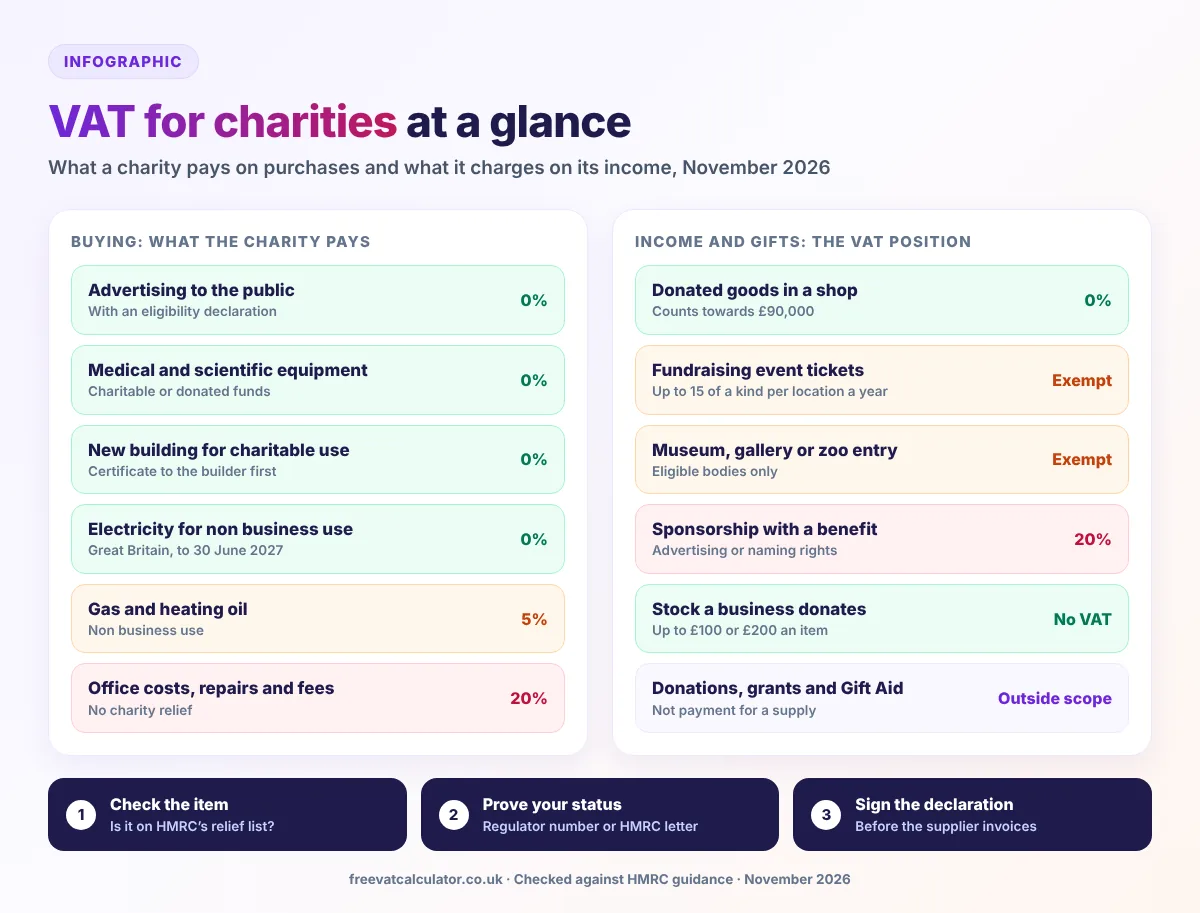
| Situation | VAT treatment | Paperwork |
|---|---|---|
| Advertising aimed at the public | 0% | Eligibility declaration |
| Medical equipment from charitable funds | 0% | Eligibility declaration |
| New building for a relevant charitable purpose | 0% | Certificate to the builder |
| Non business electricity in Great Britain | 0% to 30 June 2027 | Certificate if use is mixed |
| Gas and heating oil for non business use | 5% | Certificate if use is mixed |
| Office costs, repairs and professional fees | 20% | None |
| Donated goods sold in a charity shop | 0% | Proof of donation |
| Qualifying fundraising event tickets | Exempt | None |
| Donations, grants and Gift Aid | Outside the scope | None |
Zero rated, exempt and outside the scope
A zero rated sale carries 0% VAT, counts towards the registration threshold and lets a registered charity reclaim VAT on related costs. An exempt sale carries no VAT and does not count, but VAT on related costs is usually lost. Income outside the scope, such as a true donation, is not a supply at all.
Business and non business activities
HMRC asks whether the charity supplies something for payment and does so to obtain income, even below cost. Shops, paid admissions and room hire are business, while donations and grants that only require the money to be spent properly are not. A welfare service for people in distress, such as a night shelter, can be non business if everyone gets a subsidy of at least 15%.
Charity VAT registration: the £90,000 threshold
A charity must register when taxable turnover for the last 12 months goes over the £90,000 VAT threshold, or when it expects to pass £90,000 in the next 30 days alone. It must register within 30 days of the end of that month, or by the end of those 30 days under the second test. The Budget of 28 October 2026 kept the £90,000 threshold and the £88,000 deregistration threshold for 2026 to 2027 and 2027 to 2028.
- £90,000Registration threshold for the last 12 months
- £88,000Deregistration threshold
- 30 daysTo register after the month you pass it
What counts towards the threshold
Only taxable income counts, so zero rated charity shop sales count in full while exempt income, donations, grants and Gift Aid do not. Registering late brings penalties.
Voluntary registration: is it worth it?
A charity below the threshold can register voluntarily to reclaim VAT on, for example, a shop whose sales are zero rated. It must then charge VAT on its taxable sales and file returns every three months. A charity whose activities are wholly exempt or non business cannot register.
Trading subsidiaries
Many charities trade through a wholly owned company that passes its profits to the charity. Its sales of donated goods are still zero rated, and its fundraising events can still be exempt.
Charity VAT relief on purchases: what you can buy at 0%
GOV.UK lists 13 zero rate reliefs for charities, with conditions in Notices 701/1, 701/6 and 701/7. They fall into these groups.
- Advertising to the public and items for collecting donations
- Medical, veterinary and scientific equipment and ambulances
- Rescue equipment, lifeboats and launch equipment
- Aids, goods and adapted vehicles for disabled people
- New buildings for a relevant charitable purpose
- Medicines, research chemicals and resuscitation models
- Equipment for making talking books and newspapers
Advertising and items for collecting donations
Under Notice 701/58, advertising in any medium that reaches the public is zero rated, including recruitment ads and the cost of designing them. The charity’s own website, direct mail, search engine optimisation and ads aimed at selected people are excluded. By concession, secure named collection boxes, appeal letters, donation envelopes and lapel stickers costing well under £1 are also zero rated.
Medical, veterinary and scientific equipment
Under Notice 701/6, eligible bodies such as charity care homes and research institutions buy medical, scientific, laboratory and similar equipment at 0% when it is mainly for research, training, diagnosis or treatment. The money must be charitable or donated, and NHS funds do not count. An ambulance needs permanent signs, an attendant’s seat and a patient stretcher at least 1.95 metres long.
Rescue equipment, lifeboats, talking books and medicines
Rescue charities buy heat seekers, flares and image intensifiers at 0%, but not mobile phones, torches or binoculars. Lifeboats, slipways, talking book equipment and medicines bought by charities that treat people or animals are zero rated too.
Goods and vehicles for disabled people
A charity can buy goods designed solely for disabled people, and some adapted vehicles, without VAT when it makes them available to disabled people. Our guide to VAT relief for disabled people covers the individual’s side.
What does not qualify
Most charity spending stays at 20%, and a declaration cannot change that. Repairs to listed places of worship lost their VAT grant too when the Listed Places of Worship Grant Scheme closed in March 2026. These common costs fall outside every relief.
- Office supplies, phones and furniture
- The charity’s own website and direct mail
- Extensions, alterations and repairs
- Architects and other professional fees
- Generic protective equipment
- Vehicle fuel and branded clothing
Zero rated new buildings for a relevant charitable purpose
A new building is zero rated when the charity will use it solely for a relevant charitable purpose, meaning non business use or as a village hall for the local community. Solely means at least 95%, and Notice 708 accepts any fair method of measuring it.
The certificate the builder needs
The charity gives the main contractor the certificate in section 18 of Notice 708 before the work is supplied, and subcontractors still charge 20%. A wrong certificate can bring a penalty equal to the VAT not charged, unless the charity has a reasonable excuse.
Change of use within 10 years
HMRC expects the qualifying use to last at least 10 years after completion. If it stops, falls below 95% or the building is sold, the charity may owe VAT on a self supply.
Extensions, alterations and energy saving materials
Extensions, refurbishment and repairs are normally standard rated. Energy saving materials in a building used solely for a relevant charitable purpose are zero rated until 31 March 2027, then 5%, when heat batteries join the relief. An option to tax also has no effect if the charity tells the seller or landlord in advance that it will use the building solely for such a purpose, other than as an office.
Fuel and power: 5% and the temporary 0% on electricity
Fuel and power for a charity’s non business activities or residential accommodation, such as a care home, carries the reduced rate. In Great Britain, qualifying electricity is zero rated from 1 October 2026 to 30 June 2027, as our zero VAT electricity guide explains, while gas, oil and electricity in Northern Ireland stay at 5%.
| Fuel | Small supply limit |
|---|---|
| Electricity | Up to 1,000 kWh a month |
| Piped gas | Up to 4,397 kWh a month |
| Gas oil, fuel oil and kerosene | Up to 2,300 litres a delivery |
| Coal or coke | One tonne or less |
| Wood, peat and charcoal | No limit if not for resale |
If 60% or more of a supply is for qualifying use, all of it gets the lower rate, and below that only the qualifying share does. The charity certifies the exact percentage for each premises, vehicle fuel never qualifies, and reduced rate supplies are free of the Climate Change Levy.
How to claim charity VAT relief from a supplier
You never claim these reliefs from HMRC. The supplier applies the rate at the point of sale once it has your evidence.
- Check the item is on HMRC’s list of reliefs on VAT for charities.
- Give your Charity Commission number or HMRC recognition letter.
- Sign a declaration or certificate separate from the order.
- Check the invoice shows 0% or 5% before you pay.
- Keep the declaration with the invoice.
The supplier still decides the rate and may ask questions first. Under extra statutory concession 3.11, HMRC will not pursue a supplier who acted in good faith on a declaration that later proves false.
Proving charitable status
The charity must be based in the UK, set up for charitable purposes only, registered with its regulator where required, run by fit and proper persons and recognised by HMRC. Charities in Scotland and Northern Ireland must show their HMRC recognition letter. Non UK charities lost UK VAT reliefs from 1 April 2024.
If you were charged VAT you did not owe
Ask the supplier to correct the invoice, as only the business that paid the VAT to HMRC can reclaim it, within 4 years. Our guide to correcting VAT errors explains how. A late building certificate works only if the charity intended the qualifying use when the work was done.
Importing goods for charity
Food, medicines, clothing and blankets received free for people in need can be imported without import VAT, and so can equipment given by an overseas donor. Claim at import, using customs procedure code 40 00 C20 for freight.
VAT on what charities sell: shops, events, tickets and sponsorship
Most charity income is zero rated, exempt or outside the scope. The treatment depends on what the charity gives in return.
Charity shops and donated goods
Selling, hiring or exporting donated goods is zero rated when they are offered to the general public, or to two or more disabled people or people on means tested benefits. Goods that cannot legally be sold to the public, and scrap clothing, keep the zero rate when sold to scrap or rag merchants.
The zero rate is lost if the sale was arranged in advance or the charity used the item first, such as donated furniture put to work in its office. Bought in goods such as cards and mugs carry 20% unless, like books, they are zero rated anyway.
Fundraising events
Income from an event whose primary purpose is raising money, and which is promoted that way, is exempt under Group 12 of Schedule 9 to the VAT Act 1994. Holding more than 15 events of one kind at one location in a financial year loses the exemption for all of them, but weeks with gross takings of £1,000 or less are not counted. After an Upper Tribunal ruling in January 2025, HMRC now accepts an event with two equal purposes if one is fundraising.
Admission charges and cultural events
Admission to museums, galleries, zoos and cultural performances is exempt when an eligible body charges it. That body must be non profit and run on an essentially voluntary basis by people with no financial interest, and a botanical garden does not qualify.
Sponsorship and donations
Sponsorship carries 20% when the sponsor gets a significant benefit, such as advertising. A separate donation stays outside the scope, and a flag, sticker or name in a list of supporters does not change that.
Raffles, membership and welfare services
Raffle and lottery tickets are exempt under Group 4 of Schedule 9, and welfare services are normally exempt. By concession, the magazine part of a membership subscription can be zero rated.
Donated goods VAT relief for businesses from 1 April 2026
Before 1 April 2026, a business that gave a charity goods it had claimed input tax on usually owed VAT on the gift, unless the charity would sell them. Now it owes none when the charity passes the goods on free or uses them in its non business work.
| Goods | Limit per item |
|---|---|
| Household appliances such as cookers, fridges and heaters | £200 |
| Furniture, including mattresses | £200 |
| Flooring, including carpets and rugs | £200 |
| Computers, tablets and mobile phones | £200 |
| All other eligible goods | £100 |
| Alcohol, tobacco and vapes liable to duty | Not eligible |
Each item is valued at the lower of its cost and what an identical one would cost on the day, given its age and condition. The charity must meet HMRC’s tax definition of a charity, so charitable incorporated organisations qualify but community interest companies do not.
The charity gives the donor a signed statement of its status and how it will use the goods, and one a year covers regular gifts. The business keeps a description, quantity, value, date and proof of delivery for each donation.
Gift Aid is not VAT
Gift Aid adds 25p for every £1 a UK taxpayer gives, and neither a freely given gift nor the tax HMRC repays on it is payment for a supply, so neither counts towards the threshold. Gift Aid does not turn an admission charge into a donation, though, so the ticket keeps its usual VAT treatment.
Reclaiming VAT: non business costs and partial exemption
A registered charity reclaims VAT on costs for taxable activities but not for non business work, and apportions shared overheads such as rent. VAT linked to exempt income is lost beyond the de minimis limits in our partial exemption VAT guide.
VAT refunds for hospices and rescue charities
Hospices and air ambulance, search and rescue and medical courier charities recover VAT on non business costs under section 33C of the VAT Act 1994. An unregistered one claims on form VAT126 within 4 years after the end of the month of the supply. The Budget of 28 October 2026 announced a power for later regulations to add assessments, appeals and repayment interest to these claims.
Need the VAT on a quote?
Our main VAT calculator adds or removes VAT at 20%, 5% or 0%.
VAT for charities FAQs
These are the questions treasurers and suppliers ask most. Each answer reflects HMRC guidance at 6 November 2026.
Is there a VAT exemption for charities?
Not a general one. A charity pays VAT unless a specific relief applies, though some of its own income, such as event tickets, is exempt.
Can a charity reclaim VAT if it is not VAT registered?
Usually not, but the reliefs on purchases apply without registration. The four kinds of charity under section 33C can also claim on form VAT126.
Do charities pay VAT on electricity?
In Great Britain, non business electricity is zero rated until 30 June 2027, then 5%. A shop’s electricity carries 20% unless it is a small supply of up to 1,000 kWh a month.
Does a business pay VAT when it donates stock to a charity?
Not since 1 April 2026, for eligible goods within the £100 or £200 limits given for free distribution or non business use. Stock given for the charity to sell was already zero rated.
Is grant income subject to VAT?
Not if nothing is supplied in return, even with conditions on how it is spent. If the funder receives a service in return, the payment can be taxable.
You now know when a charity pays VAT, what it can buy at 0% or 5% with which paperwork, and how its own income is taxed. All the information you need on VAT for charities is above, so run the checker before you sign the next quote.
Sources: HMRC VAT Notice 701/1; GOV.UK, VAT for charities; how to claim relief; charities and VAT registration; Notice 701/6; Notice 701/19; Notice 701/47; Notice 701/58; Notice 708; Notice 708/6; Notice 742A; Listed Places of Worship Grant Scheme closure; Notice 700/45; Notice 1001; import relief for charities; VAT Act 1994, Schedule 9, Group 12; Group 4; Revenue and Customs Brief 3 (2025); HMRC policy paper on donated goods; restriction of reliefs to UK charities; GOV.UK, register for VAT; claiming Gift Aid; HMRC Gift Aid guidance, chapter 3; VAT126 powers and safeguards; Budget 2026, OOTLAR; Annex A. This page is general information, not tax advice.