
Side income tax guide
Trading Allowance: The £1,000 Limit, the Rise to £3,000 in April 2027 and When to Tell HMRC
How the allowance works in five steps
- Add up takingsGross, before any costs
- At or under the limitFull relief, nothing to report
- Over the limitAllowance or expenses, not both
- Tell HMRCRegister by 5 October
- File and payBy 31 January
You sell a few prints online, tutor on Saturdays or walk a neighbour’s dog, and no tax comes off the money. Then you hear that selling sites report sellers to HMRC, and wonder if a little extra income means a return, a bill or a penalty.
The calculator below uses your figures to show whether the income is covered, whether the allowance or your costs leave less to tax, and whether to register. After it come the rules and the April 2027 change, so you know where you stand with the trading allowance.
Trading allowance calculator: allowance or expenses, and do you need to tell HMRC?
Enter your gross takings, the costs you could claim instead and the tax year. The calculator works out the profit both ways, picks the cheaper and says whether HMRC needs to hear from you.
Trading allowance calculator
Full relief, partial relief or expenses, and whether to register for Self Assessment
Use the allowance: partial relief
Your takings of £2,500.00 are over the £1,000 allowance, so full relief does not apply. Deducting the £1,000 allowance instead of your £300.00 of expenses leaves £700.00 less profit to tax, which saves £140.00 of income tax at 20%. From 2027 to 2028 the same takings would be covered in full by the £3,000 allowance.
Tell HMRC: register by 5 October 2027
Takings of more than £1,000 in 2026 to 2027 must go on a tax return. If you do not already file one, register for Self Assessment by 5 October 2027, then file the return and pay any tax by 31 January 2028.
The working
With the allowance: £2,500.00 minus £1,000.00 = £1,500.00. With expenses: £2,500.00 minus £300.00 = £2,200.00. The lower profit is £1,500.00, and £1,500.00 × 20% = £300.00 of income tax.
An estimate for one person that applies the one rate you pick to the whole profit, so choose 20% only if your wages or pension already use your £12,570 personal allowance, and 0% if your total income stays within it. It assumes none of the income comes from your employer, your spouse’s or civil partner’s employer, or a partnership or close company that you or a connected person belong to, because then the allowance cannot be used at all. Class 4 National Insurance is left out because it only starts on profits above £12,570, and Scottish income tax rates differ. Nothing you enter is stored or sent.
Key facts
- Allowance for 2026 to 2027
- £1,000 of gross trading income
- From 6 April 2027
- £3,000, and the reporting threshold rises with it
- Over the limit
- Deduct the allowance or your costs, not both
- Register by
- 5 October after the tax year ends
- Property allowance
- Stays at £1,000
- Not available on
- Income from your employer, or a partnership or close company you or a connected person belong to
What is the trading allowance?
It is a yearly tax exemption for individuals with small trading or casual income. Since 6 April 2017 it has let you receive up to £1,000 a year tax free, usually without telling HMRC.
Takings at or below the limit get full relief. Above it, partial relief lets you deduct the allowance instead of your costs.
What income it covers
It covers self employment, casual services such as babysitting or tutoring, and hiring out personal equipment like power tools. The law extends it to miscellaneous income too, which catches small one off jobs.
Payment does not have to be cash. HMRC says gifts or services you receive, such as free products sent to a content creator, count at what you would have paid.
Gross income, not profit
Gross takings decide whether you are under the limit, not profit. Selling £1,400 of candles made from £700 of materials leaves £700 of profit, but the takings are still over £1,000 in 2026 to 2027.
One allowance for all your side income
You get one allowance per person per tax year, however many activities you run. With more than one source you choose how to split it, but no source can be pushed into a loss.
Trading allowance 2027: the rise from £1,000 to £3,000
The Budget on 28 October 2026 announced that the limit will treble. From 6 April 2027, the start of the 2027 to 2028 tax year, the allowance and the threshold for reporting trading income both rise to £3,000.
| What changes | 2026 to 2027 | 2027 to 2028 onwards |
|---|---|---|
| Allowance on gross trading income | £1,000 | £3,000 |
| Trading income that must be reported | More than £1,000 | More than £3,000 |
| Register for Self Assessment by | 5 October 2027 | 5 October 2028 |
| Return and tax due by | 31 January 2028 | 31 January 2029 |
| Property allowance | £1,000 | £1,000, unchanged |
| Making Tax Digital for Income Tax | Qualifying income over £50,000 | Qualifying income over £30,000 |
What the Budget announced
HMRC’s tax information note says the Finance Bill 2026 to 2027 will amend Part 6A of the Income Tax (Trading and Other Income) Act 2005. The spring 2025 promise was only a £3,000 reporting threshold by the end of this Parliament.
Who benefits and by how much
HMRC estimates that up to 1.4 million people could pay less tax or file less. About 400,000 should save £380 on average, and around 100,000 will no longer need to report.
- 1.4mPeople who could pay less tax or file less
- 400,000Expected to see a lower bill, £380 on average
- 100,000No longer need to report trading income
Does the property allowance change too?
No. The Budget papers raise only the trading allowance and its reporting threshold, so the £1,000 property allowance stays as it is.
What to do before April 2027
Takings over £1,000 in 2026 to 2027 still mean registering by 5 October 2027 if you do not already file, though takings up to £3,000 are tax free a year later. Keep a running total of takings and costs as proof you stay under £3,000.
How full relief and partial relief work
Full relief: takings at or below the limit
When gross takings do not exceed the allowance, the profit or loss is treated as nil. There is no income tax, no Class 4 National Insurance and usually nothing to report.
Losses from earlier years are left untouched. HMRC’s manual says they simply carry forward to later profits.
Partial relief: deduct the allowance instead of your costs
Above the limit, you can deduct the allowance from your takings instead of actual expenses. So £1,800 of tutoring income leaves £800 to tax in 2026 to 2027, and £4,200 leaves £1,200 from 2027 to 2028.
You cannot mix the two, so claiming the allowance means giving up every expense and capital allowance for that year. It also cannot create a loss.
Allowance or expenses: which leaves less to tax?
If your costs are below the allowance, use the allowance, and if they are above it, claim the costs. You can choose again each year.
When it pays not to use the allowance
The allowance is not always the better deal. Claiming your real figures makes more sense in these cases.
- your costs are more than the trading allowance
- your costs exceed your takings and you want to use the loss
- you want the annual investment allowance, which only works in the year you buy the equipment
How to claim or opt out
Claim partial relief, or opt out of full relief, on the self employment pages of your return. The deadline for 2026 to 2027 is 31 January 2029, a year after the normal filing date.
Worked examples: four side incomes in both tax years
The table runs four sets of figures through both years. All four get full relief once the £3,000 limit starts.
| Takings and costs | 2026 to 2027 (£1,000) | 2027 to 2028 (£3,000) | Tell HMRC? |
|---|---|---|---|
| £800, no costs | Full relief, nothing taxable | Full relief, nothing taxable | No |
| £1,000, no costs | Full relief, nothing taxable | Full relief, nothing taxable | No, the test is more than the limit |
| £2,500, £300 of costs | Allowance: £1,500 taxable, not £2,200 | Full relief, nothing taxable | 2026 to 2027 only |
| £2,500, £1,800 of costs | Costs: £700 taxable, not £1,500 | Full relief, nothing taxable | 2026 to 2027 only |
At the 20% basic rate, with wages already using your personal allowance, the third example saves £140 in 2026 to 2027 by using the allowance and the fourth saves £160 by claiming costs. In 2027 to 2028 neither owes anything on this income.
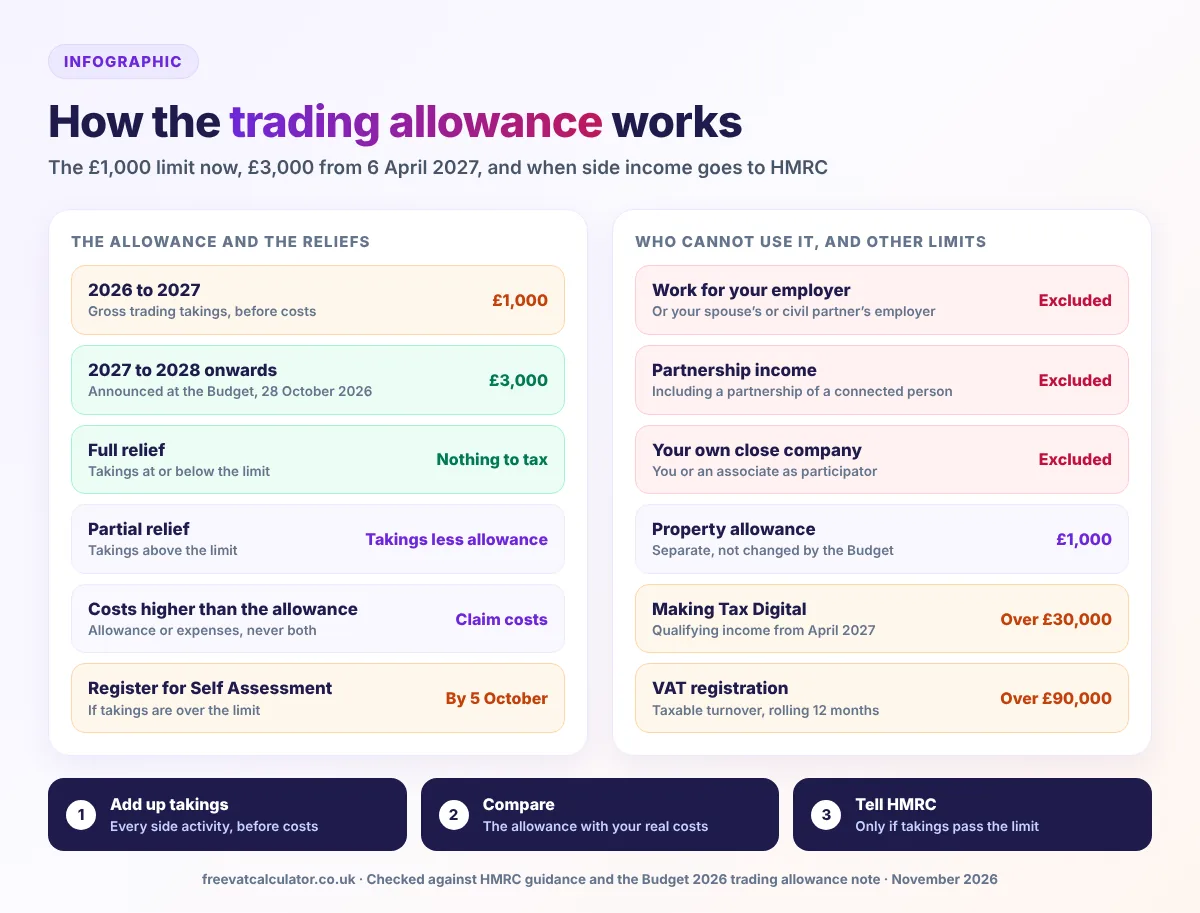
Who can use the allowance, and who cannot
Only individuals can claim it, not a company or partnership. You lose it for the whole tax year, on every source, if any trading income comes from one of these.
- your employer, or your spouse’s or civil partner’s employer
- a partnership you belong to, or one a connected person belongs to
- a close company in which you, or an associate of yours, is a participator
Partnerships and your own company
A trade run in partnership is not covered, so partners cannot use the allowance against their profit share. HMRC’s list of connected people includes a spouse, siblings, parents and children.
Can a limited company use it?
No, a company pays corporation tax and has no allowance of its own. Our sole trader vs limited company comparison shows how small profits fare in each.
Side hustle or hobby: when are you trading?
There is no separate side hustle tax. Side income is taxed as ordinary income, and the allowance only matters once what you do counts as trading.
Selling your own things
Clearing out a loft is not trading, and HMRC says tax is unlikely on selling personal items. Capital Gains Tax can apply to one item sold for £6,000 or more at a gain, while buying or making goods to sell is likely to be trading.
The badges of trade
Where the line is unclear, HMRC uses the badges of trade. A 1955 Royal Commission drew six from the case law, and HMRC’s manual now lists nine.
- a profit seeking motive
- the number of transactions
- the nature of the asset
- similar trading transactions
- changes made to the asset
- the way the sale was made
- the source of finance
- time between buying and selling
- how the asset was acquired
When you must tell HMRC about side income
You must tell HMRC if gross trading income for a tax year is more than £1,000, or £3,000 from 2027 to 2028. The tax year runs from 6 April to 5 April, so do not use a calendar year total.
Registering for Self Assessment by 5 October
If you have not filed before, or did not need a return last year, register by 5 October after the tax year ends. For 2026 to 2027 that is 5 October 2027, and our Self Assessment deadline guide covers the later dates.
- Use HMRC’s online checker to confirm you need a return.
- Register for Self Assessment online as self employed.
- Wait for your Unique Taxpayer Reference.
- File online and pay by 31 January.
When to register even below the limit
GOV.UK says you must still register to claim a loss or to pay voluntary Class 2 National Insurance. You may also need a return for other income, such as rental profit over £2,500.
Side income when you already have a job
Payroll only taxes your wages, so side income is yours to report. File online by 30 December and HMRC can usually collect a bill under £3,000 through your tax code.
If you should have declared income and did not
Tell HMRC quickly, because coming forward first lowers the failure to notify penalty. A failure that was not deliberate, disclosed unprompted within 12 months of the tax being due, can cost 0% of the tax lost, while a deliberate and concealed one can cost up to 100%.
Online platforms now report seller income to HMRC
Since 1 January 2024, platforms used to sell goods, offer services or let property have collected their sellers’ details and earnings each calendar year. The first reports reached HMRC by 31 January 2025.
Who gets reported: the 30 sales and €2,000 test
A goods seller is left out only with fewer than 30 sales and no more than €2,000, about £1,700, in the year. Services and lettings have no such exclusion, so they are reported however little they earn.
What a platform report means for you
A report does not mean you owe tax, and there is no new tax on selling online. The platform must send you a copy of what it reported.
Watch the dates, because platforms report by calendar year while tax runs to 5 April. Our online marketplace VAT guide covers the separate VAT rules.
The property allowance and Rent a Room relief
The £1,000 property allowance works the same way for income from land or property, such as letting a driveway. Using both allowances gives up to £2,000 tax free in 2026 to 2027 and £4,000 from 2027 to 2028.
Joint owners each get £1,000 against their share of the rent. It cannot be used alongside the finance cost tax reducer, such as for mortgage interest on a residential let.
Rent a Room relief
Letting furnished rooms in your own home has its own scheme, with £7,500 a year tax free, or £3,750 each if shared. The property allowance cannot be used on that income.
National Insurance, benefits and student loans
Income covered by the allowance attracts no Class 4 National Insurance, and a nil profit is below the Class 2 small profits threshold. You can still pay Class 2 voluntarily, at £3.65 a week in 2026 to 2027 and £3.80 from April 2027.
The allowance also lowers your income for the High Income Child Benefit Charge and student loan repayments. It does not reduce the earnings you report for Universal Credit.
How the allowance fits with Making Tax Digital and VAT
Making Tax Digital for Income Tax looks at qualifying income, your gross self employment and property income combined. It applies above £50,000 from 6 April 2026, £30,000 from 6 April 2027 and £20,000 from 6 April 2028, so small side income matters only alongside a bigger business or rental income.
HMRC’s own example adds £27,000 of self employment income to £25,000 of rent to reach £52,000, takings before costs. Our guide to Making Tax Digital for Income Tax explains the quarterly updates.
VAT registration only applies once taxable turnover passes £90,000 in a rolling 12 months, or is expected to within 30 days. Our VAT threshold guide explains the test, and VAT for sole traders and freelancers covers what follows.
Records to keep, even under the limit
Full relief does not remove the need for records. If you file a return, keep them for at least 5 years after its 31 January deadline.
- invoices or receipts for what you sold
- bank statements showing money in
- platform statements and report copies
- receipts for costs you might claim
Filing a return for side income?
Our Self Assessment deadline guide has every date for the next return, with a calculator for January and July payments.
Trading allowance FAQs
These are the questions people ask most about small side income. The answers cover 2026 to 2027 and the change from 6 April 2027.
Do I need to declare side hustle income?
Only if gross takings from all side activities are more than £1,000 in 2026 to 2027 or more than £3,000 from 2027 to 2028. Below that you can leave them off any return you file and just keep records.
Is the allowance £1,000 or £3,000?
It is £1,000 until 5 April 2027 and £3,000 from 6 April 2027. The higher figure needs the Finance Bill to become law.
Is the HMRC trading allowance available in Scotland?
Yes, it is a UK wide income tax relief. Scottish taxpayers pay different rates on any profit above it.
What if my takings are just over £3,000 in 2027 to 2028?
You lose full relief, but partial relief still deducts £3,000. Takings of £3,200 with few costs leave £200 to tax, and you register by 5 October 2028 if you do not already file.
You now have the rules for side income, from the £1,000 limit now to £3,000 from 6 April 2027. Run your figures through the calculator to see whether to claim the allowance, claim your costs or tell HMRC.
Sources: HMRC, increasing the trading allowance; Budget 2026 overview of tax legislation and rates; Annex A rates and allowances; GOV.UK, tax free allowances on property and trading income; HMRC Business Income Manual BIM86000; BIM86030 exclusions; BIM86050 capital allowances; BIM86052 National Insurance; ITTOIA 2005, section 783AM; BIM20205 badges of trade; GOV.UK, who must send a tax return; GOV.UK, register for Self Assessment; GOV.UK, pay through your tax code; HMRC factsheet CC/FS11; GOV.UK, selling on a digital platform; HMRC, reporting rules for digital platforms; GOV.UK, income from online platforms; HMRC news, 12 November 2025; HMRC, Tax Help for Hustles; GOV.UK, Capital Gains Tax on personal possessions; GOV.UK, Rent a Room Scheme; GOV.UK, self employed National Insurance rates; HMRC, qualifying income for Making Tax Digital; GOV.UK, when to register for VAT; GOV.UK, how long to keep records. This page is general information, not tax advice.