
Annual accounting guide
VAT Annual Accounting Scheme: Interim Payments, One Return a Year and Who Can Join
How a year on the scheme runs
- JoinOnline or form VAT600AA
- Months 1 to 3No instalments yet
- Months 4 to 129 × 10% or 3 × 25%
- Year endOne return for 12 months
- 2 months laterPay the balance or get a refund
Four VAT returns a year means four deadlines, four rounds of bookkeeping under pressure and four bills that land whenever the quarter happens to end. If your VAT bill is fairly steady, that rhythm can feel like more admin than the tax itself, and a heavy quarter tends to arrive just when cash is tight.
There is a way to file once a year and pay in smaller, planned amounts instead. Below you will find a calculator that sets out every payment date and amount, followed by the rules HMRC applies on who can join, how the instalments and the year end return work, what late payment costs, and when the VAT Annual Accounting Scheme is worth using.
VAT Annual Accounting Scheme calculator: interim payments and the year end bill
Enter last year’s VAT bill, or your estimate if you are new to VAT, then choose monthly or quarterly instalments and the month your accounting year starts. Add the actual VAT for the year once you know it, and the calculator shows the balancing payment or refund, every due date and the deadline for the return.
VAT Annual Accounting Scheme payment calculator
Plan your interim payments, the balancing payment and the annual return deadline
Annual return due by Friday 28 May 2027
Your accounting year runs from 1 April 2026 to Wednesday 31 March 2027.
Pay £2,700.00 with the return
Your VAT for the year is more than the instalments you paid.
| No. | Due by | Amount | Paid so far |
|---|---|---|---|
| 1 | Fri 31 Jul 2026 | £1,200.00 | £1,200.00 |
The working
£12,000.00 × 10% = £1,200.00 per instalment, paid 9 times = £10,800.00 before the return.
This is a planning tool, and HMRC confirms your own amounts and dates in writing when it accepts you. Its internal manual rounds the figure down to the nearest £5, so your letter may differ by a few pounds, and a first period shorter than 4 months has no instalments and a 1 month deadline. In law each deadline is the last working day of the month, so when a month ends at a weekend or on a bank holiday the calculator shows the working day before. Nothing you enter is stored or sent.
The amounts follow the standard Annual Accounting Scheme VAT pattern of 10% or 25% of the figure the payments are based on. HMRC confirms your own amounts and dates in writing when it accepts you, and that letter is what you pay against.
Key facts
- Join limit
- Taxable turnover of £1.35 million or less
- Must leave
- Turnover over £1.6 million at the year end
- Monthly instalments
- 9 payments of 10%, months 4 to 12
- Quarterly instalments
- 3 payments of 25%, months 4, 7 and 10
- Annual return
- Due 2 months after the year end
- Late return threshold
- 2 penalty points, then £200
What is the VAT Annual Accounting Scheme?
It is an optional HMRC scheme that replaces the usual four quarterly VAT returns with a single return covering 12 months. During the year you pay instalments towards the bill, based on the VAT you paid in the previous year, and then settle the difference when you file.
The scheme does not change how much VAT you owe, which rate you charge or what you can reclaim. It only changes how often you report and when the money reaches HMRC, and the rules sit in Part VII of the VAT Regulations 1995, which HMRC explains in VAT Notice 732.
Quarterly returns compared with annual accounting
The quickest way to see what changes is to put the two side by side. The table compares a normal quarterly filer with a business on the scheme.
| What changes | Quarterly returns | Annual accounting |
|---|---|---|
| Returns each year | 4 | 1, covering 12 months |
| Payments | 4, one with each return | 9 monthly or 3 quarterly instalments, then a balancing payment |
| Filing deadline | 1 month and 7 days after each quarter | 2 months after the year end |
| What the payments are based on | The actual VAT for each quarter | Last year’s VAT, or an estimate if you are new |
| Refunds | After each quarterly return | Once a year, after the annual return |
| Making Tax Digital | Applies | Applies |
The difference is mostly about timing. You still keep the same digital records all year, so the saving is in filing once and knowing your payments in advance, not in doing less bookkeeping.
How interim payments work
Interim payments are advance instalments towards the year’s VAT. You choose between nine monthly payments of 10% and three quarterly payments of 25%, and monthly is the default unless you ask for quarterly.
| Option | Each payment | Due by the last working day of | Paid before the return |
|---|---|---|---|
| Monthly | 10% of last year’s VAT | Months 4, 5, 6, 7, 8, 9, 10, 11 and 12 | 90% |
| Quarterly | 25% of last year’s VAT | Months 4, 7 and 10 | 75% |
Nothing is due in the first three months of the year. The rest of the bill, whatever it turns out to be, is paid with the annual return, so a business whose VAT has not changed pays the final 10% or 25% at the end.
How HMRC sets the amounts
If you have been registered for at least 12 months, HMRC bases the instalments on your net VAT for the previous 12 months and writes to tell you the amounts and dates. Its internal manual says the figure is rounded down to the nearest £5, so your letter can be a few pounds below a straight 10% or 25%.
On top of the instalments, HMRC accepts extra payments whenever you choose, as long as each one is a multiple of £5 and is sent by Bank Giro Credit, CHAPS or Bacs. That helps if your VAT is rising and you would rather not face a large balancing payment at the end.
Interim payments for a new business
If you have been registered for less than 12 months, the instalments are 10% or 25% of an estimate of the VAT you expect to owe. HMRC accepts any reasonable basis, such as your business plan, the figures you gave when you registered or a previous owner’s records, and you should keep a note of how you worked it out.
You will not be penalised for an estimate that turns out wrong if you had reasonable grounds for it. If your first annual period is shorter than 4 months, there are no interim payments at all and the whole bill is paid with the return.
Changing your interim payments
If your VAT is likely to change a lot, write to HMRC’s annual accounting team at BT VAT, HM Revenue and Customs, BX9 1WR with your own calculations. HMRC’s guidance for its staff asks for a flexible approach, but instalments cannot be cut below 10% or 25% of your expected VAT for the year.
You must tell HMRC straight away if your VAT has risen, or will rise, by 10% or more since the instalments were set, or if your turnover will pass £1.6 million. HMRC will then change your instalments, or it may remove you from the scheme.
HMRC also expects you to keep the same payment pattern for at least a year before switching between monthly and quarterly. Requests to switch go to the same address.
How to pay the instalments
Interim payments must be made electronically, and HMRC expects you to keep the method you choose for at least a year. Notice 732 allows each of the methods below.
- Direct Debit, set up in your VAT online account
- A standing order from your own bank
- Bank transfer by Faster Payments, CHAPS or Bacs
- Approving a payment through your online bank
- An online debit or corporate credit card
- Paying at your bank or building society
If you miss a payment, HMRC sends a reminder and asks you to pay at once by CHAPS or Bacs. Our guide on how to pay VAT has HMRC’s bank details and how long each method takes to arrive.
The annual VAT return and balancing payment
At the end of the year you file one VAT return covering all 12 months, due 2 months after the year ends. The extra 7 days that quarterly filers get for paying electronically do not apply, because the scheme already gives an extra month, and a first period shorter than 4 months has only 1 month.
The deadline is fixed in law. Regulation 50 of the VAT Regulations 1995 makes each instalment, the return and the balancing payment due by the last working day of the month, so when a month ends at a weekend or on a bank holiday the deadline is the last working day before it. HMRC’s guidance simply says the end of the month, so treat that earlier working day as your real deadline for filing and paying.
Working out the balancing payment
Fill in the return with the full year’s figures, exactly as you would for a quarter, and do not deduct your interim payments in box 5. The balancing payment is the box 5 figure minus the instalments you have paid, and if the instalments come to more, HMRC repays the difference.
HMRC usually pays a repayment within 30 days of receiving the return, by bank transfer if it holds your bank details and by cheque if not. You must still file on time when nothing more is due, and our guide to VAT return deadlines lists the quarterly dates that apply if you leave the scheme.
Making Tax Digital still applies
Annual accounting does not take you out of Making Tax Digital. All VAT registered businesses, unless HMRC has exempted them, have had to keep digital records and file through compatible software for VAT periods starting on or after 1 April 2022, and the annual return goes through the same software, as our Making Tax Digital guide explains.
Keep your records up to date as the year goes on rather than at the end, because a 12 month return built in a rush is where errors creep in. HMRC expects VAT records to be kept for at least 6 years, and that includes the workings behind any estimate you gave when you joined.
Worked example: a year on the scheme
A design studio paid £18,000 of VAT in its last 12 months and joins the scheme with an accounting year from 1 April 2026 to 31 March 2027. Its actual VAT for the year comes to £19,500.
| Due by | Monthly option | Quarterly option |
|---|---|---|
| 31 July 2026 (month 4) | £1,800 | £4,500 |
| 28 August 2026 | £1,800 | Nothing due |
| 30 September 2026 | £1,800 | Nothing due |
| 30 October 2026 (month 7) | £1,800 | £4,500 |
| 30 November 2026 | £1,800 | Nothing due |
| 31 December 2026 | £1,800 | Nothing due |
| 29 January 2027 (month 10) | £1,800 | £4,500 |
| 26 February 2027 | £1,800 | Nothing due |
| 31 March 2027 (month 12) | £1,800 | Nothing due |
| Total interim payments | £16,200 | £13,500 |
| Balancing payment by 28 May 2027 | £3,300 | £6,000 |
On monthly instalments the studio pays £16,200 during the year and £3,300 with the return, while on quarterly instalments it pays £13,500 and then £6,000. Its VAT rose by about 8%, below the 10% point at which it must tell HMRC, so the instalments stay as they were.
Had its VAT fallen to £15,000 instead, the monthly instalments would have been £1,200 too much, and HMRC would repay that after the return. The August, October, January, February and May month ends fall at a weekend or on a bank holiday, so the table shows the last working day before each one, which is the deadline the law sets. A Bacs payment takes 3 working days to reach HMRC, so start it at least that far ahead of each date.
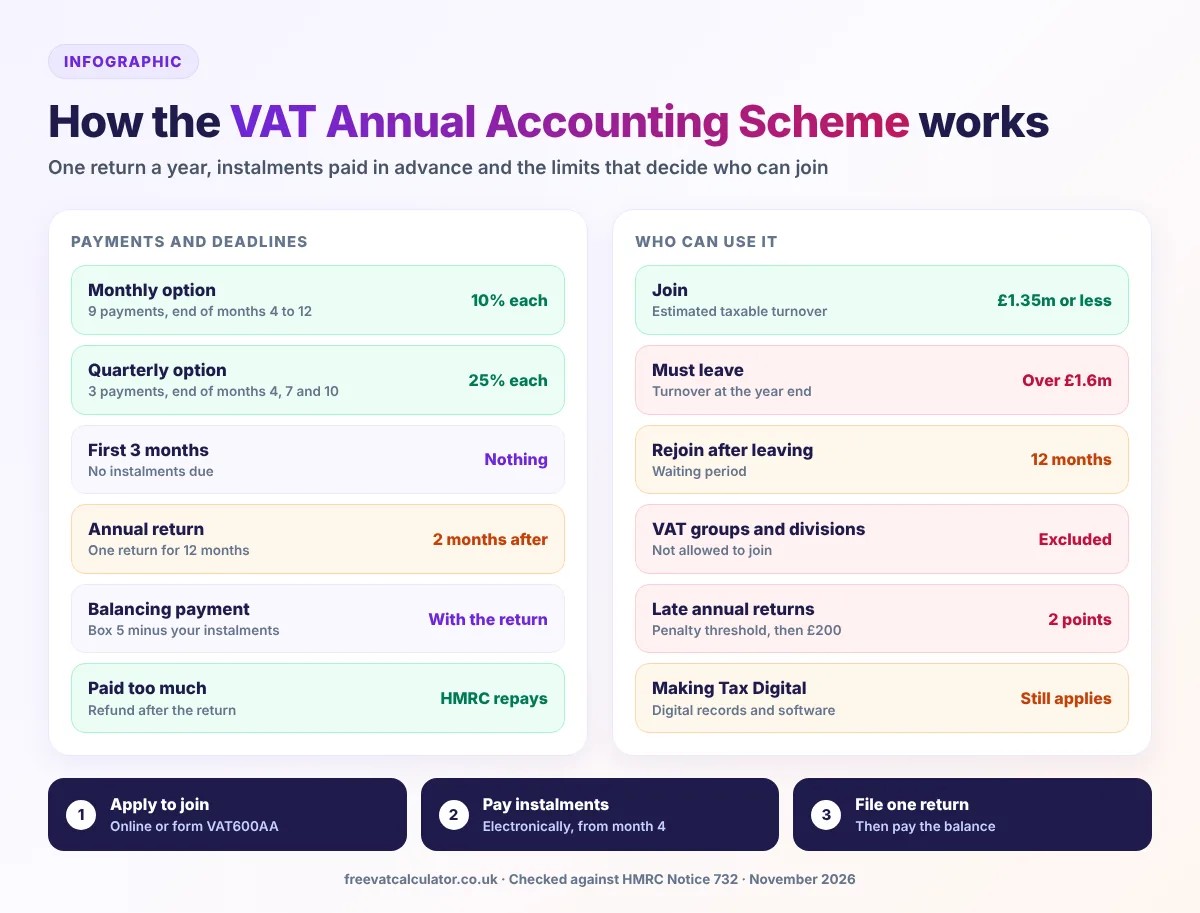
Who can join the VAT Annual Accounting Scheme
You can join if you are VAT registered and expect your taxable turnover, excluding VAT, to be £1.35 million or less over the next 12 months. Leave out exempt sales and sales of capital assets such as equipment, and if you have traded for a year, last year’s taxable sales are a fair guide.
- £1.35mMost you can expect to turn over and still join
- £1.6mTurnover at the year end that means you must leave
- 12 monthsWait before you can rejoin after leaving
These limits have not moved since 1 April 2006, when they rose from £660,000 to join and £825,000 to leave. The same £1.35 million entry limit applies to the Cash Accounting Scheme, so a business that qualifies for one usually qualifies for the other.
Who cannot join
HMRC will turn down an application in a few situations, even when turnover is under the limit. These are the main ones.
- You left the VAT Annual Accounting Scheme in the last 12 months
- Your business is part of a VAT group or registered as a division
- You are behind with VAT returns or payments
- You are insolvent
- You have a VAT debt that is getting bigger
A small debt does not always rule you out. If you have agreed a plan with HMRC to clear it, HMRC may still let you join.
When you must leave
Your place on the scheme ends when taxable turnover goes above £1.6 million at the end of an annual accounting year, or looks set to, and HMRC usually takes you off at the end of the year in which that happens. Tell HMRC as soon as you expect to pass that figure, rather than waiting for the return.
HMRC can also remove you to protect the revenue, or if your estimate had no reasonable basis. Its internal manual lists triggers such as unpaid instalments worth more than 20% of the expected annual VAT, four reminder letters across the last six instalments, or two annual returns and balancing payments missed in a row, and an insolvent business must stop using the scheme at once.
How to join or leave the scheme
If you are not yet VAT registered, you can register and ask to join at the same time. If you are already registered, apply online or on paper with form VAT600AA, and HMRC confirms its decision in your VAT online account or by post.
Applying online or with form VAT600AA
The online application cannot be saved part way through, so have everything ready before you start. HMRC asks for the details below.
- Your business name as it appears on your VAT registration certificate, and your business address.
- Your VAT registration number, or your application reference if you are registering now.
- A contact phone number.
- The annual accounting year end you want.
- Whether you will pay monthly or quarterly, and how you will pay.
To apply on paper, print form VAT600AA and post it to the address shown on the form. If you also want the Flat Rate Scheme, you apply for both together, as explained further down.
When your first year starts
Your first annual accounting year normally starts on the first day of the VAT period in which HMRC receives your application. If the return for that period has already been issued, you start from the next period instead, and an application cannot be backdated.
You can ask for a year end that suits you, such as one that matches your company’s accounts, which may make your first period shorter than 12 months. Until the scheme starts, keep filing every quarterly return HMRC sends you.
Leaving the scheme
You can leave at any time by writing to BT VAT, HM Revenue and Customs, BX9 1WR, and HMRC will confirm the date from which you go back to normal returns. You then normally have 2 months to file the final annual return and pay, or 1 month if you leave within the first 4 months of joining.
Once you leave, or HMRC removes you, the earliest you can come back into the scheme is 12 months later. If you deregister from VAT altogether, you still file a final return under the scheme, normally with 2 months to file and pay.
Using annual accounting with other VAT schemes
Annual accounting only changes when you report and pay, so it sits alongside most other schemes. Notice 732 says it can be used with the Flat Rate Scheme, the Cash Accounting Scheme, the retail schemes, the margin schemes, the Capital Goods Scheme and the Tour Operators’ Margin Scheme.
| Scheme or rule | What it changes | With annual accounting |
|---|---|---|
| Cash Accounting Scheme | VAT is due when customers pay you, not when you invoice | Allowed: follow the cash rules but do the sums once a year |
| Flat Rate Scheme | You pay a fixed percentage of your VAT inclusive turnover | Allowed: apply on forms VAT600AA and VAT600FRS |
| Retail schemes | A formula works out the VAT on mixed rate takings | Allowed: Direct Calculation Scheme 2 follows the annual adjustment in Notice 727/5 |
| Partial exemption | You split input tax between taxable and exempt sales | The annual calculation must end on your annual accounting year end |
| Payments on account | Very large VAT payers pay in advance each quarter | No overlap: it starts at £2.3 million of VAT a year |
With the Flat Rate Scheme
To use both, apply on forms VAT600AA and VAT600FRS, and you will get a separate letter for each scheme. The Flat Rate Scheme is open if your taxable turnover is £150,000 or less excluding VAT, and our flat rate VAT calculator shows whether it saves you money.
You then work out the flat rate VAT once a year instead of each quarter. If your flat rate percentage changes during the year, or you join or leave the Flat Rate Scheme part way through, you do a separate calculation for each part and add them together on the annual return.
With the Cash Accounting Scheme
Cash accounting has the same limits as annual accounting, £1.35 million to join and £1.6 million to leave, so many small businesses use both. You follow the cash accounting rules but do the calculation once a year, and our guide to the VAT cash accounting scheme explains how it works.
You cannot combine cash accounting with the Flat Rate Scheme, because the Flat Rate Scheme has its own cash based method. All three together is not possible, but annual accounting works with either one.
Penalties and late payments on the scheme
Late annual returns earn penalty points, but the threshold is lower than for quarterly filers. An annual filer reaches it at 2 points and then pays a £200 penalty, plus another £200 for each further late return.
Once you reach the threshold, clearing the points takes 24 months of returns filed on time, which means 2 annual returns, with every return due in the previous 24 months sent. Below the threshold, a point expires on the last day of the month 24 months after the month of the missed deadline, or 25 months after if that deadline was the last day of a month, so each point lasts about 2 years.
Late payment penalties work differently for the two kinds of payment. Interim instalments do not attract late payment penalties, but any instalment still unpaid when the balancing payment falls due becomes part of that balancing payment, which does.
On the balancing payment, nothing is charged for the first 15 days, then 3% of the VAT unpaid at day 15, another 3% of what is still unpaid at day 30 and a daily penalty at 10% a year from day 31. Late payment interest at the Bank of England base rate plus 4% runs from the first day the payment is overdue, and our guide to VAT penalties works through the sums.
A missed instalment can cost you the scheme even without a penalty. HMRC can remove you for late or missing instalments, and you then have to wait 12 months to rejoin.
Direct Debit from April 2029
The Budget on 28 October 2026 confirmed that from April 2029 businesses will need a Direct Debit instruction in place for VAT return liabilities, subject to exceptions still being designed. You can still pay another way before a cut off date, and HMRC will use the Direct Debit to collect anything left unpaid.
The legislation will come in a future Finance Bill, and HMRC’s consultation response does not yet say how the rule will treat interim instalments. The Budget documents do not otherwise mention the VAT Annual Accounting Scheme, so its limits and payment pattern stay as they are.
Pros and cons of the VAT Annual Accounting Scheme
The scheme suits some businesses very well and others badly, mainly depending on how steady their VAT is. These are the points that come up most often.
Advantages
- One VAT return a year instead of four
- An extra month to file and pay the annual return
- Fixed instalments that make cash flow easier to plan
- A year end you can match to your own accounts
- Fewer deadlines, so fewer chances of a penalty point
- Works with the Flat Rate and Cash Accounting schemes
Disadvantages
- Repayment traders get only one refund a year
- A large balancing payment if your VAT grows
- Instalments based on last year can run too high if trade falls
- Only 2 late returns take you to the penalty threshold
- Mistakes can build up for 12 months before you spot them
- You must report rises in VAT of 10% or more
Is annual accounting right for your business?
It tends to work best for a business with a steady VAT bill that pays HMRC every quarter and would rather budget a fixed sum each month. Sole traders and small companies with simple books are typical users, and our guide to VAT for sole traders and freelancers sets out the other schemes open to them.
It suits you less if you usually reclaim VAT, because you get one repayment a year after the annual return. A repayment trader can still join without making interim payments, but a business that moves between paying and reclaiming will find its cash flow harder to manage.
Seasonal and fast growing businesses need care too. If a strong year follows a quiet one, instalments based on the quiet year leave a large balancing payment, so set money aside or make voluntary payments as you go.
Ready to pay an instalment?
Our guide on how to pay VAT has HMRC’s bank details and how long each method takes. The main VAT calculator adds or removes VAT at any rate.
VAT Annual Accounting Scheme FAQs
These are the questions business owners ask most before they join. Each answer follows HMRC’s guidance in Notice 732 and on GOV.UK.
Can I do VAT returns annually?
Yes, but only through the VAT Annual Accounting Scheme, which HMRC has to approve before you start. Without it, most businesses file quarterly and some file monthly.
When is the annual return due?
Two months after the end of your annual accounting year, together with any balancing payment. In law the deadline is the last working day of that month, so a year ending on 31 March 2027 must be filed and paid by Friday 28 May 2027, because 31 May 2027 is a bank holiday.
Is there a separate VAT annual return form?
No. The VAT annual return is the normal VAT return with the same 9 boxes, filled in for 12 months and sent through your Making Tax Digital software.
What happens if I miss an interim payment?
HMRC sends a reminder and asks you to pay straight away by CHAPS or Bacs. There is no late payment penalty on the instalment itself, but it is added to the balancing payment if it is still unpaid, and repeated misses can get you removed from the scheme.
Can I join if I usually get VAT refunds?
Yes, and you will not have to make interim payments if you are in an annual repayment position. The catch is that you only get your refund once a year, after the annual return, so most repayment traders are better off with quarterly or monthly returns.
Can I use the VAT Annual Accounting Scheme with the Flat Rate Scheme?
Yes. Apply on both forms, VAT600AA and VAT600FRS, and work out your flat rate VAT once a year on the annual return.
Is annual accounting the same as payments on account?
No. Payments on account apply to quarterly filers that owe more than £2.3 million of VAT in a 12 month period, while annual accounting is a voluntary scheme for businesses with turnover of up to £1.35 million.
Do I need to reapply every year?
No. You stay in the scheme from one year to the next for as long as you are eligible, and each new year’s instalments are based on the VAT for the year before.
You now know how the scheme works from joining to the final return, what each instalment will be, when it is due and what happens if a payment or return is late. Run your own figures through the calculator at the top, and all the information you need to decide whether one return a year suits your business is above.
Sources: GOV.UK, VAT Annual Accounting Scheme; eligibility; join or leave the scheme; return and payment deadlines; HMRC, VAT Notice 732; HMRC, apply to join the VAT Annual Accounting Scheme; form VAT600AA; VAT Regulations 1995, Part VII; VATAAS1300; VATAAS3100; VATAAS3400; VATAAS4100; VATAAS4200; VATAAS4300; VATAAS7400; HMRC Compliance Handbook CH193080; HMRC, how late payment penalties work; HMRC, late payment interest; HMRC, penalty points for late VAT returns; HMRC, removing penalty points; LITRG, clarifying VAT return deadlines; HMRC, Making Tax Digital for VAT from April 2022; VAT Notice 700/21; GOV.UK, VAT repayments; GOV.UK, Cash Accounting Scheme eligibility; GOV.UK, Flat Rate Scheme eligibility; HMRC, VAT payments on account; Budget 2026 overview of tax legislation and rates; HMRC, Direct Debit consultation response. This page is general information, not tax advice.