
Disbursements and recharges guide
VAT on Disbursements: When You Can Pass On a Cost Without Adding VAT
How to decide the VAT on disbursements and recharges
- Who used it?Your client, or you
- Run the 8 testsNotice 700, section 25.1.1
- Pick the treatmentDisbursement or recharge
- Apply the VATNone, or your fee’s rate
- Bill and record itBelow or inside the VAT total
You paid a £526 probate fee, a £150 Land Registry fee or a £180 hotel bill for a client, and now the invoice is open in front of you. Add 20% and a client who cannot reclaim VAT pays more than it should, but leave it off and HMRC may decide later that the cost was part of your own fee, with the VAT due from you.
This guide starts with a checker that runs HMRC’s eight tests on any cost and shows the VAT to charge, with the working. It then covers recharged travel and hotels, the Brabners search fee case, examples for solicitors, accountants, estate agents, garages and funeral directors, invoices, the VAT threshold and the Flat Rate Scheme, all checked against HMRC guidance on 6 November 2026. By the end you will know how VAT on disbursements works for every line you bill.
VAT on disbursements checker: is your cost a disbursement or a recharge?
Answer the eight questions about the cost, then enter what you paid and the VAT rate of your own fee. The checker tells you whether HMRC would see a disbursement or a recharge, the VAT to add, and the VAT you can reclaim on the cost.
VAT on disbursements checker
Answer HMRC’s eight tests to see whether a cost is a disbursement or a recharge, and the VAT to charge on it
Recharge: add 20% VAT
It fails 4 of HMRC’s eight conditions: your client did not receive and use it, the bill was yours to pay, you did not pay as your client’s agent and it is not clearly extra to your own work. The cost is part of your own supply, so it takes your fee’s rate.
Do not add VAT to the gross bill
Charging 20% on the full £180.00 would give £36.00 of VAT and a £216.00 line, overcharging your client by £36.00.
The working
Reclaim £30.00 of input tax (£180.00 ÷ 6), recharge the £150.00 net cost, then add 20%: £150.00 × 20% = £30.00. Line total £180.00.
The checker applies the eight conditions in section 25.1.1 of HMRC’s VAT Notice 700 and assumes you hold a valid VAT invoice for any VAT you reclaim. An exempt fee assumes no partial exemption recovery. Figures are rounded to the nearest penny, and nothing you enter is stored or sent.
Key facts
- VAT on disbursements
- None, if all 8 HMRC conditions are met
- VAT on recharges
- Your fee’s rate, usually 20%
- Hotels, travel and phone calls
- Recharges, not disbursements
- Court fees and stamp duty
- Usually disbursements
- Postal search concession
- Withdrawn on 1 December 2020
- Flat Rate Scheme
- Disbursements left out of turnover
What is a disbursement for VAT purposes?
A disbursement is a payment you make to a third party as your client’s agent, for something your client receives, which you then pass on at exactly what it cost. HMRC’s manual VTAXPER38000 sees the agent’s role as simply paying the supplier and billing the client for the same sum. Because the supply runs from the third party straight to your client, the amount sits outside your own sale and outside your VAT.
- 8conditions HMRC sets
- £0VAT on a true disbursement
- 20%VAT on most recharges
| Question | Disbursement | Recharge |
|---|---|---|
| Who received the goods or services | Your client | You, to do your work |
| Whose sale it is | The third party’s, to your client | Yours, as part of your fee |
| VAT you add | None | Your fee’s rate, usually 20% |
| VAT you reclaim on the cost | None | Yes, with a VAT invoice |
| Where it goes on your invoice | Its own line, below the VAT total | Inside the VAT total |
| Counts towards taxable turnover | No | Yes |
| Flat Rate Scheme turnover | Left out | Included |
| Typical examples | Court fees, stamp duty land tax, Land Registry registration fees | Travel, hotels, postage, phone calls, bank fees |
Disbursement VAT means something narrower than everyday billing
Solicitors, accountants and agents often call any expense on a bill a disbursement, and the Solicitors Act 1974 uses the word in that wider sense. HMRC applies a far narrower test, and VAT Notice 700 warns that many items described as disbursements do not qualify for VAT. The label on your invoice changes nothing, because what matters is who received the supply.
No VAT on the line, and no VAT reclaim either
Treating a payment as a disbursement cuts both ways. You charge no VAT on it, but you also cannot reclaim any VAT the supplier charged, because that supply was made to your client, not to you. Notice 700 says the treatment usually only helps when the supplier charged no VAT or the client cannot reclaim it.
HMRC’s eight conditions for a disbursement
Section 25.1.1 of Notice 700, last updated on 25 June 2026, sets the test, and HMRC officers use the same list in VTAXPER39000. A payment counts as a disbursement only if every one of these is true.
- You paid the supplier as your client’s agent.
- Your client received and used what was paid for, not you.
- Paying the supplier was your client’s responsibility.
- Your client authorised you to make the payment.
- Your client knew the goods or services came from another supplier.
- The cost is shown on its own line on your invoice.
- You pass on exactly what you paid, with nothing added.
- The goods or services are clearly extra to what you supply yourself.
The condition most costs fail
HMRC’s manual calls the second condition usually the key one: did your client, or you, use the supply? In Rowe and Maw [1975] STC 340, a firm of solicitors recharged travel at cost and called it a disbursement, but the High Court held that the travel was supplied to the solicitors as part of their legal service. Notice 700 adds that this test normally rules out your own travel, subsistence, phone bills and postage.
Who has to prove it
The burden sits with you, not with HMRC. VTAXPER39000 says you must show that all eight conditions were met and that you did not reclaim input tax on the payment, which means keeping disbursements in separate records. Notice 700 gives an order form or a copy of the supplier’s invoice as examples of the evidence it expects, and keeping the client’s written authority with them supports condition 4.
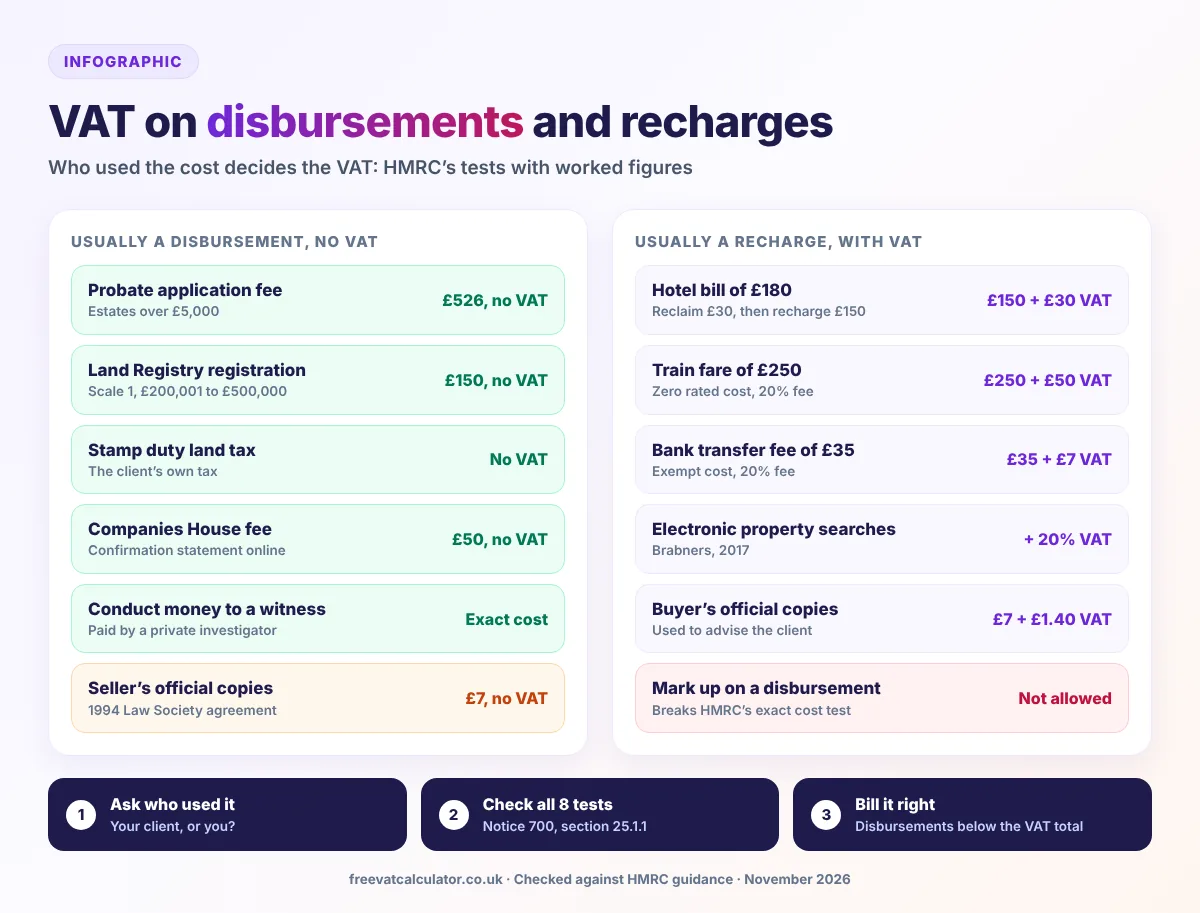
Disbursements vs recharges: costs that are part of your own supply
A recharge is a cost you incur in doing the work, which you pass on to the client as part of your price. GOV.UK’s guidance on costs or disbursements passed to customers says you must charge VAT on a recharge whether or not you paid VAT on it. Showing the cost on its own line does not turn it into a disbursement.
Travel, hotels and subsistence
Train fares, flights, taxis, hotels and meals you buy to do a job are supplies to you, even when the client agreed to pay for them. Notice 700 gives the example of a consultant whose air fare cannot be a disbursement, because the airline carries the consultant, not the client. In Medical Services and Equipment Ltd (LON/94/1702A), the tribunal applied the same reasoning to a consultant’s air fares and hotel bills for a client hospital.
One narrow exception exists for solicitors. HMRC’s valuation manual VATVAL13200 records an agreement with the Law Society that travel or accommodation paid from money held for the client, with the client’s authority, need not be added to the solicitor’s fee. HMRC states that this does not extend to other professions.
Phone, postage, printing and mileage
Your own calls, postage, printing and photocopying are overheads, so they go into the price of your service and take its VAT rate. A charge per mile for using your car is simply part of your fee as well. Postage has its own rules for mailing houses, which our guide to VAT on postage explains.
Bank transfer fees
A bank’s charge for a CHAPS or telegraphic transfer is exempt, but the bank supplies that service to you. Notice 700 gives this as its first example of a cost that cannot be a disbursement, and the tribunal reached the same answer for CHAPS fees in Shuttleworth and Co (LON/94/986A). Recharge a £35 transfer fee alongside a standard rated fee and it carries £7.00 of VAT.
Costs from suppliers that are not VAT registered
HMRC names costs from unregistered suppliers as a particular risk in VTAXPER38500. If a freelancer who is not VAT registered helps you deliver your own work, the bill has no VAT, but your recharge of it still carries your fee’s rate. Calling it a disbursement would take that value out of VAT altogether, which is exactly what HMRC checks for.
Recharging expenses: how to work out the VAT
A recharge follows the VAT treatment of your main supply, not of the cost. If your fee is standard rated, every recharge on the same invoice is standard rated too, and if your fee is exempt, so is the recharge. In the Dalesid case, cited in VTAXPER39000, a bank’s recharged surveyors’ fees shared the exemption of its loan, so the borrower had no VAT to reclaim.
| Cost | What you paid | VAT you reclaim | Recharge before VAT | VAT you add | Line total |
|---|---|---|---|---|---|
| Hotel room | £180.00, including £30.00 VAT | £30.00 | £150.00 | £30.00 | £180.00 |
| Train fare, zero rated | £250.00 | £0.00 | £250.00 | £50.00 | £300.00 |
| Bank transfer fee, exempt | £35.00 | £0.00 | £35.00 | £7.00 | £42.00 |
| Freelancer not VAT registered | £400.00 | £0.00 | £400.00 | £80.00 | £480.00 |
Costs that had VAT on them: reclaim it, then charge VAT on the net cost
When the supplier charged VAT, reclaim it as input tax in box 4 and recharge the cost without that VAT. A £180 hotel bill including £30.00 of VAT becomes a £150.00 recharge plus £30.00 of VAT, so the client pays the same £180.00 and the VAT cancels out.
Adding 20% to the full £180.00 instead produces a £216.00 line with £36.00 of VAT. The client pays £36.00 more than it should, and you have quietly marked the room up by £30.00.
Costs that had no VAT: you still add VAT
Train tickets are zero rated, yet a £250 fare recharged with a standard rated fee carries £50.00 of VAT, taking the line to £300.00. The same applies to anything bought from a supplier that is not VAT registered.
A client who cannot reclaim VAT can avoid that £50.00 by buying the ticket itself only if you are a solicitor. HMRC’s valuation manual lets solicitors leave travel the client pays for directly out of their fee, but other professionals cannot rely on that treatment.
Zero rated, exempt and overseas fees
Because the recharge is part of your price, a zero rated fee makes the recharge zero rated, and an exempt fee makes it exempt. With an exempt fee, the VAT on the cost normally cannot be reclaimed, subject to the partial exemption rules. The same logic applies to place of supply, so if your fee to an overseas business is outside the scope of UK VAT, the expenses billed with it are outside the scope as well.
Disbursements by profession: what usually qualifies
Costs that qualify tend to be statutory fees and taxes the client owes in its own right, or services the client itself receives from someone else. Costs that fail are the ones you use to produce your own advice or work.
Solicitors: stamp duty, court fees and Land Registry fees
HMRC’s solicitors page, VTAXPER46000, accepts court fees, stamp duty, and land charge and Land Registry fees as statutory charges that can be disbursements, along with fees for medical and police reports. Notice 700 names stamp duty and estate duty as examples of payments that are the client’s own responsibility. A probate application fee of £526 for an estate over £5,000, paid with the executors’ authority, normally passes on with no VAT.
Since 9 December 2024, an electronic application to register the transfer of a whole title worth £200,001 to £500,000 costs £150 under Land Registry fee scale 1. The registry charges no VAT, and the Law Society’s guidance says registration fees should ordinarily qualify as disbursements.
Medical reports and expert fees
In Barratt, Goff and Tomlinson [2011] UKFTT 71 (TC), released on 20 January 2011, the tribunal held that medical records and reports bought for clients were disbursements. The Court of Appeal took a narrower view in British Airways v Prosser [2019] EWCA Civ 547 on 2 April 2019, saying that in a typical case the solicitor is not the client’s agent and receives the reports to deliver its own service. Those comments did not bind later tribunals, but the Law Society expects many firms to take a conservative approach.
Property searches after Brabners
In Brabners LLP v HMRC [2017] UKFTT 666 (TC), the First tier Tribunal agreed with HMRC that electronic property searches were supplied to the law firm, which used the results in its own legal service. The firm was not a mere post box for the results, so about £68,000 of VAT became due for May 2012 to June 2015.
HMRC then withdrew the postal search concession from 1 December 2020 in Revenue and Customs Brief 6 (2020), saying the informal 1991 arrangement had no basis in law. A search can still be a disbursement where the results go to the client without comment, but not where you use them to advise.
Land Registry official copies
HMRC’s search fees page, VTAXPER47000, records a 1994 agreement with the Law Society under which a seller’s solicitor may pass on the fee for official copies as a disbursement. A buyer’s solicitor must add VAT, because it uses the copies to advise. At £7 per copy through the portal, that is £1.40 of VAT per copy on the buyer’s bill.
Accountants: Companies House fees
A Companies House fee is the company’s own legal cost, so an accountant who pays it as agent, itemises it and passes on the exact sum can treat it as a disbursement. The confirmation statement fee is £50 online or £110 on paper, under the Companies House fee list updated on 25 September 2026. The accountant’s own software, postage and travel stay inside the fee and carry VAT.
Estate agents
VTAXPER42000 says estate agents cannot treat photographs, advertising or boards as disbursements, even when they itemise them, because the agent uses them to sell the property. Printed brochures may be zero rated when the agent buys them, yet VAT must be added when the cost goes on the seller’s bill.
Garages and MOT test fees
An approved test centre’s MOT fee is outside the scope of VAT up to the statutory maximum, which is £54.85 for a car. A garage without its own test bay that arranges the test as the customer’s agent can pass on the test centre’s charge as a disbursement under section 25.4 of Notice 700, but anything it adds for arranging the test is standard rated. HMRC’s policy in VTAXPER48000 dates from 1 November 1996 and was upheld by the tribunal in M A Ward trading as Acorn Garage in January 1999.
Funeral directors
VAT Notice 701/32 allows a funeral director to pay newspapers, publishers and caterers as the family’s agent and pass on the exact cost outside the VAT on the funeral. Burial and cremation themselves are exempt, and fees paid to a church for a minister’s services are outside the scope of VAT.
Private investigators, search agencies and debt collectors
VTAXPER45000 lets a private investigator pass on conduct money paid to a court witness as a disbursement, at the exact amount, while train fares, postage and oath fees stay part of the investigator’s taxable fee. A search agency may recharge a Companies House search as a disbursement if it hands over the information without analysis, but not if it comments or reports on it, a rule HMRC has applied since 1 February 1998. Under section 25.6 of Notice 700, debt collectors acting as agents may treat court fees paid to solicitors as disbursements.
Tradespeople buying goods for customers
Goods follow a stricter rule. Section 47(2A) of the VAT Act 1994 treats goods bought by an agent acting in its own name as supplied to and by that agent, so a plumber who buys a boiler in its own name and fits it is selling the boiler, with VAT. Only a part the customer chose, ordered in the customer’s name and invoiced to the customer can sit outside the plumber’s own supply, and only if every condition is met.
How to show disbursements on an invoice
Put recharges with your fee inside the VAT calculation, then list disbursements on their own lines below the VAT, so the client can see they carry none. Notice 700/21 says a full VAT invoice shows the VAT rate and the amount before VAT for each description, and our guide to what a valid VAT invoice must include lists every other detail.
| Invoice line | Amount |
|---|---|
| Legal work on the probate application | £1,200.00 |
| Recharged train fare to meet the executors | £60.00 |
| Value for VAT | £1,260.00 |
| VAT at 20% | £252.00 |
| Disbursement: probate application fee, no VAT | £526.00 |
| Total due | £2,038.00 |
Notice 700 uses the same layout in its own example. An £80 fee and £20 of expenses make £100 for VAT, VAT of £20 is added, and a £50 disbursement goes on underneath for a total of £170.
Disbursements that include VAT
If the supplier charged VAT, you cannot reclaim it on a disbursement, and your client can reclaim it only with a VAT invoice addressed to the client. The alternative is to treat yourself as buying and reselling the service under section 47(3) of the VAT Act 1994, reclaim the VAT and charge VAT on the net cost. The Law Society’s worked example shows the client paying the same £1,320.00 either way, with £200.00 of VAT shown in one version and £220.00 in the other.
Records to keep
Keep the client’s authority, the order form and a copy of each supplier’s invoice, and record disbursements apart from your input tax. Notice 700/21 says VAT records must be kept for at least 6 years. Good records are your only defence if HMRC questions a disbursement years later, because the burden of proof is on you.
Disbursements, the VAT threshold and the Flat Rate Scheme
Taxable turnover and the £90,000 threshold
Your VAT taxable turnover is the total of what you sell that is not exempt, and a true disbursement is not your sale, so it stays out of the £90,000 registration test. Recharges are part of your sales and count in full, which is why ACCA notes that the split matters most to businesses close to the threshold. Our VAT threshold guide explains the rolling 12 month test.
Flat Rate Scheme turnover
On the Flat Rate Scheme, section 6.4 of Notice 733 says money you receive for genuine disbursements is not part of your flat rate turnover. A recharge is part of your sale, so its VAT inclusive amount goes into flat rate turnover and attracts your flat rate percentage. At the 14.5% rate for accountancy and legal services, recharging a £300.00 train fare plus £60.00 of VAT adds £52.20 to what you pay HMRC, as our Flat Rate VAT scheme guide explains in more detail.
When disbursement treatment saves money
Disbursement treatment only lowers the client’s bill when the supplier charged no VAT and the client cannot reclaim VAT, such as a private individual, a small charity or a business making exempt supplies. For a VAT registered client, the VAT on a recharge is reclaimable, so the difference is cash flow rather than money lost.
- Helps: a fee with no VAT, such as a court or Land Registry fee, billed to a private client
- Helps: a client that is not VAT registered or makes exempt supplies
- Neutral: a VAT registered client that reclaims the VAT anyway
- Hurts: a supplier’s bill with VAT, which you cannot reclaim as a disbursement
- Hurts: a cost you used yourself, which HMRC can assess years later
Common mistakes with VAT on disbursements
Most errors start with the word disbursement being used loosely on bills. These are the ones that cost money, with the VAT difference on each.
| Mistake | What should happen | VAT difference |
|---|---|---|
| A £250 train fare recharged with no VAT | Add 20% with the fee | £50.00 of output tax underpaid |
| 20% added to a £180 hotel bill that already included VAT | Reclaim £30, then charge VAT on £150 | Client overcharged by £36.00 |
| A £180 hotel bill passed on as a disbursement | Recharge £150 plus £30 VAT | A VAT registered client loses £30.00 it could reclaim |
| A £60 electronic search fee passed on with no VAT after you advised on it | Recharge it with VAT | £12.00 of output tax underpaid |
| A £400 bill from an unregistered freelancer billed as a disbursement | Recharge it with VAT | £80.00 of output tax underpaid |
| A handling fee added to a disbursement | Pass on the exact cost and bill the fee separately with VAT | VAT due on the fee, and the whole line is at risk |
Run through these quick checks before any cost goes on a client’s bill. They take a minute and catch most problems.
- Ask who used the supply: your client or you
- Get the client’s authority before you pay
- Pass on the exact amount, with no handling fee
- Keep VAT on disbursements out of your box 4 claim
Fixing a past disbursement error
If you have left VAT off recharges, you can correct the net error on your next return when it is no more than £10,000, or up to 1% of your box 6 figure with a ceiling of £50,000, while larger errors are reported to HMRC separately under Notice 700/45. Corrections can go back 4 years, and legislation confirmed at the Budget of 28 October 2026 will add a legal duty to correct errors once you find them, from 1 April 2028. Our guide on how to correct VAT errors sets out each step.
Need the VAT on the rest of the invoice?
Our invoice VAT calculator adds VAT line by line and totals the invoice for you.
VAT on disbursements FAQs
These are the questions people ask most when a cost goes on a client’s bill. Each answer follows HMRC guidance as it stood on 6 November 2026.
Do you charge VAT on disbursements?
No, a genuine disbursement carries no VAT on your invoice because it is not your supply. It must meet all eight conditions in Notice 700, and you cannot reclaim any VAT the supplier charged on it.
Is a hotel bill a disbursement?
Almost never, because the hotel supplies the room to you, not to your client. Reclaim the VAT on the bill and recharge the net cost with VAT at your fee’s rate.
Is a Land Registry fee a disbursement?
A registration fee normally is, as the registry charges no VAT and the fee is the client’s to pay. Official copies that a buyer’s solicitor uses to advise are a recharge and need VAT.
Can I add a mark up to a disbursement?
No, a disbursement must be passed on at exactly the amount you paid. Charge any handling or arranging fee as a separate line with VAT, as HMRC’s MOT guidance shows.
Are court fees subject to VAT?
Court fees carry no VAT, and a solicitor who pays one as the client’s agent can pass it on as a disbursement. A £526 probate application fee goes on the bill as £526, with nothing added.
Do disbursements count towards the VAT threshold?
No, a true disbursement is your client’s purchase, not your sale, so it stays out of taxable turnover. Recharges do count, so include them when you check the £90,000 limit.
What is the difference between a disbursement and a recharge?
A disbursement is something your client buys through you, while a recharge is something you buy to do your own work. The first carries no VAT and the second takes the VAT rate of your fee.
Can I reclaim VAT on a disbursement?
No, because the supply was made to your client, not to you. If the bill shows VAT and your client cannot get an invoice in its own name, treating the cost as a recharge is usually the better choice.
You now know how VAT on disbursements and recharges works, from telling one from the other to the VAT each takes and how to show both on an invoice. All the information you need is above, and the checker at the top runs HMRC’s eight tests on your next bill in seconds.
Sources: HMRC VAT Notice 700, sections 25.1 to 25.6; GOV.UK, VAT costs or disbursements passed to customers; VTAXPER38000; VTAXPER38500; VTAXPER39000; VTAXPER42000; VTAXPER45000; VTAXPER46000; VTAXPER47000; VTAXPER48000; VATVAL13200; Revenue and Customs Brief 6 (2020); VAT Notice 700/21; VAT Notice 700/45; VAT Notice 701/32; VAT Notice 733; GOV.UK, flat rates; GOV.UK, VAT thresholds; VAT Act 1994, section 47; Barratt, Goff and Tomlinson [2011] UKFTT 71 (TC); British Airways v Prosser [2019] EWCA Civ 547; Law Society, VAT treatment of disbursements and expenses; GOV.UK, probate fees; HM Land Registry, registration fees; HM Land Registry, information services fees; Companies House fees; GOV.UK, MOT test fees; Budget 2026 OOTLAR. This page is general information, not tax advice.