
Postage and delivery guide
VAT on Postage: Stamps, Couriers and Delivery Charges on Your Invoices
How to work out the VAT on a delivery charge
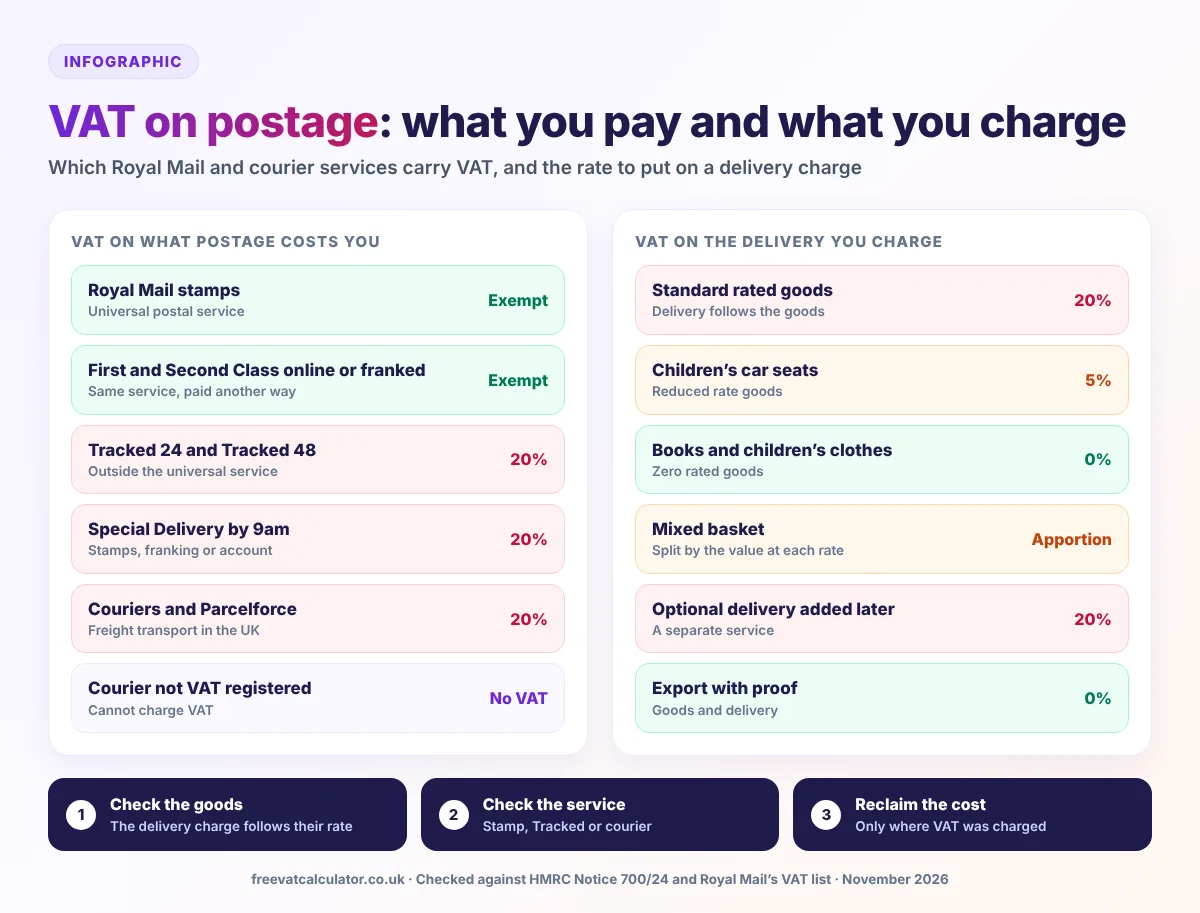
- Check the goods20%, 5% or 0%
- Check the contractIs delivery part of the sale?
- Apply the rateDelivery follows the goods
- Check the serviceStamp, Tracked or courier
- Reclaim the costOnly where VAT was charged
You post an order with a Royal Mail stamp that had no VAT on it, add £3.99 for delivery, and wonder whether that line needs VAT. The courier invoice shows 20%, book orders seem different, and a basket at two VAT rates leaves you unsure how to split one charge.
This guide starts with a checker for the VAT on a delivery charge and on the postage you paid. It then covers Royal Mail, couriers, mixed baskets, P and P, recharges and parcels abroad, so you know how VAT on postage works for every order.
Delivery charge VAT checker: the VAT on postage you charge and reclaim
Enter the goods at each VAT rate, the delivery charge and how you send the parcel. The checker applies the rule that delivery follows the goods.
Delivery charge VAT checker
The VAT on the delivery you charge, and the VAT you can reclaim on what the postage cost you
Mixed basket: £0.67 of VAT on the delivery
The delivery charge is split in proportion to the goods at each rate, and each share takes the rate of the goods it carries.
Reclaim £0.80 of VAT on the postage
Couriers and Parcelforce charge VAT at 20%, so the £4.80 includes £0.80 (£4.80 ÷ 6). Reclaim it in box 4 with the VAT invoice or receipt, so the real cost is £4.00.
The working
Goods total £60.00, so the £6.00 delivery splits into £4.00 at 20% (66.7% of the goods) and £2.00 at 0% (33.3%). VAT: £4.00 ÷ 6 = £0.67, a total of £0.67 on the delivery.
The checker splits a mixed delivery charge by the value of the goods at each rate, which is one fair method, so use the same method every time. It assumes the postage cost includes any VAT and that you hold a valid VAT invoice or receipt. Figures are rounded to the nearest penny, and nothing you enter is stored or sent.
Key facts
- Royal Mail stamps
- Exempt, so no VAT to pay or reclaim
- Tracked 24 and 48
- 20% VAT, reclaimable with a receipt
- Couriers and Parcelforce
- Usually 20% VAT
- Delivery you charge
- Follows the VAT rate of the goods
- Optional delivery added later
- Always 20% in the UK
- Exports with proof
- Goods and delivery zero rated
Is there VAT on postage?
There is no VAT on Royal Mail stamps or standard First and Second Class post, because the universal postal service is exempt. Couriers, Parcelforce and Royal Mail’s tracked and contract services usually charge 20%. What you charge for delivery depends on the goods, not the stamp.
- ExemptStamps and standard First or Second Class
- 20%Tracked, couriers and Parcelforce
- Goods rateThe delivery charge you add
| Situation | VAT on the cost to you | VAT on your charge to the customer |
|---|---|---|
| Royal Mail stamps, or standard First or Second Class | None, exempt | The rate of the goods |
| Royal Mail Tracked 24 or Tracked 48 | 20% | The rate of the goods |
| A VAT registered courier, or Parcelforce | 20% | The rate of the goods |
| Free delivery built into the price | As above | No separate charge |
| Optional delivery added after the sale | As above | 20% |
| Goods exported with proof | Usually none | 0% |
Two separate supplies: what you pay and what you charge
Royal Mail’s exempt supply is made to you, not to your customer. VAT Notice 700 and VTAXPER43000 say your charge is taxable even if it matches the Royal Mail charge exactly.
Never copy the VAT position of the stamp onto your invoice. The stamp tells you what you can reclaim, and the goods tell you what to charge.
Exempt is not the same as zero rated
An exempt supply carries no VAT and stays out of taxable turnover, while a zero rated supply is taxable at 0%. So zero rated delivery on a book order is still a taxable sale.
VAT on Royal Mail: which services are exempt and which carry 20%
Royal Mail publishes the VAT status of each product, and HMRC lists the exempt ones at VPOST9100. Basic universal services are exempt, while tracked, timed, bulk and negotiated services carry 20%.
| Royal Mail service | VAT |
|---|---|
| First and Second Class by stamp, online, franking or the universal account with no volume discounts | Exempt |
| Special Delivery Guaranteed by 1pm with stamps or franking | Exempt |
| Signed For, unless added to a standard rated service | Exempt |
| International Standard, Economy, Signed, and Tracked and Signed | Exempt |
| Tracked 24 and Tracked 48 | 20% |
| Special Delivery by 9am, or by 1pm on an account | 20% |
| Royal Mail Sameday, Business Mail and First and Second Class Account Mail | 20% |
| International Business services on contract | 0% |
Why only the universal service is exempt
Group 3 of Schedule 9 to the VAT Act 1994 exempts public postal services from a universal service provider, and only Royal Mail qualifies in the UK. Note 4 excludes services whose price is not controlled or whose terms are freely negotiated, though VPOST4150 says minor changes to a standard contract do not count.
Royal Mail services that carry VAT
Royal Mail’s universal First and Second Class account has no volume discounts and is exempt, but Business Mail and First and Second Class Account Mail carry 20%. Check the VAT column on each account invoice.
Franking machines and online postage
Franked and online First and Second Class postage is exempt like stamps, because the exemption follows the service. A franked Special Delivery by 9am item is still standard rated.
How the postal exemption narrowed
The European Court of Justice ruled in the TNT Post UK case on 23 April 2009 that only supplies made as the universal service provider are exempt, not individually negotiated ones. UK law changed from 31 January 2011, and HMRC’s exempt list runs from 1 April 2012, when the Postal Services (Universal Postal Service) Order 2012 took effect.
VAT on courier and Parcelforce services
Couriers such as DPD, Evri, DHL and UPS are not universal service providers, so the exemption never applies to them. VAT Notice 744B makes freight transport supplied in the UK standard rated, and the Post Office states that Parcelforce prices include VAT at 20%.
VAT on delivery charges when you sell goods
VAT Notice 700/24 turns on one question: does your contract require you to deliver? If it does, goods and delivery are one supply of delivered goods, and the delivery charge takes the rate of the goods.
| Goods in the sale | VAT on the goods | VAT on the delivery charge |
|---|---|---|
| Adult clothing, electronics and furniture | 20% | 20% |
| Children’s car seats | 5% | 5% |
| Books, children’s clothes and most groceries | 0% | 0% |
| Hot takeaway food | 20% | 20% |
| Valid UK stamps sold at face value | Exempt | Exempt |
Delivery that is part of the sale follows the goods
Online and phone sales normally include delivery to an address the customer chooses. Notice 700/24 says itemising the charge changes nothing, so £3.99 of delivery on a book order is zero rated.
Free delivery and free delivery thresholds
With free delivery there is no separate charge, so VAT is due on the full price at the rate of the goods, as HMRC clarified in Notice 700/24 on 30 September 2022. With free postage over £40, larger orders follow this rule and a charge on smaller orders follows the goods.
Optional delivery, goods on approval and delivering for others
Delivery is a separate supply when the contract does not require it, such as a shop sale you later agree to deliver for a fee. That charge is always standard rated in the UK, even for zero rated goods, as is delivery of goods on approval or of someone else’s goods.
Mixed baskets: splitting one delivery charge between VAT rates
One delivery charge on goods at different rates has to be split, because section 19(4) of the VAT Act 1994 treats each supply as made for the part of the price properly attributable to it. Splitting by the value of the goods mirrors the selling price method in HMRC’s guidelines GfC2 (2023), though VATVAL03700 says other methods should not be rejected out of hand.
- Add up the goods at each VAT rate, at the prices the customer pays.
- Split the delivery charge in the same proportions.
- Take the VAT out of each VAT inclusive share: divide by 6 at 20% and by 21 at 5%.
- Add the shares’ VAT together.
Say an order holds £40.00 of toys at 20% and £20.00 of books at 0%, with £6.00 of delivery including VAT. Two thirds of the delivery, £4.00, is standard rated and holds £0.67 of VAT, while the other £2.00 is zero rated.
Check your answer against the extremes. The VAT sits between nothing, if every item is zero rated, and one sixth of a VAT inclusive charge, if every item is standard rated.
VAT on postage and packaging (P and P) on your invoices
A single P and P line follows the goods when the contract includes delivery. Notice 701/8 applies this to stamp and philatelic sales, and section 8.3 of Notice 700 to all goods.
A separate packing charge
A separate packing charge is standard rated within the UK under Notice 700/24, even on zero rated goods. Packing for a journey abroad can instead be a transport related service under Notice 744B.
What a VAT invoice should show
Notice 700/21 says a full VAT invoice shows the VAT rate and the amount without VAT for each description, so give delivery its own line, or two if you split it. Invoices of £250 or less including VAT can be simplified, and our guide to what a valid VAT invoice must include lists every detail.
Recharging postage to customers and clients
Postage you buy and pass on is part of your own supply and takes its VAT rate. So courier costs a consultant adds to a fee take the fee’s rate.
When postage can be treated as a disbursement
Section 25.1.1 of Notice 700 lets you leave a payment out of your VAT only if all eight conditions are met. In short, these are the tests.
- You paid as your client’s agent
- Your client received and used the service
- Your client was responsible for paying
- Your client authorised the payment
- Your client knew a third party would supply it
- The cost is itemised separately
- You recover exactly what you paid
- It is clearly additional to your own supplies
Postage rarely passes, as Notice 700 says the test usually excludes your own postage costs. Notice 700/24 allows it for direct marketing firms posting printed matter that meet those tests, stop being responsible once the mail operator accepts the mail and pass on any discount or rebate in full.
Reclaiming VAT on postage and courier costs
A VAT registered business reclaims VAT on postage only where a supplier charged it, so there is nothing to reclaim on stamps or an unregistered courier. You reclaim the 20% on Tracked, courier and Parcelforce costs with a valid VAT invoice or receipt.
Stamps bought above face value
Unused UK stamps sold at or below face value carry no VAT, but Notice 701/8 says a seller charging more accounts for VAT on the excess. Only that VAT can be reclaimed, with a VAT invoice.
Flat Rate Scheme users
On the Flat Rate Scheme you cannot reclaim VAT on purchases, except certain capital assets over £2,000, so courier VAT stays a cost. Our Flat Rate VAT scheme guide explains the rest.
Where postage goes on your VAT return
VAT on delivery charges goes in box 1, the charges without VAT in box 6 and courier VAT in box 4. Notice 700/12 puts purchases without VAT in box 7, and postage is not on its list of items to leave out.
VAT on international postage and delivery
Exports outside the UK
Goods sent outside the UK are zero rated with evidence of export, and so is delivery in the same sale. Notice 703 allows 3 months to get the evidence: a certificate of posting for packages up to 2kg, or a customs declaration and proof of shipment for parcels.
International freight is zero rated under Notice 744B, so posting abroad usually has no UK VAT to reclaim. Keep the proof for 6 years.
Selling to customers in the EU
A sale from Great Britain to an EU consumer is an export for UK VAT, so goods and delivery are zero rated here. The customer’s country then charges import VAT, and our VAT for ecommerce guide covers the €150 Import One Stop Shop.
Northern Ireland
A sale between Great Britain and Northern Ireland is a normal UK sale, and HMRC’s guidance says the VAT is worked out in the normal way. Sales from Northern Ireland to EU consumers carry UK VAT until they pass the EU wide threshold of £8,818 (€10,000) in a calendar year.
Parcels coming into the UK and the £135 rule
On goods sold into Great Britain in consignments of £135 or less, the seller or marketplace charges VAT at checkout. HMRC measures that £135 without transport costs shown separately, but delivery built into the price counts.
Above £135, import VAT falls on the customs value plus duty and transport, packing and insurance to the first UK destination. Duty relief on £135 consignments ends by October 2028 at the latest, and our import VAT and customs duty calculator shows the landed cost.
Food deliveries, margin scheme goods and marketplaces
Takeaway and grocery deliveries
GOV.UK’s VAT rates guide says takeaways must charge VAT on hot takeaways and home deliveries, so that delivery carries 20%. Delivery of zero rated groceries is zero rated, as our guide to VAT on food explains.
Second hand goods under the margin scheme
HMRC’s margin scheme guidance of 2 November 2026 counts everything received for the goods, including incidental expenses linked to the sale, as the selling price. A delivery charge in the sale therefore normally sits inside the margin calculation.
Marketplace sales from October 2027
The Budget on 28 October 2026 announced that marketplaces are to account for the VAT on most UK sellers’ sales of goods to consumers from October 2027, with regulations still to come. Until then you charge VAT on marketplace delivery yourself, as our online marketplace VAT guide explains.
Common VAT on postage mistakes
Most errors come from mixing up the cost of postage with the charge to the customer. Watch for these.
- Charging no VAT on postage because the stamp had none
- Charging 20% on delivery for zero rated books
- Reclaiming one sixth of a stamp purchase
- Forgetting to reclaim VAT on courier invoices
- Using one rate for delivery on a mixed basket
- Zero rating an export without proof
Need the VAT on a whole order?
Our main VAT calculator adds or removes VAT at 20%, 5% or 0% on any price.
VAT on postage FAQs
These are the questions sellers ask most. Each answer reflects HMRC guidance at 6 November 2026.
Is postage VAT exempt?
Royal Mail stamps and other universal services, such as standard First and Second Class, are exempt. Tracked and contract services, couriers and Parcelforce usually carry 20%.
Do you charge VAT on delivery?
Yes, if you are VAT registered and the goods are standard rated, because delivery follows the goods. Delivery of zero rated goods is zero rated, but optional delivery added after the sale is standard rated.
Can I claim VAT back on stamps?
No, because stamps are exempt and carry no VAT to reclaim. Their cost still goes in box 7 of your VAT return.
Is there VAT on Royal Mail Tracked 24?
Yes. Royal Mail lists Tracked 24 and Tracked 48 at the standard rate, so a VAT registered business can reclaim it with a valid receipt.
Do I charge VAT on postage if I am not VAT registered?
No, but your delivery charges still count towards taxable turnover. Include them when you check the £90,000 limit on our VAT threshold guide.
You now know where VAT on postage applies, what to charge on each delivery line and what you can reclaim. Everything you need to invoice your next order is above, and the checker gives the figures in seconds.
Sources: HMRC VAT Notice 700/24; VAT Notice 700, sections 8.3 and 25.1; VAT Notice 701/8; VAT Notice 744B; VAT Notice 703; VAT Notice 700/21; VAT Notice 700/12; VAT Act 1994, Schedule 9, Group 3; VPOST9100; VPOST4050; VPOST4150; VPOST3400; VTAXPER43000; Royal Mail, VAT and postal services; Post Office, Parcelforce prices; Court of Justice, TNT Post UK (2009); GfC2 (2023); VATVAL03700; GOV.UK, VAT rates on goods and services; GOV.UK, Flat Rate Scheme; GOV.UK, VAT thresholds; HMRC, goods of £135 or less; HMRC, import VAT; HMRC, low value imports; HMRC, GB and NI movements; HMRC, NI dispatches to the EU; HMRC, margin scheme selling price; Budget 2026 OOTLAR. This page is general information, not tax advice.