World VAT rates guide
VAT Rates by Country 2026: EU, UK and World VAT and GST Rates
How to find and use the right rate
- Find the countryWhere the sale is taxed
- Pick the rateStandard, reduced or zero
- Check the customerBusiness or consumer
- Work out the taxAdd or remove it
- Keep the evidenceRate, country and proof
A supplier in Germany sends an invoice with 19% on it, a customer in Ireland asks why your price has no Irish VAT, or a client in Australia wants a quote that includes GST. Every country sets its own rates, many have two or three of them, and the rules on whose rate applies change at the border. Pick the wrong one and the invoice, the price and possibly a foreign tax bill are all wrong.
This page puts the answers in one place. Use the calculator to add or remove VAT at any country’s rate, check the table of standard and reduced rates for 92 countries and territories, then read which rate a UK business should actually charge when it sells abroad. Every figure was checked in November 2026 against the European Commission, HMRC, national tax authorities and PwC’s Worldwide Tax Summaries, so you can rely on these VAT rates by country for invoices, prices and quotes.
VAT rates by country calculator
Choose a country, type an amount and say whether VAT is already included. The calculator loads that country’s standard and reduced rates from the table below, then shows the net amount, the tax and the gross amount with the working.
VAT rates by country calculator
Add or remove VAT, GST or consumption tax at any country’s rate
Germany: 19% standard rate
1,000.00 × 19% = 190.00 of VAT, so the total is 1,190.00.
Amounts stay in the currency you enter and are rounded to two decimal places. Rates come from the VAT rates by country table below, checked on 6 November 2026.
Key facts
- UK rates
- 20%, 5% and 0%
- Highest EU rate
- 27% in Hungary
- Lowest EU rate
- 17% in Luxembourg
- EU average
- 21.9% standard rate
- EU minimum
- 15% standard rate
- Lowest VAT in Europe
- 8.1% in Switzerland and Liechtenstein
- IOSS limit
- Consignments up to €150
VAT rates by country 2026: the full table
The table lists the standard rate and every reduced or other rate in force on 6 November 2026. Use the buttons to show one region, or type a name to find a country straight away.
Showing all 92 countries and territories.
| Country | Region | Standard rate | Reduced and other rates |
|---|---|---|---|
| Austria | EU | 20% | 13%, 10%, 4.9% |
| Belgium | EU | 21% | 12%, 6% |
| Bulgaria | EU | 20% | 9% |
| Croatia | EU | 25% | 13%, 5% |
| Cyprus | EU | 19% | 9%, 5%, 3% |
| Czechia | EU | 21% | 12% |
| Denmark | EU | 25% | None |
| Estonia | EU | 24% | 13%, 9% |
| Finland | EU | 25.5% | 13.5%, 10% |
| France | EU | 20% | 10%, 5.5%, 2.1% |
| Germany | EU | 19% | 7% |
| Greece | EU | 24% | 13%, 6% |
| Hungary | EU | 27% | 18%, 5% |
| Ireland | EU | 23% | 13.5%, 9%, 4.8% |
| Italy | EU | 22% | 10%, 5%, 4% |
| Latvia | EU | 21% | 12%, 5% |
| Lithuania | EU | 21% | 12%, 5% |
| Luxembourg | EU | 17% | 14%, 8%, 3% |
| Malta | EU | 18% | 12%, 7%, 5% |
| Netherlands | EU | 21% | 9% |
| Poland | EU | 23% | 8%, 5% |
| Portugal | EU | 23% | 13%, 6% |
| Romania | EU | 21% | 11% |
| Slovakia | EU | 23% | 19%, 5% |
| Slovenia | EU | 22% | 9.5%, 5% |
| Spain | EU | 21% | 10%, 4% |
| Sweden | EU | 25% | 12%, 6% |
| United Kingdom | Europe | 20% | 5%, 0% |
| Isle of Man | Europe | 20% | 5%, 0% |
| Jersey (GST) | Europe | 5% | None |
| Guernsey | Europe | None | None |
| Gibraltar | Europe | None | None |
| Norway | Europe | 25% | 15%, 12% |
| Iceland | Europe | 24% | 11% |
| Switzerland | Europe | 8.1% | 3.8%, 2.6% |
| Liechtenstein | Europe | 8.1% | 3.8%, 2.6% |
| Turkey | Europe | 20% | 10%, 1% |
| Ukraine | Europe | 20% | 14%, 7% |
| Moldova | Europe | 20% | 12%, 8% |
| Serbia | Europe | 20% | Not listed |
| Albania | Europe | 20% | Not listed |
| Montenegro | Europe | 21% | Not listed |
| North Macedonia | Europe | 18% | Not listed |
| Kosovo | Europe | 18% | Not listed |
| Bosnia and Herzegovina | Europe | 17% | Not listed |
| Georgia | Europe | 18% | None |
| Australia (GST) | Asia Pacific | 10% | None |
| New Zealand (GST) | Asia Pacific | 15% | None |
| Japan (consumption tax) | Asia Pacific | 10% | 8% |
| China | Asia Pacific | 13% | 9%, 6% |
| South Korea | Asia Pacific | 10% | None |
| Taiwan (business tax) | Asia Pacific | 5% | Not listed |
| India (GST) | Asia Pacific | 18% | 40%, 5% |
| Singapore (GST) | Asia Pacific | 9% | None |
| Malaysia (sales and service tax) | Asia Pacific | 10% | 8% service tax |
| Thailand | Asia Pacific | 7% | Not listed |
| Vietnam | Asia Pacific | 10% | Not listed |
| Philippines | Asia Pacific | 12% | Not listed |
| Indonesia | Asia Pacific | 12% | Not listed |
| Cambodia | Asia Pacific | 10% | Not listed |
| Hong Kong | Asia Pacific | None | None |
| Pakistan (sales tax) | Asia Pacific | 18% | 15% or 16% on services |
| Kazakhstan | Asia Pacific | 16% | Not listed |
| United Arab Emirates | Middle East | 5% | None |
| Saudi Arabia | Middle East | 15% | None |
| Bahrain | Middle East | 10% | Not listed |
| Oman | Middle East | 5% | Not listed |
| Qatar | Middle East | None | None |
| Kuwait | Middle East | None | None |
| Israel | Middle East | 18% | Not listed |
| South Africa | Africa | 15% | Not listed |
| Egypt | Africa | 14% | Not listed |
| Morocco | Africa | 20% | Not listed |
| Nigeria | Africa | 7.5% | Not listed |
| Ghana | Africa | 15% | Not listed |
| Kenya | Africa | 16% | Not listed |
| Tanzania | Africa | 18% | Not listed |
| Uganda | Africa | 18% | Not listed |
| Rwanda | Africa | 18% | Not listed |
| Zambia | Africa | 16% | Not listed |
| United States (sales tax) | Americas | None | None |
| Canada (GST and HST) | Americas | 5% | 13%, 14%, 15% HST |
| Mexico | Americas | 16% | Not listed |
| Brazil | Americas | Varies | Varies |
| Argentina | Americas | 21% | Not listed |
| Chile | Americas | 19% | Not listed |
| Colombia | Americas | 19% | Not listed |
| Peru | Americas | 18% | Not listed |
| Ecuador | Americas | 15% | Not listed |
| Uruguay | Americas | 22% | 10% |
| Paraguay | Americas | 10% | 5% |
| Panama | Americas | 7% | Not listed |
“None” means the country has no reduced rate, and “Not listed” means only the standard rate is shown, taken from PwC’s quick chart, so check the local tax authority before you use a lower rate. Zero rates appear only for the UK and the Isle of Man, because almost every country zero rates exports and the domestic zero rates vary widely.
Types of VAT rate: standard, reduced, super reduced and zero
Standard rate
The standard rate covers everything that is not given a lower rate or an exemption. Under the EU VAT Directive it must be at least 15%, with no upper limit, which is why EU standard rates run from Luxembourg’s 17% to Hungary’s 27%.
Reduced rates
EU countries may apply up to two reduced rates of at least 5% to the categories listed in Annex III of the VAT Directive, such as food, water, medicines, books, passenger transport and hotel stays. Each country can apply its reduced rates to no more than 24 of the categories in that annex, and it chooses which ones to use.
Super reduced and parking rates
A super reduced rate is any rate below 5%, such as France’s 2.1%, Luxembourg’s 3% and the 4% charged in Italy and Spain. A parking rate of at least 12% is a leftover from older rules, kept by Austria, Belgium, Ireland, Luxembourg and Portugal for goods that were taxed at a lower rate under older rules.
Zero rate and exempt supplies
A zero rated sale is still taxable, so the seller charges 0% but can reclaim the VAT on its costs, and the UK zero rates most food, children’s clothes and books. An exempt sale has no VAT at all and the seller usually cannot reclaim the VAT it paid, which is how most countries treat insurance, finance and many health services.
EU VAT rates 2026 for all 27 member states
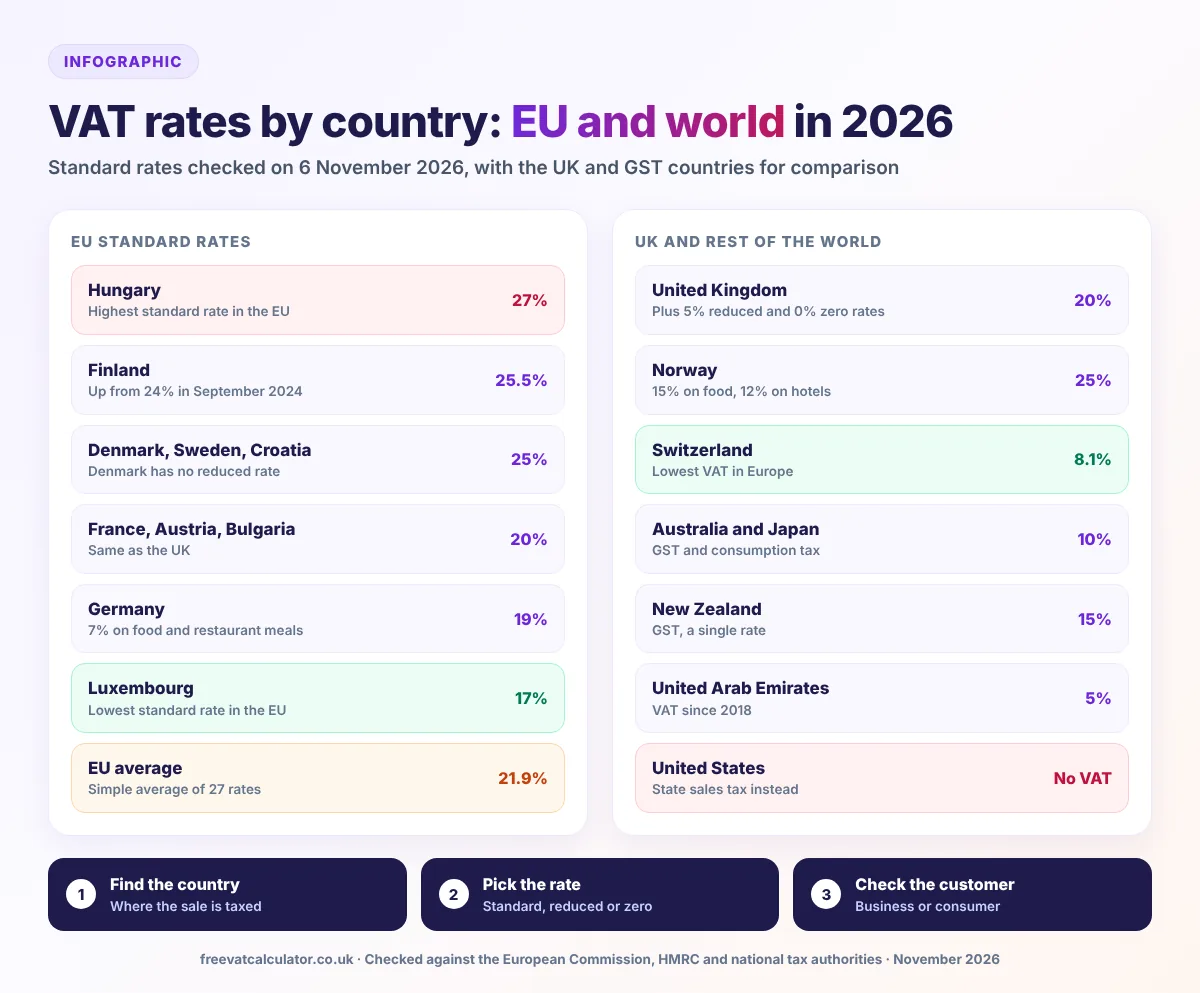
Every EU country follows the same VAT Directive, but each sets its own numbers within it. The simple average of the 27 standard rates is 21.9%, the same figure the Tax Foundation publishes for 2026.
EU VAT number prefixes
Every EU VAT number starts with a two letter prefix, which you need when you check a customer’s number on the European Commission’s VIES service. Most prefixes match the country code, but Greece uses EL rather than GR, and Northern Ireland businesses trading goods with the EU use XI.
Islands and territories with their own rates
Some parts of member states charge less than the mainland. Madeira charges 22%, 12% and 4% and the Azores 16%, 9% and 4%, while certain Greek Aegean islands apply rates 30% lower, at 17%, 9% and 4%. In France, Guadeloupe, Martinique and Réunion use a standard rate of 8.5% and a reduced rate of 2.1%.
Reduced VAT rates by category: food, hotels, restaurants and books
The same product can carry very different rates across Europe, so the category matters as much as the country. The table compares four common categories in eight countries, using each country’s 2026 rates.
| Country | Basic food | Restaurant meals | Hotel rooms | Printed books |
|---|---|---|---|---|
| Germany | 7% | 7% for food, 19% for drinks | 7% | 7% |
| France | 5.5% | 10% | 10% | 5.5% |
| Spain | 4% or 10% | 10% | 10% | 4% |
| Netherlands | 9% | 9% | 21% | 9% |
| Belgium | 6% | 12% for food, 21% for drinks | 12% | 6% |
| Ireland | 0% for most | 9% | 13.5% | 0% |
| Sweden | 6% | 12% | 12% | 6% |
| Finland | 13.5% | 13.5% | 13.5% | 13.5% |
Food and drink
Basic food is taxed at a reduced or zero rate almost everywhere, but drinks are often treated differently. Sweden cut VAT on food from 12% to 6% on 1 April 2026, a temporary measure that runs to 31 December 2027, and Austria added a 4.9% rate for staples such as bread, butter, eggs and milk from 1 July 2026.
Germany shows how fine the lines can be, because a milk drink with at least 75% milk is taxed at 7% to take away but 19% when it is drunk on the premises. Ireland and the UK go further than most countries and zero rate a large share of basic food.
Restaurants and takeaways
Germany made its 7% rate for restaurant and catering food permanent from 1 January 2026, although drinks served with a meal stay at 19%. Ireland moved food and catering services, hot takeaway food and hairdressing from 13.5% to 9% on 1 July 2026, and Finland taxes restaurant meals at its 13.5% rate.
Hotels and holiday accommodation
VAT on hotel rooms has gone up in several countries since the start of 2025. The Netherlands raised accommodation from 9% to 21% on 1 January 2026, although breakfast included with a stay remains at 9%, while Belgium moved hotels and campsites from 6% to 12% on 1 March 2026 and Estonia has charged 13% on accommodation since 1 January 2025.
Books, newspapers and e books
Books are among the most common reduced rate items, and several countries zero rate them. Czechia has charged 0% on books since 1 January 2024, Ireland zero rates printed books, and Lithuania moved books to 5% when it abolished its 9% rate on 1 January 2026. For the UK position, see our guide to VAT on books.
VAT rates in Europe outside the EU
Leaving the EU does not mean leaving VAT, and most of the continent’s non EU countries charge rates close to the EU’s. The exceptions are the lowest European VAT rates of all: Switzerland and Liechtenstein at 8.1%, and Jersey’s 5% GST.
United Kingdom and the Isle of Man
The UK charges a 20% standard rate, a 5% reduced rate and a 0% zero rate, and the Isle of Man shares the UK’s VAT system and rates with a few local differences, such as for hotel accommodation. Our page on UK VAT rates and their history explains which goods fall into each band.
Channel Islands and Gibraltar
Jersey charges GST at 5% on most goods and services and on imports, and a business must register once its turnover passes £300,000. Jersey collects GST on imported goods worth £60 or more, while Guernsey and Gibraltar have no VAT or GST for now. Guernsey’s States voted in October 2026 to bring in a GST of 3%, rising to 5% over four years, with 2028 the earliest target date and no start date fixed yet. Gibraltar is not tax free on imports, though, because since the UK and EU treaty began to apply on 15 July 2026 it charges a transaction tax on imported goods at 15%, rising to 17% by the third year.
Switzerland and Liechtenstein
Switzerland’s rates have been 8.1% standard, 3.8% for hotel stays with breakfast and 2.6% for food, medicines, books and newspapers since 1 January 2024. Restaurant food is taxed at the full 8.1%, menstrual hygiene products moved to the 2.6% rate on 1 January 2025, and Liechtenstein applies the same rates through its customs union with Switzerland.
Norway and Iceland
Norway charges 25% standard, 15% on food (but not restaurant meals) and 12% on passenger transport, hotel stays, cinema and events, with 0% on books, newspapers and some electric cars. Foreign businesses register once sales pass NOK 50,000 in 12 months, and overseas sellers of goods worth under NOK 3,000 an item can use the simplified VOEC scheme. Iceland charges 24%, with a single reduced rate of 11%.
Turkey, Ukraine and the Balkans
Turkey charges 20%, with reduced rates of 10% and 1%, and Ukraine charges 20%, with 14% and 7%. In the Balkan countries outside the EU, standard rates run from 17% in Bosnia and Herzegovina to 21% in Montenegro, Moldova charges 20% with reduced rates of 12% and 8%, and Georgia a single 18%.
GST rates by country: Australia, New Zealand, Canada, India and Singapore
GST is VAT under another name: it is charged at each stage, and registered businesses reclaim the GST on their costs. The rates are mostly lower than Europe’s, from 5% in Canada to 18% in India, but the registration rules can still catch overseas sellers.
Australia
Australia charges GST at 10%, and basic food, most health care and most education are GST free. A business must register once its GST turnover reaches A$75,000, or A$150,000 for a non profit body.
New Zealand
New Zealand charges a single GST rate of 15%, and a business registers once its turnover passes NZ$60,000 in 12 months. Inland Revenue’s shortcut for finding the GST inside a GST inclusive price is to multiply it by 3 and divide by 23.
Canada: GST, HST and provincial taxes
Canada’s federal GST is 5%, according to the Canada Revenue Agency, but five provinces combine it with their own tax into a single harmonised sales tax, or HST. Quebec, British Columbia, Manitoba and Saskatchewan charge their own sales tax on top of the 5% instead, and Nova Scotia cut its HST from 15% to 14% on 1 April 2025.
| Province or territory | Federal or harmonised tax | Provincial tax |
|---|---|---|
| Alberta | 5% GST | None |
| British Columbia | 5% GST | 7% PST |
| Manitoba | 5% GST | 7% PST |
| New Brunswick | 15% HST | Included in HST |
| Newfoundland and Labrador | 15% HST | Included in HST |
| Nova Scotia | 14% HST | Included in HST |
| Ontario | 13% HST | Included in HST |
| Prince Edward Island | 15% HST | Included in HST |
| Quebec | 5% GST | 9.975% QST |
| Saskatchewan | 5% GST | 6% PST |
| Northwest Territories, Nunavut and Yukon | 5% GST | None |
India
India moved to a simpler GST structure on 22 September 2025, with two main rates of 5% and 18% and a special 40% rate for luxury and sin goods. Tobacco products stay on the older rates until the compensation cess obligations end.
Singapore and Malaysia
Singapore charges GST at 9%, the rate since 1 January 2024. Malaysia scrapped its GST in 2018 and now charges a sales tax of 10% on most taxable goods and a service tax of 8%, with lower rates for some items.
VAT in Asia, the Middle East and Africa
Outside Europe the tax goes by many names, but the mechanics are the same and most rates sit between 5% and 18%. The Gulf states introduced VAT only recently, while several large Asian economies use more than one rate.
Japan, China and South Korea
Japan’s consumption tax is 10%, made up of 7.8% national and 2.2% local tax, with an 8% rate for food and non alcoholic drinks (but not meals eaten in or alcohol) and for subscribed newspapers issued at least twice a week. The Cabinet sent the Diet a bill on 9 October 2026 that would cut the tax on food to 1% for two years from 1 April 2027, but this is still only a proposal, because the Diet had not passed it when we checked on 6 November 2026.
China charges 13% on most goods, 9% on items such as farm produce, transport and construction, and 6% on many services, and its new VAT Law took effect on 1 January 2026. South Korea charges a single rate of 10%.
South East Asia
Thailand charges 7%, Vietnam and Cambodia 10%, and the Philippines and Indonesia 12%. Taiwan’s business tax is 5% for general industries, and Hong Kong has no VAT or sales tax at all.
The Gulf states and Israel
The UAE charges 5% VAT and Saudi Arabia 15%, a rate it tripled from 5% on 1 July 2020. Bahrain charges 10% and Oman 5%, Qatar and Kuwait have not introduced VAT, and Israel charges 18%.
Africa
South Africa charges 15%, after a planned rise to 15.5% from 1 May 2025 was withdrawn. Kenya and Zambia charge 16%, Egypt 14%, Morocco 20%, Tanzania, Uganda and Rwanda 18%, and Nigeria 7.5%, one of the lowest rates on the continent. Ghana’s standard rate is 15%, but two levies of 2.5% each are charged on top.
VAT and sales tax in the Americas
United States sales tax
The United States has no VAT or national sales tax. Instead, most states and many cities charge a retail sales tax that only the final consumer pays, and Alaska, Delaware, Montana, New Hampshire and Oregon have no statewide sales tax.
Because there is no federal tax, a UK business selling to US consumers deals with each state’s rules, which usually depend on how much it sells into that state. Our calculator lists the US with no VAT, and you can enter a state’s rate as a custom rate.
Latin America
Most of Latin America uses VAT, often called IVA. Mexico charges 16%, Argentina 21%, Uruguay 22%, Chile and Colombia 19%, Peru 18%, Ecuador 15% and Paraguay 10%, with Paraguay and Uruguay also using reduced rates of 5% and 10%.
Brazil
Brazil has no single VAT rate, but several overlapping taxes, including a state ICMS that usually runs from 17% to 20% and a municipal ISS of 2% to 5% on services. A reform is replacing them with a dual VAT, phased in between 2026 and 2033.
Highest and lowest VAT rates in the world
Highest VAT rates
Comparing VAT rates by country, Hungary’s 27% is the highest standard rate in our table. Finland at 25.5%, then Croatia, Denmark, Sweden and Norway at 25%, follow close behind, which makes the Nordic countries the most expensive region for VAT.
- 27%Hungary, the highest standard rate
- 17%Luxembourg, the lowest EU standard rate
- 21.9%average EU standard rate
Lowest VAT rates
Among countries that charge VAT or GST, the 5% in Taiwan, the UAE, Oman and Jersey and Canada’s 5% federal GST are some of the lowest. Nigeria charges 7.5%, Thailand and Panama 7%, and Switzerland and Liechtenstein have the lowest standard VAT rate in Europe at 8.1%.
Countries with no VAT
A handful of places have no VAT or GST at all, often because they rely on oil revenue, customs duties or other taxes. In our table these are the United States, Hong Kong, Qatar, Kuwait, Guernsey and Gibraltar.
VAT, GST and sales tax: what is the difference?
VAT and GST work the same way: tax is charged at every stage of the supply chain, each business reclaims the tax on its purchases, and only the final consumer bears the cost. Sales tax is charged once, at the final retail sale, so a business buying goods to resell usually gives the seller an exemption certificate instead of paying tax and claiming it back.
Which country’s VAT rate should a UK business charge?
Knowing the rate is only half the job, because the rate you use depends on where the sale is taxed. That turns on three things: whether you sell goods or services, whether the customer is a business or a consumer, and where the goods move.
Selling goods to EU consumers
Goods sent from Great Britain to EU consumers are exports, so they leave the UK zero rated, but import VAT is due in the customer’s country at that country’s rate. For consignments worth up to €150, the seller can collect the EU VAT at checkout through the Import One Stop Shop (IOSS), which files monthly returns.
UK sellers cannot use the €10,000 threshold. That limit, below which a seller can charge its home rate on cross border sales to consumers, applies only to businesses established in a single EU member state, so a GB business owes the customer’s VAT from the first sale; our guide to VAT for ecommerce covers marketplaces and parcels in detail.
Northern Ireland businesses selling goods to EU consumers are treated differently. Below £8,818 (€10,000) of such sales a year they can charge UK VAT, and above it they charge the customer’s rate and report it through the Union One Stop Shop run by HMRC, keeping records for 10 years.
Digital services to EU consumers
Digital services such as apps, streaming, e books and online courses are taxed where the consumer lives, at that country’s rate, from the first sale for a UK business. Most UK sellers register for the non Union One Stop Shop in one EU country and file a single quarterly return covering every member state, as our guide to VAT on digital services explains.
Business customers and the reverse charge
Most services to a business customer abroad are taxed where the customer belongs, so the UK supplier charges no UK VAT and the customer accounts for its own country’s VAT under the reverse charge. HMRC’s VAT Notice 741A treats these services as outside the scope of UK VAT, so keep the customer’s VAT number or other proof that it is in business.
Exports from Great Britain
Goods exported from Great Britain to anywhere outside the UK can be zero rated, as long as you hold evidence of export within three months of the supply. HMRC’s VAT Notice 703 sets out what counts, such as customs export records and commercial transport documents.
VAT registration thresholds by country
Most countries make their own businesses register only once sales pass a threshold, but overseas sellers often have no threshold at all. The table shows the limits that matter most to UK businesses.
| Country or scheme | Threshold | Who it applies to |
|---|---|---|
| United Kingdom | £90,000 of taxable turnover in 12 months | UK established businesses (deregistration below £88,000) |
| United Kingdom, overseas sellers | No threshold | Businesses not established in the UK |
| EU cross border sales to consumers | €10,000 a year across the EU | Sellers established in one EU country, and Northern Ireland for goods |
| EU small business scheme | National limits up to €85,000, and €100,000 across the EU | EU established small businesses only |
| Jersey | £300,000 of turnover | Businesses supplying in Jersey |
| Norway | NOK 50,000 in 12 months | All businesses, NOK 140,000 for charities |
| Australia | A$75,000 of GST turnover | A$150,000 for non profit bodies |
| New Zealand | NZ$60,000 in 12 months | All businesses |
| Japan | ¥10 million of taxable sales | Measured in the base period two years earlier |
Japan’s test looks back at sales two years earlier rather than over a rolling 12 months, so a new business is usually outside the tax for its first two years. Our guide to the UK VAT threshold explains the £90,000 test and when to register.
How to add or remove VAT at any country’s rate
The maths is the same in every country; only the rate changes. To add VAT, multiply the net price by one plus the rate, and to remove it, divide the gross price by the same figure.
| Rate | Used in | To add | To remove | Tax inside a gross price |
|---|---|---|---|---|
| 27% | Hungary | × 1.27 | ÷ 1.27 | 27/127 |
| 25% | Croatia, Denmark, Norway, Sweden | × 1.25 | ÷ 1.25 | 1/5 |
| 21% | Belgium, Czechia, Netherlands, Spain | × 1.21 | ÷ 1.21 | 21/121 |
| 20% | UK, France, Austria | × 1.2 | ÷ 1.2 | 1/6 |
| 19% | Germany, Cyprus | × 1.19 | ÷ 1.19 | 19/119 |
| 15% | New Zealand, Saudi Arabia, South Africa | × 1.15 | ÷ 1.15 | 3/23 |
| 10% | Australia, Japan | × 1.1 | ÷ 1.1 | 1/11 |
| 5% | UAE, Jersey, Canada GST | × 1.05 | ÷ 1.05 | 1/21 |
For example, a €500 net order to a Hungarian consumer becomes €635 with 27% VAT, and a €1,190 German invoice at 19% contains €190 of VAT on a net price of €1,000. Round the way each country’s rules require, and see our guide on how to calculate VAT for the UK rounding rules.
VAT rate changes in 2025 and 2026
VAT rates by country change more often than most people expect, and several EU countries have raised them to repair their budgets. The table lists the main changes since late 2024, with the date each one took effect.
| Date | Country | Change |
|---|---|---|
| 1 September 2024 | Finland | Standard rate up from 24% to 25.5% |
| 1 January 2025 | Slovakia | Standard rate up from 20% to 23%, with reduced rates of 19% and 5% |
| 1 April 2025 | Canada (Nova Scotia) | HST down from 15% to 14% |
| 1 July 2025 | Estonia | Standard rate up from 22% to 24% |
| 1 August 2025 | Romania | Standard rate up from 19% to 21%, and the 9% and 5% rates merged into 11% |
| 22 September 2025 | India | GST simplified to 5% and 18%, plus a 40% special rate |
| 1 January 2026 | Finland | Reduced rate down from 14% to 13.5% |
| 1 January 2026 | Lithuania | 9% rate abolished, with items moved to 12%, 5% or 21% |
| 1 January 2026 | Netherlands | Hotel stays up from 9% to 21% |
| 1 January 2026 | Germany | Restaurant food down from 19% to 7%, permanently |
| 1 March 2026 | Belgium | Hotels and campsites up from 6% to 12% |
| 1 April 2026 | Sweden | Food down from 12% to 6% until 31 December 2027 |
| 1 July 2026 | Austria | New 4.9% rate on basic foods |
| 1 July 2026 | Ireland | Food and catering and hairdressing down from 13.5% to 9% |
| 1 July 2026 | Latvia | Temporary 12% on bread, milk, fresh poultry and eggs until 30 June 2027 |
Changes coming in 2027 and later
Several more changes are already scheduled or proposed. Treat the proposals as unconfirmed until the law is passed, and check again close to the date.
- Japan: a proposed 1% rate on food for two years from 1 April 2027, in a bill sent to the Diet on 9 October 2026 and not yet law
- EU: a €3 customs duty on each tariff category in parcels worth under €150, charged since 1 July 2026 and due to run until 1 July 2028, so a parcel with two kinds of blouse pays €6
- EU: VAT in the Digital Age changes from 1 January 2027, a single EU VAT registration from 1 July 2028 and digital reporting of cross border business sales from 1 July 2030
- Guernsey: a GST of 3%, rising to 5% over four years, approved by the States in October 2026, with 2028 the earliest target date
Claiming back VAT paid in another country
If you pay VAT abroad, for example on a hotel or a trade fair stand, you cannot reclaim it on your UK VAT return. A GB business claims it from each EU country under the 13th Directive procedure, normally by 30 June of the year after the expense, while a Northern Ireland business can use the EU’s electronic refund system for VAT on goods.
Tourists are a separate case. The UK ended tourist VAT refunds in Great Britain on 1 January 2021, but most EU countries still refund VAT to visitors above a minimum spend, and our guide on how to claim a VAT refund as a foreigner lists those minimum spends country by country.
How to check a VAT rate before you invoice
Rates change several times a year somewhere in Europe, so a quick check before a large invoice is worth the minute it takes. Follow these steps whenever you sell to a new country or a new type of customer.
- Find the country where the sale is taxed, using the rules above for goods, services and business customers.
- Look up the rate in the VAT rates by country table above, and note any reduced rate for your product.
- Confirm it on the European Commission’s Taxes in Europe Database or the national tax authority’s website.
- Check an EU business customer’s VAT number on VIES, or note why you are charging consumer VAT.
- Keep the rate, the country and your evidence with the invoice.
The Taxes in Europe Database is built from data the member states supply themselves, which makes it a better final check than any summary table, including this one. For rates outside the EU, the national tax authority is the safest source.
Common mistakes to avoid
- Charging UK VAT on a sale that is taxed in another country
- Using the €10,000 threshold when your business is based in Great Britain
- Applying a reduced rate without checking that your product qualifies
- Forgetting that rates change, as Finland, Estonia, Romania and Slovakia showed
- Adding VAT to a US order, where state sales tax applies instead
Working out UK VAT instead?
Our main VAT calculator adds or removes 20%, 5% or any custom rate in one click.
VAT rates by country FAQs
These are the questions people ask most about VAT and GST around the world. Each answer uses the rates in force in November 2026.
Which country has the highest VAT rate?
Hungary has the highest standard VAT rate in our table at 27%. Finland follows at 25.5%, then Croatia, Denmark, Sweden and Norway at 25%.
Where can I find world VAT rates in one place?
Our table of VAT rates by country covers 92 countries and territories, and PwC’s Worldwide Tax Summaries publishes a quick chart of standard rates for more than 140 territories. For EU countries, the European Commission’s Taxes in Europe Database holds the official rates each member state reports.
Do I charge VAT to customers in other countries?
It depends on what you sell and to whom. Most services to overseas businesses are outside the scope of UK VAT, goods exported from Great Britain are zero rated, and sales to EU consumers usually carry the customer’s VAT, collected through an OSS or IOSS registration.
Is GST the same as VAT?
In practice, yes, because GST is a value added tax under another name. Australia, New Zealand, Canada, India, Singapore and Jersey call it GST, and businesses reclaim it on their costs just as they do with VAT.
Does the US have VAT?
No, the United States has no VAT or federal sales tax. Most states and many local areas charge a retail sales tax instead, while five states have no statewide sales tax.
You now have VAT rates by country in one place, a calculator to apply them and the rules for which country’s VAT to charge. Check the national tax authority before a large invoice, and use our main VAT calculator for your UK sales.
Sources: European Commission, VAT rates; European Commission, Taxes in Europe Database; European Commission, One Stop Shop; GOV.UK, VAT rates; HMRC VAT Notice 703; HMRC VAT Notice 741A; Vero (Finland); EMTA (Estonia); German VAT Act, section 12; Service Public (France); Belastingdienst (Netherlands); Skatteverket (Sweden); Revenue (Ireland); ESTV (Switzerland); Revenue Jersey; Canada Revenue Agency; Inland Revenue (New Zealand); National Tax Agency (Japan); MFAT, Japan proposed consumption tax changes; IRAS (Singapore); PwC Worldwide Tax Summaries, VAT rates; Tax Foundation, VAT rates in Europe 2026. This page is general information, not tax advice.