
Children’s clothing VAT guide
VAT on Children’s Clothes: What Is Zero Rated, from School Uniform to Shoes
How to find the VAT on any children’s item
- Is it clothing?Not jewellery or hair bands
- Check for furReal fur costs 20%
- Measure itWithin HMRC’s sizes
- How is it sold?Shown as children’s
- Apply the rate0%, 5% or 20%
Your son’s trainers cost £10 more in a size 7 than in a size 6, the school blazer jumps in price at the next size up, and nobody at the till can say why. Parents feel it at every growth spurt, and shop owners face the same puzzle when they set the rate on each line.
This guide starts with a checker that gives the rate, the VAT and the reason for 14 common items. Every size, test and exception below is checked against HMRC’s VAT Notice 714 and the law as at 6 November 2026, so you will know exactly how VAT on children’s clothes applies to your family or your shop.
Children’s clothing VAT checker: the rate on any item
Pick the item, say whether it is made in a child’s size for under 14s, and enter the price. The checker shows the VAT rate, the VAT inside the price and the reason, with the working.
Children’s clothing VAT checker
Find the VAT rate on clothes, shoes, school uniform, helmets, costumes and kits, with the reason and the working
Zero rated: no VAT on children’s clothes
Clothing designed and sold for young children is zero rated when it is within HMRC’s maximum sizes.
The working
Zero rated, so the VAT is £0.00 and the price of £24.00 is the same with or without VAT.
Based on HMRC’s VAT Notices 714 and 701/23 for UK sales. A child’s size means within HMRC’s maximum measurements. Figures are rounded to the penny, and nothing you enter is stored or sent.
Key facts
- Children’s clothes and shoes
- 0% within HMRC’s sizes
- HMRC’s age line
- Under 14, set by garment size
- Largest zero rated shoes
- Boys 6.5, girls and unisex 5.5
- Junior school uniform with badge
- 0% in any size
- Cycle and motorcycle helmets
- 0% for all ages
- Child car seats
- 5% reduced rate
Are children’s clothes VAT free in the UK?
Yes, most of them are. Clothing and footwear designed for young children and not suitable for older people are zero rated under Group 16 of Schedule 8 to the VAT Act 1994, so they carry VAT at 0%. HMRC treats young children as under 14, meaning up to the day before the 14th birthday.
- 0%Clothes and shoes in children’s sizes
- Under 14HMRC’s age line, applied through size
- 20%Adult sizes, real fur and accessories
Zero rated is not exempt: the shop records the sale at 0% and still reclaims VAT on its costs, as a grocer does with most food, and our current VAT rate guide explains the difference. The relief follows the garment, not the child, so a 12 year old in adult sizes pays 20% while an adult who fits a child’s coat does not.
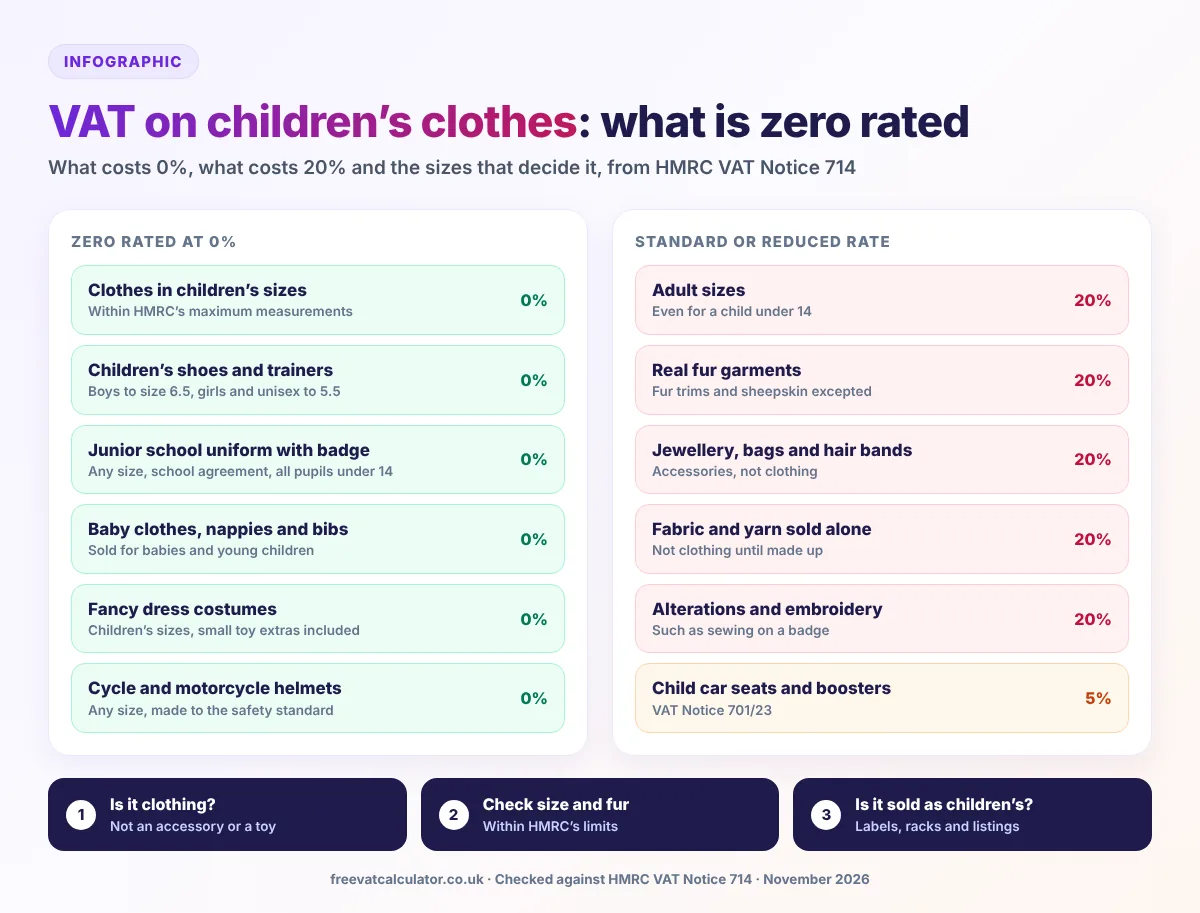
| Item | VAT rate | Condition |
|---|---|---|
| Clothes in children’s sizes | 0% | Within HMRC’s maximum sizes |
| Children’s shoes and trainers | 0% | Boys up to size 6.5, girls up to 5.5 |
| School uniform with the school badge | 0% | Any size, under a school agreement, if all pupils are under 14 |
| Baby clothes, nappies and bibs | 0% | Sold for babies |
| Cycle and motorcycle helmets | 0% | Any size, made to the safety standard |
| Children’s fancy dress costumes | 0% | Children’s sizes |
| Child car seats and boosters | 5% | Reduced rate |
| Adult sizes, even for a child | 20% | Standard rate |
| Real fur, jewellery, bags and hair bands | 20% | Not covered |
Why children’s clothes carry no VAT
The relief is older than VAT. It began as a Purchase Tax relief in the Finance Act 1940, with the line drawn at the size of an average child on their 14th birthday, when body measurements start to overlap with adults, as HMRC’s clothing manual records.
It is also costly and rare. Replying to a school uniform petition on 3 April 2023, HM Treasury said the UK is one of only two of the 37 OECD countries with this relief. HMRC’s tax relief statistics of January 2026 put its cost, with protective boots and helmets, at £2.2 billion in 2024 to 2025, and forecast £2.3 billion for 2025 to 2026. Ireland, for comparison, zero rates certain clothing for children under 11.
The four tests every item must pass
HMRC’s notice sets four conditions, and an item is zero rated only when it meets all of them. Take them in this order.
- It is an article of clothing or footwear.
- It is not made of fur.
- It is designed for young children.
- It is suitable only for young children.
Is it clothing or footwear?
Hats, belts, scarves, gloves and ties count, and so do safety items shaped like clothes, such as a cyclist’s reflective tabard or a lifejacket. Children’s face masks were added in October 2022, when designed and sold for young children.
Buttons, zips, separate badges, reflective armbands, hair bands, scrunchies, sun visors and earmuffs are standard rated, and paper or plastic party hats count as toys. HMRC has ruled that purses and Scout woggles are not clothing. Jewellery and bags are not named in HMRC’s guidance, but on our reading they are accessories rather than clothing, so expect 20%.
Is it made of fur?
A garment made wholly or partly of real fur skin is standard rated, even in a toddler’s size, although fur hats, gloves, belts and footwear can still be zero rated. Artificial fur, rabbit skin, sheepskin and lambskin do not count as fur, and a fur trim is fine unless it covers more than one fifth of the outer surface or costs more than the main material.
Is it designed for a child under 14?
HMRC accepts that a garment is designed for young children when it is within its maximum measurements, measured flat with buttons fastened. The law itself never mentions an age: it says “young children”, and the under 14 line comes from HMRC’s guidance.
Is it suitable only for young children?
This test is about how the item is sold. Labels, packaging, displays and adverts must show it is for young children, and a shop cannot zero rate a line just because its supplier did.
Maximum sizes for zero rated children’s clothes
These are the largest garment measurements HMRC accepts in VAT Notice 714. Chest is measured 2.5cm below the armhole and doubled, and waist across the fastened waistband and doubled.
| Garment and measurement | Boys | Girls |
|---|---|---|
| Shirts and knitwear, chest | 104cm | 105cm |
| Jackets and waistcoats, chest | 109cm | 110cm |
| Top coats and outerwear, chest | 114cm | 115cm |
| Dresses, chest | Not applicable | 98cm |
| Skirts, waist | Not applicable | 71cm |
| Trousers and shorts, waist | 72cm | 71cm |
| Underwear and swimwear, chest and waist | 88cm and 72cm | 89cm and 71cm |
| Nightwear, chest and waist | 105cm and 73cm | 106cm and 72cm |
Elasticated waists are measured at full stretch. A garment with no fastening can be zero rated up to a stretched waist of 85cm for boys and 90cm for girls.
Tights, socks, bras and other items
Some items use a different yardstick. Socks follow shoe sizes, up to 6.5 for boys and 5.5 for girls, and teen bras qualify up to size 34B.
- Tights: 51cm waist to crotch to waist if lightweight, 56cm if heavyweight
- Leotards and full body swimsuits: 70cm shoulder to crotch
- Lifejackets: for a body weight up to 52kg
Larger, one size and stretch garments
A garment above the table can still qualify if it was designed for a body no bigger than HMRC’s body measurements and limited to under 14s by another feature, but HMRC must agree in writing first. Stretch sportswear can qualify on the same basis, while a one size item that also fits adults never can.
| Body measurement | Boys | Girls |
|---|---|---|
| Height | 163cm | 161cm |
| Chest | 84cm | 85cm |
| Waist | 70cm | 69cm |
| Hips | 85cm | 90cm |
VAT on children’s shoes: the size limits
Footwear has its own size rules, which is why the same trainer can cost more one size up. HMRC accepts footwear as designed for young children up to these sizes.
| Footwear | UK size | US size | EU size |
|---|---|---|---|
| Boys’ shoes | 6.5 | 7 | 40 |
| Girls’ court shoes, no straps | 3 | 4.5 | 35.5 |
| Other girls’ shoes with a low heel | 5.5 | 7 | 38.5 |
| Unisex shoes | 5.5 | 7 | 38.5 |
Girls’ shoes in sizes 3.5 to 5.5 qualify only if the heel is no more than 4cm higher than the sole depth. The boys’ limit was raised to 6.5 on 1 April 1994, according to HMRC’s policy history, and the measurements were raised again in 2001 because young people were getting bigger.
Unisex shoes, odd feet and sports footwear
True unisex shoes, as suitable for girls as for boys, qualify only up to size 5.5, the girls’ limit. If a child needs a different size on each foot, the pair qualifies when the smaller shoe does. Ballet shoes, football boots and skating boots with blades fitted all count, but blades, laces and insoles sold on their own carry 20%.
VAT on school uniform
There is no separate relief for school uniform, so the normal size limits apply to most of it. A plain white shirt or grey trousers in an adult size carries 20%, even when the school insists on them.
Uniform for schools where every pupil is under 14
One exception allows any size. The uniform must be supplied under an agreement with a school whose pupils are all under 14, be unique to it by design, such as a prominent badge, and be sold only for that school.
HMRC’s examples include school sweatshirts with a prominent logo sold only to pupils, not to staff. So a prep school blazer with the badge stays at 0% even in a large size, and Beaver or Brownie uniform works the same way, though Scout uniform does not.
Secondary school uniform and the 2026 changes
Secondary schools also teach pupils aged 14 and over, so their uniform follows the normal limits and larger sizes carry 20%. HM Treasury said in April 2023 it had no plans to extend the relief, and the Budget of 28 October 2026 made no change.
Costs are being tackled another way. Under the Children’s Wellbeing and Schools Act, law since 29 April 2026, schools in England must cap branded uniform items at three, not counting ties, from September 2026, says the Department for Education.
Helmets and protective boots zero rated at any age
Pedal cycle helmets have been zero rated in any size since 1 April 2001, and motorcycle helmets are zero rated in any size too. HMRC’s VAT Notice 701/23 says both must be made to the standards in regulation 8(2) of the Personal Protective Equipment Regulations 2002 and marked to show it, and the law also accepts a motorcycle helmet of a type prescribed under section 17 of the Road Traffic Act 1988. Skateboarding and ice hockey helmets are zero rated only as children’s headgear, up to 59cm, while riding hats qualify up to size 6¾, or size 1 for jockey skulls, even when not sold only for children.
Industrial protective boots and helmets are zero rated too, but not when sold to an employer for its staff. Child car seats, boosters and bases carry the reduced rate of 5% under VAT Notice 701/23.
Baby clothes, nappies and bibs
Babywear such as bonnets, bootees and sleepsuits is zero rated, and so are bibs, including plastic bibs with a curved tray, and disposable or reusable nappies sold for babies. A mother and baby shawl, a sleeping bag with no arm holes and nappy material sold on a roll are standard rated.
Gift sets need care. A bib sold with a feeding cup is not one supply of clothing, so the price may need splitting between 0% for the bib and 20% for the cup.
Fancy dress costumes, fabric and knitting kits
Fancy dress and dressing up
A child’s dressing up outfit is clothing, so it is zero rated in children’s sizes. HMRC’s own example is a cowboy outfit sold with a toy gun for one price: the gun is incidental, so the whole price is zero rated.
Adult sized costumes carry 20%. Hiring a child’s costume, bridesmaid dress, bowling shoes or skates can be zero rated, because hire follows the rate the item would have if sold.
Fabric, cloth kits and alterations
Fabric, buttons and zips sold on their own are standard rated. A packaged cloth kit is zero rated if the finished garment would be, the material is cut to the pattern or printed with it, and the packaging says it is only for young children.
Notice 714 does not mention knitting kits, but on our reading a kit of yarn and a pattern fails that test, because nothing is cut or printed to shape, so expect 20%. Alterations and embroidery, such as sewing on a school badge, are standard rated too.
Tall children and kids clothes in adult sizes
The relief follows the garment, not the child, so there is no VAT refund for a tall 11 year old in adult sizes. A shop cannot zero rate an adult size because the buyer says it is for a child, and HMRC’s manual explains that a general relief for school uniform would let many adults buy zero rated shirts and shoes, because they are ordinary adult wear.
Pressure for change has not moved the rules. A petition asking the government to make shops resize children’s ranges was rejected on 15 April 2024, because sizing is a matter for manufacturers.
How shops and online sellers apply the zero rate
A seller can zero rate children’s clothing only when the buyer can see it is for young children. HMRC expects a children’s shop, department or catalogue section, or racks clearly marked boys, girls or children’s, and an online shop must never list the same product in both its adult and children’s pages. A delivery charge that is part of the sale follows the goods, so it is zero rated on an order of children’s clothes, as our guide to VAT on postage explains.
Records and retail schemes
Keep supplier specifications, size charts, screenshots of your listings and any agreement with a school or HMRC for at least 6 years, as VAT Notice 700/21 requires. A shop selling at both rates must split its takings unless its tills record the rate on each sale.
HMRC’s retail schemes do this, with limits of £1 million for the simpler schemes and £130 million for the rest. Direct calculation often suits a children’s wear shop, because it works from the expected selling prices of the goods at the rate you sell least of.
Registration and the Flat Rate Scheme
Zero rated sales count towards the £90,000 VAT threshold. A business with mostly zero rated sales can ask for exemption from registration, but then cannot reclaim VAT on its costs.
Registration often pays, because a children’s wear shop can reclaim VAT on shopfitting and adult stock while charging little VAT. The Flat Rate Scheme rarely suits it: the rate for retailing children’s clothing is 4% of all turnover, zero rated sales included, so check it with our flat rate VAT calculator first.
Selling through online marketplaces
From October 2027, online marketplaces are due to collect VAT on goods that UK sellers sell through them, a change confirmed at the Budget on 28 October 2026. Each listing will need the right rate, and our guide to online marketplace VAT explains who is affected.
Worked examples of VAT on children’s clothes
A back to school shop for two children
A family buys uniform for a 9 year old at a junior school where every pupil is under 14, from the shop the school has an agreement with, and for a 13 year old at a secondary school who wears adult sizes. All prices include any VAT.
| Item | Price | Rate | VAT |
|---|---|---|---|
| Junior school blazer with badge, large size | £32.00 | 0% | £0.00 |
| School shoes, child size 2 | £40.00 | 0% | £0.00 |
| Secondary school blazer, adult size | £48.00 | 20% | £8.00 |
| Trainers, adult size 8 | £60.00 | 20% | £10.00 |
| Cycle helmet, adult size | £30.00 | 0% | £0.00 |
| Total | £210.00 | £18.00 |
The family pays £18.00 of VAT, all of it on the 13 year old’s adult sizes. Had the secondary blazer been within HMRC’s jacket limit, it would have been zero rated too.
A children’s clothes shop’s VAT quarter
A VAT registered children’s wear shop takes £30,000 in a quarter: £27,000 at 0% and £3,000 of adult lines at 20%. Its output tax is £3,000 ÷ 6, which is £500, and with £1,500 of VAT reclaimed on stock and costs, its return shows a £1,000 repayment.
Its sales of about £118,000 a year without VAT are under the £150,000 limit for joining the Flat Rate Scheme, where at 4% it would pay 4% of £30,000, which is £1,200. That is £2,200 worse in a single quarter.
Common mistakes with children’s clothing VAT
Most errors come from treating the shelf label as the test, rather than the garment. These are the ones HMRC’s guidance deals with directly.
- Thinking VAT on children’s clothes depends on the child’s age, not the garment’s size
- Zero rating a line because the supplier invoiced it at 0%
- Treating all school uniform as zero rated, whatever the school
- Zero rating hair accessories, bags or separate badges
- Joining the Flat Rate Scheme without comparing it first
Net errors up to £10,000, or up to £50,000 if no more than 1% of your box 6 sales, can be corrected on your next return. Larger ones must be reported separately, as our guide on how to correct VAT errors explains.
Need the VAT on a mixed receipt?
Our main VAT calculator adds or removes VAT at 20%, 5% or 0% and shows the working.
VAT on children’s clothes FAQs
These are the questions parents and shop owners ask most. Each answer reflects HMRC’s guidance as at 6 November 2026.
Is there VAT on kids’ clothes?
Not on most of them. Clothes and shoes within HMRC’s maximum sizes and sold as children’s are zero rated, while adult sizes carry 20%.
At what age do children pay VAT on clothes?
From the size a child outgrows the children’s range, not from a birthday. HMRC’s sizes are based on an average child at their 14th birthday, so a child who is tall for their age can outgrow them, and start paying 20%, well before then.
Are cycle helmets VAT free for adults?
Yes. Cycle and motorcycle helmets made to the safety standard and marked to show it are zero rated in any size.
Can I claim back the VAT on my child’s clothes?
No. Only VAT registered businesses reclaim VAT, and only on business costs, so a parent cannot recover VAT on adult sizes.
Is there VAT on second hand children’s clothes?
Notice 714 makes no distinction between new and used goods, so on our reading the rules on VAT on children’s clothes are the same and a VAT registered seller zero rates second hand clothes in children’s sizes. Private sellers, and unregistered shops below £90,000, charge no VAT at all.
VAT on children’s clothes comes down to the garment: its size, what it is made of and how it is sold, not the child’s age. Use the checker at the top for any item, and the size tables above whenever a garment sits close to the line.
Sources: HMRC VAT Notice 714; VAT Act 1994, Sch 8; VCLOTHING1100; VCLOTHING2150; VCLOTHING6100; VCLOTHING8000; VCLOTHING9120; HMRC VAT Notice 701/23; VPROTEQUIP4010; Petition 633778 response; HMRC tax relief statistics, January 2026; Petition 660027; DfE, 30 April 2026; Revenue Ireland; VAT thresholds; VAT Notice 700/1; VAT Notice 700/21; VAT Notice 700/45; VAT Notice 727; VAT Notice 727/5; Flat rates; VAT Notice 733; Marketplace VAT extension. This page is general information, not tax advice.