
Private school VAT guide
VAT on Private School Fees: How the 20% Charge Works for Parents and Schools
How VAT on private school fees works
- Check the schoolIs it a private school?
- Check the placeNursery, EHCP or standard
- Apply 20%Tuition and boarding
- Leave out exempt extrasCare and separate lunches
- Work out the billPer term and per year
The fee letter arrives, the termly bill has jumped by a fifth, and the line that says VAT at 20% raises more questions than it answers. Is the nursery place your youngest child holds really exempt, who carries the cost of a place named in an EHC plan, and were the fees you paid early in 2024 caught after all?
This guide opens with a calculator that turns any termly or yearly fee into the VAT, the fee before VAT and the full cost, then explains each rule behind the figure from HMRC’s guidance and the Finance Act 2025. It covers boarding, nurseries, SEND places, bursaries, what schools must do, business rates and the court challenge now at the Supreme Court, so you can check every line of VAT on private school fees for yourself.
School fees VAT calculator: the VAT per term and per year
Enter the fee from your bill, say whether it is per term or per year and whether it includes VAT, and set the number of terms. Then answer the two questions on council funded places and nursery classes to see the fee before VAT, the VAT, the totals and the working.
School fees VAT calculator
The VAT, the fee before VAT and the total, per term and per year
You pay £3,600.00 of VAT a year
That is £1,200.00 a term over 3 terms, on top of £18,000.00 of fees before VAT, so the year costs £21,600.00 in total.
The working
£6,000.00 × 20% = £1,200.00 of VAT a term, so each term costs £6,000.00 plus £1,200.00, which is £7,200.00. Over 3 terms that is £3,600.00 of VAT and £21,600.00 in total.
This uses the 20% rate on education and boarding at a private school. A council funded place is one the council names in the EHC plan and pays for. Leave separately billed lunches, transport and childcare out of the fee, as they may be exempt. Figures are rounded to the penny, and nothing you type is stored or sent.
Most schools bill three terms a year, but some charge one annual fee or split the year into more instalments, which is why the number of terms can be changed. The tool works at the 20% standard rate, the only rate that applies to taxable school fees, and our guide to the current VAT rate lists the other UK rates.
Key facts
- VAT rate on fees
- 20% since 1 January 2025
- Fees paid in advance
- Caught if paid from 29 July 2024
- Nursery classes
- Exempt below compulsory school age
- Council funded EHCP place
- The council reclaims the VAT
- £6,000 a term before VAT
- £7,200 with VAT, £3,600 VAT a year
- Supreme Court hearing
- 1 and 2 December 2026
VAT on private school fees at a glance
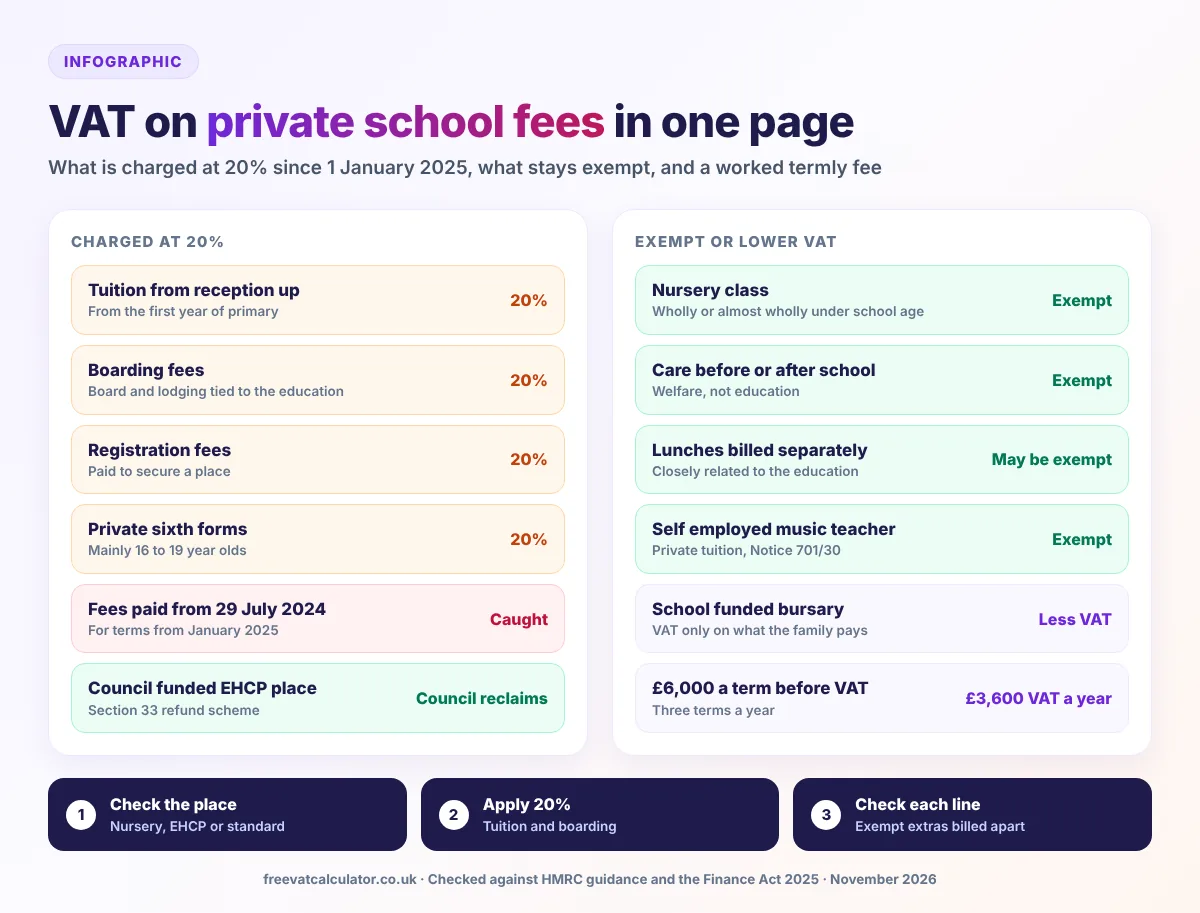
The charge reaches further than tuition, yet several common items still carry no VAT. The table shows how HMRC treats each part of a typical fee bill, based on its school fees guidance last updated on 5 February 2026.
| Item on the bill | VAT treatment | Why |
|---|---|---|
| Tuition for pupils from reception upwards | 20% | Part 3 of Schedule 9 to the VAT Act 1994 |
| Private sixth form or college fees | 20% | The provider mainly teaches 16 to 19 year olds |
| Boarding fees | 20% | Board and lodging closely related to the education |
| Registration and application fees | 20% | Treated in the same way as the school fees |
| Educational clubs and activities | 20% | Extra curricular education by the school |
| Nursery class below compulsory school age | Exempt | The class is wholly or almost wholly under that age |
| Care before or after school | Exempt | Welfare rather than education |
| Lunches or transport billed separately | May be exempt | Closely related goods and services |
| Place funded by the council under an EHC plan | 20%, reclaimed by the council | Section 33 refund scheme |
| Donations given freely | Outside the scope | Nothing is received in return |
One caution applies to every row. A package sold for one price is usually a single supply, so meals or transport folded into the main fee take the 20% rate, and an artificial split does not change that.
What changed on 1 January 2025
Until the end of 2024, private school fees were exempt under Group 6 of Schedule 9 to the VAT Act 1994. The government announced the change on 29 July 2024 and confirmed it at the Autumn Budget on 30 October 2024, and education and boarding at private schools have been standard rated at 20% since 1 January 2025.
The law behind the charge
Section 47 of the Finance Act 2025, dated 20 March 2025, added a new Part 3 to Schedule 9, which takes education, vocational training and closely related boarding at a private school out of the exemption. Section 49 treats the change as in force from 30 October 2024 and applies it to any education supplied on or after 1 January 2025, whenever the supply is treated as taking place.
Fees paid in advance from 29 July 2024
To stop families paying years of fees early to avoid the charge, section 48 sets its own tax point for fees received from 29 July to 29 October 2024. The table shows when VAT is due on fees paid before, during and after that window.
| When the school received the fee | VAT on terms from January 2025 |
|---|---|
| Before 29 July 2024 | Depends on the contract, with no VAT if a valid tax point arose when you paid |
| 29 July 2024 to 29 October 2024 | Due, treated as supplied on the later of 1 January 2025 or the first day of term |
| From 30 October 2024 | Due under the normal tax point rules, usually when the fee is paid |
Fees paid before 29 July 2024
Payments made before the announcement are judged on their terms. HMRC says no VAT is due where the payment created a valid tax point when it was made, but the July 2024 technical note warned that HMRC would challenge lump sums paid before the education they bought was settled.
HMRC normally has four years from the end of a VAT period to raise an assessment under section 77 of the VAT Act 1994, so 2024 prepayment schemes can still be reviewed. If you prepaid, keep the contract and ask the school how it treated the payment.
Which schools must charge VAT
For VAT, a private school is one that provides full time education to pupils of compulsory school age for a fee, other than a nursery school. State schools, academies and further education colleges are outside the rule, and moving the teaching into a connected body does not keep the exemption.
Private sixth forms and colleges
A sixth form attached to a fee paying school charges VAT like the rest of the school. A standalone college is caught if it is wholly or mainly concerned with 16 to 19 year olds, teaches them full time and charges most of them fees, and HMRC’s February 2026 update puts wholly or mainly at 51% or more of its provision.
England, Scotland, Wales and Northern Ireland
VAT is a UK wide tax, so the same 20% applies in all four nations. Compulsory school age runs from 5 to 16 in England, Scotland and Wales and from 4 to 16 in Northern Ireland, according to the government’s July 2024 technical note, and in England a child reaches it on 31 December, 31 March or 31 August after their fifth birthday, whichever comes first.
Non maintained special schools
A non maintained special school approved under section 342 of the Education Act 1996 is also inside the charge. Block grant funding not tied to a pupil stays outside the scope of VAT, but when a council pays per pupil for a child whose EHC plan names the school, the school charges VAT and the council reclaims it.
What is charged at 20%
The standard rate covers the education and anything HMRC treats as part of it. These charges on a typical bill carry VAT.
- tuition fees for every year from reception upwards
- private sixth form and standalone college fees
- boarding and lodging fees for boarders
- registration and application fees you must pay for a place
- educational clubs, activities and courses run by the school
- packages that combine tuition with meals, trips or transport for one price
VAT on boarding fees
Board and lodging that is closely related to the education is standard rated, so a boarder pays VAT on both the tuition and the boarding element. The law does not define board and lodging, and HMRC reads it as pupils living in school accommodation during term time.
Many boarding schools quote one inclusive termly fee, and VAT applies to the whole of it. Boarding at a state boarding school is not affected by the change, because the new rule applies only to private schools.
Registration and application fees
Fees that must be paid to apply, such as a registration fee, carry VAT in the same way as the school fees. If one is refunded because a pupil does not take up the place, the school can adjust the VAT as for any other refund.
Clubs, lessons and holiday courses
Educational clubs and courses run by a private school, such as drama or revision classes, are standard rated, and HMRC treats a dance class as an activity club rather than exempt care. Instrumental lessons billed by the school are taxable too, but a self employed teacher who bills parents directly for a subject commonly taught in schools makes an exempt supply of private tuition under section 6.1 of VAT Notice 701/30.
Lunches, transport, trips and exams
Meals, transport, field trips and stationery charged separately can still be exempt as closely related to the education, if they are for the pupil’s direct use and needed to deliver it. Separately billed exam entry fees are usually exempt too, because section 7.2 of Notice 701/30 exempts examination services supplied by an eligible body.
A residential trip is a special case. If the school buys in travel or accommodation and resells it to pupils, HMRC says it may be acting as a tour operator and must use the Tour Operators’ Margin Scheme.
What stays exempt from VAT
Several parts of private education were deliberately left outside the charge, and others were never part of it. These supplies carry no VAT even when a private school makes them.
- nursery classes made up wholly or almost wholly of children under compulsory school age
- childcare before and after school and care based holiday clubs
- teaching English as a foreign language
- higher education courses
- private tuition by a self employed teacher
- qualifying therapy from registered health professionals
- donations given freely with nothing in return
Nursery classes below compulsory school age
A nursery class is exempt if it is composed wholly or almost wholly of children under compulsory school age who would not be expected to reach that age while in the class. HMRC’s example is a class in which 90% of the children are below that age, which stays exempt.
Reception is the usual dividing line. The technical note confirmed that fees for the first year of primary school, whether called reception, Primary 1 or Year 1, are taxable, because most children reach compulsory school age during that year, so a family with one child in the nursery and one in reception sees VAT on only one bill.
Wraparound care and holiday childcare
Care that is mainly about looking after children is welfare rather than education, so breakfast clubs, after school care and childcare holiday clubs stay exempt. Where education and care come together, HMRC looks at the main element, and in a school day the education usually dominates.
Therapy, higher education and English language courses
Therapy from a registered health professional, such as speech and language therapy, can be exempt when its main purpose is health, but therapy folded into one inclusive school fee follows the standard rated education. Teaching English as a foreign language and higher education courses stay exempt, because item 1 of the new Part 3 lists them as exceptions.
SEND pupils and EHCP funded places
There is no blanket exemption for pupils with special educational needs. Where a council names a private school in a pupil’s EHC plan and funds the place, the school still charges VAT, but the council pays it and reclaims it through the section 33 refund scheme in VAT Notice 749, so neither the family nor the school budget carries the cost.
The same approach applies elsewhere in the UK. The July 2024 technical note pointed to coordinated support plans in Scotland and individual development plans or statements in Wales, and HMRC’s impact note confirms that the Education Authority in Northern Ireland can recover the VAT on the places it funds.
Parents who choose a private school for a child whose needs could be met in a state school pay VAT on the fees in the normal way, even if the child has an EHC plan. That is why the calculator asks whether the council funds the place rather than whether the pupil has a plan.
Bursaries, scholarships and discounts
How a fee reduction is funded decides how much VAT is charged. HMRC says VAT is due on the total value received for the education, so when a separate bursary pays 30% of the fee and the parent pays 70%, VAT is charged on the full 100%.
A bursary the school funds from its own money is outside the scope of VAT, so in practice the school charges VAT only on the reduced fee the family actually pays. Scholarships and sibling discounts given by the school work the same way, and a free place with nothing paid carries no VAT at all.
| Arrangement | Who pays | VAT for the term |
|---|---|---|
| No bursary | Family pays £7,200.00 | £1,200.00 |
| School funded 30% fee reduction | Family pays £5,040.00 | £840.00 |
| Outside bursary paying 30% of the bill | Charity pays £2,160.00 and the family £5,040.00 | £1,200.00 |
| Free place funded by the school | Nobody pays | £0.00 |
The family pays the same £5,040.00 in the second and third rows, yet the VAT differs by £360.00, because the outside bursary is part of what the school receives for the education. The figures assume the school passes the full VAT on to the payer.
Parents abroad, employers and forces families
VAT is charged on the education supplied in the UK, so it does not matter who pays the bill or where they live. Fees paid by parents overseas, by grandparents or by an employer all carry the same 20%.
There is no income tax relief for parents on school fees, and a family cannot reclaim the VAT, because only a VAT registered business can reclaim VAT on its costs. Our guide to what VAT is explains why the final consumer always bears the tax.
Forces and diplomatic families who claim Continuity of Education Allowance got direct help, as the Department for Education said the Ministry of Defence and the Foreign, Commonwealth and Development Office would increase its funding to cover fee rises. The Royal Navy confirmed that rates were recalculated to include VAT, with the Ministry of Defence still paying up to 90% of fees for eligible claimants.
Will fees rise by the full 20%?
Not necessarily, because a VAT registered school can now reclaim VAT on the costs it uses to make taxable supplies. HMRC’s impact note expected net VAT to average about 15% of fee income and average fees to rise by around 10%, although each school sets its own price.
| Figure | Per term | Per year |
|---|---|---|
| Fee before VAT | £6,000.00 | £18,000.00 |
| VAT at 20% | £1,200.00 | £3,600.00 |
| Fee including VAT | £7,200.00 | £21,600.00 |
| VAT inside the bill, one sixth of it | £1,200.00 | £3,600.00 |
To find the VAT inside a fee that already includes it, divide the fee by 6, or divide it by 1.2 to get the fee before VAT. Our remove VAT calculator does the same sum for any VAT inclusive price.
A school that absorbs part of the cost still owes the full VAT on what it charges. If it holds a fee at £6,000 including VAT, the VAT is £1,000 and the school keeps only £5,000, so absorbing VAT means accepting a lower net fee.
What schools must do
For a school, VAT on private school fees brought the full set of duties, from registration to quarterly returns. HMRC’s impact note expected about 2,600 businesses to be affected, with continuing costs averaging £3,400 a year each.
Registering for VAT
A school must register if its taxable turnover over the last 12 months goes above £90,000, or if it expects to take more than £90,000 in the next 30 days alone. Only fees for terms starting on or after 1 January 2025 count, and exempt nursery fees are left out. Our guide to the VAT threshold explains both tests and the 30 day deadlines. A school below the threshold can still register voluntarily to reclaim VAT on its costs.
VAT invoices and fee bills
A school cannot show VAT on a bill until it has a VAT registration number, although it can raise its prices to cover the VAT. A bill that mixes taxable tuition with exempt items, such as separate lunches, must show the VAT rate for each line, as section 4 of VAT Notice 700/21 requires.
VAT returns, Making Tax Digital and accounting schemes
Registered schools file VAT returns, usually every quarter, through software that meets the Making Tax Digital rules. A school with estimated taxable turnover of £1.35 million or less can join the cash accounting scheme and pay VAT when fees are received, and must leave once turnover passes £1.6 million.
Reclaiming VAT on school costs
Many schools still make some exempt supplies, such as nursery classes or exempt lettings, so they are often partially exempt and must split VAT on shared costs under VAT Notice 706. If the VAT linked to exempt supplies passes the de minimis tests in our partial exemption guide, all of it can be reclaimed.
VAT on goods bought up to four years before registration and still in use, and on services received up to six months before, can also be claimed, apportioned for any use before 1 January 2025. In HMRC’s example, a 12 month subscription that began on 1 September 2024 is 67% recoverable, and our guide to pre registration VAT covers the claim in detail.
Buildings and the Capital Goods Scheme
Under the Capital Goods Scheme, VAT on land, buildings and civil engineering works is adjusted over 10 intervals, so when a building’s use moves from exempt to taxable, part of the old VAT comes back each year. A school that paid £400,000 of VAT on a building in 2022 and now uses it 85% for taxable education could reclaim one tenth of £400,000 multiplied by 85%, which is £34,000, for each remaining interval.
HMRC’s school fees guidance still quotes a £250,000 threshold and includes computers, but Revenue and Customs Brief 7 (2026) explains that regulations (SI 2026/765) raised the threshold to £600,000 excluding VAT and took computers out of the scheme from 29 July 2026. Items already in the scheme stay in it until their adjustment periods end.
Business rates: the end of charitable relief
VAT was not the only change. From 1 April 2025, private schools in England that are charities lost the 80% mandatory charitable rate relief under the Non Domestic Rating (Multipliers and Private Schools) Act 2025, which received Royal Assent on 3 April 2025.
Schools wholly or mainly providing full time education for pupils with an EHC plan keep the relief, while schools wholly concerned with the training or welfare of disabled people stay fully exempt from business rates under an existing rule. The government identified 1,024 schools losing relief out of 2,474 private schools in England, and expects the change to raise £85 million for the Exchequer in 2026 to 2027.
Scotland made the same move three years earlier. Section 17 of the Non Domestic Rates (Scotland) Act 2020 removed charitable relief from mainstream independent schools from 1 April 2022, while independent special schools and specialist music schools kept it.
The legal challenge: High Court, Court of Appeal and Supreme Court
Families, pupils and schools challenged the law under the European Convention on Human Rights, mainly the right to education and the ban on discrimination. The challenge has lost twice, and the VAT remains payable while it continues.
High Court, June 2025
In a judgment handed down on 13 June 2025, a Divisional Court led by Dame Victoria Sharp ruled on three claims heard together in R (ALR and others) v Chancellor of the Exchequer [2025] EWHC 1467 (Admin). It granted permission for judicial review but dismissed all three claims, finding the measure within Parliament’s broad margin of discretion.
Court of Appeal, February 2026
A Charedi Jewish pupil and parent appealed, as did four Evangelical Christian schools with parents and pupils. On 27 February 2026 the Court of Appeal dismissed both appeals in [2026] EWCA Civ 170, holding that the government had an objective and reasonable justification for not exempting low cost schools.
Supreme Court hearing, 1 to 2 December 2026
The Supreme Court granted permission to appeal on 22 May 2026, and the two linked cases, UKSC/2026/0045 and UKSC/2026/0056, are listed for a hearing on 1 and 2 December 2026. No judgment date has been set, so schools must keep charging VAT and parents must keep paying it.
Even a win for the appellants would not end the charge by itself. Under section 4(6) of the Human Rights Act 1998, a declaration that an Act is incompatible with Convention rights does not affect its validity or continuing operation, so the VAT would stay until Parliament changed the law.
Did the Autumn Budget 2026 change anything?
No. The Budget on 28 October 2026 kept the 20%, 5% and 0% rates and left the private schools rules alone, and our Autumn Budget VAT guide lists the VAT changes it did make.
Private school VAT in numbers
The official figures come from HMRC’s tax information and impact note of 30 October 2024 and from the Department for Education’s school census. The revenue line was certified by the Office for Budget Responsibility, and the pupil count is the latest one, taken in January 2026.
- £1,560mVAT expected from private schools in 2026 to 2027
- 560,300pupils in independent schools in England in January 2026
- 35,000pupils expected to move to state schools in the long run
| Tax year | Expected revenue |
|---|---|
| 2024 to 2025 | £460 million |
| 2025 to 2026 | £1,505 million |
| 2026 to 2027 | £1,560 million |
| 2027 to 2028 | £1,610 million |
| 2028 to 2029 | £1,665 million |
| 2029 to 2030 | £1,725 million |
The school census counted 560,300 pupils in independent schools in England in January 2026, down 3.8% on a year earlier and the second fall in a row, which is 6.3% of all pupils. HMRC’s note expected around 35,000 pupils to move to state schools in the long run, under 0.5% of the state school population, with the private sector losing about 37,000 pupils in total.
Planning tips for parents
A fee rise of a fifth is easier to manage when you know which parts of the bill can change. These steps follow from the rules above.
- Check that each line of the bill has the right VAT rate, especially lunches, transport and wraparound care.
- Ask whether a bursary is funded by the school or by an outside body, because that changes the VAT.
- If your child has an EHC plan, ask the council whether it will name and fund the school.
- Check when a younger child moves from nursery to reception, because VAT starts from that term.
- Ask about termly, monthly or advance payment plans, remembering that VAT is still due on them.
- Read the notice period in the parent contract before deciding to move school.
Moving to a state school
In England, joining a state school once the school year has started is an in year application, which you begin by contacting your local council, and a child offered a place usually starts at the beginning of the next term. Free transport applies if the nearest suitable school is more than 2 miles away for a child under 8, or more than 3 miles for a child aged 8 or over.
For a September 2027 start in the main admissions round, primary applications close on 15 January 2027. The secondary deadline of 31 October 2026 has already passed.
Common mistakes with VAT on private school fees
Most errors on fee bills and school VAT returns come from a handful of misunderstandings. These are the ones to check first.
- adding VAT to a nursery class fee that is still exempt
- treating every pupil with an EHC plan as exempt, when only council funded places are reclaimed
- assuming a fee paid early in 2024 is safe without checking the contract
- charging VAT only on the reduced fee when an outside body funds the bursary
- splitting one inclusive fee into separate charges just to make part of it exempt
- assuming VAT on private school fees must raise the price by exactly 20%
- using the old £250,000 Capital Goods Scheme limit for a project from 29 July 2026
Need the VAT on one line of a fee bill?
Our main VAT calculator adds or removes 20% VAT on any amount. Use it to check a single charge on a school invoice in seconds.
VAT on private school fees FAQs
These are the questions parents and bursars ask most often about the charge. Each answer reflects the law and HMRC guidance as at 6 November 2026.
When did VAT on private school fees start?
It started on 1 January 2025 for education and boarding supplied by private schools. Fees paid in advance from 29 July 2024 for terms starting on or after that date were also caught.
Is VAT on school fees charged on nursery places?
Not on a nursery class made up wholly or almost wholly of children under compulsory school age, which stays exempt. VAT starts in reception or the equivalent first year of primary school.
Do parents of a child with an EHCP pay VAT?
Not when the council names the school in the plan and funds the place, because the council pays the VAT and reclaims it. If parents choose and pay for a private school themselves, VAT applies as normal.
Is there VAT on boarding fees?
Yes, boarding and lodging closely related to the education is standard rated at 20%. Boarding at a state boarding school is not affected, because the rule applies only to private schools.
Can parents reclaim VAT on school fees?
No. Only a VAT registered business can reclaim VAT on costs used for its taxable supplies, so families bear the VAT in full, and there is no income tax relief on school fees either.
Will the Supreme Court scrap the VAT?
The appeal is listed for 1 and 2 December 2026, and no judgment date has been set. Even if the appellants won, a declaration of incompatibility does not change the law by itself, so the VAT would stay until Parliament acted.
Does private school VAT apply in Scotland, Wales and Northern Ireland?
Yes, VAT is a UK wide tax, so the same 20% applies in every nation. Business rates differ, because charitable relief for private schools ended in England in April 2025 and in Scotland in April 2022.
You now have what you need to check VAT on private school fees: what is charged at 20%, what stays exempt, how funded SEND places and bursaries work, and what schools must do to register and reclaim. Run your own termly or yearly fee through the calculator at the top before you budget for the next school year, and query any line on the bill that does not match.
Sources: HMRC, Charging and reclaiming VAT on goods and services related to private school fees; HMRC, Check if you must register for VAT if you receive private school fees; HMRC tax information and impact note, Private school fees VAT measure; HM Treasury and HMRC, VAT on private school fees policy paper; HM Treasury, VAT on private school fees technical note, July 2024; Finance Act 2025, section 48; Finance Act 2025, section 49; VAT Act 1994, Schedule 9 Part 3; VAT Act 1994, section 77; VAT Notice 701/30, Education and vocational training; VAT Notice 706/2, Capital Goods Scheme; Revenue and Customs Brief 7 (2026); GOV.UK, VAT Cash Accounting Scheme eligibility; MHCLG, Removal of eligibility of private schools for business rates charitable relief; Non Domestic Rates (Scotland) Act 2020, section 17 notes; R (ALR and others) v Chancellor of the Exchequer [2025] EWHC 1467 (Admin); R (BYL and another) v Chancellor of the Exchequer [2026] EWCA Civ 170; UK Supreme Court, UKSC/2026/0045; UK Supreme Court, UKSC/2026/0056; Human Rights Act 1998, section 4; DfE, Schools, pupils and their characteristics 2025/26; DfE Education Hub, VAT on private schools; Royal Navy, The impact of VAT changes on the Continuity of Education Allowance; GOV.UK, School starting age; GOV.UK, How to apply for a school place; GOV.UK, Free school transport; Budget 2026, overview of tax legislation and rates. This page is general information, not tax advice.