
Group registration guide
VAT Group: Who Can Join, How to Register and the Pros and Cons
How group registration works
- Check who qualifiesControl and UK tests
- Pick a representativeIt files the one return
- Complete VAT50/51With the online application
- Wait for HMRCReply in 40 working days
- File one returnNo VAT between members
You run a holding company and two trading companies, so every quarter brings three VAT returns, three deadlines and VAT charged on fees that only move money between your own businesses. If one of them sells insurance, lets homes or runs a nursery, part of that VAT never comes back at all.
This guide opens with a checker that shows whether your businesses can group and who could act as the representative member. It then covers HMRC’s tests, form VAT50/51, partial exemption, divisional registration and the pros and cons, checked against Notice 700/2 on 6 November 2026, so you can decide whether a VAT group suits you and set one up.
VAT group eligibility checker
Choose up to four businesses, say what each one is, whether it is established in the UK and whether it makes exempt sales, then say who controls them. The checker applies the tests in Notice 700/2 and shows who can join, who could be the representative member and what would change.
Can these businesses form a group?
Test up to four businesses against HMRC’s eligibility, control and UK establishment rules
Business A
Business B
Business C
Business D
Yes: 3 businesses can form a group
Business A, Business B and Business C pass the eligibility, control and UK establishment tests. Business A could act as the representative member, although HMRC has 90 days from a complete application to refuse it to protect the revenue.
What would change
- One new VAT number and one return for 3 members, filed by Business A, and existing numbers are cancelled.
The working
- Business A, a company: can join, because it is established in the UK and controls the others.
Based on HMRC VAT Notice 700/2 and sections 43A and 43AZA of the VAT Act 1994. It does not test the extra conditions for specified bodies in groups with turnover over £10 million, or HMRC’s protection of the revenue powers. A guide, not a ruling, and nothing you enter is stored or sent.
It covers the main tests only. HMRC can still refuse an application to protect the revenue, and groups with turnover over £10 million face extra conditions for some members.
Key facts
- Who can join
- Companies, LLPs and the individual or partnership controlling them
- Control test
- One person controls every member
- Establishment
- Each member in the UK or with a UK fixed establishment
- Application
- Form VAT50/51 with the online registration
- HMRC reply
- 40 working days to confirm receipt, 90 days from receipt to refuse
- Budget 2026
- No change to the grouping rules
What is a VAT group?
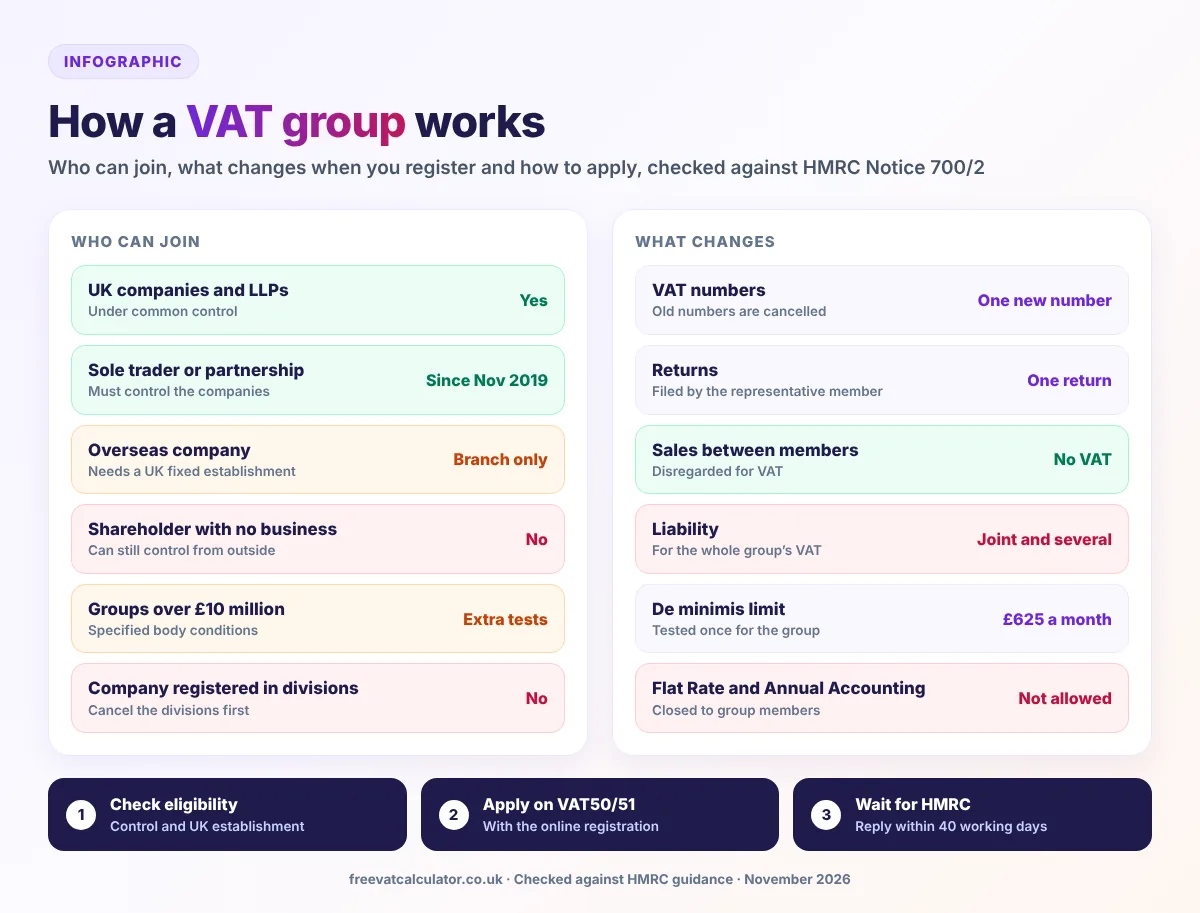
A VAT group is two or more businesses that HMRC treats as a single taxable person under section 43 of the VAT Act 1994. It has one VAT number, files one return and deals with HMRC through one member, the representative member.
Sales to and purchases from outside businesses carry VAT as normal, but charges between members are ignored. Each member stays a separate legal person for company law and for other taxes such as Corporation Tax.
Grouping, group registration and group VAT registration
These names mean the same thing. HMRC says group registration, many accountants say VAT grouping and some guides say group VAT registration, but each describes one registration covering several legal persons.
Who can join a VAT group?
The VAT group rules set three tests for every member. Each must be an eligible person, each must be established or have a fixed establishment in the UK, and all must be controlled by one person.
| Type of business | Can it join? | Main condition |
|---|---|---|
| UK company or LLP | Yes | Under common control with the others |
| Overseas company with a UK branch | Yes | The branch is a fixed establishment |
| Overseas company with no UK presence | No | It can still control the group from outside |
| Individual running a business | Yes, since 1 November 2019 | Controls all the companies |
| Partnership or Scottish partnership | Yes, since 1 November 2019 | Controls them through the partnership |
| Individual who only holds shares | No | Can still control the group from outside |
| Company in another group or in divisions | No | Must leave or cancel first |
Companies and LLPs
Companies of every kind and limited liability partnerships count as bodies corporate, so they can group once they pass the control and UK tests. HMRC’s manual also lets in non trading, dormant and shell companies, intending traders and members whose only sales are exempt.
Individuals and partnerships since 1 November 2019
Since 1 November 2019, when Schedule 18 to the Finance Act 2019 came into force, an individual, a partnership or a Scottish partnership can join too. It must control the UK companies in the group, carry on a business by making supplies, and be established or have a fixed establishment in the UK.
Where a partnership is the controller, control must run through the partnership rather than through the partners one by one. An individual who owns two companies but runs no business of their own cannot join, although the two companies can still group because one person controls both.
Some older guides, and a few GOV.UK pages, still say only companies and LLPs can join. That was the rule before November 2019, so rely on the current Notice 700/2.
The control test
Control follows the parent company test in section 1159 of the Companies Act 2006: a majority of the voting rights, the right to appoint or remove most of the board, or a majority of votes under an agreement. Every member must be controlled by one member or by a single person outside the group, so two companies owned half each by unrelated people fail.
UK establishment and fixed establishment
Each member must have its central administration in the UK, or a fixed establishment here with enough permanent staff and equipment to make supplies. A registered office, a brass plate or a UK agent is not enough, and Notice 700/2 says its references to the UK include the Isle of Man.
Specified bodies and the £10 million rule
Since 1 August 2004, groups with turnover over £10 million a year face two extra conditions for a specified body, a member partly owned or managed by an outsider that carries on a relevant business activity. No more than 50% of the benefits of its business may go to third parties, and the controlling person must consolidate it in its group accounts. Charities, pension scheme trustees and a body that controls all the other members are among the exceptions.
Who cannot join
- An overseas company with no fixed establishment in the UK
- An individual or partnership that does not control all the others
- A business already in another VAT group, as one group at a time is the limit
- A company registered in divisions, until it cancels them
- Certain tour operators, under article 13 of the Tour Operators Order 1987
How group registration works
Any business carried on by a member is treated as carried on by the representative member. Its supplies to and from outside businesses, and VAT on its imports, all go on the one group return.
Supplies between members are disregarded
Sales between members are ignored, so no VAT is charged and no VAT invoices are issued. This saves money when a member cannot recover all its VAT, because a management charge, rent or staff recharge to it no longer carries any.
Exceptions and the overseas branch change
Goods moved from Great Britain to Northern Ireland are still taxed, as are goods sold while in Northern Ireland unless both members are established there, and section 43(2A) taxes certain services bought in through an overseas establishment. Revenue and Customs Brief 7 (2025) ended HMRC’s Skandia approach from 26 November 2025, so a member’s branch in an EU country now counts as part of the UK group. Groups that paid VAT under the old rule can reclaim it through an error correction under Notice 700/45.
Limits tested on the whole group
- The partial exemption de minimis limit of £625 a month on average
- Cash accounting limits of £1.35 million to join and £1.6 million to leave
- Payments on account once the group’s VAT is over £2.3 million a year
- The limit for correcting errors on a later return
- Any retail scheme, which must cover every retailer in the group
The representative member
The representative member is named on the registration, files the single return, pays the VAT or receives any repayment, and must gather every member’s figures in time. HMRC’s manual, citing the Thorn case, calls this a statutory function rather than an agency.
VAT due from any member while it is in the group counts as due from the representative member. VAT a company owed before joining is still assessed on that company under its old number.
Choosing and changing the representative member
Section 43B of the VAT Act only says the applicants appoint one of themselves, so any member can do it, and the parent or the company with the finance team is the usual choice. Use form VAT56 to change it later, plus form VAT50/51 if the new one is not yet a member, and the group keeps its VAT number.
Late submission penalty points
The group has one points total, held by the representative member and passed to any new one, and a quarterly group pays £200 at 4 points. A joining company does not bring its points, a leaver registering alone starts from zero, and one slow subsidiary can earn a point for everyone.
Joint and several liability
Under section 43(1) of the VAT Act 1994, every member is jointly and severally liable for VAT due from the representative member. If the group return shows £60,000 due and the representative member cannot pay, HMRC can collect the full £60,000 from any other member.
A company that leaves stays liable for VAT due while it was a member, and HMRC’s debt manual, updated on 3 November 2026, says the group is not liable for debts a company ran up before joining. A buyer of a company leaving a group should check the group’s VAT position and agree warranties.
When a member becomes insolvent
An insolvency practitioner taking over a member does not by itself change control, so it can stay until shares or voting rights change or it is dissolved. If the insolvent company is the representative member, the group must appoint a new one.
Partial exemption in a group
A group is partly exempt if any member incurs VAT linked to exempt supplies, and there is then one method, one recovery rate and one de minimis test for everyone, as section 15 of Notice 706 explains. Our partial exemption VAT guide shows the calculation, and a new group that wants a special method must agree a fresh one with HMRC.
One de minimis limit for the whole group
Two companies that each have £1,500 of exempt input tax a quarter, and pass the half test, can each recover it on their own, because £1,500 is under the quarterly limit of £1,875. Grouped, their £3,000 is over £1,875, so none of it is recoverable, a loss of £12,000 a year caused purely by grouping.
The standard method override
The override corrects a result that does not reflect real use, and normally applies only where residual input tax is over £50,000 a year. The limit falls to £25,000 for a business with fellow group companies outside its VAT group.
Buying a business and capital goods
When a partly exempt group buys a business as a going concern, the representative member must account for VAT on some of the assets as a supply to and by itself. The charge applies only to an asset that meets all three conditions: the seller owned it for 3 years or less, it would be standard or reduced rated if sold, and it is not a Capital Goods Scheme item. Capital Goods Scheme items owned by any member count as the representative member’s. Revenue and Customs Brief 7 (2026) removed computers from the scheme from 29 July 2026 and raised the land and buildings threshold from £250,000 to £600,000.
Pros and cons of a VAT group
Grouping saves some families of companies real money and costs others, so weigh both sides against your own figures. The table and examples below show where each side bites.
| Area | Advantage | Disadvantage |
|---|---|---|
| Returns | One return and one deadline | One late member makes it late |
| Internal charges | No VAT on fees, rent or recharges | Only a saving if a member cannot recover VAT |
| Liability | One relationship with HMRC | Every member liable for all of it |
| Schemes | Cash accounting within group limits | No Flat Rate or Annual Accounting Scheme |
| Cash flow | Repayments and payments net off | Payments on account above £2.3 million |
Advantages
- One return, one deadline and one VAT account
- No VAT or VAT invoices between members
- VAT saved where a member makes exempt sales
- One penalty points total instead of several
Disadvantages
- Shared liability for the whole group’s VAT
- One de minimis limit, which can cut recovery
- Existing VAT numbers are cancelled
- Digital links needed between members’ software
Worked example: a fee to an exempt member
A holding company charges its insurance broking subsidiary £120,000 a year plus £24,000 VAT, which the exempt broker cannot reclaim. In a group the fee is disregarded and the £24,000 disappears, although some VAT on the holding company’s own costs may then become irrecoverable through the partial exemption calculation.
Worked example: two fully taxable companies
Where both companies are fully taxable, the £24,000 is charged by one and reclaimed by the other, so grouping saves no VAT. The only gain is less paperwork, set against taking on each other’s VAT debts.
When grouping works well and when to be careful
Grouping suits a stable family of companies with central accounts, heavy internal charges and a member that cannot recover all its VAT. Take care where a subsidiary may be sold, a member is financially weak, or a small member could use the Flat Rate Scheme.
Schemes, Making Tax Digital and return deadlines
A business in a group, or eligible to join an existing one, cannot use the Flat Rate Scheme, and the bar lasts 24 months, although HMRC can relax it where there is no risk to the revenue. The Annual Accounting Scheme is closed to any business registered as part of a group or division.
Cash accounting
A group can use the Cash Accounting Scheme, but the £1.35 million and £1.6 million limits apply to the whole group’s taxable turnover. The scheme must cover the whole VAT registered business, which means every member.
Making Tax Digital for a group
Members can keep their own software, as long as figures reach the representative member through digital links rather than being typed in again, as our Making Tax Digital guide explains. HMRC’s example in Notice 700/22 has three members exporting monthly totals to a spreadsheet that the representative member combines into one return. The link starts at each member’s ledger, so a hand copied total breaks it.
One return deadline
The group files one return per period, usually due one calendar month and 7 days after it ends, which is also the payment deadline. Groups with VAT over £2.3 million a year also pay on account at the end of the second and third months of each quarter.
How to apply for VAT group registration
Applications go to HMRC on form VAT50/51, as section 2 of Notice 700/2 explains. Our guide on how to register for VAT covers sign in and the online service, so these steps cover only what differs for a group.
- Check each member passes the control and UK establishment tests.
- Agree which member will be the representative member.
- Gather each member’s incorporation details, VAT number, expected turnover, location and control position.
- Complete form VAT50/51 on GOV.UK in one sitting, as progress cannot be saved.
- Submit it with the online registration in the representative member’s name, or ask for a paper VAT1.
- Send form VAT53 if an accountant will act for the group.
What HMRC asks for
The form also asks for the exemption status of every member and of the group, and about capital assets bought in the last 3 years that members lease or use. It asks too about Capital Goods Scheme assets and payments for supplies made after a company joins.
| Form | What it is for |
|---|---|
| VAT50/51 | Forming a group, adding or removing members, disbanding |
| VAT1 | Paper registration, and each division |
| VAT53 | Authorising an accountant or agent |
| VAT56 | Changing the representative member |
When the group takes effect and backdating
A group normally starts on the date HMRC receives the application, or a later date you choose. Backdating is normally limited to 30 days and to the start of the current accounting period, and anything longer needs exceptional circumstances, such as HMRC losing the form.
How long HMRC takes
HMRC writes within 40 working days to confirm the date it received the application, a timescale it updated on 22 July 2026. It then has 90 days from a complete application to make enquiries and can refuse within that time, and it asks you not to chase before 40 working days.
- 40working days for HMRC to confirm receipt
- 90 daysfor HMRC to make enquiries or refuse
- 30 daysnormal limit on backdating
While you wait
Until a group VAT number is issued, no invoice the group raises may charge or show VAT, even though HMRC treats the application as provisionally accepted from the day it arrives. Agree with key customers how invoices will be handled in the gap.
If HMRC refuses
A refused application is treated as never granted, and members’ earlier registrations come back from the date they were cancelled. Anyone who became liable to register meanwhile has 30 days from the refusal letter to do so, and you can appeal the refusal to an independent tribunal.
Adding or removing members and disbanding
You can add or remove members or disband the group through GOV.UK’s online amendment service or a posted form VAT50/51, and you change the representative member on form VAT56. HMRC replies within 40 working days and has 90 days to make enquiries, as for a new group.
Adding a company you have bought
A company you acquire can join once you control it, and its own VAT number is cancelled. Its penalty points stay behind, and VAT it owed before joining remains its own debt.
Removing a member and the 30 day duty
If a member stops meeting the conditions, for example because it is sold, tell HMRC within 30 days. HMRC can exclude it from a date you ask for, but not before it stopped being eligible.
Leaving the group: the time of supply trap
In Prudential Assurance v HMRC [2025] UKSC 34, decided in September 2025, a success fee for work done inside a group was invoiced after the supplier had left, and the Supreme Court held VAT was due. Before a member leaves, check fees, deposits and bonuses that will be paid after the exit date.
Disbanding the group
Disbanding cancels the group VAT number. Members that still need to be registered must apply again for new numbers, so time it with customers and suppliers in mind.
HMRC’s protection of the revenue powers
HMRC can refuse an application, refuse a new member or remove one where that is necessary to protect the revenue, for example where tax collection is at risk or a group would enable avoidance. Notice 700/2, whose explanation of these powers was updated on 4 December 2025, asks whether the loss goes beyond the normal effect of grouping and weighs it against the effect on the business.
HMRC removes only the members it needs to, ending a group only if it has just two members. Schedule 9A to the VAT Act also lets it include or exclude members to counter avoidance schemes.
Divisional registration and how it differs
Divisional registration is the reverse of grouping: one company splits its registration into a number for each division. It suits a large company whose units keep separate accounts and would struggle to file one return within 30 days of the period end.
Only a body corporate can apply, under section 46(1) of the VAT Act, and it must be fully taxable. Every division must register, even one below the £90,000 VAT threshold, all must use the same periods, and you apply on paper with a VAT1 for each division.
| Feature | Group registration | Divisional registration |
|---|---|---|
| Who it covers | Several legal persons | One body corporate |
| VAT numbers | One for the group | One per division |
| Partly exempt | Allowed | Not allowed |
| How to apply | VAT50/51 with the online application | Paper VAT1 for each division |
| Penalty points | One total | Each division has its own |
A company cannot have both. One in a group must leave before registering divisions, and one in divisions must cancel them before grouping.
Grouping after the Autumn Budget 2026
The Budget on 28 October 2026 made no change to the grouping rules, and its overview of tax legislation contains no grouping measure. The thresholds stay at £90,000 to register and £88,000 to deregister, which matters when a member leaves and must decide whether to register alone.
- 1 April 2027: the reverse charge on overseas services applies only to VAT registered customers
- 1 April 2028: a legal duty to correct errors in returns
- 1 April 2029: electronic VAT invoices between VAT registered businesses
- April 2029: a Direct Debit instruction for VAT payments
Supplies between members need no VAT invoice, so the e invoicing mandate should mainly affect invoices to and from outside businesses. HMRC will set out the detailed rules in secondary legislation.
Checks before you form a group
Most grouping problems come from points nobody checked before applying. Work through this list first.
- Map who controls every company
- Confirm each member’s UK establishment
- List internal charges and the VAT they carry
- Test the group’s de minimis position
- Check options to tax held by any member
- Plan for companies you may sell
An option to tax made by one member generally binds the others, who may stay bound after they leave, as section 6.3 of Notice 742A explains. Our option to tax guide covers the detail.
Registering one business instead?
If grouping does not suit you, register each business on its own. Our guide on how to register for VAT covers it step by step.
VAT group FAQs
These are the questions owners and accountants ask most about grouping. Each answer reflects HMRC guidance at 6 November 2026.
Is VAT grouping compulsory?
No, eligible businesses choose whether to apply. HMRC can only direct that a person is treated as a member under anti avoidance rules.
Can a sole trader join a VAT group?
Yes, since 1 November 2019, if the sole trader controls the companies, runs a business making supplies and is established in the UK. A sole trader cannot group with companies they do not control.
Do members charge each other VAT?
No. Supplies between members are disregarded, apart from a few exceptions such as some goods in Northern Ireland.
Does the group get a new VAT number?
Yes. Every member’s number, including the representative member’s, is cancelled and HMRC issues a new one that lasts as long as the group.
Can an overseas company join?
Only through a UK fixed establishment that makes supplies. An overseas parent with no UK presence cannot join, but its UK subsidiaries can still group.
How long does group registration take?
HMRC confirms receipt within 40 working days and has 90 days to make enquiries. Treat the application as provisionally accepted meanwhile.
Who pays if a member cannot?
Every member is jointly and severally liable, so HMRC can collect the whole debt from any of them. A former member stays liable for VAT due while it was in the group.
You now know who can join, how the control and UK establishment tests work, what the representative member does and how to apply on form VAT50/51. Run your businesses through the checker at the top, weigh the pros and cons against your own figures, and apply early so the group starts when you want it to.
Sources: HMRC VAT Notice 700/2; GOV.UK, Apply for VAT group registration; GOV.UK, Amend a VAT group; VAT Act 1994, section 43; VAT Act 1994, section 43B; SI 2019/1348; HMRC VAT Groups Manual; HMRC DMBM530180; Revenue and Customs Brief 7 (2025); Revenue and Customs Brief 7 (2026); HMRC VAT Notice 706; HMRC VAT Notice 700/22; HMRC VAT Notice 733; GOV.UK, Annual Accounting Scheme; HMRC VAT Notice 731; HMRC VAT Notice 742A; HMRC, VAT penalty points; GOV.UK, VAT Return deadlines; Prudential Assurance v HMRC [2025] UKSC 34; Budget 2026, OOTLAR; HMRC, e invoicing requirements. This page is general information, not tax advice.