
Gift voucher VAT guide
VAT on Gift Vouchers: Gift Cards, Single and Multi Purpose Rules and When VAT Is Due
How VAT on gift vouchers works
- Sell the voucherNote its face value
- Check what it buysOne rate, in the UK?
- Name the typeSingle or multi purpose
- Time the VATOn sale or when spent
- Keep the recordsFor 6 years
For many salons, restaurants and shops, voucher sales peak in the run up to Christmas, and the money lands weeks or months before you cut any hair, serve any meal or hand over any goods. That leaves a VAT question your till cannot answer: does the VAT go on this quarter’s return or only when the voucher is spent, and what happens to the ones nobody ever uses?
This guide starts with a calculator that names the voucher type and shows when the VAT falls due and how much it is. It then sets out HMRC’s rules for single purpose and multi purpose vouchers, part payments, expired cards, free and discount vouchers, distributors, invoices and the Flat Rate Scheme, with HMRC’s own examples, so you can account for VAT on gift vouchers in the right period every time.
Gift voucher VAT calculator
Enter the face value, what the voucher can buy and its VAT rate. Then enter the amount spent, lower for a part used voucher or higher for one topped up with cash, to see the type and the VAT at the sale and at the till.
Gift voucher VAT calculator
Find the voucher type, when VAT is due and how much
VAT is due when you sell the voucher
Put £8.33 of VAT on the return for the period in which you sell or issue the voucher, and VAT is due again on any later resale. Nothing more is due when it is spent.
The working
The VAT inside £50.00 at 20% is £50.00 × 20 ÷ 120 (one sixth) = £8.33, due on the sale. The voucher is spent in full, so nothing more is due at the till.
This assumes the voucher is sold at its face value by the business that issues it. If you sell it for less, VAT on a single purpose voucher is due on the price you charge, and a multi purpose voucher is valued at the price last paid if the business taking it knows that figure, with each VAT rate worked out separately when it is spent on mixed items. Enter 0 as the value spent for a voucher that is unused or has expired. Figures are rounded to the nearest penny, and nothing you enter is stored or sent.
Key facts
- Single purpose voucher
- VAT due when sold and on each resale
- Multi purpose voucher
- VAT due only when it is spent
- VAT in a £50 voucher at 20%
- £8.33, one sixth of the price
- Unused single purpose voucher
- No VAT back unless you refund it
- Unused multi purpose voucher
- No VAT is ever due
- Rules in force
- Vouchers issued from 1 January 2019
VAT on gift vouchers at a glance
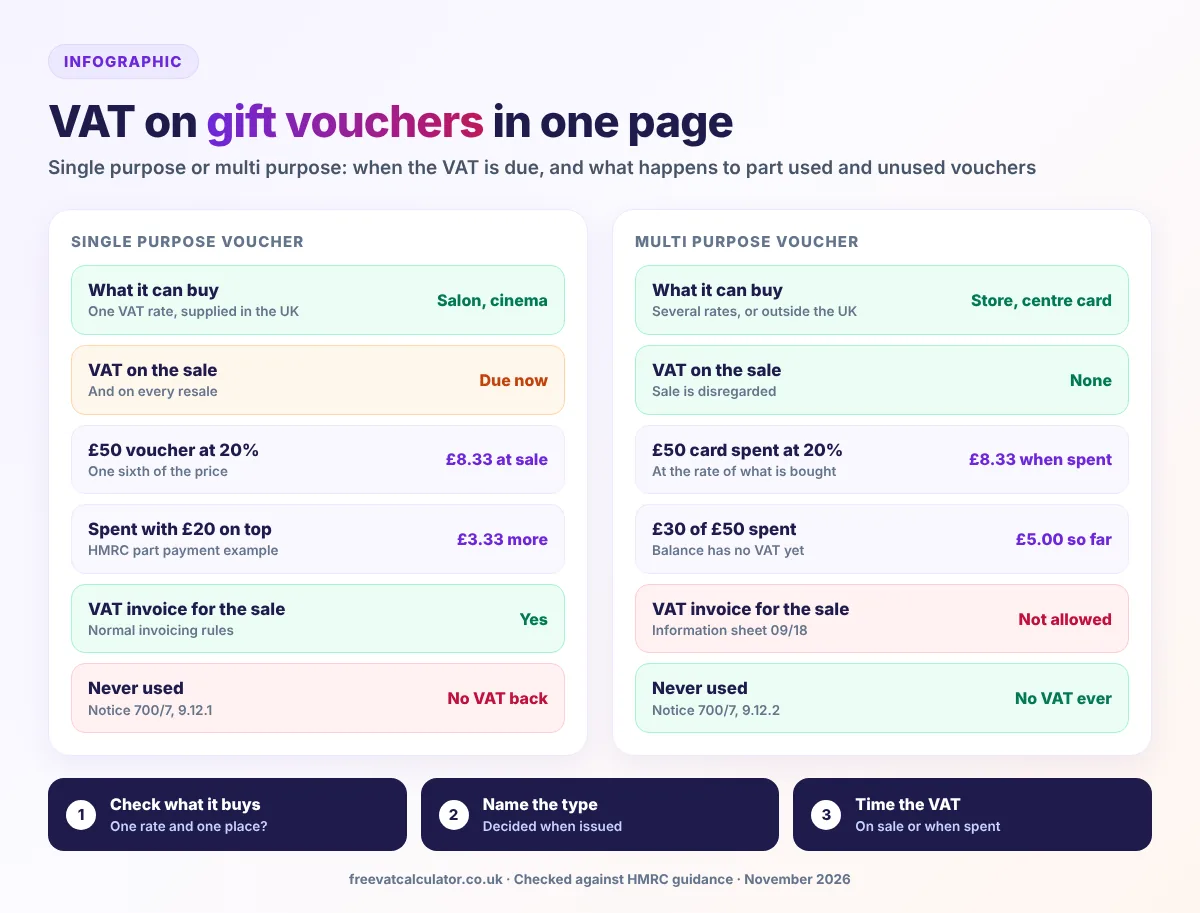
Every voucher issued since 1 January 2019 falls into one of two types, and the type decides when VAT is due and whether any is due on a voucher that is never used. The table sets out the main differences, drawn from section 9 of HMRC’s VAT Notice 700/7 and Schedule 10B of the VAT Act 1994.
| Question | Single purpose voucher | Multi purpose voucher |
|---|---|---|
| What it can buy | Goods or services at one VAT rate, in a known place | Anything else, as the default type |
| VAT on the sale | Due when sold or issued, and on each resale | None, because the sale is disregarded |
| VAT when it is spent | None, unless money is paid on top or another business redeems it | Due from the business that accepts it |
| VAT invoice for the sale | Yes, under the normal rules | No, it cannot be a VAT invoice |
| Never used | VAT stays paid unless you refund it | No VAT is ever due |
| Typical example | Salon, cinema or theme park voucher | Department store or shopping centre card |
Schedule 10B applies to vouchers issued on or after 1 January 2019. A voucher sold before that date still follows the old Schedule 10A rules, even if it is spent today.
What counts as a voucher for VAT
A gift card, an e voucher code and a paper gift voucher are treated the same way, because the law looks at what the instrument does rather than its format. Paragraph 1 of Schedule 10B sets three tests, and an instrument must pass all of them before the rules on VAT on gift vouchers apply.
- One or more businesses must accept it as payment, in full or in part, for goods or services.
- The goods or services, or the businesses that accept it, must be limited and stated on the voucher or in its terms.
- It must be transferable by gift, so the buyer can hand it to someone else.
Common examples of vouchers
HMRC lists gift cards and gift vouchers, Pay As You Go phone cards and book tokens as typical examples. The limitation test is what separates them from money, because a voucher works only for named products or suppliers while cash works almost anywhere.
- paper and plastic gift vouchers and gift cards
- e gift cards and codes sent by email or text
- book tokens and other product vouchers
- Pay As You Go phone cards and top up codes
- experience, treatment and day out vouchers
What is not a voucher
Some things that look like vouchers sit outside these rules, and the line between a ticket and a voucher is often argued over, as the Go City case below shows. Section 9.2 of Notice 700/7 excludes the items below, so each follows its own VAT treatment instead.
- travel and admission tickets
- postage stamps
- discount vouchers and money off coupons
- SIM cards
- electronic money, credit cards and prepaid payment cards
- keys or codes that give access to software
- vouchers that cannot be passed to anyone else
What changed on 1 January 2019
Before 2019, UK law split face value vouchers into credit, retailer, single purpose and other vouchers, each with its own timing. Section 8 of Notice 700/7 still holds that guidance for older vouchers.
The change came from EU Council Directive 2016/1065, agreed on 27 June 2016, after an HMRC consultation that ran from 1 December 2017 to 23 February 2018. Schedule 17 of the Finance Act 2019 inserted Schedule 10B on 12 February 2019, about six weeks after the new rules began to apply, and they stayed in place after Brexit.
Single purpose vouchers: VAT when you sell
A single purpose voucher is one where, at the moment it is issued, you know where the goods or services will be supplied and that they all fall into one VAT category. Paragraph 4 of Schedule 10B lists four categories: standard rate, reduced rate, zero rate, and exempt or other non taxable supplies. This is the type where VAT on gift vouchers is paid up front.
HMRC’s examples of single purpose vouchers
The goods no longer need to be of one type, only of one VAT category, which brought many more vouchers into this group in 2019. HMRC gives these examples in section 9.4.1 of Notice 700/7.
- a UK cinema voucher for film tickets, food and merchandise, all standard rated
- a prepaid phone card that can only be used for calls
- a download voucher only for apps, music, streaming or other electronic services
- a theme park admission voucher, or one for park goods and services at a single rate
- a perfume voucher
When a voucher fails the single purpose test
A voucher that can be spent in more than one country cannot be single purpose. HMRC’s example is a children’s clothes voucher usable at a UK and Channel Islands retailer, which fails because the Channel Islands are outside the UK for VAT, while the UK itself counts as one country.
A voucher also fails if goods normally sold at one rate could be sold at another rate, unless its terms exclude those uses. HMRC names vouchers that could buy goods under VAT relief for disabled people, zero rated exports or airside tax free sales, and any voucher for goods sold under the VAT margin scheme, where VAT falls on the margin rather than the full price.
VAT at each step of the chain
The voucher stands in for the goods or services, so VAT is charged when it is first sold and again every time it is sold on, and each business can reclaim the VAT it pays under the normal rules. If each price in HMRC’s spa example below includes VAT at 20%, the VAT at each step is one sixth of it, so £1.33, £1.50 and £1.67.
| Sale | Price | VAT is accounted for on |
|---|---|---|
| Spa to distributor | £8 | £8 |
| Distributor to retailer | £9 | £9 |
| Retailer to customer | £10 | £10 |
| Customer spends it at the spa | No payment | Nothing more |
When a different business redeems it
Many vouchers are sold by one business and spent at another, such as a brand’s vouchers sold online by head office and used in franchised shops. The redeeming business is then treated as supplying the goods or services to the issuer, so it accounts for VAT on that supply at the standard or reduced rate and invoices the issuer, as sections 9.4.4 and 9.4.6 of Notice 700/7 explain.
Multi purpose vouchers: VAT when spent
Any voucher that is not single purpose is a multi purpose voucher, so this is the default type. Selling it, and any later resale, is disregarded for VAT, and VAT arises only when the holder hands it over for goods or services.
This suits shops that sell items at different rates, because nobody knows at the sale which rate will apply. A department store card might buy a £40 adult jumper at 20% and £30 of children’s clothes at 0%, and the VAT is worked out on each item at the till.
What value to use when it is spent
The business that accepts the voucher accounts for VAT on the price paid at its most recent sale if it knows that figure, and on the face value if it does not. HMRC’s example is a £100 voucher sold to the customer for £90, where the seller accounts on £100 unless it knows the voucher last sold for £90.
A voucher given as a present keeps its value. If someone pays £49 for a £50 multi purpose voucher and gives it to a friend, the shop values the sale at £50, or £49 if it knows that price, and never at £0 just because the friend paid nothing.
Gift cards for a shopping centre or a group of shops
A shopping centre gift card that can be spent in many shops is a typical multi purpose voucher, since those shops sell goods at several rates. Each shop accounts for VAT when the card is spent with it, and the centre has no VAT on the card sales, although any commission or service fee it charges the shops is taxable.
Check the small print first, because a centre card that runs on Mastercard or Visa and works in any shop that takes cards is a prepaid payment card. HMRC places those outside the voucher rules.
Distributors, resellers and agents
Businesses that only buy and resell multi purpose vouchers, such as a website selling other brands’ gift cards, make no taxable supply of the vouchers, so they charge no VAT and cannot reclaim VAT on that trade. In HMRC’s example a retailer sells a £20 voucher to an intermediary for £15, which sells it on for £20 or £18 with no VAT on either sale.
VAT does arise on genuine services around the voucher. A distributor’s marketing service is taxable on its margin, and in one HMRC example a £1 handling fee including VAT is kept from a £20 reimbursement, so the £1 is a taxable supply.
Third party websites and marketplaces
Selling your vouchers through another website does not change their type. A site that buys and resells them in its own name is treated as making the supply itself, while one that only arranges sales for commission supplies a taxable agency service, under section 9.7 of Notice 700/7. The online marketplace VAT change from October 2027, announced in the Autumn Budget on 28 October 2026, covers goods, and HMRC’s policy paper does not mention vouchers.
Single purpose or multi purpose: a quick test
Most small businesses can classify a voucher in a minute by asking three questions in order. If any answer is no, or you cannot be sure at the time of sale, the voucher is multi purpose.
- Can it only be spent in one country, such as the UK, so the place of supply is known?
- Does everything it can buy carry the same VAT rate, or is all of it exempt?
- Is that true for every customer, with no relief, export or margin scheme sale possible?
The test is applied once, when the voucher is issued, using what it can be spent on under its terms rather than what customers usually buy. A voucher that a salon client can spend on standard rated treatments or standard rated products is single purpose, even though the client chooses later.
| Voucher | Likely type | Why |
|---|---|---|
| Hair salon, spa or beauty voucher | Single purpose | Treatments and products all at 20% in the UK |
| Cinema voucher | Single purpose | HMRC’s own example at 20% |
| Restaurant voucher for meals on the premises | Single purpose | Meals and drinks served there are at 20% |
| Voucher for books only | Single purpose | Books are zero rated |
| Bookshop card also valid on cards and gifts | Multi purpose | Books at 0%, gifts at 20% |
| Supermarket or department store card | Multi purpose | Food, children’s clothes and other goods at different rates |
| Shopping centre card for many shops | Multi purpose | Many shops and many rates |
| Sightseeing pass for many attractions | Multi purpose | Attractions taxed differently, as in Go City |
| Voucher valid in the UK and abroad | Multi purpose | The place of supply is not known |
Salons, spas and restaurants
Service businesses where everything is standard rated usually sell single purpose vouchers, so the VAT goes on the return for the quarter in which the voucher is sold, not the quarter in which the client visits. A salon that sells 30 vouchers at £60 each in December takes £1,800 and owes £300 of VAT on that quarter’s return, even if most clients book in the new year. If your terms let clients spend a voucher on something at another rate, it becomes multi purpose and the VAT moves to when it is spent.
When the VAT rate changes during a voucher’s life
Because the test is done at issue, a planned rate change can affect the type. The temporary 5% rate on children’s meals, children’s and family tickets and family attractions ran from 25 June to 1 September 2026 inclusive and was not renewed in the Autumn Budget. A family attraction voucher sold after the relief was announced in May 2026 could be spent at 5% or 20%, which points away from single purpose treatment, while one sold earlier would normally stay single purpose at 20%. Neither the government’s fact sheet nor HMRC’s Revenue and Customs Brief 5 (2026) mentions vouchers, so check any such case with HMRC.
When VAT on gift vouchers is due and how much
For a single purpose voucher, the VAT belongs on the return for the period in which you sell or issue it, at the rate of what it buys. For a multi purpose voucher, it belongs on the return for the period in which it is spent, at the rate of whatever the customer actually buys. In both cases the place of supply follows the goods or services, not where the voucher is bought.
To find the VAT inside a voucher price, use the VAT fraction rather than taking 20% off. A £50 voucher at 20% holds £8.33 of VAT, one sixth of the price, and at 5% the VAT is one twenty first.
- ÷ 6The VAT in a voucher price at 20%
- ÷ 21The VAT in a voucher price at 5%
- £8.33The VAT in a £50 voucher at 20%
Paying partly with a voucher
When a customer pays with a single purpose voucher and adds money on top, the two parts are taxed at different times. In HMRC’s example a £50 voucher is used towards £70 of standard rated goods with £20 in cash, so the issuer has already accounted for VAT on £50 and the shop accounts for VAT on the £20 at the till.
With a multi purpose voucher in the same example, nothing was due when the voucher was sold, so the shop accounts for VAT on the full £70 when it is spent. At 20% that is £11.67, compared with £8.33 at the sale and £3.33 at the till for the single purpose version.
Partly used vouchers and balances
A gift card is often spent over several visits. With a multi purpose card, VAT is due on each amount as it is spent, so £30 spent from a £50 card at 20% gives £5.00 of VAT and the £20 balance carries none until it is used.
With a single purpose card, the VAT on the full face value was settled at the sale. Later visits only reduce the balance, with nothing to post and no adjustment for any unspent amount.
Unused and expired vouchers
Every voucher scheme has breakage, the value that customers never spend. This is where VAT on gift vouchers differs most between the two types, as section 9.12 of Notice 700/7 confirms.
Single purpose vouchers that are never used
No VAT adjustment is allowed when a single purpose voucher is not used, or not used in full, unless you refund the customer. The VAT you paid at the sale stays with HMRC, which is the main drawback of this type.
If you do give money back for an unwanted voucher, treat it as a refund and reduce the VAT by the VAT share of the amount repaid in the period you pay it, as our guide to VAT on refunds explains. Keep the refund record with the original sale.
Multi purpose vouchers that are never used
An unused multi purpose voucher never creates any VAT, because its sale was disregarded and no goods or services were ever supplied. For a retailer’s own vouchers, HMRC treats the VAT on costs linked to vouchers that are never redeemed as part of its general overheads.
Expiry dates and consumer law
VAT law does not set an expiry date for vouchers, so how long a voucher lasts is a matter for your terms. Those terms must be fair and transparent for consumers under sections 62 and 68 of the Consumer Rights Act 2015, so show the expiry date clearly on the voucher and at the point of sale.
Discount vouchers and money off coupons
A money off coupon gives a reduction on a future purchase rather than standing in for the goods, so it is not a voucher under Schedule 10B. When one is used you account for VAT on what the customer actually pays, plus any amount a manufacturer later pays you for the coupon, and selling a book of discounts with other businesses is a standard rated supply under section 7.2 of Notice 700/7.
Loyalty points work in a similar way. If points are swapped for a £10 voucher that a customer uses with £80 of cash, VAT is due on the £80, and if a customer pays for an item entirely with such vouchers, the business gift rules may apply instead.
Vouchers given away with other goods
A voucher handed out with a purchase, such as a hotel voucher on checkout or a phone card boxed with a phone, is treated as issued for no consideration when the price would not be much different without it. This anti avoidance rule in paragraph 11 of Schedule 10B stops businesses moving part of a taxable price into a voucher, so the main sale keeps its full value.
Free vouchers, staff rewards and promotions
Vouchers you give away follow their own rules, set out in section 9.10 of Notice 700/7. A multi purpose voucher given free, which the customer spends with you without paying more, is likely to be a discount voucher and can have a value of £0 when it is redeemed.
Giving away your own single purpose vouchers is likely to be a deemed supply of the goods or services themselves. For goods, the business gift rules then apply, so no VAT is due if gifts to one person cost £50 or less, excluding VAT, in any 12 month period, while services given away free are usually not a supply at all.
Buying vouchers for staff or customers is a separate question. Multi purpose vouchers carry no VAT to reclaim because none was charged, while VAT on single purpose vouchers can be reclaimed under the normal rules, subject to the gift rules, and our guide to VAT on staff entertainment covers gifts to staff and clients in more detail.
Where staff give up salary in return for vouchers, the salary they sacrifice is the price paid for the vouchers. In HMRC’s example an employee sacrifices £18 for a £20 voucher, and the shop that redeems it uses £20 unless it can show the price was £18.
Digital codes, phone top ups and online vouchers
E gift cards and emailed codes follow the paper voucher rules, since Schedule 10B covers electronic instruments too. For prepaid phone cards, HMRC treats redemption as the moment the value is added to the account linked to the phone number.
Digital vouchers sold across borders need the most care. A code that can only be redeemed in one country, for content that all carries one VAT rate, is single purpose, so VAT can fall due in that country on every sale along the chain, as the M GbR case below explains.
Court cases on vouchers since 2019
Most disputes turn on whether something is a voucher at all and, if so, which type. These three decisions show how the courts have applied the 2019 rules to real products.
| Case | Court and date | Outcome |
|---|---|---|
| DSAB Destination Stockholm | Court of Justice of the EU, 28 April 2022 | A city card for around 60 attractions and sightseeing bus and boat tours was a multi purpose voucher |
| M GbR v Finanzamt O | Court of Justice of the EU, 18 April 2024 | Codes for digital content usable only in Germany could be single purpose vouchers if all the content carried one VAT rate |
| Go City Ltd v HMRC | First Tier Tribunal, 14 August 2024 | The London Pass was a multi purpose voucher, not a ticket, and the assessments were set aside |
In Go City Ltd v HMRC [2024] UKFTT 745 (TC) the tribunal set aside assessments of about £9.3 million, and the case does not appear on HMRC’s list of VAT appeal updates, last updated on 20 October 2026. Both Court of Justice rulings came after Brexit, so they do not bind UK courts, although a UK tribunal may have regard to them and the tribunal in Go City relied on DSAB.
VAT invoices, records and your VAT return
For a single purpose voucher the sale is a normal supply, so a VAT registered buyer gets a VAT invoice, and the redeeming business issues no further invoice unless the customer pays extra. For a multi purpose voucher, no VAT invoice can be issued for the sale or any resale, and the business that accepts the voucher issues the VAT invoice when it supplies the goods or services.
On your VAT return, a single purpose voucher sale goes in Box 1 for the VAT and Box 6 for the net value in the period you sell it. A multi purpose voucher sale goes nowhere on the return until the voucher is spent, when the redeeming business includes the supply in the same boxes.
HMRC expects you to keep VAT records for at least 6 years, and a simple voucher register makes each figure easy to prove. Record these details for every voucher you issue.
- the voucher number, date of issue and expiry date
- the face value and the price charged
- whether it is single purpose or multi purpose, and why
- the VAT rate and the VAT accounted for on the sale
- each redemption, with the date, amount and items bought
- any refund, with the refund record
Bookkeeping and income tax timing
VAT timing and profit timing are separate questions. In most accounts the money from gift card sales sits as a liability until the card is spent or lapses, while sole traders and partnerships on the cash basis, now their standard method, count it as income when received. Limited companies cannot use the cash basis.
Retail schemes
Shops using a VAT retail scheme record a single purpose voucher sale under the scheme rules when it is sold. A multi purpose voucher sale is kept outside the scheme, and its redemption value goes into takings when the voucher is spent, as VAT information sheet 09/18 sets out.
Flat Rate Scheme
On the Flat Rate Scheme you apply your flat rate to VAT inclusive turnover, so voucher sales follow the same timing as above. A salon on the 13% rate for hairdressing and beauty treatment that sells a £60 single purpose voucher pays £7.80 on the sale, while a multi purpose voucher adds to turnover only when it is spent.
Section 10.3 of VAT Notice 733 still tells retailers on the daily takings method to add the face value of gift vouchers redeemed to their takings, which fits multi purpose vouchers. A single purpose voucher you redeem yourself is not a further supply under paragraph 5 of Schedule 10B, so leave it out, because it was counted when you sold it. Section 10.6 then points them to Notice 727/3 for any further voucher adjustments.
If your business is not VAT registered
A business that is not VAT registered charges no VAT on vouchers, so the type does not matter yet, and the VAT setting in your till or booking software should be 0%. You must register once taxable turnover passes £90,000 in a rolling 12 months, and our guide to the VAT threshold explains the test.
When you count turnover for that test, include a single purpose voucher for standard, reduced or zero rated supplies when it is sold, since that is when its supply takes place, and a multi purpose voucher when it is spent. A busy December of voucher sales can therefore push a salon or restaurant over the threshold sooner than its bookings suggest.
Worked examples
These examples run the main cases through the rules, at 20% unless stated. They match the test cases used for the calculator above.
| Voucher | Type | VAT when sold | VAT when spent |
|---|---|---|---|
| £50 cinema voucher, spent in full | Single purpose | £8.33 | £0.00 |
| £50 shopping centre card, spent on goods at 20% | Multi purpose | £0.00 | £8.33 |
| £25 book voucher for books only | Single purpose at 0% | £0.00 | £0.00 |
| £50 multi purpose card, £30 spent so far | Multi purpose | £0.00 | £5.00, with £20 left |
| £50 voucher towards a £70 bill | Single purpose | £8.33 | £3.33 on the £20 extra |
| £50 voucher never used | Single purpose | £8.33 | None, and no VAT back |
| £60 salon voucher on the 13% flat rate | Single purpose | £7.80 | £0.00 |
Common mistakes with voucher VAT
Most voucher errors come from applying one rule to every voucher. Watch for these when you set up a scheme or review your returns.
- treating a salon or cinema card as multi purpose because customers choose later
- charging VAT twice on a single purpose voucher, at the sale and again at the till
- taking 20% off the voucher price instead of dividing by 6
- reclaiming VAT on multi purpose vouchers bought for staff
- issuing a VAT invoice for the sale of a multi purpose voucher
- cutting the VAT on single purpose vouchers that expire unused
- assuming VAT on gift vouchers always waits until the voucher is spent
Need the VAT inside a voucher price?
Our main VAT calculator takes the VAT out of any price at 20% or 5% in seconds. Use it to check the VAT on a voucher sale before it goes on your return.
VAT on gift vouchers FAQs
These are the questions business owners ask most often about selling and redeeming vouchers. Each answer reflects HMRC guidance as at 6 November 2026.
Is there VAT on gift vouchers?
Yes, but the timing depends on the type. VAT on a single purpose voucher is due when it is sold, and VAT on a multi purpose voucher is due when it is spent.
Do I charge VAT when I sell a gift card?
Only if it is a single purpose voucher, meaning everything it can buy is at one VAT rate and supplied in the UK. For any other gift card the sale is outside VAT, and VAT is accounted for when the card is used.
What happens to VAT on gift vouchers that expire?
For a single purpose voucher, the VAT already paid stays paid unless you refund the customer. For a multi purpose voucher no VAT is ever due, because nothing was supplied.
Can I reclaim VAT on gift vouchers I buy for staff?
Not on multi purpose vouchers, because no VAT is charged on them. On single purpose vouchers you may reclaim the VAT under the normal rules, but the business gift rules can then apply when you hand them out.
Are gift vouchers VAT exempt?
No, a voucher is not exempt in itself. Its VAT follows what it buys, so a voucher only for exempt services is single purpose in the exempt category, while most gift cards carry VAT either at the sale or when they are spent.
Did the Autumn Budget 2026 change VAT on vouchers?
No. The Budget on 28 October 2026 left the 20%, 5% and 0% rates and the voucher rules unchanged, so Schedule 10B and section 9 of Notice 700/7 still apply.
You now know how to tell a single purpose voucher from a multi purpose one, when VAT on gift vouchers falls due, how much it is, and what happens to part used, free and expired vouchers. Run your own vouchers through the calculator at the top before your next VAT return, and keep a voucher register so every figure can be traced.
Sources: HMRC VAT Notice 700/7, Business promotions, sections 7, 8, 9 and 12; VAT information sheet 09/18, Face value vouchers; VAT Act 1994, Schedule 10B; Finance Act 2019, Schedule 17; HMRC policy paper, VAT treatment of vouchers from 1 January 2019; Council Directive (EU) 2016/1065; Go City Ltd v HMRC [2024] UKFTT 745 (TC); M GbR v Finanzamt O, CJEU, 18 April 2024; HMRC, list of VAT appeals updates; HM Treasury, Great British Summer Savings fact sheet; Revenue and Customs Brief 5 (2026); HMRC, extending VAT online marketplace liability; Budget 2026, overview of tax legislation and rates; GOV.UK, rates of VAT on different goods and services; VAT Notice 733; GOV.UK, Flat Rate Scheme percentages; VAT Notice 700/21; GOV.UK, cash basis; Consumer Rights Act 2015, Part 2; European Union (Withdrawal) Act 2018, section 6. This page is general information, not tax advice.