
VAT on capital assets
VAT Capital Goods Scheme: Which Assets Are Caught and How the Adjustments Work
How one capital item is adjusted
- Check the limit£600,000 or £50,000
- Set the baselineRecovery at the start
- Track each interval10 or 5 in total
- Work it outVAT ÷ intervals × change
- Report itBox 4, second return
You reclaimed the VAT on a new building or a big refit, and now part of it is let to an exempt tenant, used for a nursery or about to be sold. The fear is a VAT bill landing six or eight years after the work was paid for, or the opposite problem: VAT you could reclaim sitting untouched because your taxable use went up and nobody noticed.
This guide starts with a calculator that tells you whether your asset is caught and works out the adjustment for any interval. It then covers the changes from 29 July 2026, how the intervals run, which return each figure goes on, and what happens when you sell, opt to tax or transfer the business, so every year of the capital goods scheme is planned rather than a surprise.
Capital Goods Scheme adjustment calculator
Choose the asset, enter what it cost and the VAT you paid, then set the recovery you claimed at the start and the taxable use for the interval you are checking. The calculator applies the value limits in force since 29 July 2026 and shows the adjustment, the working and the return it belongs on.
Capital Goods Scheme adjustment calculator
Check whether an asset is a capital item and work out the adjustment for one interval
You repay £8,000.00 to HMRC for interval 4
This is a capital item. Taxable use fell from 100% to 60%, so part of the VAT first reclaimed goes back to HMRC in box 4 of the return for the second VAT period after interval 4 ends.
The working
- Land, buildings and civil engineering works costing £1,000,000 meet the £600,000 limit, so this is a capital item.
Based on HMRC VAT Notice 706/2 and regulations 112 to 116 of the VAT Regulations 1995 as amended by SI 2026/765 from 29 July 2026. It does not apply the disposal test, sale rules, the rules for items used before VAT registration or rounding of your partial exemption percentage. A guide, not a ruling, and nothing you enter is stored or sent.
A payable result means you hand back part of the VAT you first reclaimed, and a reclaimable one means HMRC owes you more. The first interval normally produces no adjustment, because the VAT claimed at the start already reflects your use in that period.
Key facts
- Property limit
- £600,000 excluding VAT from 29 July 2026
- Boats and aircraft
- £50,000 or more, unchanged
- Computers
- Out of the scheme for new spending
- Intervals
- 10 for property, 5 for boats and aircraft
- Formula
- VAT ÷ intervals × change in taxable use
- Return
- Box 4, second VAT period after the interval
What the scheme does and why it exists
Normally VAT recovery is fixed when you buy something, based on how you use it at the time. For costly, long lived assets that would be unfair, because a building used for taxable sales in year one might be used for exempt work for the next nine. The scheme spreads the VAT over a set number of intervals and compares the use in each later interval with the use at the start, so a fall means you repay VAT and a rise means you reclaim more.
Who it affects most
Partly exempt businesses feel it most: care homes, healthcare providers, banks and insurers, property groups, schools and charities. Private schools that registered when fees became standard rated on 1 January 2025 can bring buildings paid for earlier into the scheme, as our guide to VAT on private school fees explains, and charities face the same sums, covered in VAT for charities. Even a fully taxable business is caught if it sells a building as an exempt supply within the period.
Why HMRC changed it in 2026
The scheme began in 1990, and its £250,000 property limit had never moved, so modest refits were dragged into ten years of calculations. The Office of Tax Simplification urged reform in 2017, a 2019 call for evidence drew 80 responses, and the change was announced on 28 April 2025. HMRC’s policy paper puts the admin saving at about £0.6 million a year, with a negligible effect on tax receipts.
Which assets are caught and the value limits
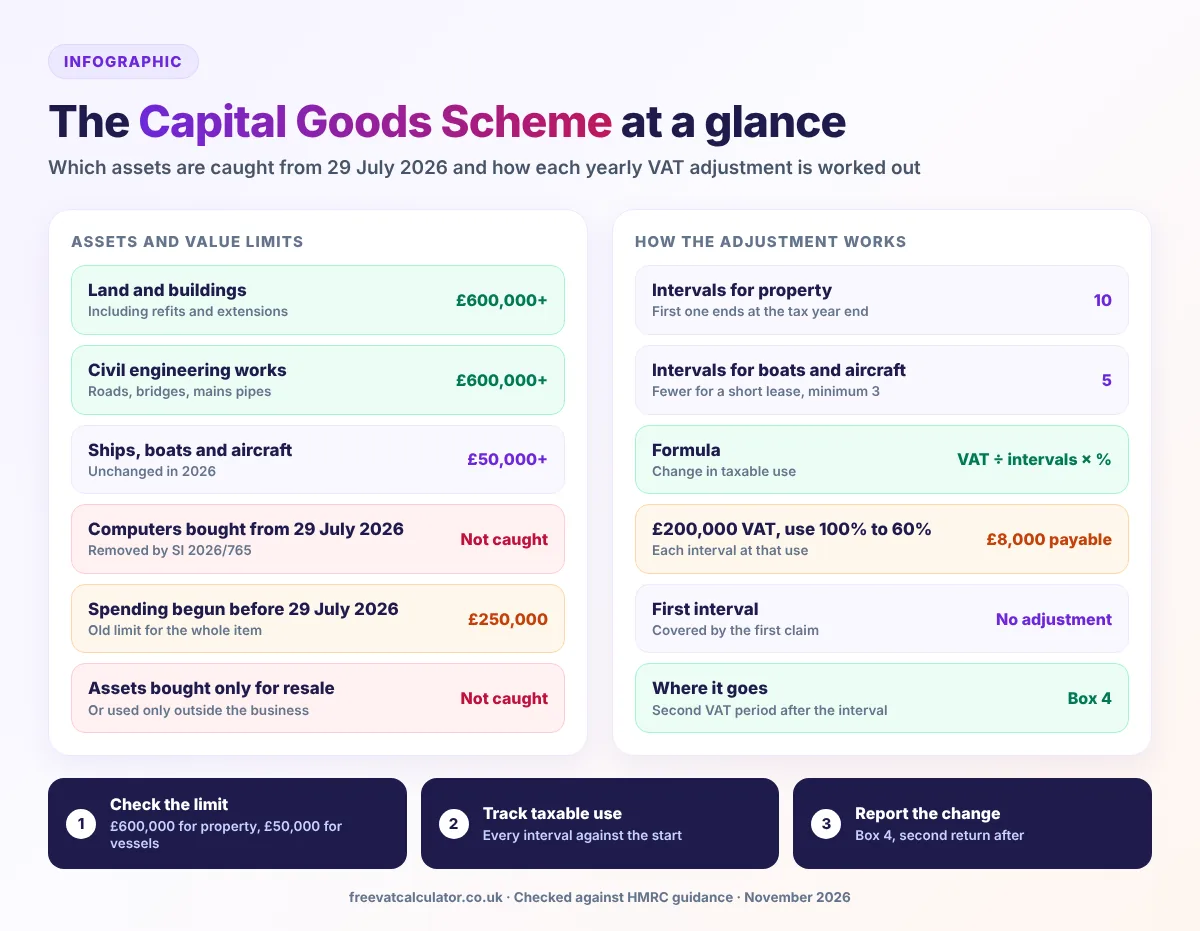
Only five kinds of asset can now be capital items, and each has a value limit measured without VAT. Below the limit, normal VAT rules apply and nothing is adjusted later.
| Item | Value limit, excluding VAT | Intervals | From 29 July 2026 |
|---|---|---|---|
| Land | £600,000 or more | 10 | Raised from £250,000 |
| Buildings, refits, fitting out, extensions and annexes | £600,000 or more | 10 | Raised from £250,000 |
| Civil engineering works | £600,000 or more | 10 | Raised from £250,000 |
| Aircraft | £50,000 or more | 5 | No change |
| Ships, boats and other vessels | £50,000 or more | 5 | No change |
| Computers and computer equipment | £50,000 per item under the old rule | 5 | Removed for new spending |
Land, buildings and civil engineering works
The limit covers buying an interest in land or a building and spending on constructing, refurbishing, fitting out, altering or extending one, including an annex. Civil engineering works include roads, bridges, golf courses, running tracks and pipes laid for mains connections, and the special rule for self storage facilities in regulation 113A moved to £600,000 too.
Aircraft, ships, boats and other vessels
Aircraft and vessels stay in at £50,000 or more excluding VAT, counting VAT bearing spending on buying, building, refitting or extending them. A charter boat bought for £80,000 plus VAT and later used partly for private trips is adjusted over five intervals.
Computers and computer equipment
Computers bought on or after 29 July 2026 are outside the scheme whatever they cost. Under the old rule each item was tested on its own and software never counted, and a computer that entered the scheme before 29 July 2026 stays in until its five intervals end.
Assets the scheme never covers
- Assets bought only for resale
- Assets used only for non business purposes
- An item sold before you ever use it
- Spending below the value limit for its type
- Any part kept outside the business when bought
What changed on 29 July 2026
The Value Added Tax (Amendment) Regulations 2026, SI 2026/765, were made on 7 July, laid on 8 July and came into force on 29 July 2026. HMRC explained them in Revenue and Customs Brief 7 (2026), published on 30 July, and updated VAT Notice 706/2.
| Rule | Before 29 July 2026 | From 29 July 2026 |
|---|---|---|
| Land, buildings and civil engineering works | £250,000 or more | £600,000 or more |
| Computers and computer equipment | £50,000 or more per item | Not capital items |
| Aircraft, ships and boats | £50,000 or more | £50,000 or more |
| Self storage facilities rule | £250,000 | £600,000 |
| Intervals, formula and return box | 10 or 5 intervals, box 4 | Unchanged |
Spending that straddles the date
The new rules do not apply to an item if the owner incurred any VAT bearing capital spending on it before 29 July 2026. One invoice dated before the change keeps the whole item under the old £250,000 limit, so a £450,000 refit that began in June 2026 is still a capital item, while one started today is not.
Items already in the scheme also stay there until their periods end, even where the first adjustment falls after 29 July 2026. The Autumn Budget on 28 October 2026 made no further change.
An older GOV.UK page, The Capital Goods Scheme for VAT, last updated in June 2018, still shows £250,000 and lists computers. Rely on Notice 706/2 and Brief 7 (2026), which carry the current figures.
How to work out the value of a capital item
The value is the cost without VAT, and only spending that carried VAT at the standard or reduced rate counts. Land and the building on it bought together form one item.
- Professional fees, demolition, contractors and materials
- Site security, equipment hire, haulage and landscaping
- Fitting out, including lifts, air conditioning and lighting
- The land itself, where its purchase was taxable
Legal and estate agency fees for buying land are left out, as are furniture, carpets and computers. Rent and service charges count only if paid or invoiced more than 12 months ahead, and if the final cost is unknown, estimate it and keep the papers behind the estimate.
Refurbishments and part business use
Each refurbishment or fit out is its own capital item with its own ten intervals, so a £650,000 refit after 29 July 2026 is caught even if the building is not. Notice 706/2 has specific rules for work done in phases, so check them before treating each stage as separate.
If you have private or non business activities, you can choose at purchase to keep part of an asset outside the business and record that choice. The VAT on that part is never reclaimed, does not count towards the limit and is never adjusted.
The adjustment period and its intervals
Land, buildings and civil engineering works run for ten intervals, and aircraft, vessels and computers already in the scheme for five. Because the first interval is usually short, ten intervals often cover a little over nine years.
- 10intervals for land and buildings
- 5intervals for boats and aircraft
- 3minimum for a short lease
The first interval
The first interval starts when you first use the item, which for a building usually means the earlier of granting a lease or licence and moving in. It ends the day before your next partial exemption tax year begins, and no adjustment is made for it. If your use does not change and the first two intervals together last no more than 12 months, they merge.
Later intervals
Each later interval matches your partial exemption tax year, which ends on 31 March, 30 April or 31 May depending on your VAT periods. Monthly filers always have a year ending 31 March.
Shorter leases and items owned before registration
With a lease of fewer complete years than the normal period, the intervals fall to one more than those years, with a minimum of three, so a seven year lease gives eight. For an item used before you registered, one interval is removed per complete year before registration and the starting recovery is nil. The VAT per interval is still the total divided by the full ten or five, and the first interval after registration is adjusted like a later one.
Later taxable use then earns a repayment each year. You cannot also claim that VAT under the normal rules in our guide to pre registration VAT.
How a capital goods scheme adjustment is worked out
Every adjustment uses the same steps, and you need only four figures. HMRC’s formula is the total VAT divided by the number of intervals, multiplied by the adjustment percentage.
- Find the baseline: the VAT deducted at the start as a percentage of all the VAT on the item.
- Find the taxable use for the interval, using your partial exemption method and any business and non business split.
- Take the baseline away from that taxable use to get the adjustment percentage.
- Divide the total VAT by the number of intervals and multiply by that percentage.
Worked example: taxable use falls
A company buys an office for £1,000,000 plus £200,000 of VAT in September 2026 and reclaims all of it, so the baseline is 100%. From interval 4 it lets a floor to an insurer without an option to tax, and its taxable use falls to 60%, as this capital goods scheme property example shows.
| Interval | Taxable use | Working | Adjustment |
|---|---|---|---|
| 1 | 100% | Baseline set by the first claim | None |
| 2 and 3 | 100% | £20,000 × 0% | None |
| 4 and 5 | 60% | £20,000 × 40% fall | £8,000 payable each |
| 6 | 75% | £20,000 × 25% fall | £5,000 payable |
| 7 to 10 | 100% | £20,000 × 0% | None |
| Total | £21,000 payable |
Worked example: taxable use rises
A partly exempt business spends £800,000 plus £160,000 of VAT on a building and recovers 50% at the start. In interval 3 its taxable use is 80%, so it reclaims £160,000 ÷ 10 × 30%, which is £4,800, and another £33,600 if that use holds for the last seven intervals.
Rounding and non business use
Under the standard partial exemption method, recovery percentages are rounded up to the next whole number, while special methods and businesses with over £400,000 of residual input tax a month work to two decimal places. For VAT incurred from 1 January 2011, changes in non business use of land, buildings, ships and aircraft are adjusted through the scheme too, which matters for charities and churches with mixed use halls.
When the adjustment goes on your VAT return
Enter each adjustment in box 4 of the return for the second VAT period after the interval ends. With quarters to March, June, September and December and a tax year to 31 March, the adjustment goes on the September quarter, while a monthly filer uses the return to 31 May.
The owner immediately before an interval ends makes the adjustment, which in a VAT group is the representative member. After a transfer of a going concern, the buyer is treated as the owner.
Correcting an earlier mistake
An error in the baseline can only be fixed by correcting the original deduction, within the normal time limits. Later adjustments then use the corrected baseline, and our guide on how to correct VAT errors explains when a fix can go on your next return.
Selling, losing or deregistering during the period
If you sell a capital item before its period ends, you make the normal adjustment for the interval of sale. Each complete interval still to run then counts as 100% taxable if the sale is taxable, or 0% if it is exempt, and that final adjustment goes on the return for the second period after the interval of sale.
Example: selling a building as an exempt supply
Take the £1,000,000 office, used fully for taxable work and sold during interval 7 without an option to tax. Intervals 8, 9 and 10 count as exempt, so the owner repays 3 × £20,000, which is £60,000, whereas an opted, taxable sale would cost nothing.
The disposal test
An anti avoidance rule can cap the adjustments on a sale by comparing the VAT recovered with the output tax charged on the sale. It applies only where there is an unjustified tax advantage, usually from an avoidance scheme, not to ordinary market losses.
Lost, stolen or destroyed items and deregistration
If an item is lost, stolen or destroyed, you adjust for that interval as if it had been used throughout, and nothing follows. When registration is cancelled, every remaining interval goes on the final return, as our guide on how to deregister from VAT explains.
How an option to tax affects the adjustments
Opting to tax a commercial building makes its rents and any sale taxable, so taxable use can stay at 100% and a sale counts as taxable. Our guide to the option to tax covers how to opt and notify HMRC.
The option is switched off where the building is, or will become, a capital item occupied by the grantor, a financier or someone connected who uses it less than 80% for purposes that carry VAT recovery. One route to revoking an option after 20 years, on form VAT1614J, also needs the building to be free of scheme adjustments, ignoring amounts of £10,000 or less.
Residential landlords
Letting homes is exempt, so most residential landlords never reclaimed VAT in the first place. The scheme rarely touches them, except on mixed buildings with opted commercial floors.
Buying or selling a business with capital items
On a transfer of a going concern, the buyer takes over the adjustments for every remaining interval. If it takes over the seller’s VAT number, the interval carries on; if not, the seller’s interval ends at the transfer and later ones end on its anniversaries.
The seller should hand over the purchase date, the VAT incurred and the recovery percentage for each item. A buyer should ask for that history before agreeing the price, because it inherits any repayment.
Joining or leaving a VAT group
When an owner joins a VAT group, the current interval ends the day before it joins, and later intervals end on anniversaries of that date. A company leaving with an item bought while a member has its interval end on the day it leaves, as our guide to the VAT group rules notes.
Where the scheme meets partial exemption and clawback
Your baseline and later taxable use come from your partial exemption method, explained in our partial exemption guide. Scheme adjustments are left out of the de minimis tests and the standard method override.
Below the new limits, only clawback and payback apply, and only if your intended use changes before first use, within six years. After first use nothing is adjusted, so a building under £600,000 that turns exempt keeps its recovery, but one that turns taxable earns nothing more.
Capital allowances
For plant and machinery, Chapter 18 of Part 2 of the Capital Allowances Act 2001 treats extra VAT you pay as more qualifying spending and a VAT refund as a disposal value. Tell whoever prepares your tax return about each adjustment.
Records to keep
- A description of the item, its value and the VAT incurred
- The input tax reclaimed and the method used
- The start and end dates of every interval
- When each adjustment is due and on which return
- The date and value of any sale or disposal
VAT records are normally kept for six years, but a ten interval item can produce adjustments for up to ten years. Keep everything until you can show how each calculation was made, and pass it on with the asset.
Common mistakes to avoid
- Forgetting adjustments after the first year
- Making an adjustment for the first interval
- Applying the £600,000 capital goods scheme limit to spending begun before 29 July 2026
- Dropping computers already in the scheme
- Including VAT when testing the value limit
- Missing rises in taxable use that earn a refund
- Selling without passing on the records
A checklist for the new rules
- List every capital item, its first use date and the intervals left.
- Test planned building work against £600,000 and the straddling rule.
- Decide on any option to tax before you sell or let a building.
- Diarise each interval end and the return it feeds.
Partly exempt as well?
Your baseline and yearly taxable use come from your partial exemption method. Our partial exemption guide explains the standard method and the de minimis tests.
Capital Goods Scheme FAQs
These are the questions owners and bookkeepers ask most. Each answer reflects the rules in force since 29 July 2026.
Does the £600,000 limit include VAT?
No, the limit is tested on the cost excluding VAT. Only spending that carried VAT at the standard or reduced rate counts.
Are boats and aircraft still in the scheme?
Yes, aircraft, ships, boats and other vessels costing £50,000 or more are still capital items. Their period stays at five intervals.
What happens to a computer already in the scheme?
It stays in until its five intervals end, so keep making the adjustments. Only computers bought on or after 29 July 2026 are outside.
Is there an adjustment in the first interval?
No, the VAT claimed at the start covers the first interval, unless you used the item before registering for VAT. Otherwise the first adjustment comes after the second interval ends.
What are capital goods for VAT purposes?
For this scheme they are land, buildings, civil engineering works, aircraft, ships and boats at or above the value limits. Other equipment, however costly, follows the normal VAT rules.
What is CGS VAT?
CGS VAT is shorthand for the VAT spread and adjusted under the Capital Goods Scheme. It runs through your normal VAT returns.
Did the Autumn Budget 2026 change the scheme?
No, the Budget on 28 October 2026 left it alone. The latest change took effect on 29 July 2026.
You now know whether your asset is caught, how long it runs, how to work out each adjustment and where it goes on your return. Use the calculator at the top each year, and the scheme becomes a short routine rather than a surprise bill.
Sources: HMRC VAT Notice 706/2; Revenue and Customs Brief 7 (2026); SI 2026/765; SI 2026/765 explanatory memorandum; VAT Regulations 1995, regulation 113; VAT Regulations 1995, regulation 114; HMRC policy paper, Simplification of the Capital Goods Scheme; HMRC VAT Notice 706; HMRC VAT Notice 742A; HMRC manual VIT25600; Capital Allowances Act 2001, Part 2, Chapter 18; GOV.UK, The Capital Goods Scheme for VAT (2018 page); Budget 2026, OOTLAR. This page is general information, not tax advice.